FREE WHITEWATER

Monthly Archives: April 2009

Daily Bread: April 30, 2009

Good morning, Whitewater

There are no public meetings scheduled for Whitewater today.

Over at the Wisconsin Historical Society website, there’s an entry commemorating an event from 1845: “Wisconsin Approves Free Schools.” The text of the text of the entry accurately places free in quotations (that is “free”):

On this date, under the leadership of Michael Frank, Wisconsin adopted “free” education for its residents. Frank’s plan narrowly passed the legislature by a vote of 90 to 79. Frank’s motivation for free education in Wisconsin was partially inspired by a similar campaign, promoted by Horace Mann in Massachusetts. On June 16, 1845 the first free school opened in Wisconsin. It was one of only three free schools in the country, outside the New England states. By August 1845, Wisconsin had five free schools in operation. [Source: Badger Saints and Sinners, Fred L. Holmes, pg 78-92]

It’s true, of course, that no public education is free; it’s a measure of the strength of the public education lobby that placing the word free in scare quotes seems almost defiant.

It’s a great anniversary in science today, as Wired notes that “Claude Elwood Shannon, the father of information theory and the man who coined the term bit, is born” —

Shannon’s 1938 master’s thesis, A Symbolic Analysis of Relay and Switching Circuits, used Boolean algebra to establish the theoretical basis of modern digital circuits. The paper came out of Shannon’s insight that the binary nature of Boolean logic was analogous to the ones and zeros used by digital circuits.

His paper was widely cited, laying the foundations for modern information theory. It has been called “one of the most significant master’s theses of the 20th century.” Not bad for a 22-year-old kid from a small town in Michigan.

That paper includes the first known use of the term bit to refer to a “binary digit.” Later wags would expand the terminology to include byte (usually an 8-digit binary number) and even nybble (half a byte, or 4 binary digits).

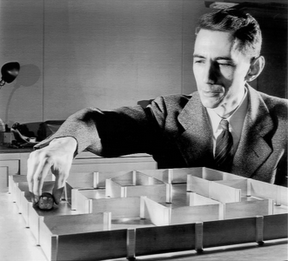
Shannon and his famous electromechanical mouse Theseus (named after Theseus from Greek mythology) which he tried to have solve the maze in one of the first experiments in artificial intelligence.
http://en.wikipedia.org/wiki/Claude_Shannon

Almanac
Thursday, April 30, 2009 Sunrise Sunset
Official Time 05:50 AM 07:54 PM
Civil Twilight 05:20 AM 08:25 PM
Tomorrow 05:49 AM 07:55 PM
Tomorrow will be: 2 minutes longer
Amount of sunlight: 14h 4m
Amount of daylight: 15h 5m
Moon phase: Waxing crescent

Clean Sweep the Triangle — May 1st

I received the following notice for posting —

SAVE THE DATE
CLEAN SWEEP THE TRIANGLE
MAY 1, 2009
8:00 AM TO 2:00 PM

We will have two shifts this year:

8:00 a.m. to 11:00 a.m.

11:00 a.m. to 2:00 p.m.

We will meet behind the Main Streets Shops in the parking lot. You will be given a map and all of the tools you need to help clean up the TRIANGLE.

Please call Tami @ 262.473.2200 to sign up for a shift. Thank you for your continued support of the Triangle and helping to keep the Downtown sparkling.

Daily Bread: April 29, 2009

Good morning, Whitewater

There are no public meetings scheduled for the City of Whitewater today.

In our school district, there’s Summer School walk-in registration today, from 4 to 6 p.m. at Lincoln School, proud home of the leopards. The summer school registration deadline is June 5th, with band lesson registration by May 29th. The registration form is available online.

Almanac
Wednesday, April 29, 2009 Sunrise Sunset
Official Time 05:52 AM 07:53 PM
Civil Twilight 05:21 AM 08:23 PM
Tomorrow 05:50 AM 07:54 PM
Tomorrow will be: 3 minutes longer
Amount of sunlight: 14h 1m
Amount of daylight: 15h 2m
Moon phase: Waning Gibbous

more >>

Seniors Triangle Walk for Health Program

I received the following press release from Downtown Whitewater, Inc. that I am happy to post —  

Downtown Whitewater, Inc.  Sponsors the  Senior Triangle Walk for Health Program  May 6 through October 8, 2009  

Kick off the program at our clinic Wednesday, May 6 and Thursday, May 7 at the Cravath Lakefront Center from 8:00 am to 11:00 am where you will receive your walking pass, score card and also view the 4 walking routes.  

You can do an early bird sign up at The Sweet Spot Coffee Shoppe, Dales Bootery, The Senior Center at Starin Park, GMA Printing, Quiet Hut Sports, First Citizens State Bank, Commercial Bank, and City Hall.  

We encourage seniors to walk everyday and shop downtown and receive the 10% discount offered at the participating stores.  The more you shop the better your chances are to win one of our monthly drawings.  

For more information please contact Downtown Whitewater, Inc. @ 262.473.2200  

Daily Bread: April 28, 2009

Good morning, Whitewater

There’s an Arbor Day tree planting ceremony in the city today at 11 a.m. As public events go, it’s benign.

Almanac
Tuesday, April 28, 2009 Sunrise Sunset
Official Time 05:53 AM 07:51 PM
Civil Twilight 05:23 AM 08:22 PM
Tomorrow 05:52 AM 07:53 PM
Tomorrow will be: 3 minutes longer
Amount of sunlight: 13h 58m
Amount of daylight: 14h 59m
Moon phase: Waxing Crescent

more >>

Prisoner Monday

Continuing for the next few weeks, it’s Prisoner Monday here at Free Whitewater. Why? Because a longtime reader previously suggested to me that being in Whitewater sometimes felt like living the plot of The Prisoner.

It’s a great British series, that tells the story of a secret agent who resigns from his agency, only to find himself in a mysterious place called The Village.

AMC has the full episodes of the original series online, and also offers one-minute summaries of those original episodes. I’ve previously posted the first nine videos.

Here’s the tenth, one-minute summary, of an episode entitled, “Hammer into Anvil.” (“No. 6 swears to avenge the death of a girl whose appeals for help when being persecuted by No. 2 are just too late for him to save her life …”)

The full video is also available at AMC.

Enjoy.

more >>

Daily Bread: April 27, 2009

Good morning, Whitewater

There’s a Community Development Authority Board of Directors meeting today, beginning at 4:30 p.m., at the Municipal Building. The agenda is available online.

Almanac
Monday, April 27, 2009 Sunrise Sunset
Official Time 05:55 AM 07:50 PM
Civil Twilight 05:24 AM 08:21 PM
Tomorrow 06:53 AM 07:51 PM
Tomorrow will be: 3 minutes longer
Amount of sunlight: 13h 55m
Amount of daylight: 14h 57m
Moon phase: Waxing Crescent

more >>

Daily Bread: April 24, 2009

Good morning, Whitewater

There are no public meetings scheduled in the city today.

This is, however, a notable anniversary for our small city. The Wisconsin Historical Society notes that on this date in 1977, the Pratt Institute moved to from Whitewater to Waukesha:

On this date the Morris Pratt Institute, dedicated to the study of Spiritualism and Mediumship, moved from Whitewater to Waukesha. Founded in 1888 and incorporated in 1901, it was one of the few institutes in the world that instructed spiritualists. These were people “who believe as the basis of his or her religion, in the communication between this and the Spirit World by means of mediumship and who endeavors to mould his or her character and conduct in accordance with the highest teachings derived from such communication.”

Why notable? Because after 1977, we’ve no excuse for Whitewater’s problems except within us. We might look elsewhere to account for our many failures, but a look in the mirror, not a crystal ball, would do us the most good.

Almanac
Friday, April 24, 2009 Sunrise Sunset
Official Time 05:59 AM 07:47 PM
Civil Twilight 05:29 AM 08:17 PM
Tomorrow 05:58 AM 07:48 PM
Tomorrow will be: 2 minutes longer
Amount of sunlight: 13h 48m
Amount of daylight: 14h 48m
Moon phase: New Moon

more >>

Daily Bread: April 23, 2009

Good morning, Whitewater

There’s a meeting of the Whitewater-University Tech Park Board at at 12:30 p.m.

A happy memory from the Wisconsin Historical Society —

On this date [in 1954] Hank Aaron, playing for the Milwaukee Braves, hit his first major league home run. Twenty years later he broke Babe Ruth’s career home run record of 714.

Almanac
Thursday, April 23, 2009 Sunrise Sunset
Official Time 06:01 AM 07:46 PM
Civil Twilight 05:31 AM 08:16 PM
Tomorrow 05:59 AM 07:47 PM
Tomorrow will be: 3 minutes longer
Amount of sunlight: 13h 45m
Amount of daylight: 14h 45m
Moon phase: New Moon

more >>

Wisconsin State Journal: Milwaukee Suburb May Join Urban Chicken Movement

Many communities have regulations against chickens or other animals on a private homeowner’s land. Even one may violate a city’s code. These government impositions on private activity likely have less to do with health than with the class consciousness of regulators against activities deemed beneath them.

Urban chickens? You bet –

Wisconsin State Journal: Milwaukee Suburb May Join Urban Chicken Movement

Happy Earth Day

Reason offers a good question this Earth Day –

Yielding to Ideology Over Science: Why don’t environmentalists celebrate modern farming on Earth Day? In the past 50 years, crop yields have more than doubled while global land area devoted to agriculture increased just 5 percent. This is because modern farming practices, including biotech enhanced crops, have dramatically boosted crop productivity.

So why do so many environmental activists refuse to acknowledge these facts? Science Correspondent Ronald Bailey examines that question as he picks apart a new report attacking biotech crops from the advocacy group Union of Concerned Scientists.

http://www.reason.com/news/show/132997.html

Daily Bread: April 22, 2009

There are no public meetings scheduled in Whitewater today.

Almanac
Wednesday, April 22, 2009 Sunrise Sunset
Official Time 06:02 AM 07:45 PM
Civil Twilight 05:32 AM 08:15 PM
Tomorrow 06:01 AM 07:46 PM
Tomorrow will be: 2 minutes longer
Amount of sunlight: 13h 43m
Amount of daylight: 14h 43m
Moon phase: Waning Crescent

more >>

Common Council for April 8th: Part 2

After about thirty minutes of preliminary discussion, our Common Council on April 8th considered a chronic nuisance ordinance for Whitewater. Versions of these ordinances are in force in Madison, Green Bay, Janesville (and surely other communities, too). An officer (Aaron Ellis) from the Janesville Police Department, responsible for enforcement of Janesville’s ordinance, spoke before Whitewater’s Common Council. Officer Ellis discussed Janesville’s ordinance, in law and practice. His initial discussion, including PowerPoint slides, was about twenty minutes long.

Nuisances and Numbers. There’s more than one way to protect property owners who’ve experienced property damage, or meaningful irritations from neighbors. Unlike a nuisance ordinance, one could try to solve problems by restricting the number of residents at a location. Ultimately, every effort to enforce zoning restrictions on the number of unrelated persons in an R-1 district depends on the idea that, inherently, large numbers of unrelated people living together are troublesome. Reduce that number, and you’ll (supposedly) reduce nuisances in a neighborhood.

Note how crude, how simple-minded all this is — it’s not about actual conduct, character, outlook, etc. — it’s civic betterment by decimation. (Worse, really, as for the Ancients decimation meant only one of ten; under strict R-1 enforcement, one of four or five might be removed.) Such has been much of the talk over these last two years — culling the herd, any way one might. Look for cars, stare at garage doors, etc. Not only was this strategy meant to reduce neighborhood trouble-making — one heard also that it would lower home prices for new home buyers, increase the number of children enrolled in our schools, and give cats and dogs especially shiny coats.

(That falling home prices merely impoverish sellers to the benefit of buyers was conveniently ignored. Restrictions on demand benefit some to the detriment of others.)

Restrictions on numbers living in an area may seem tactical, but it’s really strategic — a way to change the very composition of a neighborhood, back to a supposedly idyllic past, and produce a better market outcome, too. Government, to produce a better market than the market: the futile dream of every planner. These sought-after demographic changes were more than just tactics — they were community-changing even more so than complaints about the changes to Tratt Street.

What happened near Tratt Street did not happen through coercion, but through peaceful, voluntary transactions between buyers and sellers. What those who have sought to achieve through government restrictions in an area depends on the coercive power of local government enforcement, against the wishes of homeowner-landlords and tenants.

Much of our last years has been about the number of students unrelated persons in certain districts.

Conflating Ideas. Sometimes, code enforcement of aesthetic regulations, or conduct regulations, have been jumbled into this discussion, sometimes they’ve been separate. They need not have been jumbled together; they might always have been considered separately. A properly designed nuisance ordinance would focus on conduct, leaving aside number-of-unrelated- persons discussions that have achieved nothing. Well, not nothing, actually: they’ve show that Whitewater has wasted its time, like Westmoreland in Vietnam, looking to produce a numerical tally as proof of success.

A nuisance ordinance, if drafted and enforced properly, might shift away from the last few years’ wasted, numbers-culling effort.

Property Rights. I’m am opposed to these zoning restrictions, on the number of unrelated persons living in a given residence, anywhere in the city. I don’t care; neither should the city. Yet, without question, I believe in strong property rights, and have sympathy for homeowners whose property and its enjoyment has been ruined by those living nearby. Those rights will not be protected by reducing numbers, but by narrow regulations directed to specific, objectionable conduct. (It’s because I believe in strong property rights that I am opposed to many municipal zoning restrictions.)

Enforcement. What, though, of a nuisance ordinance — how many infractions will trigger government oversight, sanctions, and review of required abatement? Just as significant, who will oversee all this? These are tactical, not strategic, questions. They’re the questions for which people at neighborhood meetings have sought answers. Sought, but not found.

The City of Whitewater should have, long ago, enforced existing laws regarding conduct toward neighbors, fairly and thoroughly, without the empty talk about supposed problems of student housing. There is no student housing problem, or rental problem — there’s a conduct-of-a-few people problem. Discussions of classes of people shift responsibility from the individual to the group, unfairly and over-broadly.

City Manager Kevin Brunner doesn’t have a housing problem, or even a rental housing problem — he has an enforcement-of-specific-conduct problem. It’s not just a problem of director this, or chief that, it’s the city manager’s problem, too. To whom much is given, much is expected. (One can study Lincoln on leadership, without seeing, I’d guess, that Lincoln was stalwart.) There’s so much desire here to defend, to coddle, to support this city manager, one often wonders if this white-collar career appointee can account for his departments, himself.

Nuisances are also a huge problem, of individual responsibility of a few, and the city manager’s done little to address it. It’s all one study, one commission, one task force, after another. For a man whose vision is much-touted by the same small circle of back-patters, he’s shown no real understanding of how to fix a broken enforcement regime.

How do I know? If you’ve lived in this town — without fair and adequate enforcement of your legitimate concerns — or even fair and reasonable enforcement against you — and many of you have experienced these failures — then you’re the proof, the demonstration, of my argument.

So what will a possible nuisance ordinance do? Turn enforcement over under the same city manager who’s done so little for so long. Divide the responsibilities for enforcement or unite them, it’s a leadership too ineffectual to produce noticeable change.

Well, yes, that’s the plan.

The proposed ordinance will likely be back at another meeting, soon. Some will be hoping for better enforcement under it; others will be concerned about unfair and erratic enforcement from it.

Many will be ambivalent, I’d guess.

We’ll see….

Common Council for April 8th: Part 1

Here’s a quick review of the first part of our Common Council meeting, from April 8th. In this post, I’ll comment on the meeting before the discussion of a proposed nuisance ordinance. (I’ll comment on the nuisance ordinance in my next post.)

What’s most striking about the first thirty minutes of our last Common Council meeting is how ordinary, and predicable, the proceedings were: students singing at the opening, a few proclamations, staff reports, citizen comments. I don’t mean to belittle those who performed or received proclamations (including Abraham Lincoln, posthumously, in a way). Quite the contrary — if one considered our town only from these first minutes, one would be reassured, I wouldn’t wonder, that we must be a well-ordered small town, in good condition.

We’re not, of course — we’ve above-average poverty, a shaky budget, the chimera of tax incremental financing, a school district with a retiring administrator with a retiree’s outlook, and a culture with an anti-growth instinct in a time when growth is hard to come by anywhere in America.

There are hints of something troubled, though, even before the discussion of nuisances.

A merchant complains, and no one really seems to care. He might be right, he might be wrong — no one responds, either way. It’s all been said, and heard, before.

A quick list of all the federal money that might, just might, come Whitewater’s way, for proposals, well, previously proposed. One wonders how we would have funded these ideas absent the unexpected developments of a deep recession, and deep spending as a supposed remedy. There’s no embarrassment about feeding at the federal trough; it’s our opportunity to hold our hands out, in line with other communities. We’re plucky and unique and independent, until we’re looking for money, and then we’re eager realists taking what we can from others’ taxes and interest obligations. Walden Pond this is not.

A defeated Council candidate, against whom I have disagreed as much as anyone, offers thoughtful remarks on his service, and on the press in this town, too. His victorious rival thanks her supporters for their support, a self-congratulatory shout-out to all the people who are sure our best future depends on them, alone.

Little over thirty minutes in, we come to a topic years in the making….