



Lavish, but defensive, spending on Gov. Walker’s behalf » FREE WHITEWATER bit.ly/wpUAXl #walker #afp
Bastiat: ‘Everyone wants to live at the expense of the State. They forget that the State lives at the expense of everyone’
Oh my:
What happened next would be funny if, you know, it didn’t involve actual, real-life people: $10 million ransom negotiated down to $120,000, being held hostage for four days, and the South Koreans leaving town before they could testify….
Via The Atlantic Wire.
When white settlers arrived in Wisconsin, they were intrigued by the ancient mounds that dotted the landscape. This sparked excitement about archaeology generally, and during the late 19th century the discovery of new “antiquities” fueled speculation about the state’s ancient past. It also led to one memorable blunder in 1878 concerning a find at Hartford, in Washington Co.
A resident there whom the press called “a student of American antiquity” found two large millstones buried in a collapsed mound. The stones had roughened surfaces and center holes through which rods would be inserted so that they could revolve. This appeared to be evidence of ancient milling, and the two stones were displayed at the State Historical Society in Madison. A report on them said that of all the relics so far unearthed in the state, “there was none more curious or valuable” than these. The discovery of prehistoric millstones in Wisconsin was reported far and wide.
That’s when a pioneer settler of Hartford spoke up.
“I have seen the stones often,” he wrote to the West Bend Democrat, and recalled that “when the railroad was first built through Hartford, there was a man by the name of Swandollar, who built him a shanty on the railroad company’s ground, east of the depot. He was a potter buy trade, and used the two mill-stones to grind his clay. Mr. Swandollar soon died, however, and left a large family without means.”
The mound was nothing more than earth that the potter had heaped up around his walls to keep the winter wind out. It collapsed over the stones when the railroad removed the shanty while expanding its yard some years earlier.
Archaeology fever had led knowledgeable people to turn modern junk into a precious ancient technology. The journalist who reported the story in 1918 charitably called it “an amusing incident of blundering eagerness.”
3:30 PM CT 1.15.12 @ Lambeau.
Good morning.
It’s a snowy day in Whitewater. This small city is lovely, surrounded by abundant natural beauty, but never lovelier than when covered in snow. Whitewater will have a high temperature of twenty. In Phoenix, sunny with a high near seventy. I’ll take the snow.
The Wisconsin Historical Society recalls that on this day in 1922,
WHA Radio Founded
On this date the call letters of experimental station 9XM in Madison were replaced by WHA. This station dates back to 1917, making it “The oldest station in the nation.” [Source: History Just Ahead: A Guide to Wisconsin’s Historical Markers, edited by Sarah Davis McBride]
That’s 970 AM in Madison, part of Wisconsin’s Public Radio Network.
So the theory of hot hands in sports may be true, after all: Big score for the hot hand.
Bruce Bower reports in ScienceNews that
Not only do top volleyball strikers go on scoring runs that can’t be chalked up to chance, but players and coaches notice when a player is on a hot streak and funnel the ball his or her way, say psychologist Markus Raab of German Sport University Cologne and his colleagues, who studied the hot-hand phenomenon by analyzing playoff game data from a German volleyball league.
That strategy usually works, because players who on average score on a high percentage of shots tend to get hot hands. So getting them the ball during a scoring streak boosts a team’s score, the researchers will report in an upcoming Journal of Experimental Psychology: Applied. This tactic backfires if a player with a low scoring average develops a hot hand and draws shots away from better scorers, the scientists hold.
Go with what’s working.
Amazing, but true: you can Get Photos Sent Directly From Mars to Your Phone.
Why not use your smartphone to get pictures from the surface of another planet?
The Mars Images app fetches images from the NASA Opportunity rover’s latest downlink as soon as they’re available. On Mars since 2004, Opportunity has far exceeded its planned mission life and is still making groundbreaking discoveries, such as the recent unambiguous evidence that water once flowed on Mars.
Developed by computer scientist Mark Powell of NASA’s Jet Propulsion Laboratory, the app also allows you to browse older photos from the rover’s archive. It is free and available for both iPhone/iPad and Android phones.
I’ve downloaded the app for the iPhone, and it’s astonishing. The photos are black and white, and come with identifying information.
Here’s one of the millions-of-miles-away photos:
From the IJ, highlights of ongoing work:
Litigating for Liberty. The Wall Street Journal featured IJ’s founder and president, Chip Mellor, this past Sunday. Read the in-depth interview here.
Georgia property owners are fed up with forfeiture. The state’s forfeiture law allows law enforcement to seize the property of innocent owners without convicting or even accusing them of a crime. IJ and the Georgia NAACP are coming to the rescue and urging lawmakers to do what’s right.
It’s movie time! Battle for Brooklyn has been shortlisted for an Academy Award, and with screenings across the country, it’s not to be missed. Catch it near you in D.C., Chicago, San Francisco, Pittsburgh, and more. Here are the show times for this gut-wrenching tale.
Celebrate School Choice: National School Choice Week is January 22-28. Town halls, documentary screenings, and rallies are happening all over the nation! Visit schoolchoiceweek.com to register for an event near you – or to host your own.
Licensed to speak? New Orleans has made it a crime to speak without first getting permission from the government—punishable by hundreds of dollars in fines and five months in jail. Watch our video on how local tour guides are fighting back.
How are food truck entrepreneurs like the Buffalo Bills? They’re unrelenting underdogs & dreamers! This compelling video exposes the plight of food truck owners in Buffalo.
Predictably, opportunistic GOP rivals want to attack Mitt Romney’s career at Bain Capital as proof that he’s heartless, greedy, etc. This is unsurprising, as these GOP rivals (except Ron Paul) don’t favor free and voluntary markets, they favor particular businesses (those that contribute to their campaigns, first and foremost).
They talk about being pro-business, but they truly favor only businesses that favor them and advance their interests. (The GOP is sadly riddled with Republicans like this, at the federal, state, and local level.)
His work at Bain is probably the best thing Romney has ever done, and surely better than his time as governor of Massachusetts. For that matter, it’s better than any public work either his GOP rivals or Pres. Obama has done.
Why is that? It’s because the market is a place of peaceful, voluntary transactions between parties for mutual benefit. Romney didn’t confiscate anyone’s earnings through taxes, impose regulations on others, or start any wars while he was at Bain Capital. (He made two of those three mistakes while governor, but his rivals can say no better for their time in state or federal office.)
In fact, if Romney spent each and every day at Bain doing nothing, it would still be better than expanding the reach of regulatory agencies or grandstanding about bogus public accomplishments.
There’s much about Romney about which one should be skeptical, but his time at Bain is not one of them.
The Whitewater-Area League of Women Voters’ January 2012 Newsletter is out, featuring both articles and a calendar of upcoming LWV events.
This latest edition is available as a link on my blogroll, and is embedded below, with coding through Google.
Whitewater League Website to Launch February 2012
A landmark event in the history of our league will take place February 1st 2012, the date we are scheduled to launch our website, www.lwvwhitewater.org! League member Stacey Lunsford is spearheading the effort as our webmistress.
Date: January 19th (Thursday)
Event: “Budget Repair Bill Update: Impact on City/County Operations” Speakers: Kevin Brunner, Whitewater City Manager and David
Bretl, Walworth County Administrator.
Where: 7 PM City Hall Council Chambers
Date: January 26th (Thursday)
Event: Advance Voter Registration Training with Michele Smith, Whitewater City Clerk.
Where: 3 PM City Hall Council Chambers
Date: February 18th (Saturday)
Event: Membership Meeting –Privatization Study Discussion.
Where: 10 AM Fairhaven Fellowship Hall
Good morning.
It’s snow for Whitewater today, with several inches expected, and a high temperature in the mid-twenties. For Atlanta, showers and windy, with a high of fifty-nine.
On this day in 1915, the U.S. House of Representatives rejected a proposal to give women the right to vote, 174-204.
Whalers kill more whales than ever before, despite the efforts of conservationists and animal right activists, but there’s a solution: A Market Proposal for Saving Whales. Here’s the idea:
The proposed market would be patterned after a system known best known from fisheries management as catch shares: Sustainable harvest levels are quantified, a maximum quota established, and catch allotments put up for sale by the International Whaling Commission. Costello’s proposal would add the crucial wrinkle of allowing activists to buy shares, too. If they did, a corresponding number of whales would be removed from the quota. (Indigenous groups would receive a set number of shares to be owned in perpetuity, apart from the market — though those could conceivably be sold, too.)
According to Costello’s estimates, global whaling profits amount to $31 million, and likely less when government subsidies are removed. Mainstream anti-whaling groups — Greenpeace, Sea Shepherd Conservation Society, and the World Wildlife Fund — spend about $25 million to fight the hunts.
“This money could be used to purchase whales, arguably with the same or better effect,” write the researchers in Nature.
Conservationists may not want to put a price on a whale, but they’d save more of them this way than are saved now.
Google has a particularly interesting puzzle for today: “Which would be bigger: the offspring of a female lion and a male tiger, or the offspring of a male lion and a female tiger?”
Good morning.
For Whitewater: a sunny day, with a high temperature of forty-nine. For Charlestown, SC: showers, a high of sixty-eight, and televised political ads non-stop until their presidential primary.
There’s a meeting of the Tech Park Board this morning at 8 AM. Even mentioning the meeting gives the board more attention than it should ever receive.
On this day in 1935, “aviator Amelia Earhart began a trip from Honolulu to Oakland, Calif., becoming the first woman to fly solo across the Pacific Ocean.”
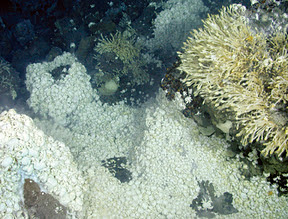
There’s a disparity among different deep-sea ecosystems, as it’s Crabs hither, shrimp thither:
Like the boroughs of New York City or the arrondissements of Paris, deep-sea communities are turning out to have a strong local flavor.
In the waters off Antarctica at the southernmost seafloor vents where hot water percolates from below, piles of hairy crabs swarm in the thousands. In the middle of the Indian Ocean lives a motley collection of creatures never before seen together. And south of Cuba, at the world’s deepest vents, shrimp rule.
Google’s puzzle for 1.11 asks about flowers: “In Texas they’re called Tarragon, in South America they’re turned into perfume, and in England you put them on to wash dishes. What is the more common name for these flowers?”
Of all items in an organization’s over-spending, which ones might cause a budget shortfall?
One might say, of course, that a 2% increase in X, or a 5% increase in Y, would be the cause an expected shortfall.
There’s a simple answer, though: each and every expenditure contributes to the overall shortfall.
An organization might have many costs: materials, salaries, benefits, advertising, utilities, etc. It’s not just a 5% increase in Y, but a continuing expenditure on Z (even at last year’s levels) that adds to a shortfall.
Pointing to some costs distracts from looking at others.
Emphasizing more-recent costs (for example), to the exclusion of long-standing expenditures, isn’t simply an objective financial calculation, but a subjective political one.
What really pushed the organization over the top? All that lies below.