FREE WHITEWATER

Monthly Archives: March 2018

Daily Bread for 3.12.18

Good morning.

Monday in Whitewater will be partly cloudy with a high of forty. Sunrise is 7:10 AM and sunset 6:58 PM, for 11h 48m 10s of daytime. The moon is a waning crescent with 22.2% of its visible disk illuminated. Today is the {tooltip}four hundred eighty-seventh day.{end-texte}Days since Trump’s election, with 11.9.16 as the first day.{end-tooltip}

Whitewater’s Planning Commission meets at 6:30 PM.

On this day in 1933, Pres. Roosevelt gives his first fireside chat. On this day in 1862, the 2nd Wisconsin Cavalry musters in: “It would go on to participate in the Battle of Prairie Grove, Arkansas, on December 7, 1862, and in the siege of Vicksburg, Mississippi, the following year. The regiment would lose 312 men during service. Twenty-four enlisted men were killed in combat, and four officers and 284 enlisted men died from disease.”

Recommended for reading in full —

➤ Jordan Kyle and Yascha Mounk explain Why it’s so difficult to kill a populist movement:

But why do so many citizens give populists a second chance, even when their flaws are well-known? One answer has to do with the depth of disenchantment with democratic institutions that usually precedes the populists. Since some populists experience a meteoric rise, breaking onto the political scene suddenly, it is tempting to think of the causes of their success as ephemeral. Yet populists in virtually every country have exploited deep social divisions (such as fears about immigration in Europe) and long-standing economic frustrations (such as the vast differences in prosperity between town and country in Thailand). Since these underlying causes are rarely remedied after populists are deposed, it’s not surprising that the same kind of politics can live on.

Another answer has to do with the way populists destroy the most basic rules and norms of the political system. Leaders’ willingness to signal that their adversaries are legitimate participants in the system, and to respect the sanctity of institutions instead of pressing their partisan advantage to the limit, is largely dependent on the premise that voters would punish them for such transgressions. Italians before Berlusconi and Americans before 2015 assumed that a candidate who attacked the independent judiciary or called for his opponent to be jailed could never garner mass support. Once a ruthless and talented political leader demonstrates that this assumption is mistaken, it becomes more tempting for future politicians to break norms with abandon.

The experiences of countries like Peru, Italy and Thailand are a warning for Americans not to underestimate Trump’s staying power. To vanquish the broader style he represents will require more than voting him out of office. It will require healing the disease — fixing the reasons for Americans’ growing disenchantment with democratic institutions and reestablishing their commitment to the country’s most fundamental norms — not merely managing the symptoms.

➤ Maria Sacchetti reports Defiance, resistance: The front lines of California’s war against the Trump administration:

SAN FRANCISCO – In the nerve center of the Trump resistance, some volunteers staff 24-hour hotlines in case immigration agents strike in the middle of the night. Others flood neighborhoods to film arrests and interview witnesses. Local governments are teaming with donors to hire lawyers for those facing expulsion hearings.

California and the Trump administration are engaged in an all-out war over immigration enforcement, the president’s signature issue on the campaign trail and in the White House. It is a deeply personal battle in the nation’s most populous and economically powerful state, where 27 percent of the 39 million residents are foreign-born.

“Local governments and state government have stepped up in a way to protect immigrants like never before in my lifetime,” said Eric Cohen, the 57-year-old executive director of the Immigrant Legal Resource Center, a national nonprofit headquartered in the Mission district of San Francisco.

The stakes are high for the Trump administration because if California defies the White House on sanctuary cities, then others can, too, jeopardizing Trump’s main campaign promise to deport many of the nation’s 11 million illegal immigrants.

(Conditions in a blue state like California may seem more favorable for resistance and opposition than a red state like Wisconsin, but one does not choose where one is called. In any event, there’s no better place to be in all the world than tiny Whitewater, and from this city to contend confidently, come what may.)

➤ Robinson Meyer reports The Grim Conclusions of the Largest-Ever Study of Fake News
(“Falsehoods almost always beat out the truth on Twitter, penetrating further, faster, and deeper into the social network than accurate information”):

“Falsehood flies, and the Truth comes limping after it,” Jonathan Swift once wrote.

It was hyperbole three centuries ago. But it is a factual description of social media, according to an ambitious and first-of-its-kind study published Thursday in Science.

The massive new study analyzes every major contested news story in English across the span of Twitter’s existence—some 126,000 stories, tweeted by 3 million users, over more than 10 years—and finds that the truth simply cannot compete with hoax and rumor. By every common metric, falsehood consistently dominates the truth on Twitter, the study finds: Fake news and false rumors reach more people, penetrate deeper into the social network, and spread much faster than accurate stories.

“It seems to be pretty clear [from our study] that false information outperforms true information,” said Soroush Vosoughi, a data scientist at MIT who has studied fake news since 2013 and who led this study. “And that is not just because of bots. It might have something to do with human nature.”

(See The spread of true and false news online. Twitter is one medium only, of course, and the rapid spread of lies is an incentive to work harder in opposition to them.)

➤ GOP consultant and author Stuart Stevens observes that

(Stevens’s remark is in response to another’s observation that one should not call poor white opioid addicts privileged. Whatever one calls them, Stevens is right that their circumstances do not – cannot – excuse racial and anti-immigrant prejudice. If they think it does, then they’re either ignorant or claiming an entitlement to malice. Misery doesn’t justify malevolence toward others.)

➤ So, Why Don’t Birds’ Legs Freeze?:

Daily Bread for 3.11.18

Good morning.

Sunday in Whitewater will be partly sunny with a high of forty-two. Sunrise is 7:11 AM and sunset 6:57 PM, for 11h 45m 14s of daytime. The moon is a waning crescent with 31.1% of its visible disk illuminated. Today is the {tooltip}four hundred eighty-sixth day.{end-texte}Days since Trump’s election, with 11.9.16 as the first day.{end-tooltip}

On this day in 1941, Pres. Roosevelt signs the Lend-Lease Act (formally: An Act to Promote the Defense of the United States). On this day in 1865, the 3rd Wisconsin Cavalry takes part in a skirmish in Clear Lake, Arkansas.

Recommended for reading in full —

➤ Maggie Haberman and Michael S. Schmidt report Trump Talks With Clinton Impeachment Lawyer About Aiding in Mueller Response:

The lawyer, Emmet T. Flood, met with Mr. Trump in the Oval Office this past week to discuss the possibility, according to the people. No final decision has been made, according to two of the people.

Should Mr. Flood come on board, the two people said, his main duties would be a day-to-day role helping the president navigate his dealings with the Justice Department.

Two people close to the president said that the overture to Mr. Flood did not indicate any new concerns about the inquiry. Still, it appears, at the least, to be an acknowledgment that the investigation is unlikely to end anytime soon.

Mr. Flood would not replace Ty Cobb, the White House lawyer who since the summer has taken the lead role in dealing with the special counsel, Robert S. Mueller III. But Mr. Cobb has told friends for weeks that he views his position as temporary and does not expect to remain in the job for much longer.

(A lawyer familiar with impeachment proceedings would only be significant if one thought that the investigation would not merely last longer, but would produce even more damning findings, in conditions under which the House might take up impeachment.)

➤ Seung Min Kim, Jenna Johnson and Philip Rucker report At Pennsylvania rally, Trump again calls for the death penalty for drug dealers:

Trump said that allowing prosecutors to seek the death penalty for drug dealers — an idea he said he got from Chinese President Xi Jinping — is “a discussion we have to start thinking about. I don’t know if this country’s ready for it.”

“Do you think the drug dealers who kill thousands of people during their lifetime, do you think they care who’s on a blue-ribbon committee?” Trump asked. “The only way to solve the drug problem is through toughness. When you catch a drug dealer, you’ve got to put him away for a long time.”

It was not the first time Trump had suggested executing drug dealers. Earlier this month, he described it as a way to fight the opioid epidemic. And on Friday, The Washington Post reported that the Trump administration was considering policy changes to allow prosecutors to seek the death penalty.

(Most people are very sharp, but imagine being part of a crowd so ignorant – or stupid – that the death penalty would seem like an effective solution to opioid addiction, or any other kind of addiction. The people at these Trump’s rallies are both individually deplorable and collectively confirmation that whites cannot possibly be better than others. Supportive presence at a Trump rally is prima facie evidence that one resides in the bottom quartile of understanding or ability.)

➤ Rebecca Moss reports Injured Nuclear Workers Finally Had Support. The Trump Administration Has Mothballed It:

Nearly three years ago, President Barack Obama responded to long-standing concerns that workers exposed to toxic chemicals at the country’s nuclear weapons labs were not receiving proper compensation.

Obama created an advisory board to be composed of scientists, doctors and worker advocates. Their recommendations have led to significant changes, including the repeal of a rule that made it more difficult for workers who’d been injured in the last two decades to get compensation.

President Donald Trump and his administration have taken a different approach: His Labor Department has let nearly all of the board member’s terms expire — and so far hasn’t nominated new ones.

“For two years our board put a lot of brain power and cutting-edge expertise into developing recommendations,” said Ken Silver, an occupational health professor at Eastern Tennessee State University, who until last month was a board member. “Without appointing another board, those recommendations may disappear into the ether.”

Silver was one of 14 members on the Advisory Board on Toxic Substances and Worker Health whose terms expired in February. The remaining member’s term expires in the middle of this month. The Department of Labor has kept silent on when it will appoint a new board. Meetings have been put on hold until further notice, according to the Labor Department’s website.

➤ Mark Ebner reports ‘Picked Apart by Vultures’: The Last Days of Stan Lee (“Months after losing his wife, the 95-year-old comic book legend is surrounded by charlatans and mountebanks”):

You might expect Stan Lee, at age 95, to be enjoying the fruits of his many labors: Marvel Comics, the company he served as the former president and chairman of, dominates popular culture. Characters he co-created — among them Spider-Man, Iron Man, X-Men, and the Avengers — are household names. He’s a comics legend, with his own star on the Hollywood Walk of Fame. When Marvel sold to Disney in 2010 for $4 billion, he personally pocketed a cool $10 million, and tours the world as its ambassador emeritus. And midway through his tenth decade, Black Panther, based on a character he and Jack Kirby first envisioned in 1966, currently sits atop the global box office charts, and carries a Rotten Tomatoes score of 97%.

Instead, seven months after the death of Joan, his wife of almost 70 years, beset with pneumonia, the apparent victim of gross financial malfeasance and surrounded by a panoply of Hollywood charlatans and mountebanks, he may be facing his greatest challenge, every bit the equal of any of the psychologically flawed superheroes he helped shepherd into being. According to one insider with working knowledge of Lee’s current situation, “It’s a real fucking mess over there. I think his money will be gone in a few weeks… Stan and [his daughter] JC are literally being picked apart by vultures.”

In just over two months, there have been published reports of an unauthorized check for $300,000 written from Lee’s business account without his knowledge to Hands of Respect, a “merchandising company” and ersatz charity formed by Lee and Jerry Olivarez, a former business associate of his daughter’s. The word “loan” is inscribed on the face of the check.

Other red flags included the purchase in the fall of 2017 of an $850,000 condo in West Hollywood a short distance from Lee’s home in the Hollywood Hills; and $1.4 million that mysteriously disappeared in a complicated wire-transfer transaction. Most dramatically—and according to published reports— police on February 16th were called to Lee’s home to remove long-time bodyguard Mac “Max” Anderson, often seen accompanying Lee at his lucrative live appearances, after he allegedly threatened Lee and his daughter. Anderson’s attorney declined to comment for this story.

Taste Hawaii’s Famous Mochi:

Japan’s favorite, mochi, has become a Hawaii treat—at least in Nora Uchida’s kitchen. Uchida, a third-generation Japanese-American living in Hilo, Hawaii, inherited her grandmother’s mochi recipe and evolved it to include the colors and eclectic tastes of her beloved state. For the past 25 years, she and her family have owned and operated Hilo’s last mochi storefront, Two Ladies Kitchen. If you can beat the line running out the door on weekends, you’re in for a delicious, only-in-Hawaii treat.

Daily Bread for 3.10.18

Good morning.

Saturday in Whitewater will be sunny with a high of forty-one. Sunrise is 6:13 AM and sunset 5:56 PM, for 11h 42m 26s of daytime. The moon is a waning crescent with 40% of its visible disk illuminated. Today is the {tooltip}four hundred eighty-fifth day.{end-texte}Days since Trump’s election, with 11.9.16 as the first day.{end-tooltip}

On this day in 1876, “three days after his patent was issued, [Alexander Graham] Bell succeeded in getting his telephone to work, using a liquid transmitter similar to Gray’s design. Vibration of the diaphragm caused a needle to vibrate in the water, varying the electrical resistance in the circuit. When Bell spoke the sentence “Mr. Watson—Come here—I want to see you” into the liquid transmitter,[84] Watson, listening at the receiving end in an adjoining room, heard the words clearly.[85]”

Recommended for reading in full —

➤ Jennifer Rubin asks Will Kim Jong Un — like every other dictator — sucker Trump?:

Is Trump now to glad-hand with Kim, treating him as just another world leader? Will Trump even bring up human rights? (You will recall that, in 2008, then-candidate Barack Obama was ridiculed for suggesting he’d sit down with the North Korean dictator; he prudently backed off that idea.)

John McLaughlin, former acting director of the CIA, pointed to other concerns — namely Trump’s team: “These people have never been in a real negotiation … and have no idea how complicated this will be.” If there is no progress before a May meeting, what is the point of a face-to-face discussion between Trump and a recalcitrant dictator? “May seems too soon,” observed McLaughlin, although he noted the meeting could be delayed.

And that is really the rub: Is Trump or anyone else in the administration, including the intelligence community, really prepared to have such a high-stakes negotiation? With Trump — who cannot even follow his lawyers’ advice to not incriminate himself — the chance of going off-script is exceptionally high, with potentially disastrous results. Initial indications were far from encouraging.

(The meeting might never take place, but if does happen, one can safely predict that Trump’s past history of business failures and profound ignorance will lead Kim, or any other leader, to sucker Trump easily. Even the announcement of the meeting is a victory of recognition, of sorts, for Kim.)

➤ Ben Collins and Spencer Ackerman report Exclusive: Reddit Says It’s Cooperating With Russia Investigations. They’ve Handed Over Zero Documents (“Reddit’s CEO said the ‘front page of the Internet’ is working with Congress to uncover Russian propaganda. But it’s turned over no material to investigators”):

After a long public silence, the Internet giant Reddit has finally acknowledged the presence of Russian propaganda on its platform—and indicated it’s working with the Congressional probes into Russia’s 2016 election interference.

“While I know it’s frustrating that we don’t share everything we know publicly, I want to reiterate that we take these matters very seriously, and we are cooperating with congressional inquiries,” Reddit CEO Steve Huffman wrote to the Reddit community in a blog post on Monday.

“We’ve been taking action for a long time,” Huffman added in a follow-up comment.

But The Daily Beast has learned that the cooperation Reddit is providing is, at most, precursory. Knowledgeable sources tell The Daily Beast that Reddit has not, for instance, produced any documents to the House or Senate committees shedding light on how Russian propaganda hijacked a site that bills itself as the “front page of the internet.”

➤ Nico Hines, Adam Rawnsley, and Tanya Basu report What Was the Mysterious WMD an Assassin Used on a Russian Spy? The Answer Could Lead to Vladimir Putin (“Forensic detectives and military scientists have embarked on a complex trail of clues that could lead all the way from a quiet city in southwest England to Vladimir Putin:

Poisoning a Russian double agent exiled in Britain with a lab-made substance? Well, that’s usually an assassination ordered by the Kremlin.

Britain’s police detectives and security services now need to prove it.

Scotland Yard’s counterterrorism detectives are deep into a sophisticated version of classic murder weapon analysis with the help of Ministry of Defence biological weapons experts at the  Porton Down military research facility.

This weapon of mass destruction was deployed against a Russian father and his daughter who were spending a leisurely Sunday afternoon in the picturesque cathedral city of Salisbury. The WMD was so powerful that 21 people have been treated for its effects.

The Porton Down facility has been home to Britain’s defense and technology research since reports emerged from First World War battlefields that the Germans had killed 140 British soldiers with chlorine gas in January 1915. Coincidentally, the highly secretive facility is located on the outskirts of Salisbury, just seven miles from where former Russian military intelligence colonel Sergei Skripal and his daughter, Yulia, were found on Sunday.

➤ Peter Beinart explains What Trump Means When He Calls Gary Cohn a ‘Globalist’:

The term “globalist” is a bit like the term “thug.” It’s an epithet that is disproportionately directed at a particular minority group. Just as “thug” is often used to invoke the stereotype that African Americans are violent, “globalist” can play on the stereotype that Jews are disloyal. Used that way, it becomes a modern-day vessel for an ancient slur: that Jews—whether loyal to international Judaism or international capitalism or international communism or international Zionism—aren’t loyal to the countries in which they live.

That slur has a long, dark history. The infamous 1903 forgery, The Protocols of the Elders of Zionwarns that, “The nations of the West are being brought under international control”—by Jews. In 1935, Nazi Minister of Propaganda Joseph Goebbels railed against “the absolute destruction of all economic, social, state, cultural, and civilizing advances made by western civilization for the benefit of a rootless and nomadic international clique of conspirators”: Jews. David Duke called Brexit a triumph over the “Jewish globalist agenda.”

It’s possible to use the term “globalist”—even about a Jew—innocently, just like it’s possible to use the term “thug” about an African American with no racist intent. And perhaps that’s what Trump was doing when he applied it to Cohn. The problem is that this requires giving Donald Trump a benefit of the doubt that he forfeited long ago.

When Trump uses anti-Semitic language, his defenders often counter that his daughter, son-in-law, and grandchildren are Orthodox Jews. Sure, but even bigots contain multitudes. Trump may feel genuine affection for Jared Kushner, and likely Gary Cohn too. But that doesn’t change the fact that he employs anti-Semitic tropes in ways that make him almost unique among contemporary American politicians. After all, history is filled with politicians who fomented anti-Semitism yet enjoyed warm relationships with individual Jews.

For Cohn, there’s a sad irony here. He reportedly considered resigning after Trump’s equivocal response to last August’s outbreak of white supremacism in Charlottesville, but stuck it out, and instead resigned over Trump’s tariff policy. What thanks did he get? A presidential tribute using language that would have made the Charlottesville marchers smile.

Embed from Getty Images

They’re out there, watching, waiting…

➤ Anna Fifield reports Japanese towns struggle to deal with an influx of new arrivals: wild boars:

HIRAIZUMI, Japan—  Rapidly shrinking towns and cities across Japan are experiencing a population explosion. Not an explosion of humans, though. An explosion in wild boar numbers.

Across the country, wild boars are moving in as Japan’s rapidly aging population either moves out or dies out. The boars come for the untended rice paddies and stay for the abandoned shelters.

“Thirty years ago, crows were the biggest problem around here,” said Hideo Numata, a farmer in Hiraizumi, human population 7,803, precise boar population unknown.

“But now we have these animals and not enough people to scare them away,” he said, sitting in a hut with a wood stove and two farmer friends. At 67, Numata is a relative youngster around here. His friends, Etsuro Sugawa and Shoichi Chiba, are 69 and 70 respectively. One of their farmer neighbors is 83.

Southern parts of Japan have had a wild boar problem for some years. The papers are full of reports of boars in train stations and parking garages, around school dormitories and even in the sea, swimming out to islands.

3 Conditions of a Worthy Process

A good process, of whatever type, should meet at least three conditions:

➤ Fairness

➤ Effectiveness

➤ An unwillingness to compromise on fairness or effectiveness.

One might wish for more, but these three are necessary.

Daily Bread for 3.9.18

Good morning.

Friday in Whitewater will be partly sunny with a high of thirty-seven. Sunrise is 6:15 AM and sunset 5:54 PM, for 11h 39m 31s of daytime. The moon is a waning crescent with 48.5% of its visible disk illuminated. Today is the {tooltip}four hundred eighty-fourth day.{end-texte}Days since Trump’s election, with 11.9.16 as the first day.{end-tooltip}

On this day in 1841, the United States Supreme Court rules in United States v. The Amistad [United States v. Schooner Amistad, 40 U.S. (15 Pet.) 518 (1841)]:

In 1840, a federal district court found that the transport of the kidnapped Africans across the Atlantic Ocean on the Portuguese slave ship Tecora was in violation of laws and accepted treaties against the international slave trade by Great Britain and Ireland, Spain, and the United States. The captives were ruled to have acted as free men when they fought to escape their kidnapping and illegal confinement. The court ruled the Africans were entitled to take whatever legal measures necessary to secure their freedom, including the use of force. Under international and sectional pressure, eighth American President Martin Van Buren (1782-1862, served 1837-1841), ordered the case appealed to the Supreme Court. It affirmed the lower district court ruling on March 9, 1841, and authorized the release of the Africans, but overturned the additional order of the lower court that they be returned to Africa at government expense.

Supporters arranged for temporary housing of the Africans in Farmington, Connecticut as well as funds for travel. In 1842 they transported by ship those who wanted to return to Africa, together with American Christian missionaries.

Recommended for reading in full —

➤ Chris Mueller reports Gov. Scott Walker: Wisconsin fending off ‘very real’ cybersecurity threats:

APPLETON – Gov. Scott Walker said Wednesday that Wisconsin faces daily cybersecurity threats and continues to learn how best to fend them off.

“There are attempts every single day to compromise our systems,” he said.

Walker emphasized cybersecurity during his speech at the annual Governor’s Conference on Emergency Management and Homeland Security on Wednesday at the Fox Cities Exhibition Center in downtown Appleton.

➤ Max Boot contends North Korea and South Korea snooker Trump:

South Korean conservatives have had two nightmare scenarios about President Trump: that he would either embroil their country in a ruinous war with North Korea or that he would sell out their interests to the North.

Trump spent his first year in office lending credence to the first concern. He threatened to rain “fire and fury” down on North Korea. He called its dictator, Kim Jong-un, “Little Rocket Man,” and bragged that his “nuclear button” was much bigger than Kim’s. Administration officials claimed that deterrence couldn’t work and discussed the possibility of a “bloody nose” strike that could have triggered a nuclear war.

Now, in a head-snapping display of incoherence, Trump has agreed to meet Kim, giving the worst human-rights abuser on the planet, what he most wants: international legitimacy. Kim will be able to tell his people that the American president is kowtowing to him because he is scared of North Korea’s mighty nuclear arsenal.

➤ Dan Friedman writes Here’s Why Republicans Stopped Talking About a Uranium One “Whistleblower” (“The guy they hoped would implicate Hillary Clinton doesn’t appear too reliable”):

A former FBI informant who GOP lawmakers have claimed could implicate the Clintons in the so-called Uranium One scandal failed to produce any evidence of wrongdoing by the Clintons or anyone else during a February 7 interview with staffers of three congressional committees, Democrats on the House Oversight and Government Reform Committee say in a summary of the meeting released Thursday.

For months Republicans have said the informant, a former lobbyist named William D. Campbell, had explosive information regarding the sale of Uranium One, a Canadian firm that owned mines in the United States, to Rosatom, a Russian-state owned company. They claimed that Campbell could shed light on how Russians exerted influence over then-Secretary of State Hillary Clinton—allegedly steering money to her family foundation—in order to win approval of the sale. Senate Judiciary Chairman Chuck Grassley and several House Republicans cited Campbell’s claims to urge the appointment of a new special counsel to investigate the Uranium One sale. But lately, Republicans have largely stopped talking about Campbell. His recent congressional interview may help explain why.

During the meeting, Campbell admitted that he lacked knowledge of the interagency review process through which the sale was approved. Campbell said he “looked on Google to see” how the process worked, according to Democrats, who also note that he “identified no evidence that Secretary Hillary Clinton, President Bill Clinton, or anyone from the Obama Administration took any actions as a result of” Russian influence.

(See also Interview Summary of Uranium One “Confidential Informant” William Campbell.)

➤ Ella Nilsen and Rachel Wolfe aggregate stories about the Seychelles — land of sun, surf, and suspicious meetings with Russians:

  • The latest place of interest in special counsel Robert Mueller’s investigation is Seychelles, an East African archipelago nation in the Indian Ocean. [Huffington Post / Nick Visser]
  • It’s the location of a January 2017 meeting that Mueller is homing in on, between Trump campaign adviser (and Blackwater founder) Erik Prince and a Russian investor named Kirill Dmitriev, who was reportedly there representing Russian President Vladimir Putin. [NYT / Mark Mazzetti, David Kirkpatrick, and Adam Goldman]
  • Reporters have been getting bits and pieces about this meeting from anonymous sources, who have long claimed that the Seychelles meeting was supposed to set up a covert channel between the Trump and Putin teams, to communicate without others knowing. We now know that Mueller is digging deeper. [Vox / Andrew Prokop]
  • The interesting news is that a Lebanese-American businessman named George Nader, one of the people who helped set up and attend the meeting, is now claiming that’s exactly what happened. Nader is cooperating with Mueller and recently testified before a grand jury. [Washington Post / Sari Horwitz and Devlin Barrett]
  • This goes against what Prince said in testimony last year (he claimed he was in Seychelles on business). [Vox / Andrew Prokop?]
  • On Capitol Hill, Democrats working on the congressional Russia investigation are wondering if Prince lied under oath, while some Republicans are dismissing the issue. [CNN / Manu Raju and Marshall Cohen]
  • We don’t know what was discussed at the meeting, but we do know Mueller is examining a money trail between the men. Where it leads is the next question. [NYT / Mark Mazzetti, David Kirkpatrick, and Adam Goldman]

Free-Diving Under Ice, ‘There Is No Place For Fear, Panic, or Mistakes’:

“At first, I did not like it,” says Johanna Nordblad, who holds the Guinness World Record for 50-meter free-diving, in a new short film from Ian Derry. “The cold was agony. But slowly, I got used to the feeling.” As Nordblad descends into the unforgiving subterranean world of the Arctic Ocean, she reveals the wherewithal necessary for free-diving under the ice. “There is no place for fear,” she says. “No place for panic. No place for mistakes. Under the ice, you need total control.”

Johanna was born of accidents. Nordblad began free-diving after suffering an injury; she was required to submerge in freezing water for treatment. Derry, too, suffered an accident and received a settlement, which he used to fund the film, his first directorial effort. “I wanted to do something positive from the negative,” the filmmaker told The Atlantic. “When I think back, it was quite fortuitous that accident happened.”

But the process of making the film was characterized by strict intentionality. “This is not something you can do without a proper approach,” Derry said. “Safety was paramount. We needed a safety team in and out of the water, so we had to be very precise.” The main enemy was the cold, which drained the camera’s batteries during the first two minutes of filming. Later, in the -16 ºC air temperature, the camera froze. Water leaked into the monitor. Despite the various setbacks, Derry and his team managed to capture the serene beauty of Nordblad’s sport.

“She is not just a woman who can free-dive in freezing water,” Derry said. “She genuinely is a creature with aquatic DNA.”

The Seats in the House

At public meetings, people who are hard of hearing or weak of eyesight should receive preference to sit close to the meeting’s speakers. People who have difficulty walking should receive a preference to sit near an exit.

Otherwise, in a well-ordered environment, leaders will sit in the back, allowing non-leader residents to sit closer to the front. The better view (except for the disabled) belongs to non-leaders.

The opposite often happens among Old Whitewater’s leaders. They sit in the front row, backs to everyone else in the room, arms folded, almost never looking back at others. They speak as though there were only two groups in the room: guest speakers and these entitled few. They do not hesitate to push themselves forward; they take first for themselves.

This is funny, of course, because there are no dignitaries, VIPs, notables, etc., in Whitewater.

Where are there dignitaries, VIPs, notables, etc.? Buckingham Palace, perhaps, but even that’s doubtful.

In Whitewater, there’s truly not one dignitary. We’re better off.

In any case, one might happily yield the front to others for another reason.  The back of the room allows one to survey the entire scene – speaker, entitled few, and residents.

It is the entire scene, viewed quietly and without commotion, that should matter more than the view closer to a few prominently, but selfishly placed, local grandees.

How to Build a Better Candidate Forum

Posted originally 2.16.16. Reposted 3.8.18. A private local organization, in the habit of hosting candidate debates forums, may freely follow its national organization’s practices. Fair enough.

Whitewater, however, would do better if she adopted better standards. There are two easy ways that Whitewater can make her candidate forums much better.

Release Candidate Statements Before the Forum Takes Place. It’s a poor practice to hold a forum on March 10th, for example, but post candidates’ completed questionnaires “by the end of the day, Monday, March 12.”

Those attending a forum should be able to read, and ask questions based on, the candidates’ prepared statements. Releasing statements after the forum deprives residents of an informative written statement of a candidate’s positions before he or she speaks.

Releasing candidates’ statements before the forum is useful in a second way. If statements are released before a forum, then there can be no possibility – even as a suspicion – that candidates’ written answers might be altered at a candidate’s behest to adjust for political advantage after the forum.

Statements released before the forum assure those asking questions will be better informed, and prevent the possibility of pressure for alteration afterward.

Hold the Forum Even if Some Candidates Cancel. A policy that requires cancellation of an entire event if one candidate in a single contested race cancels favors gamesmanship from a better-know candidate and short-changes the community on information about every other candidate.

If a better-known candidate in a contested race knows that by canceling (for whatever reason) he or she can prevent a lesser-known candidate from speaking, that familiar candidate has an incentive to cancel.  In this way, the familiar candidate could deny a needed forum to a lesser-known one, and to all the community.

Worse – and stranger still – is the absurd claim that if a candidate in a contested race cancels, then the entire forum should be canceled, including for candidates in other races:

“Although only the Councilmember at Large seat is contested, the League invited the uncontested candidates to share their views as well. However, should either one of the two candidates running for the At Large seat choose not to participate, the forum will be cancelled. The League has a long tradition of not supporting “empty-chair” debates or forums because any candidate in a contested race, who appears alone, has the distinct advantage of presenting partisan views and comments without challenge.”

Were those invited candidates in uncontested races able legitimately to speak? If so, then there’s nothing about the absence of candidates in different races that would make the invited, uncontested candidates’ remarks more or less legitimate. If the invited candidates in uncontested races were not able legitimately to speak in the first place, they never should have been invited.

(Needless to say, a properly organized forum of sound principles would have found each candidate’s participation legitimate.)

Finally, the use of partisan here is odd (to the point of silliness). First, Whitewater’s local races are, by law, non-partisan.

Second, in the ordinary definition of the term –  as support for a party, cause, faction, person, or idea – all candidates in all cases are partisan. Honest to goodness, they’re all supporting some discernible thing, aren’t they?  Even if they’re supporting their own sense of entitlement (!), that’s a kind of partisan view.

Worse, of course, is a policy that rewards a candidate who cancels by allowing him or her to stifle everyone else of information. If the worry is uncontested views, it’s the canceling candidate who creates that situation, to everyone else’s detriment. Candidates  declining a forum shouldn’t have the power to cancel all other presentations.

A better practice would issue candidate statements before a forum, and would hold a forum for any and all candidates (and residents) wishing to attend.

Daily Bread for 3.8.18

Good morning.

Thursday in Whitewater will be partly sunny with a high of thirty-four. Sunrise is 6:17 AM and sunset 5:53 PM, for 11h 36m 36s of daytime. The moon is a waning gibbous with  58.1% of its visible disk illuminated. Today is the {tooltip}four hundred eighty-third day.{end-texte}Days since Trump’s election, with 11.9.16 as the first day.{end-tooltip}

Whitewater’s Fire Department will hold a business meeting at 5 PM, and her Police & Fire Commission will meet at 5:15 PM (update: canceled).

On this day in 1854, Commodore Perry makes his second visit to Japan: “After initial resistance, Perry was permitted to land at Kanagawa, near the site of present-day Yokohama on March 8, 1854, where, after negotiations lasting for around a month, the Convention of Kanagawa was signed on March 31, 1854. Perry signed as American plenipotentiary, and Hayashi Akira, also known by his title of Daigaku-no-kami signed for the Japanese side.”

Recommended for reading in full —

➤ Sari Horwitz and Devlin Barrett report Mueller gathers evidence that 2017 Seychelles meeting was effort to establish back channel to Kremlin:

Special counsel Robert S. Mueller III has gathered evidence that a secret meeting in the Seychelles just before the inauguration of Donald Trump was an effort to establish a back channel between the incoming administration and the Kremlin — apparently contradicting statements made to lawmakers by one of its participants, according to people familiar with the matter.

In January 2017, Erik Prince, the founder of the private security company Blackwater, met with a Russian official close to Russian President Vladi­mir Putin and later described the meeting to congressional investigators as a chance encounter that was not a planned discussion of U.S.-Russia relations.

A witness cooperating with Mueller has told investigators the meeting was set up in advance so that a representative of the Trump transition could meet with an emissary from Moscow to discuss future relations between the countries, according to the people familiar with the matter, who spoke on the condition of anonymity to discuss sensitive matters.

➤ Peter Coy contends Trump’s Hard-Line Take on Trade Plays Into China’s Hands:

The tragedy is that Trump has made the U.S., rather than China, the focus of the world’s opprobrium. Citing national security as a justification for the metals tariffs will give other countries the excuse to do the same, tearing a hole in the delicate web of trade agreements the U.S. spent decades spinning. And applying the tariffs to all countries, as he has threatened to do, weakens the united front of American trading partners that’s needed to confront China and get it to change its behavior. “This will be seen as the latest, and one of the more significant, signals that the U.S. under Trump is not a reliable economic partner,” says Roland Rajah at the Lowy Institute, a Sydney-based think tank.

As critics are fond of pointing out, China is the 11th-biggest seller of steel to the U.S. and comes in fourth in selling America aluminum. The Trump tariffs are a serious risk for about “zero percent” of the Chinese economy, Bloomberg Economics analyst Tom Orlik wrote on March 1. Far more affected will be Canada, the No. 1 exporter to the U.S. of both metals.

➤ Max Bouchet and Joseph Parilla explain How Trump’s steel and aluminum tariffs could affect state economies:

At least three scenarios are possible for U.S. regional and state economies. The argument in favor of the tariffs is that they are a counterweight against foreign producers of aluminum and steel that have flooded the U.S. market, putting American companies at a disadvantage. And for those metro areas and states that concentrate steel and aluminum production, this may represent a welcome relief.

However, the decision may put regions and states at an economic disadvantage, in at least two additional ways.

The first mechanism is via retaliatory tariffs from other countries on key American export industries. While it is unclear whether other countries will respond with their own retaliatory measures, Canada, China, and the European Union (EU) have signaled that they will respond by increasing tariffs on American-made products, potentially curbing exports. It is still too early to tell whether Trump’s move will result in a larger scale trade war, but changing the export competitiveness in particular products and industries will come to ground differently based on the unique export strengths of cities, regions, and states. The EU has already identified three iconic American products—bourbon, blue jeans, and motorcycles. Interestingly all implicate the states of key congressional leaders.

The second mechanism is through the ripple effects of higher prices for steel and aluminum imports, two critical inputs for industries as diverse as auto manufacturing, brewing, and construction. Using U.S. Census Bureau data on imports, we can examine how higher tariffs on aluminum and steel will implicate state economies that rely on those materials to support their key industries.

➤ Motoko Rich and  Ernesto Londono report U.S. Allies to Sign Sweeping Trade Deal in Challenge to Trump:

TOKYO — A trade pact originally conceived by the United States to counter China’s growing economic might in Asia now has a new target: President Trump’s embrace of protectionism.

A group of 11 nations — including major United States allies like Japan, Canada and Australia — is set to sign a broad trade deal on Thursday that challenges Mr. Trump’s view of trade as a zero-sum game filled with winners and losers. Covering 500 million people on either side of the Pacific Ocean, the pact will represent a new vision for global trade as the United States threatens to impose steel and aluminum tariffs on even its closest friends and neighbors.

Mr. Trump withdrew the United States from an earlier version of the agreement, then known as the Trans-Pacific Partnership, a year ago as one of his first acts in office. It will be undeniably weaker without the participation of the world’s biggest economy.

But the resuscitated deal could serve as a powerful sign of how countries that have previously counted on American leadership are now forging ahead without it.

“Only free trade will contribute to inclusive growth of the world economy,” Taro Kono, Japan’s foreign minister, told a group of ministers from Southeast Asian countries in Tokyo on Thursday. “Protectionism isn’t a solution.”

➤ Sara Nealeigh reports Kayakers report bloody otter attack on Braden River:

Sue Spector, who spoke with FOX 13, said she needed stitches as a result of the attack.

“It was very pristine and very nice and I heard someone make a comment that, ‘Oh, there’s an otter!’” Spector told FOX 13. “And then all of a sudden he jumped on the kayak and two seconds later he jumped on me.”

A Florida Fish and Wildlife Conservation Commission spokeswoman confirmed Monday the agency is investigating reports of kayakers injured by a river otter on the Braden River in Manatee County over the weekend and officials are looking for the otter.

The first report was received Saturday by FWC, saying two people were injured after they were bitten by a river otter while kayaking, according to a statement from FWC public information coordinator Melody Kilborn.

Sunday, FWC received two more reports of kayakers who were attacked and bitten by a river otter about two miles from the previous day’s attack.

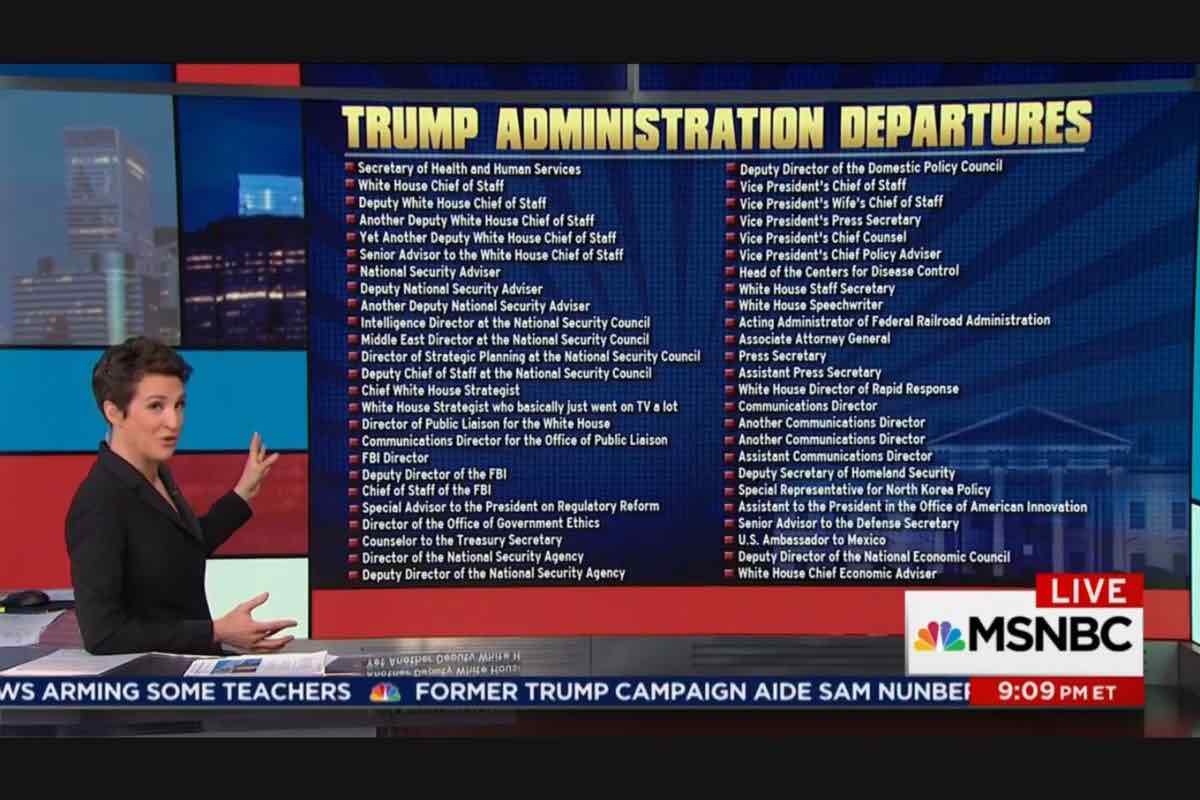
Trump Administration Departures

Brian Steler sent along to his readers a photo showing the departures – so far – from the Trump Administration. Stelter writes that

On MSNBC Tuesday night, Lawrence O’Donnell joked that this graphic is a “copyrighted feature of Rachel Maddow’s show:” Her “big board” of Trump admin departures. The list keeps getting longer and the font keeps getting smaller. “We have never seen a graphic like that in any White House at this point,” O’Donnell said…

No doubt, these departing second-raters will be replaced by even worse operatives.

Daily Bread for 3.7.18

Good morning.

Wednesday in Whitewater will be partly sunny with a high of thirty. Sunrise is 6:18 AM and sunset 5:52 PM, for 11h 33m 42s of daytime. The moon is a waning gibbous with  67.4% of its visible disk illuminated. Today is the {tooltip}four hundred eighty-second day.{end-texte}Days since Trump’s election, with 11.9.16 as the first day.{end-tooltip}

On this day in 1965, during the Selma to Montgomery marches, Bloody Sunday leaves protesters severely injured:

The Selma to Montgomery marches were three protest marches, held in 1965, along the 54-mile (87 km) highway from Selma, Alabama to the state capital of Montgomery. The marches were organized by nonviolent activists to demonstrate the desire of African-American citizens to exercise their constitutional right to vote, in defiance of segregationist repression, and were part of a broader voting rights movement underway in Selma and throughout the American South. By highlighting racial injustice, they contributed to passage that year of the Voting Rights Act, a landmark federal achievement of the Civil Rights Movement.

The first march took place on March 7, 1965, organized locally by Bevel, Amelia Boynton, and others. State troopers and county possemen attacked the unarmed marchers with billy clubs and tear gas after they passed over the county line, and the event became known as Bloody Sunday.[6][7] Law enforcement beat Boynton unconscious, and the media publicized worldwide a picture of her lying wounded on the Edmund Pettus Bridge.[8]

Recommended for reading in full —

➤ Betsy Woodruff and Spencer Ackerman report Trump Lawyer Michael Cohen Received Inside Info From Russia Probe (“Closed-door testimony before the House Russia probe is supposed to stay behind closed doors. Somehow, it got into the hands of another witness—and key Trump confidant—instead”):

On Dec. 19, 2017, a former staffer for Sen. John McCain named David Kramer testified before the House intelligence committee behind closed doors. He’d played a role in bringing the salacious and unverified Steele dossier to the FBI’s attention, and members peppered him with questions about it.

Then something unusual happened. Word of Kramer’s testimony got out—to the lawyer of another witness.

The following, based on conversations with multiple sources familiar with the matter, illuminates the extraordinary breakdown of trust between committee investigators and the witnesses they call. It also suggests that some people working on the committee investigation may be trying to covertly assist one of the president’s closest allies—when the president’s inner circle is ostensibly a focus of their probe.

A few days after Kramer’s testimony, his lawyer, Larry Robbins, got a strange call. The call was from Stephen Ryan, a lawyer who represents Trump’s longtime personal attorney Michael Cohen. Cohen is facing scrutiny from special counsel Robert Mueller and congressional investigators regarding potential coordination between Trump’s team and the Kremlin. He featured prominently in the Steele dossier—the document that Kramer handled—and is suing BuzzFeed for publishing it.

➤ Rosalind S. Helderman, Tom Hamburger, and Josh Dawsey report Special counsel has examined episodes involving Michael Cohen, Trump’s longtime lawyer:

Special counsel Robert S. Mueller III has requested documents and interviewed witnesses about incidents involving Michael Cohen, the longtime lawyer for President Trump whose wide-ranging portfolio has given him a unique vantage point into Trump’s business, campaign and political activities.

There is no indication that Cohen is a subject or target of the investigation into Russian interference in the 2016 election. But the scrutiny of his interactions is another sign of the far-reaching nature of the special-counsel probe, which is examining members of the president’s inner circle and aspects of Trump’s past business outreach to Russia.

As one of Trump’s closest advisers, Cohen played a role in at least two episodes involving Russian interests that have drawn Mueller’s attention, according to several people familiar with document subpoenas and witness interviews.

One area of focus has been negotiations Cohen undertook during the campaign to help the Trump Organization build a tower in Moscow. Cohen brought Trump a letter of intent in October 2015 from a Russian developer to build a Moscow project. Later, he sent an email to Russian President Vladi­mir Putin’s chief spokesman seeking help to advance the stalled project. He said he did not recall receiving a response.

➤ Jennifer Jacobs reports Trump Confronted Cohn on Trade Hours Before Resignation, Sources Say:

President Donald Trump demanded economic adviser Gary Cohn’s cooperation on tariffs in a meeting in the Oval Office Tuesday — asking Cohn directly if he would support his decision to move forward with the plan.

Trump, during the trade policy meeting in the Oval Office Tuesday, asked for an update on the legal paperwork that will make the tariffs official and discussed the timing of the signing of the tariffs order. He then sought confirmation that everyone — and especially Cohn — was willing to stand behind him.

According to one source with knowledge of the exchange, Trump specifically asked Cohn: We’re all on the same team, right? He then asked if Cohn was going to support the president on the issue.

Cohn didn’t answer, the people said.

➤ Linda Qiu describes  President Trump’s Exaggerated and Misleading Claims on Trade (“The president’s claims about massive trade deficits, tariffs and the World Trade Organization are overstated and contradicted by his own economic report”):

In defending his embrace of steep tariffs — and in comments that seem to encourage a trade war — President Trump has repeatedly claimed massive trade imbalances, unfair practices and an international system that benefits everyone but the United States.

But these claims are often overstated and contradicted by his own economic council. Here is a fact-check of recent comments that Mr. Trump has made on trade deficits, the World Trade Organization and tariffs.

“We have a trade deficit of $800 billion a year.” — March 6 remarks

This is exaggerated.

A White House spokesman said the $800 billion deficit figure that Mr. Trump has cited refers to the trade balance in goods. The Department of Commerce reported a $810 billion deficit in goods in 2017, but a total trade deficit of $566 billion that includes a trade surplus in services.

Mr. Trump’s preoccupation with trade in goods contradicts his own White House economic report, which he signed and was released in February.

The United States’ economy has shifted “away from manufacturing and toward service provision industries” in recent decades, according the report. “Focusing only on the trade in goods alone ignores the United States’ comparative advantage in services.”

Like most developed countries, the United States is primarily a services economy, said Scott Lincicome, a trade analyst at the Cato Institute, a libertarian think tank. And American service sectors — like accounting, finance, technology, engineering and law — are globally dominant.

“By focusing only on goods, you make it seem far weaker than it actually is,” Mr. Lincicome said. Doing so also means “ignoring a large, growing and vibrant part of the economy,” he said.

➤ James Gorman and Christopher Whitworth describe Pelican Spiders, Ancient Assassins That Eat Their Own Kind:

Supporting Civil Disobedience in Support of Dreamers

A hard condition of our communities is found among Dreamers vulnerable to unjust deportation; the hard work on their behalf is found among those who have actively protested in defense of those Dreamers.

For the rest of us, Voces de la Frontera offers an opportunity to contribute to pay the fines of twenty-three who protested at the Racine office of US Speaker of the House Paul Ryan. I’ve contributed, and I hope that others will, too.

Below readers will find the original fundraisng letter from Voces de la Frontera, in English and Spanish:

March 5th.

Today, 23 brave community members were arrested in an act of civil disobedience at the Racine office of US Speaker of the House Paul Ryan. They were demanding Speaker Ryan protect immigrant youth and pass the clean Dream Act now!

Will you take five minutes to contribute $20 towards the fines these bold leaders have been ordered to pay?

Click here to donate. 

All 23 have been released! Among those arrested in Wisconsin were children of immigrant parents, public school teachers, a union ironworker, elected officials, Catholic Workers, and retirees.

Today has been an incredible day. In the hours leading up to the civil disobedience, hundreds of students from five Milwaukee and Racine high schools walked out of classes and marched on Paul Ryan’s Racine office.

We took these bold actions because after today, immigrant youth will begin losing DACA protections in much higher numbers, thanks to the President’s cruel decision to eliminate the program, and Speaker Ryan’s refusal to allow a vote on the clean Dream Act.

While we acted in Wisconsin, dozens of leaders in Washington, D.C. were arrested outside of Ryan’s Washington office as part of the national fight for the clean Dream Act now.

Click here to donate to the fund to pay the fines of the 23 Wisconsin leaders arrested today. 

Thank you, and please share the link to the fundraiser!

Hoy, 23 miembros de la comunidad valientes fueron arrestados en un acto de desobediencia civil en frente de la oficina de Racine del líder de la Cámara de Representantes de Estados Unidos, Paul Ryan. ¡Exigieron que Ryan proteja a los jóvenes inmigrantes y apruebe el limpio Dream Act ahora!

¿Tomarán cinco minutos para contribuir $20 hacia las multas que estos audaces líderes han sido ordenados a pagar?

Haga clic aquí para contribuir.

¡Todos los 23 han sido liberados! Los arrestados en Wisconsin incluyeron hijos de padres inmigrantes, maestros de las escuelas públicas, un herrero sindicalista, oficiales electos, Trabajadores Católicos y jubilados.

Hoy ha sido un día increíble. En las horas antes de la desobediencia civil, cientos de estudiantes en cinco preparatorias en Milwaukee y Racine salideron de sus clases y marcharon a la oficina de Paul Ryan en Racine.

Tomamos estas acciones audaces porque después de hoy, los jóvenes inmigrantes comenzarán a perder las protecciones de DACA en números mucho más altos, gracias a la cruel decisión del Presidente de eliminar el programa, y gracias a Paul Ryan, que ha rechazado hasta ahora permitir un voto sobre el Dream Act limpio. ??

Mientras actuábamos en Wisconsin, docenas de líderes en Washington, DC también fueron arrestados afuera de la oficina de Ryan en Washington como parte de la lucha nacional por el Dream Act.

Haga clic aquí para donar al fondo para pagar las multas de los 23 líderes de Wisconsin arrestados hoy.

Gracias, ¡y favor de compartir la página para recaudar los fondos!

Daily Bread for 3.6.18

Good morning.

Tuesday in Whitewater will see some snow with a high of thirty-nine. Sunrise is 6:20 AM and sunset 5:51 PM, for 11h 30m 47s of daytime. The moon is a waning gibbous with  76.5% of its visible disk illuminated. Today is the {tooltip}four hundred eighty-first day.{end-texte}Days since Trump’s election, with 11.9.16 as the first day.{end-tooltip}

The Whitewater Common Council meets tonight at 6:30 PM.

On this day in 1475, Michelangelo is born in the Republic of Florence. On this day in 1862, the 4th Wisconsin Cavalry heads south:  “the 4th Wisconsin Cavalry (then an infantry unit) embarked to join the “Army of the Gulf.” It arrived below New Orleans on March 12, 1862, and landed in New Orleans on May 1. The 4th was at once assigned to active service and joined an expedition up the Mississippi River against Vicksburg in May. By June they occupied Baton Rouge, Louisiana. The troops there were employed in several successful expeditions during that winter, and remained in the area through most of the war. In June of 1862, its commander was punished for refusing to return escaping slaves to their masters (more information on this event is at Turning Points in Wisconsin History). In 1863 the unit was equipped as a Cavalry Regiment; it returned to Wisconsin in 1866.”

Recommended for reading in full —

➤ ABC News reports on a change of ownership:

(Cathartic… See also Thugs, Leeches, Shouting and Shoving at Trump Hotel in Panama.)

➤ Ella Nilsen and Rachel Wolfe report Trump operative Sam Nunberg can’t stop talking:

There were some serious fireworks in Trump-Russia investigation world today, and they all happened on live television. [Vox / Andrew Prokop]

They came in the form of former Trump campaign aide Sam Nunberg, who went on several afternoon television shows on MSNBC and CNN and made eye-popping statements about the Trump campaign, after it was revealed a grand jury had subpoenaed him as part of the Russia investigation. [Washington Post / Josh Dawsey]

Among other things, Nunberg appeared to ask CNN’s Jake Tapper for legal advice, refused to turn over his emails, suggested special counsel Robert Mueller has “something” on Trump, and said he believed former Trump foreign policy adviser Carter Page colluded with the Russians. [CNN / Eli Watkins]

Nunberg’s biggest grievance in being subpoenaed seemed to be being asked to dig through years’ worth of emails and turn them over to Mueller’s team or going in for questioning. [MSNBC / Katy Tur]

In case there was any doubt of how he felt, Nunberg made it clear. “Screw that,” he told CNN’s Gloria Borger. “Why do I have to go? Why? For what?” [CNN / Eli Watkins]

That brings us to the question: Who the hell is Sam Nunberg? [Haley Byrd via Twitter]

Nunberg is a conservative activist with roots in New York. He was a Trump acolyte before the real estate mogul formally launched his presidential campaign in summer 2015. [BuzzFeed / McKay Coppins]

Before Trump, Nunberg worked in political opposition research. He was also mentored by the original “dirty trickster” Roger Stone, and worked for Stone’s consulting firm, which counted Trump as a client back in 2015. [BuzzFeed / McKay Coppins]

Nunberg certainly has a history of his mouth getting him into trouble; he was fired by the Trump campaign just a few months after it launched, due to some racist Facebook posts. [CNN / Jeremy Diamond]

If Nunberg was trying to tell Mueller that there’s no there there, he failed spectacularly. It’s far more likely his performance today will pique the special counsel’s interest. [Atlantic / Adam Serwer]

(Trump’s crew is disordered, drunk, or delusional.)

➤ Mark Treinen and Alan Hovorka report UW-Stevens Point plans to cut 13 majors, add or expand 16 programs:

STEVENS POINT – The University of Wisconsin-Stevens Point would eliminate more than a dozen majors including history, political science and geography under a proposal announced Monday.

The university also might lay off faculty as a result of program changes.

The proposal is part of a plan to address a projected deficit of $4.5 million over two years because of declining enrollment and lower tuition revenues.

UW-Stevens Point also would add or expand 16 programs “in areas with high-demand career paths” to increase overall enrollment on the campus, according to a news release.

The 13 programs that would be eliminated because of low enrollment are: American studies, art (but not graphic design), English (other than English for teacher certification), French, geography, geoscience, German, history (social science for teacher certification would continue), music literature, philosophy, political science, sociology (social work major would continue) and Spanish.

(One can expect similar liberal arts reductions elsewhere, as Stevens Point is not alone in having troubled finances.)

 reports Trump claims ‘there is no chaos’ in White House, but warns of future firings:

President Trump claimed Tuesday that “there is no chaos” in response to recent reports in The Washington Post and elsewhere of volatility in his White House. But he also warned of future staff firings because, the president said, he is “always seeking perfection.”

In a morning tweet, Trump wrote, “The new Fake News narrative is that there is CHAOS in the White House. Wrong! People will always come and go, and I want strong dialogue before making a final decision. I still have some people that I want to change (always seeking perfection). There is no Chaos, only great Energy!”

(Oh, brother.)

This Special Training Keeps Astronauts From Vomiting Everywhere:

Subsidies for Subsidies

In Wisconsin, UW System schools typically rely on private foundations to offset the costs of some university expenses. This make sense – alumni and other donors can support activities at their schools. What happens, though, when private foundations designed to supplement public programs wind up depending, themselves, on public money?

One finds that even subsidies, so to speak, have their own subsidies: private organizations that are supposed to be helping the UW System schools by reducing universities’ reliance on tax dollars are, in fact, receiving large sums of public money:

The 112-page audit report estimated $258 million has flowed from UW System schools to private foundations over the last 10 years, and lax record-keeping makes it unclear whether the total was actually higher.

Auditors highlighted blurred lines created when university employees are assigned to work for the foundations without clear guidelines to ensure that the schools are reimbursed and lines of authority remain clear.

“The proactive steps we announced last spring are a step in the right direction in providing additional accountability and transparency in the UW System’s relationships with its fundraising and real estate foundations,” [System President Ray] Cross said.

“While we have made significant progress, we appreciate the feedback from LAB [Legislative Accounting Bureau] in assisting us in those efforts,” he said. “We continually strive to ensure the ongoing integrity, efficiency, and transparency of these organizations.”

But the audit report said Cross in April made efforts to tighten financial rules for fewer than one-third of the private foundations. By December, the System was able to show auditors only one contract demonstrating that a school and a foundation were in compliance with new policies.

In December, the UW System Board of Regents formally approved the new policies aimed at ensuring responsible dealings with 28 primary fundraising and real estate foundations.

But Cross and the board didn’t address about 62 other private organizations that were paid an estimated $168 million in 2007 to 2017, auditors said.

Via UW subsidizing private groups that are supposed to subsidize it, audit says.

(What a gift Cross is to contemporary bureaucratic thinking: instead of admitting how far he’s fallen short, he unctuously praises auditors for “the feedback from LAB in assisting us in those efforts” – efforts of course he either didn’t undertake or undertook so poorly millions were not accounted properly.)

Here’s the executive summary of the audit:

Here’s the UW-Whitewater specific part of the audit, page 6-15 (with UW-Whitewater mentioned elsehere in the full audit):

UW-Whitewater Foundation (UW-Whitewater)

FY 2007-08 through FY 2016-17

Reported Net Assets: $29.4 million, as of June 30, 2016.

Memorandum of Understanding: In effect in June 2017. Bylaws: In effect from October 2008 through June 2017.

Board of Directors: UW employees served simultaneously as voting members of the foundation’s board. More than three UW employees served on the foundation’s board at some point from FY 2007-08 through FY 2016-17.

Executive Director as of June 30, 2017: The Vice Chancellor for University Advancement at UW-Whitewater also worked as the executive director of the foundation.

Number of UW Employees as of June 30, 2017: The foundation provided reimbursement to UW-Whitewater for some of the salary and fringe benefit costs of two UW-Whitewater employees who worked for the foundation. The foundation did not provide reimbursement for the salary or fringe benefit costs of the UW-Whitewater employee who worked as the executive director.

Approval of Financial Transactions: Two UW-Whitewater employees were authorized to approve financial transactions on behalf of the foundation.

Office Space: The foundation paid an annual fee to use office space at UW-Whitewater. The fee was $2,040 from FY 2007-08 through FY 2015-16. Information indicated this amount was half of the fair-market rate when the original lease for office space was signed in 1992.

New Memorandum of Understanding as of June 7, 2017

The UW System President required UW institutions to comply by November 1, 2017, with written requirements previously provided to all chancellors in April 2017. We requested that UW System Administration provide us with all new memoranda of understanding, which must contain the provisions that are now required by the Board of Regents policy. Most memoranda of understanding referred to related agreements that contained additional information.

Board of Directors: Not all UW employees are prohibited from serving as voting members of the foundation’s board, and the total number of UW employees serving on the board is not limited.

Executive Director: The Vice Chancellor for University Advancement at UW-Whitewater also works as the executive director of the foundation.

Number of UW Employees: Reimbursements for the salary and fringe benefits costs of any UW employees who work for the foundation are required to be documented in a separate agreement. We were not provided such an agreement.

Approval of Financial Transactions: The foundation is required to have policies defining the circumstances in which UW employees may approve transactions on its behalf.

Office Space: The foundation is required to pay an annual fee of $2,040 to use office space at UW-Whitewater. Information indicated this amount is half of the fair-market rate when the original lease for office space was signed in 1992.

Here’s a link to the full, 112-page auditRelationships between the University of Wisconsin and Certain Affiliated Organizations, Wisconsin Legislative Audit Bureau, Report 18-4 March 2018.