
Sammy the Boxer Dog wants to jump on the sofa. She makes her plea in the video below.
Are you persuaded – should she get to rest on the sofa?
Sammy the Boxer Dog wants to jump on the sofa. She makes her plea in the video below.
Are you persuaded – should she get to rest on the sofa?
Good morning, Whitewater.
We’ll have morning showers with a high of fifty-five.
On this day in 1990, after decades of division and Communist oppression, East Germany is reunified with the West:
The Volkskammer, the Parliament of East Germany, passed a resolution on 23 August 1990 seeking the accession (Beitritt) of the German Democratic Republic to the Federal Republic of Germany as allowed by article 23 of the West German Basic Law, effective 3 October 1990.[7][8] In the wake of that resolution, the “German reunification treaty”,[9][10][11] commonly known in German as “Einigungsvertrag” (Unification Treaty) or “Wiedervereinigungsvertrag” (Reunification Treaty), that had been negotiated between the two German states since 2 July 1990, was signed on 31 August 1990. This Treaty, officially titled Vertrag zwischen der Bundesrepublik Deutschland und der Deutschen Demokratischen Republik über die Herstellung der Einheit Deutschlands (Treaty between the Federal Republic of Germany and the German Democratic Republic on the Establishment of German Unity), was approved by large majorities in the legislative chambers of both countries on 20 September 1990[12] (442–47 in the West German Bundestag and 299–80 in the East German Volkskammer). The amendments to the Federal Republic’s Basic Law that were foreseen in the Unification Treaty or necessary for its implementation were adopted by the Federal Statute of 23 September 1990. Under article 45 of the Treaty,[13] it entered into force in international Law on 29 September 1990, upon the exchange of notices regarding the completion of the respective internal constitutional requirements for the adoption of the treaty in both East Germany and West Germany.
With that last step, and in accordance with article 1 of the Treaty, Germany was officially reunited at 00:00 CET on 3 October 1990. East Germany joined the Federal Republic as the five Länder (states) of Brandenburg, Mecklenburg-Vorpommern, Saxony, Saxony-Anhalt and Thuringia. These states had been the five original states of East Germany, but had been abolished in 1952 in favour of a centralised system. As part of the 18 May treaty, the five East German states had been reconstituted on 23 August. At the same time, East and West Berlin reunited into one city, which became a city-state along the lines of the existing city-states of Bremen and Hamburg. In an emotional ceremony, at the stroke of midnight on 3 October 1990, the black-red-gold flag of West Germany—now the flag of a reunited Germany—was raised above the Brandenburg Gate marking the moment of German reunification.
Google-a-Day asks about art:

Many of the cave paintings at Lascaux show the animals with heads in profile, but with horns facing forward. This is an example of what convention of representation?
I’m sorry I didn’t get to this sooner, but one of UW-Whitewater Dean of Students Mary Beth Mackin’s remarks about drug busts on campus deserves a reply. She’s offered an argument for equality of treatment on and off campus. Her argument implies that she either misunderstands the underlying justification for equality arguments, or that she supports the Drug War no matter how Draconian in Whitewater, inner cities, or anywhere in America.
Her remarks came during an interview with Gilman Halsted of Wisconsin Public Radio. (See, UW Campuses Use Undercover Student Informants In Drug Busts: Students Caught Dealing Drugs Are Offered Option Of Wearing Wire In Exchange For Reduced Charges.)
In that interview with WPR, Dean Mackin offers the contention that because non-college students might be subjected to drug charges (even for small amounts of narcotics), it’s fair that college students should be, too:
She said that when students break drug laws on campus, they shouldn’t be treated differently just because they’re students.
“I think the important thing is this is not an anomaly to a college campus,” Mackin said. “It’s the same thing that happens to 19-year-old who has not come to college, who’s working somewhere out in society.”
There’s her equality argument. On campus, off campus, wherever: the same drug policies equally enforced.
Dean Mackin, however, can only make this equality argument ethically if she believes that the Drug War is a positive one for society.
That’s because the extension of equality depends on the conviction that what one extends is, in itself, positive. One can virtuously seek an extension of a good thing; the extension of suffering or harsh treatment to greater numbers in the name of equality is no virtue.
So extending the right to vote, freedom of speech and assembly, or marriage makes sense when one sees those as fundamental expressions of one’s humanity. Equality in these cases is an extension of positive goods.
By contrast, no one contends that equality of treatment would have justified the extension of Jim Crow laws, for example, from parts of America to the whole country. The unfairness of the laws trumps an argument from equality that they should have been extended to all fifty states.
To believe morally in the equal reach of the Drug War requires the belief that the Drug War is a social good.
Ms. Mackin may believe that, of course.
If she does, then she might tell those from the inner city, not just in Whitewater, that she’s committed to the equality of severe penalties and incarceration everywhere: Milwaukee, Chicago, Whitewater, wherever.
Dean Mackin might ask those many inner city residents, if she has the time, if they feel better about their treatment under the law now that she’s advocating equality of conditions on her rural campus.
I’d guess she’d not be met with a positive or thankful response.
Good morning, Whitewater.
We’ll have a probability of thunderstorms today, with a high temperature of seventy-four.
Whitewater’s Landmarks Commission meets tonight at 6 PM.
On this day in 1919, Pres. Wilson suffers a stroke while in office:
The immediate cause of Wilson’s incapacity in September 1919 was the physical strain of the public speaking tour he undertook in support of ratification of Treaty of Versailles. In Pueblo, Colorado, on September 25, 1919, he collapsed and never fully recovered.[247]
On October 2, 1919, he suffered a serious stroke, leaving him paralyzed on his left side, and with only partial vision in the right eye.[248] He was confined to bed for weeks and sequestered from everyone except his wife and physician, Dr. Cary Grayson.[249] For some months he used a wheelchair and later he required use of a cane. His wife and aide Joe Tumulty were said to have helped a journalist, Louis Seibold, present a false account of an interview with the President.[250]
He was insulated by his wife, who selected matters for his attention and delegated others to his cabinet. Wilson temporarily resumed a perfunctory attendance at cabinet meetings.[251] By February 1920, the President’s true condition was public. Many expressed qualms about Wilson’s fitness for the presidency at a time when the League fight was reaching a climax, and domestic issues such as strikes, unemployment, inflation and the threat of Communism were ablaze. No one, including his wife, his physician or personal assistant were willing to take upon themselves responsibility for the certification, required by the Constitution, of his “inability to discharge the powers and duties of the said office”.[252] This complex case became a motivation for passage of the 25th Amendment.[253]
Google-a-Day poses a question about music:
Unlike most oratorios, the one written by Handel in 24 days does not have what kind of plotline?
The latest Marquette Law School Poll is out today, with just over a month before the gubernatorial election. The last poll was 9.17.14.
The 10.1.14 poll has Walker 50, Burke 45 with likely voters, and 46-45 to Walker’s favor among registered voters.
The race is now just outside the poll’s statistical margin of error.
I’ve thought that the most important local issue in Whitewater will be, paradoxically, the statewide gubernatorial race; I still think so. The schools referendum – no matter how important as policy – isn’t nearly so attention-getting.
Still, even with limited local election data, one could construct a reasonable upper and lower limit for the referendum’s chances. Results from the district’s communities in statewide races over the last few years, checked against referendum voting in relation to party voting during the most recent spring referendum, would give (I think) the rough boundaries of a referendum’s high and low levels.
Hardly a model, but still a reasoned approach, let’s say.
Why would upper and lower limits matter?
There’s a good reason: although the referendum will sail on statewide currents, there will be an independent local influence, too. It’s not as though nothing said locally will matter.
If it should be true that the vote is likely to be close, and likely to be close because the November 4th statewide contests will limit a lopsided result one way or the other, then a remaining question is how persuadable local voters will be on the referendum question.
If it’s likely to be lopsided persuasion won’t matter; if it’s a fixed and decided electorate persuasion will matter little.
A close race and a persuadable electorate will make advocacy more important than it would be otherwise.
I’ll always favor high-quality, high-octane advocacy – more information of good quality benefits a community.
It’s worth crunching prior election results over the next week, to estimate the limits of the vote, and consequently the importance of solid advocacy.

Good morning, Whitewater.
A new month begins, with partly cloudy skies and a high of seventy-one. Sunrise is 6:52 AM and sunset 6:36 PM. We’ll have a first quarter moon this afternoon.
On this day in 1890, an act of Congress creates Yosemite National Park:
Yosemite National Park … is a United States National Park spanning eastern portions of Tuolumne, Mariposa and Madera counties in the central eastern portion of the U.S. state of California. The park, which is managed by the National Park Service, covers an area of 747,956 acres (3,026.87 km2)[2] and reaches across the western slopes of the Sierra Nevada mountain chain.[5] Over 3.7 million people visit Yosemite each year:[3] most spend their time in the seven square miles (18 km2) of Yosemite Valley.[6] Designated a World Heritage Site in 1984, Yosemite is internationally recognized for its spectacular granite cliffs, waterfalls, clear streams, Giant Sequoia groves, and biological diversity.[6] Almost 95% of the park is designated wilderness.[7] Yosemite was central to the development of the national park idea. First, Galen Clark and others lobbied to protect Yosemite Valley from development, ultimately leading to President Abraham Lincoln’s signing the Yosemite Grant in 1864. Later, John Muir led a successful movement to establish a larger national park encompassing not just the valley, but surrounding mountains and forests as well – paving the way for the United States national park system.[8]
Yosemite is one of the largest and least fragmented habitat blocks in the Sierra Nevada, and the park supports a diversity of plants and animals. The park has an elevation range from 2,127 to 13,114 feet (648 to 3,997 m) and contains five major vegetation zones: chaparral/oak woodland, lower montane forest, upper montane forest, subalpine zone, and alpine. Of California’s 7,000 plant species, about 50% occur in the Sierra Nevada and more than 20% within Yosemite. There is suitable habitat or documentation for more than 160 rare plants in the park, with rare local geologic formations and unique soils characterizing the restricted ranges many of these plants occupy.[6]
The geology of the Yosemite area is characterized by granitic rocks and remnants of older rock. About 10 million years ago, the Sierra Nevada was uplifted and then tilted to form its relatively gentle western slopes and the more dramatic eastern slopes. The uplift increased the steepness of stream and river beds, resulting in formation of deep, narrow canyons. About 1 million years ago, snow and ice accumulated, forming glaciers at the higher alpine meadows that moved down the river valleys. Ice thickness in Yosemite Valley may have reached 4,000 feet (1,200 m) during the early glacial episode. The downslope movement of the ice masses cut and sculpted the U-shaped valley that attracts so many visitors to its scenic vistas today.[6]
Google-a-Day asks a baseball question:
One of the greatest baseball players of all time was banned from the game for life after he and seven other players accepted bribes to throw a game in what year?
They’d have a sort of nineteenth- century aspect to them –
Update: Video interview embedded immediately below.
On Monday night, WISC-TV Madison broadcast an interview with UW-Whitewater’s former wresting coach, Tim Fader. Coach Fader was dismissed from his position in June 2014, two months after he reported an alleged sexual assault to the Whitewater Police Department. A story based on the broadcast interview is now online. See, Former UW-Whitewater wrestling coach seeks to clear name.
The interview provides significant new information about UW-Whitewater’s actions in Coach Fader’s dismissal, and more broadly the university’s evident misunderstanding of the difference between actual reporting and mere formalism.
Here’s the reported account of Fader’s actions:
But on Good Friday, April 18, he [Fader] said he received a phone call from the mother of a student he knew on campus. His reaction, he believes, cost him his job and has harmed his chances to continue his career.
“She was very emotional and she said, ‘You know that recruit you had here yesterday. (He) sexually assaulted my daughter,'” Fader said. “I called the police and said, ‘I’m Tim Fader. I’m the wrestling coach. I have a sexual assault allegation. What do I do?'”
Fader said the Whitewater police officer he spoke to suggested he get the recruit to the station for questioning. Fader did that, sending the recruit with an assistant coach to meet with detectives.
A spokesman for the Whitewater Police Department said officers are meeting with the Walworth County District Attorney’s Office this week to determine if charges will be filed. Whitewater police would not discuss how the department learned about the alleged incident, stating it remained an open investigation.
Fader believed that by reporting as he did, the Whitewater Police Department would notify the university, as it had in past incidents.
The interview also includes key information elicited from university officials Sara Kuhl and Mary Beth Mackin.
Of the April incident reported to the city’s police department, Dean of Students Mackin states that the “university responded appropriately in accordance with its obligations under Title IX and its own institutional policies and practices.”
It’s an empty response, three times over.
First, it was Fader, not the university, not an institution, that initially responded.
Second, an appropriate response would not have been to create the impression of punishing direct, initial communication to the police, as that is the very opposite of the goals of Title IX reporting. (It’s the opposite of any climate that correctly supports reporting and open discussion). Mackin obtusely conflates actual conduct with mere formalism, and rests on the latter rather than the former.
Third, if the university had wanted a more canned reply, it could not have picked a better one than Mackin’s defensive, organizational one; it’s as though she thumbed through a phrase book for institutional defenders and found something especially lifeless (‘Defenses, company men and women, Page 6…’).
The WISC-TV story also relates that UW-Whitewater press spokeswoman Sarah Kuhl “denied an open records request asking for documents related to the Title IX investigation into the alleged incident in April because she said its attorneys and the federal government advised the school to do so.”
Included is the reasoning behind the denial:
“Given that your request seeks information that has been or is likely to be requested by OCR as part of the investigation, the university believes that the release of information could compromise the integrity of the investigation, including the university’s ability to adequately represent its interests,” Kuhl said the records request response.
A refusal to release information now is temporary only, as Kuhl (or others) must know. Here’s why. A federal investigation may resolve administratively and if so records will be available via subsequent state and federal records requests to UW-W and the Department of Education, respectively. Alternatively, UW-Whitewater may also find itself in litigation with the 2-14-14 claimant or others in a necessarily public forum.
Either way, information about these matters will become public. There’s no avoiding a public airing – nor should there be such avoidance.
There’s no way to know, of course, whether Kuhl’s concern about protecting the university’s position is boilerplate or also an implicit admission of a true vulnerability concerning the claimant’s case from which the ongoing federal investigation derives.
One can be sure, however, that Chancellor Telfer was quick to issue a statement in May protecting his position in all this, but made no mention of Coach Fader’s actions. It was, after all, Fader and not Telfer who took practical action here.
Now that there’s investigative press coverage, Chancellor Telfer’s nowhere to be found, leaving the talking to a spokeswoman and subordinate.
And that, to be sure, is neither a positive climate nor even personal leadership at UW-Whitewater.
For prior posts about this matter, please see:
Questions on Assault Reporting, Formality, and Former UW-Whitewater Wresting Coach Fader
Assault Reporting, Formality, and Former UW-Whitewater Wresting Coach Fader
Good morning, Whitewater.
Month’s end in Whitewater will be partly cloudy with a high of sixty-two.
On this day in 1954, America commissions the world’s first nuclear submarine:
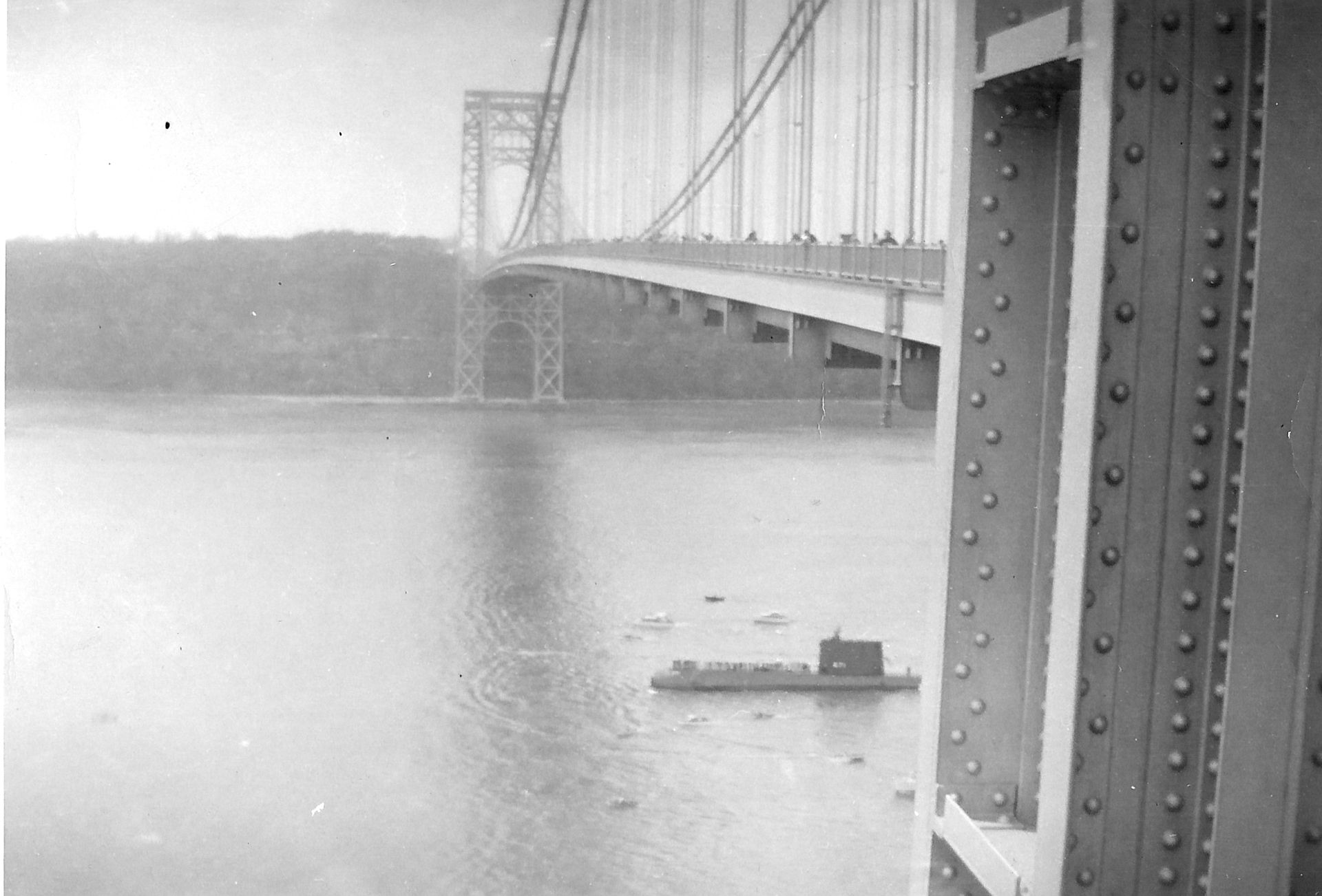
USS Nautilus (SSN-571) was the world’s first operational nuclear-powered submarine. The vessel was the first submarine to complete a submerged transit to the North Pole on 3 August 1958. Sharing names with the submarine in Jules Verne’s Twenty Thousand Leagues Under the Sea, and named after another USS Nautilus (SS-168) that served with distinction in World War II, Nautilus was authorized in 1951 and launched in 1954. Because her nuclear propulsion allowed her to remain submerged far longer than diesel-electric submarines, she broke many records in her first years of operation, and traveled to locations previously beyond the limits of submarines. In operation, she revealed a number of limitations in her design and construction. This information was used to improve subsequent submarines.
Nautilus was a component of SubRon Ten (Submarine Squadron Ten). The squadron commander was stationed aboard the USS Fulton (AS-11), a submarine tender stationed in New London, Connecticut at State Pier. Nautilus and other submarines in the squadron made their home tied up alongside the tender, where they received preventive maintenance and, if necessary, repairs, from the well-equipped Fulton and her crew of machinists, millwrights, and other crafts.
Nautilus was decommissioned in 1980 and designated a National Historic Landmark in 1982. The submarine has been preserved as a museum of submarine history in Groton, Connecticut, where the vessel receives some 250,000 visitors a year.
On this day in 1859, Abraham Lincoln speaks in Wisconsin:
1859 – Abraham Lincoln Speaks at State Fair
On this date Abraham Lincoln delivered an address at the Wisconsin State Fair. In his speech, he connected agriculture to education: “Every blade of grass is a study; and to produce two, where there was but one, is both a profit and a pleasure.” The rising political star (who was elected the following year), also stressed the importance of free labor. This was Lincoln’s last visit to Wisconsin. In 1861, after winning the presidential election, Lincoln signed the bill establishing the U.S. Department of Agriculture. [Source: AbrahamLincoln.org]
Google-a-Day asks about a poem:
What poem title did T. S. Eliot say he created by combining the titles of a romance by William Morris with the title of a Rudyard Kipling poem?
Wisconsin has had years of embarrassments from the Wisconsin Economic Development Corporation, of economic manipulation, of picking supposed winners as though party hacks would know better than markets. It was a method bound to disappoint.
These smarmy men at the WEDC have been trying to show progress on the millions of bad loans they’ve made. Lazy men that they are, they’re reducing millions in bad loans not by trying to salvage them, but simply by writing them off –
Friday’s audit [by the Legislative Audit Bureau] found that the troubled loans held by WEDC dropped from 49 loans totaling $13.2 million as of June 2013 to 30 loans totaling $5.5 million as of December 2013.
Of the $7.7 million decrease in troubled loans held by WEDC, the biggest chunk — $3.2 million — came from loans that were written off by WEDC because they were 90 days past due.
For the state to proceed with the collection process, those loans had to be transferred from WEDC to the Department of Administration. So by itself that change is just a bureaucratic shuffle, not a gain for taxpayers.
The audit didn’t examine what had happened to the loans after they went to the administration department.
The next biggest chunk of past due loans, worth $2.1 million, had their contracts rewritten by WEDC to delay repayment by the borrowers.
Another $1.3 million in loans were forgiven by WEDC in whole or in part….
See, Audit: jobs agency makes progress on bad loans by writing many off.
When Messrs. Telfer, Knight, and Clapper met for a second time at the Innovation Center with WEDC leader Reed Hall, to crow about what a great program the WEDC has been, it’s a shambling, stumbling, dishonest agency they were praising.
That’s what they dragged into Whitewater yet again. This agency is the embodiment of disrespect or ignorance of sound policy
That’s a problem of corporate welfare, of course, yet more: if one will overlook such obvious failure, loss, and disgrace to Wisconsin from the WEDC, perhaps one will overlook the risks, costs, and vital details of other bad ideas.
Previously, at FREE WHITEWATER on the WEDC:
See, below, the Legislative Audit Bureau report and a reply from the WEDC’s Reed Hall: