FREE WHITEWATER

Daily Bread for 6.20.14

Good morning, Whitewater.

Morning rain, but otherwise a mostly sunny Friday awaits, with a high of eighty-three.

On this day in 1782, Congress adopted the design for the Great Seal of the United States.

On June 13, 1782, the Congress turned to its Secretary Charles Thomson, and provided all material submitted by the first three committees.[10] Thomson was 53 years old, and had been a Latin master at a Philadelphia academy.[27] Thomson took elements from all three previous committees, coming up with a new design which provided the basis for the final seal.[10]

Thomson used the eagle – this time specifying an American bald eagle – as the sole supporter on the shield. The shield had thirteen stripes, this time in achevron pattern, and the eagle’s claws held an olive branch and a bundle of thirteen arrows. For the crest, he used Hopkinson’s constellation of thirteen stars. The motto was E Pluribus Unum, taken from the first committee, and was on a scroll held in the eagle’s beak.[10][27]

An eagle holding symbols of war and peace has a long history, and also echoed the second committee’s themes. Franklin owned a 1702 emblem book, which included an eagle with olive branch and arrows near its talons, which may have been a source for Thomson.[18] The arrows also mirror those in the arms of the Dutch Republic, the only country in Europe with a representative government at the time, which depicted a lion holding seven arrows representing their seven provinces.[17][18] State currency may have provided further inspiration; a 1775 South Carolina bill showed a bundle of 13 arrows and a 1775 Maryland note depicted a hand with an olive branch of 13 leaves.[28]

Thomson’s drawing, the basis for the final seal

For the reverse, Thomson essentially kept Barton’s design, but re-added the triangle around the Eye of Providence and changed the mottos to Annuit Cœptisand Novus Ordo Seclorum.[27] Thomson sent his designs back to Barton, who made some final alterations. The stripes on the shield were changed again, this time to “palewise” (vertical), and the eagle’s wing position was changed to “displayed” (wingtips up) instead of “rising”. Barton also wrote a more properly heraldic blazon.[10]

The design was submitted to Congress on June 20, 1782 and was accepted the same day. Thomson included a page of explanatory notes, but no drawing was submitted. This remains the official definition of the Great Seal today.[10]

Puzzability‘s Game Boxes series concludes with Friday’s game:

This Week’s Game — June 16-20
Game Boxes
Playing around will work well for you this week. For each day, we’ll give a three-by-three letter grid in which we’ve hidden the name of a tabletop game. Each has 10 or more letters and any number of words. To find the game, start at any letter and move from letter to letter by traveling to any adjacent letter—across, up and down, or diagonally. You may come back to a letter you’ve used previously, but may not stay in the same spot twice in a row. You will not always need all nine letters in the grid.
Example:
RFT/UOC/NNE
Answer:
Connect Four
What to Submit:
Submit the game’s name (as “Connect Four” in the example) for your answer.
Friday, June 20
KAS/DYT/MER

Crony Capitalism: Wrong, Erroneous, and Laughable

Across America, from among left, small-government conservatives, and libertarians, a coalition now works to turn the tide against crony-capitalism and white-collar welfare.  They will succeed, as America’s political tradition will reject the manipulation of the country’s political-economy for the selfish, rigged ends of well-fed men. 

Sometimes, these critiques against crony capitalism will be deservedly severe; the ideological object of criticism is, after all, a false economics and an inferior ideology. 

Other times, they’ll be light-hearted critiques that appeal against white-collar welfare with humor.

Above are two videos lampooning crony capitalism in the style of Saturday-morning cartoons or commercials for action figures. 

The style is intentional; they’re made to appeal to middle-aged or younger viewers, who are either successful through their own efforts or aware of how a few scheming men take from others for their own gain. 

The focus is meant, of course, to split an older group of pols [pols, that is, political operatives and long-term incumbents] (mostly over sixty) from a more successful, rightly more skeptical (of deal-making) demographic. 

The result makes crony capitalists look conniving, laughably condescending, embarrassingly obvious in their lies, and shows them as the oily peddlers they are. 

Far from being ‘successes,’ ‘innovators,’ or ‘visionaries,’ they’re simply manipulators working against an honest, fair, efficient, and productive way of life. 

Videos posted previously @ Daily Adams.

Tomorrow: The local implications of it all.

Daily Bread for 6.19.14

Good morning, Whitewater.

Thursday will open with morning thunderstorms, and then develop into a partly cloudy day with a high of seventy-eight.

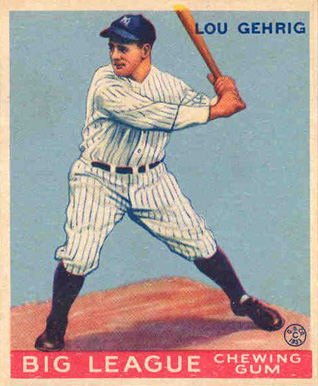
LouGehrigGoudeycard
Lou Gehrig baseball card by Goudey, 1933 via Wikipedia

It’s Lou Gehrig’s birthday:

Henry Louis “Lou” or “Buster[1] Gehrig (June 19, 1903 – June 2, 1941) was an American baseball first baseman who played 17 seasons in Major League Baseball (MLB) for the New York Yankees (1923–1939). Gehrig was renowned for his prowess as a hitter and for his durability, a trait which earned him his nickname “The Iron Horse“. He finished with a career batting average of .340, an on-base percentage of .447, and aslugging percentage of .632, and he tallied 493 home runs and 1,995 runs batted in (RBIs). A seven-time All-Star[2] and six-time World Series champion, Gehrig won the Triple Crown in 1934[3] and was twice named theAmerican League‘s (AL) Most Valuable Player. Gehrig was the first MLB player to have his uniform number retired, and he was elected to the Baseball Hall of Fame in 1939.

A native of New York City and attendee of Columbia University, Gehrig signed with the Yankees in 1923. He set several major league records during his career,[4] including the most career grand slams (23) (since broken)[5][6] and most consecutive games played (2,130), a record that stood for 56 years and was long considered unbreakable until surpassed by Cal Ripken, Jr. in 1995.[7] Gehrig’s streak ended in 1939 after he was stricken with amyotrophic lateral sclerosis (ALS), a disorder now commonly referred to as Lou Gehrig’s Disease in North America,[8] which forced him to retire at age 36 and claimed his life two years later. The pathos of his farewell from baseball was capped off by his iconic “Luckiest Man on the Face of the Earth” speech at the original Yankee Stadium.

Here’s Thursday’s Game Boxes puzzle from Puzzability:

This Week’s Game — June 16-20
Game Boxes
Playing around will work well for you this week. For each day, we’ll give a three-by-three letter grid in which we’ve hidden the name of a tabletop game. Each has 10 or more letters and any number of words. To find the game, start at any letter and move from letter to letter by traveling to any adjacent letter—across, up and down, or diagonally. You may come back to a letter you’ve used previously, but may not stay in the same spot twice in a row. You will not always need all nine letters in the grid.
Example:
RFT/UOC/NNE
Answer:
Connect Four
What to Submit:
Submit the game’s name (as “Connect Four” in the example) for your answer.
Thursday, June 19
HEZ/TNP/SIA

A Tech Company That Seeks Private Support

What does a small tech company that seeks private support look like?  Often, we’ll not know, because those private companies seek the support of private venture capital, in thousands of encounters and presentations across America each day. 

Sometimes, though, one sees more because a private tech startup looks to something like Kickstarter to win backing from private parties (many of them ordinary people, making small contributions).

Here’s one example, that received $102,382 in private funding, far ahead of its $36,000 goal: Sprout: HiFi Stereo Amp that transforms the way you listen.

I well understand that Kickstarter’s not for everyone, but these tech companies (and other projects) are relying on support from consumers in the marketplace.

They can feel good about what they’re trying.  They’re not tenured, white-collar academics exaggerating their so-called discoveries while supping parasitically on the tax earnings of working-class wage earners. 

I strongly believe in the opportunities – and even more in the joy of learning – that a formal education can offer.

Proper academic life never has – and never will – include scheming university administrators funding their pals’ ideas with public money. 

Hundreds of years of university life on this continent merit more than that. 

Much more.

Film: Today @ 12:30 PM at Seniors in the Park, The Great Beauty

There’s a screening today at 12:30 PM of The Great Beauty @ Seniors in the Park, in the community building. 

The 2014 winner of Best Foreign Film (at both the Academy Awards and Golden Globes) will be shown in Italian with English subtitles.  The film runs two hours, twenty-two minutes in length and is rated R for content.

Here’s a trailer for the film – enjoy – 

Daily Bread for 6.18.14

Good morning, Whitewater.

Our Wednesday will have a likelihood of thunderstorms and a high of eighty-one.

As it turns out, naked mole rats are hardier than other rodents, and resistant to diseases that afflict other mammals (notably cancer). How is that? Vox explains:

On this day in 1812, America goes to war with Britain:

The day after the Senate followed the House of Representatives in voting to declare war against Great Britain, President James Madison signs the declaration into law–and the War of 1812 begins. The American war declaration, opposed by a sizable minority in Congress, had been called in response to the British economic blockade of France, the induction of American seaman into the British Royal Navy against their will, and the British support of hostile Indian tribes along the Great Lakes frontier. A faction of Congress known as the “War Hawks” had been advocating war with Britain for several years and had not hidden their hopes that a U.S. invasion of Canada might result in significant territorial land gains for the United States.

Here is the Wednesday game in Puzzability‘s Game Boxes series:

This Week’s Game — June 16-20
Game Boxes
Playing around will work well for you this week. For each day, we’ll give a three-by-three letter grid in which we’ve hidden the name of a tabletop game. Each has 10 or more letters and any number of words. To find the game, start at any letter and move from letter to letter by traveling to any adjacent letter—across, up and down, or diagonally. You may come back to a letter you’ve used previously, but may not stay in the same spot twice in a row. You will not always need all nine letters in the grid.
Example:
RFT/UOC/NNE
Answer:
Connect Four
What to Submit:
Submit the game’s name (as “Connect Four” in the example) for your answer.
Wednesday, June 18
USB/HAE/LDR

Anger and Exhaustion Stalk Local Elites

Years of asking for money for big-ticket projects for big-talking cronies, and insisting on imaginary successes and fabricated accomplishments, have left local insiders facing community anger and exhaustion. 

Of the two, exhaustion is – by far – the more debilitating to town squires’ plans.

Anger flares over a project, here and there, and sometimes prevails against bad ideas. Exhaustion, by its very nature, never flares – it simply erodes and corrodes confidence in local officials.

In communities near Whitewater, local leaders and their press enablers are encountering some anger over local projects (particularly Janesville, a city with long-term leaders who are stumbling and fumbling project after project). 

Worse, though, than anger is the indifference from weariness that residents display when someone comes along to talk up another big idea.  Leaders want residents to get excited about the Next Big Thing, but residents have heard so many false promises, exaggerations, and outright lies from local influencers that few line up to support new proposals. 

These men quickly look like smooth-talking heels trying to get someone into the back of a car. Far from meeting with success, they’re met with a mixture of disinterest and contempt: You’re joking, right?

Look at something like trying to sell another round of WEDC grants. Who runs a big story touting that supposed triumph?  A newspaper that prints an afternoon daily (and that’s not even printed in its own city).  Fair enough to flack in the media one can find, but that’s publishing to an unrepresentative, aged demographic. 

(Afternoon newspapers are traditionally understood to be skewed old even compared with other papers.) 

I come from a newspaper-loving family, going back generations.  And yet, one should be clear: the only demographic group in America with a majority that reads newspapers daily is over sixty-five. 

(These disappointing data are actually generous to newspapers – they’re from Scarborough Research, a firm the newspaper industry prefers to use. An analysis from media consultant Alan Mutter, for example, is even less favorable.)

WEDC ‘CEO’ Reed Hall and Chancellor Telfer would have about as much community reach if they posted their press releases next to a store’s Geritol® counter. 

Here we are, and other cities, too: a decade of boosterism, with aching needs ignored, and these gentlemen speak to nearly-empty rooms, and through declining papers, to communities that are sometimes angry but mostly exhausted from the big sell of the next big thing. 

Daily Bread for 6.17.14

Good morning, Whitewater.

We’ll have morning showers and thunderstorms today, and thereafter a partly sunny day, with a high of eighty-nine.

Common Council meets tonight at 6:30 PM.

On this day in 1972, five burglars are arrested:

In the early morning of June 17, 1972, five men are arrested for breaking into the Democratic National Committee headquarters at the Watergate, an office-hotel-apartment complex in Washington, D.C. In their possession were burglary tools, cameras and film, and three pen-size tear gas guns. At the scene of the crime, and in rooms the men rented at the Watergate, sophisticated electronic bugging equipment was found. Three of the men were Cuban exiles, one was a Cuban American, and the fifth was James W. McCord, Jr., a former CIA agent. That day, the suspects, who said they were “anti-communists,” were charged with felonious burglary and possession of implements of crime.

On June 18, however, it was revealed that James McCord was the salaried security coordinator for President Richard Nixon’s reelection committee. The next day, E. Howard Hunt, Jr., a former White House aide, was linked to the five suspects. In July, G. Gordon Liddy, finance counsel for the Committee for the Re-election of the President, was also implicated as an accomplice. In August, President Nixon announced that a White House investigation of the Watergate break-in had concluded that administration officials were not involved. In September, Liddy, Hunt, McCord, and the four Cubans were indicted by a federal grand jury on eight counts of breaking into and illegally bugging the Democratic National Committee headquarters.

On this day in 1673, a stunning sight along a great journey:

1673 – Marquette & Joliet Reach the Mississippi

“Here we are, then, on this so renowned river, all of whose peculiar features I have endeavored to note carefully.” It’s important to recall that Marquette and Joliet did not discover the Mississippi: Indians had been using it for 10,000 years, Spanish conquistador Hernan De Soto had crossed it in 1541, and fur traders Groseilliers and Radisson may have reached it in the 1650s. But Marquette and Joliet left the first detailed reports and proved that the Mississippi flowed into the Gulf of Mexico, which opened the heart of the continent to French traders, missionaries, and soldiers. View a Map of Marquette & Joliet’s route. Read Marquette’s journal on our Historic Diaries pages.

Here’s the Tuesday game from Puzzability:

This Week’s Game — June 16-20
Game Boxes
Playing around will work well for you this week. For each day, we’ll give a three-by-three letter grid in which we’ve hidden the name of a tabletop game. Each has 10 or more letters and any number of words. To find the game, start at any letter and move from letter to letter by traveling to any adjacent letter—across, up and down, or diagonally. You may come back to a letter you’ve used previously, but may not stay in the same spot twice in a row. You will not always need all nine letters in the grid.
Example:
RFT/UOC/NNE
Answer:
Connect Four
What to Submit:
Submit the game’s name (as “Connect Four” in the example) for your answer.
Tuesday, June 17
NSM/RAX/OGB

Bear Pursues Joggers

They made it into their car, and thereafter published their video to YouTube.

Ironically, news reports at both the Huffington Post and Canada Journal websites cite animal experts who contend that backing away as they did was risky; the better practice here would have been to stand one’s ground, making noise or hurling a rock if necessary.