
Daily Bread
Daily Bread for 5.7.13
by JOHN ADAMS •
Good morning.
Tuesday brings mostly sunny skies and a high of seventy-four to Whitewater.
Common Council meets this evening at 6:30 PM.
On this day in 1945, war in Europe ends with Nazi Germany’s unconditional surrender.
In London, V-E celebrations swept the city:
On this day in 1932 in Janesville, another episode from a failed Prohibition:
1932 – Illegal Distillery Discovered in Janesville
On this date Rupert E. Fessenden, Rock County’s chief deputy, discovered the largest ever illegal liquor distillery in southern Wisconsin. The distillery was found on the old Frances Willard estate south of the Wisconsin School for the Blind. Ironically, Willard was one of the founders of the Women’s Christian Temperance Union. [Source: Janesville Gazette].
Google has a question about coyotes: “What is the source of the pressure that has caused coyotes, which were once essentially diurnal, to adjust to a more nocturnal behavior?”
Music
Monday Music: Bebel Gilberto, Sem Contenção
by JOHN ADAMS •
Recent Tweets, 4.28 – 5.4
by JOHN ADAMS •
Yes, please: “@TPM: Ted Cruz invites Biden to a debate on guns: http://t.co/usrt12m40q”
— John Adams (@DailyAdams) May 3, 2013
“@feeonline: Happy Birthday, Machiavelli! You are both feared and loved. http://t.co/qrF30gTjXI”
— John Adams (@DailyAdams) May 3, 2013
Alternatives: “@reason: Expanded Options Are the Best Justification for School Choice http://t.co/WCGA2K7t0J”
— John Adams (@DailyAdams) May 3, 2013
It's all a matter of definition: Rat meat sold as lamb in China #rats http://t.co/VApdqbIF3n
— John Adams (@DailyAdams) May 3, 2013
Peace: “@CatoInstitute: Syria: The Only Red Line Should be to Stay Out http://t.co/hdHijLuSxK
— John Adams (@DailyAdams) April 30, 2013
The crucial distinction: "Capitalism is not pro-business. It is pro-market." – @PeterBoettke”
— John Adams (@DailyAdams) April 30, 2013
Just the stuff! Florida Libertarian Joseph Wendt netted 43% of vote on platform to abolish his office http://t.co/FGy0Cz8wO3
— John Adams (@DailyAdams) April 30, 2013
Let's hope so: Online sales tax bill could crash in House – The Hill's On The Money http://t.co/sxP8OZEOMP
— John Adams (@DailyAdams) April 28, 2013
Cartoons & Comics
Monday Animation: Video for Northern Bells – Animal Kingdom
by JOHN ADAMS •
Daily Bread
Daily Bread for 5.6.13
by JOHN ADAMS •
Good morning.
Like yesterday, Monday will be mostly sunny, the temperature in the low seventies, with light winds. We’ll have 14h 18m of sunlight, 15h 21m of daylight, and three minutes more light tomorrow.
You may have been hungry for breakfast today, but probably not this enthusiastic:
It’s on this day in 1937 that the hydrogen-filled Hindenburg dirigible explodes in Lakehurst, New Jersey.
Hindenburg Disaster from Carl Pugliese on Vimeo.
On 5.6.1915, Orson Welles is born in Kenosha:
1915 – Orson Welles Born
On this date George Orson Welles was born in Kenosha. The name George was soon dropped. The family moved to Chicago in 1919, and two years later, Welles’ parents separated. After his mother’s death in 1924, he travelled the world with his father, only to lose him in 1928. Welles turned down the chance at college in 1931, choosing instead to go on a sketching trip to Ireland. In 1934, Welles made his New York debut, playing Tybalt in Katherine Cornell’s staging of Romeo and Juliet.
In the mid 1930s, he established himself as a radio actor on The March of Time and The Shadow, among other shows. He began working with John Houseman and together they formed the Mercury Theatre in 1937. Their program, The Mercury Theatre on Air, became famous for the notorious events surrounding their version of The War of the Worlds in 1938, in which they provoked mass panic among listeners.
A renowned actor, writer, producer, and director, Welles is known best for his roles in such films as Citizen Kane (1941), Jane Eyre (1944), MacBeth (1948), Moby Dick (1956), A Man for all Seasons (1966), and Catch 22 (1970). Welles was awarded an Honorary Oscar in 1971 and a Lifetime Achievement Award from the American Film Institute in 1975.
Despite his lack of commercial success, the Directors Guild of America awarded him their highest award, the D.W. Griffith Award, in 1984. Welles was briefly married to Hollywood actress Rita Hayworth from 1943 to 1948, with whom he had one daughter. Orson Welles died on October 9, 1985. [Source: Wisconsin Film Office].
Google’s daily quiz wonders about geography: “The expansion of the earth’s surface is demonstrated by what U.S. state that is believed to be increasing by 1.2 “nanostrains” per year?”
Daily Bread
Daily Bread for 5.5.13
by JOHN ADAMS •
Beautiful Sunday weather is ahead for Whitewater. We’ll have partly sunny skies, a high of seventy-two, and light winds at five to ten miles per hour.
On this day in 1961, “astronaut Alan B. Shepard Jr. became America’s first space traveler as he made a 15-minute suborbital flight in a capsule launched from Cape Canaveral, Fla.”
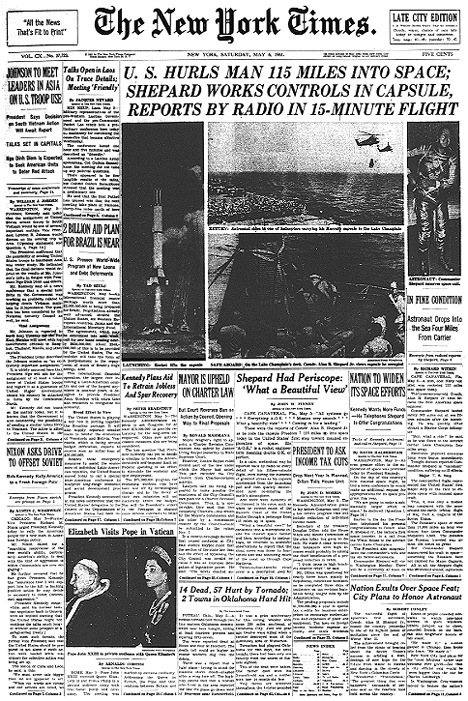
Shepard wasn’t the first man in space, but Americans yet had reason to be proud of his accomplishment.
On 5.5.1862, Wisconsin soldiers fought in Virginia:
1862 – (Civil War) Battle of Williamsburg, Virginia
The Battle of Williamsburg was a key engagement in the Peninsular Campaign that began on March 17, 1862. The 5th Wisconsin Infantry and Company G of the 1st U.S. Sharpshooters participated in this battle. Outnumbered Confederate forces held off the Union advance long enough for the bulk of the Confederate army to continue its withdrawal toward the capital at Richmond.
Google’s daily question isn’t just about art, but an art collector: “In 1861, Louis-Napoléon Bonaparte bought 11,835 artworks for the Louvre, including 641 paintings from what Italian art collector?”
Daily Bread
Daily Bread for 5.4.13
by JOHN ADAMS •
Good morning.
A Saturday of isolated, afternoon thunderstorms and a high of sixty-nine awaits. Whitewater will enjoy 14h 13m of sunlight, 15h 16m of daylight, with a waning crescent moon.
On this day in 1927, Academy of Motion Picture Arts and Sciences was founded. At the Academy’s website, among so many other offerings, there’s an interesting interview with special effects designer Douglas Trumball, on the Science of Movies. Trumbull talks about creating believable effects through the use of miniatures, his film “Silent Running,” and plans for future filmmaking.
On this day in 1864, Wisconsin soldiers take part in the Wilderness Campaign:
1864 – (Civil War) Wilderness Campaign opens in Virginia
Union forces crossed the Rapidan River in Virginia and prepared to fight at the Wilderness the next day. The resulting series of battles between May 5 and June 12, 1864, is called the Wilderness Campaign, or Grant’s Overland Campaign.The 2nd, 5th, 6th, 7th, 19th, 36th and 38th Wisconsin Infantry regiments and the 4th Wisconsin Light Artillery participated in this series of bloody battles. The initial Battle of the Wilderness on May 5-7, 1864, produced nearly 30,000 casualties without giving either side a clear victory.
Google poses a question about French design: “Of what type of architecture is the Paris Cathedral that in 1970 was the site of Charles de Gaulle’s funeral?”
Cats
Friday Catblogging: Cheetahs
by JOHN ADAMS •
How fast are cheetahs?
Really fast:
Poll
Friday Poll: Is Hockey Too Violent?
by JOHN ADAMS •
Yesterday, in the NHL playoffs, Eric Gryba hit Lars Eller, leaving him bleeding on the ice:
Montreal Canadiens center Lars Eller was taken off the ice on a stretcher after being leveled by a hit from Ottawa Senators defenceman Eric Gryba on Thursday night.
With 6:37 remaining in the second period of Game 1 of the first round Eastern Conference playoff series between the Canadiens and Senators, Eller was looking back to receive a pass from teammate Raphael Diaz when Gryba delivered a high, hard hit. Eller dropped to the ice near the Canadiens’ blue line and lay motionless as blood pooled beneath his face. According to NHL.com, Canadiens medical personnel prevented Eller from getting up. He was taken off the ice on a stretcher. Gryba was hit with a major penalty for interference and a game misconduct.
The story’s graphic, of couse, as is video of the incident:
So, is hockey too violent? I’ll say no – both fans and officials react against Gryba’s conduct – he’s both booed from the crowd and penalized for the hit. There’s a fan and official rejection of Eric Gryba that speaks well of the sport.
What do you think?
Daily Bread
Daily Bread for 5.3.13
by JOHN ADAMS •
Good morning.
It will be a rainy day with a high of fifty-one for Whitewater.
It’s Machiavelli’s birthday:
On this day in 1469, the Italian philosopher and writer Niccolo Machiavelli is born. A lifelong patriot and diehard proponent of a unified Italy, Machiavelli became one of the fathers of modern political theory….
Machiavelli’s political life took a downward turn after 1512, when he fell out of favor with the powerful Medici family. He was accused of conspiracy, imprisoned, tortured and temporarily exiled. It was an attempt to regain a political post and the Medici family’s good favor that Machiavelli penned The Prince, which was to become his most well-known work.
Though released in book form posthumously in 1532, The Prince was first published as a pamphlet in 1513. In it, Machiavelli outlined his vision of an ideal leader: an amoral, calculating tyrant for whom the end justifies the means. The Prince not only failed to win the Medici family’s favor, it also alienated him from the Florentine people. Machiavelli was never truly welcomed back into politics, and when the Florentine Republic was reestablished in 1527, Machiavelli was an object of great suspicion. He died later that year, embittered and shut out from the Florentine society to which he had devoted his life.
Though Machiavelli has long been associated with the practice of diabolical expediency in the realm of politics that was made famous in The Prince, his actual views were not so extreme. In fact, in such longer and more detailed writings asDiscourses on the First Ten Books of Livy (1517) and History of Florence (1525), he shows himself to be a more principled political moralist. Still, even today, the term “Machiavellian” is used to describe an action undertaken for gain without regard for right or wrong.
In Wisconsin history, Golda Meier is born on this date in 1898:
1898 – Golda Meir Born
On this date, Golda Meir (nee Mabovitch) was born in Kiev, Russia. Economic hardship forced her family to emigrate to the United States in 1906, where they settled in Milwaukee. She graduated from the Milwaukee Normal School (now University of Wisconsin-Milwaukee) and joined the Poalei Zion, the Milwaukee Labor Zionist Party, in 1915.In 1921, she emigrated to Palestine with her husband, Morris Myerson, where they worked for the establishment of the State of Israel. Meir served as Israel’s Minister of Labor and National Insurance from 1949 through 1956 and as the Foreign Minister until January of 1966. When Israeli Prime Minister Levi Eshkol died suddenly in 1969, Meir assumed the post, becoming the world’s third female Prime Minister. She died in Jerusalem on December 8, 1978. [Source: Picturing Golda Meier]
Google-a-Day asks about a treaty: “What treaty was responsible for the creation of the intergovernmental organization that would eventually be replaced by the UN?”
Public Meetings
Tech Park Board
by JOHN ADAMS •
Public Meetings
Common Council
by JOHN ADAMS •
Anderson, Cartoons & Comics
Kinds of Chocolates
by JOHN ADAMS •
Reader Karl Marx mentioned a liking for chocolate, and cartoonist Mark Anderson has a cartoon with the some of the many flavors of that treat. (He’s inexplicably omitted sweet and contented.)
