
CDA, City, Corporate Welfare, Government Spending, Innovation Center/Tech Park, Law, Official Misconduct, Open Government, State Government, Taxes/Taxation, Wisconsin
The Truth about the Wisconsin Economic Development Corporation
by JOHN ADAMS •
A person should be able to make simple distinctions, as between the sensible and foolish, or practical and impractical. Sometimes those distinctions should be clear, and as stark as the difference between the contents of a sample cup and a glass of Chardonnay.


You’ll hear a lot locally over the next few days about a ‘partnership’ between Whitewater and Gov. Walker’s Wisconsin Economic Development Corporation (WEDC), the public-private hybrid replacement for the Wisconsin Dept. of Commerce.
You’ve probably read in these last few days that there’s more to the WEDC than grant funding. This agency has been a train wreck since its formation. It’s an inefficient, mistake-prone exercise in crony capitalism on a grand scale.
Here’s what publicity-mad insiders don’t want you to recall about the Wisconsin Economic Development Corporation:
The WEDC wanted hundreds of millions in people’s pension funds. See, WEDC request rejected | $200 million was sought from state pension fund.
This supposedly private venture relies on public money, from ordinary taxpayers, to pick and choose businesses it prefers. Greedy for more, the current head of the WEDC
….Reed Hall asked the State of Wisconsin Investment Board in November for the venture capital seed money. The board rejected the request late last year, saying that the use of pension funds to pay for economic development initiatives “does not meet our fiduciary duty.”
These aren’t private men investing their own money – they’re public men avariciously looking for every last dollar of public money they can control, even from the pensions of ordinary workers.
That’s their vision, their proactive approach, their supposedly new idea: to take from weaker people while ignoring people’s basic needs.
The WEDC has neglected millions in taxpayer funded loans. See, Neglected WEDC taxpayer-financed loans grow to $12.2 million.
Borrowers have fallen behind in making payments on taxpayer-funded loans worth $12.2 million in total that were neglected by officials at the state’s top jobs agency – $3 million more than was previously believed to be at risk.
As of Nov. 2, borrowers were late in making payments totaling $2.5 million, but the state could easily end up losing more than that, records show. One late borrower, Flambeau River Biofuels, is unlikely to repay $2 million of its outstanding loans from the state, though the amount currently past due is only a fraction of that total, according to state figures and past interviews with its owner.
The Wisconsin Economic Development Corp. Friday afternoon turned over the information on the 67 past-due loans and a stack of other documents in response to an open records request by the Milwaukee Journal Sentinel.
There’s Whitewater’s new ‘partner’: a negligent organization that doesn’t properly account for the people’s money.
The WEDC has tried to conceal its problems. See, WEDC won’t say whether past-due loans top $9 million.
…the state’s top jobs agency isn’t saying whether the total amount owed to taxpayers by scores of unnamed businesses could go higher than the $9 million figure that officials first estimated.
A spokesman for the Wisconsin Economic Development Corp. told the Journal Sentinel that the agency wouldn’t provide information on the total owed until it finishes an internal review that will take an unspecified amount of time. “WEDC is developing a corrective action plan. It is reviewing each loan and the status of each loan. We will provide additional information when we have completed the review,” WEDC spokesman Tom Thieding said.
Last week, the newspaper [MJS] reported that the agency had discovered it had failed to systematically track nearly $9 million in loans that are not current. As a result, WEDC’s chief financial officer resigned and GOP Gov. Scott Walker, a champion of the quasi-public agency created last year, brought in a new interim leader.
If one had a drunk, coma victim, or skid-row bum for a partner, he’d still be more responsible than this agency.
The WEDC has been the subject of federal complaints. See, Walker aide apologizes over handling of WEDC federal complaints.
Most people shy away from misconduct in public affairs, and one good reason would be when a state agency is under federal investigation:
Gov. Scott Walker’s top cabinet secretary apologized to the state’s flagship jobs board Thursday for not telling them about sharp criticism from the federal government about legal violations by the state and promised to keep them better informed in the future.
The apology by Department of Administration secretary Mike Huebsch came after a member of the Wisconsin Economic Development Board told Walker that he is frustrated about the lack of communication and will resign if it doesn’t improve. Huebsch, a nonvoting member of the WEDC board, had said he had first wanted to resolve the outstanding issues with HUD – initially raised more than a year ago.
“I should have brought this to the board earlier and it was my mistake not to do that. . . . I thought it was premature but it clearly wasn’t,” Huebsch told the board in a telephone conference Thursday. “I will certainly err on the side of providing greater information in the future.”
The WEDC has a mediocre jobs record. See, Second review gives low marks to state jobs agency.
Even a second review’s not the charm:
Another independent report has found that the tracking of millions of dollars of taxpayer-funded loans at the state’s flagship jobs agency hasn’t measured up, and Gov. Scott Walker could soon be interviewing finalists to turn the agency around.
The latest report by a subsidiary of the state bankers group showed that the Wisconsin Economic Development Corp. didn’t have the right bookkeeping policies, computer systems and collection procedures to track the loans that the agency made to businesses. Walker, who also serves as the chairman of the WEDC board, last year signed legislation creating the organization as a replacement for the former Department of Commerce.
In a four-hour meeting of the WEDC board Tuesday at the Marshfield Clinic in Eau Claire, Walker acknowledged and pledged to correct the failures in basic accounting practices at the quasi-public agency that in recent months have drawn attention away from its mission of creating jobs.
There we are. Just a quick survey of the Wisconsin Economic Development Corporation shows it to be one of the worst-performing organizations in the state.
A sensible man or woman would do well to stay as far away from the WEDC as possible. It’s only the foolish or the gluttonous who’d hold out their hands, asking from this agency for as much public money as they could carry away.
In any event, it’s worth watching and tracking what happens to these grants, as it is for all the money the Wisconsin Economic Development Corporation has taken from the public.
Daily Bread
Daily Bread for 2.6.13
by JOHN ADAMS •
Good morning.
It’s a Wednesday of morning fog, increasing clouds, and a high of twenty-nine for Whitewater.
Whitewater’s Tourism Council meets at 9 AM this morning, and her Zoning Rewrite Steering Committee later today at 6 PM.
How did dogs become domesticated dogs? There’s a compelling theory that Learning to love grains, potatoes was key to the evolution of dogs:

You know that dog biscuit shaped like a bone but made mostly of wheat? Your dog’s willingness to eat that treat, instead of going for a bone in your thigh, helps explain how its ancestors evolved from wolves into house pets.
A team of Swedish researchers compared the genomes of wolves and dogs and found that a big difference is dogs’ ability to easily digest starch. On their way from pack-hunting carnivore to fireside companion, dogs learned to desire — or at least live on — wheat, rice, barley, corn and potatoes….
The theory’s new, and will need more evaluation, but it’s intriguing.
On this day in 1778, America and France sign a Treaty of Amity and Commerce and a Treaty of Alliance in Paris:
The Treaty of Amity and Commerce recognized the United States as an independent nation and encouraged trade between France and the America, while the Treaty of Alliance provided for a military alliance against Great Britain, stipulating that the absolute independence of the United States be recognized as a condition for peace and that France would be permitted to conquer the British West Indies.
With the treaties, the first entered into by the U.S. government, the Bourbon monarchy of France formalized its commitment to assist the American colonies in their struggle against France’s old rival, Great Britain. The eagerness of the French to help the United States was motivated both by an appreciation of the American revolutionaries’ democratic ideals and by bitterness at having lost most of their American empire to the British at the conclusion of the French and Indian Wars in 1763.
In 1776, the Continental Congress appointed Benjamin Franklin, Silas Deane, and Arthur Lee to a diplomatic commission to secure a formal alliance with France. Covert French aid began filtering into the colonies soon after the outbreak of hostilities in 1775, but it was not until the American victory at the Battle of Saratoga in October 1777 that the French became convinced that the Americans were worth backing in a formal treaty.
On February 6, 1778, the treaties of Amity and Commerce and Alliance were signed, and in May 1778 the Continental Congress ratified them. One month later, war between Britain and France formally began when a British squadron fired on two French ships. During the American Revolution, French naval fleets proved critical in the defeat of the British, which culminated in the Battle of Yorktown in October 1781.
Google-a-Day asks a question about art: “Many of the cave paintings at Lascaux show the animals with heads in profile, but with horns facing forward. This is an example of what convention of representation?”
Film
Stardust
by JOHN ADAMS •
City, History, Politics
Millard Fillmore
by JOHN ADAMS •
I’ve no idea if Pres. Fillmore ever visited Whitewater. That’s Millard Fillmore, the political disaster: supporter of the Compromise of 1850, the Fugitive Slave Act, the Know Nothing Movement, and a thorn in Lincoln’s side during the Civil War.
Simply put, Fillmore would be a hard sell to anyone looking at his record honestly. That’s why historians rank him as a failure.
How could one turn that perception around?
The right way would have been to persuade Fillmore, during his career, not to have made so many disastrous mistakes. That is, the best outcome would be for Fillmore not to have had a career as bad as Fillmore’s.
There’s another – decidedly worse way – to flack Fillmore to future generations: simple declare him a success, and publish a really big portrait of him.
Like this:
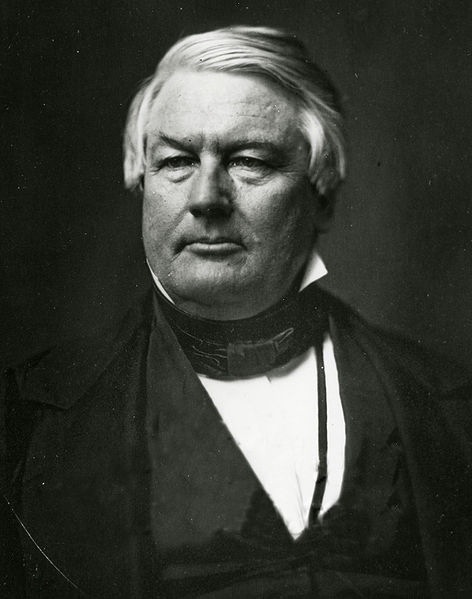
Are you now persuaded and over-awed?
Where once was a political wreck do you now see only COMPELLING AUTHORITY to which, by God, you must DEFER and YIELD?
Did Fillmore’s mediocre career and proposals become, upon your seeing his large portrait, now INFALLIABLE and BEYOND QUESTION?
No, of course not: that sort of groveling before authority is unsuited to a free people. Fillmore was just a man (and a middling one at that).
Just a person, as we all are: the same was true of Governor Doyle, is true of Governor Walker, and will be true of our next governor.
Just one more person, visiting the town.
CDA, City, Economy, Gov. Walker, Innovation Center/Tech Park, Local Government, Technology
The New Whitewater Start Up Grants (in Proper Perspective)
by JOHN ADAMS •
Whitewater’s Community Development Authority has been working on a seed capital fund (working on this fund for some time), and today the Wisconsin Economic Development Corporation has announced a $150,000 matching contribution to the CDA, and two grants – each in the amount of $10,000 – for entrepreneurs from that fund.
The matching grant from WEDC “is providing a $150,000 “Capital Catalyst” matching grant to the CDA which will be used for grants to new-start companies and to take a debt or equity position in the emerging businesses selected. The CDA is providing a dollar for dollar match of the award.”
Here’s more about the program:
WEDC’s Capital Catalyst program provides grants to regional organizations or communities to leverage matching funds to provide seed funding for start-up and emerging companies. This is the second investment made by WEDC in a regional fund. The first was made in October 2012 to the Innovation Fund of Western Wisconsin in Eau Claire.
The CDA will create an investment committee which will establish criteria for awarding grants and an application process, and oversee the administration of the seed funds. Funds are to be invested into Wisconsin innovation-based businesses. Some of the industry sectors of focus include advanced manufacturing, agriculture/food processing, information systems/software, medical device, renewable/green energy.
The award made by WEDC requires at least one-third of funds allocated by WEDC ($50,000) as direct grants not to exceed $10,000 per business. The CDA must award the remaining two-thirds of the funds awarded by WEDC and the match (total of at least $250,000) to Wisconsin start-up businesses.
The two start ups are Date Check Pro and Got Apps, Inc. There’s a relationship between the two: Date Check Pro is a customer of Got Apps, Inc. The City of Whitewater is now providing rent assistance to the companies, and the two share office space in the city.
A few remarks:
1. Best wishes. I hope the two start up businesses take off and do well.
2. Public funding. Better to have no public funding, but in the scheme of all possible projects, this is a fairly modest investment. Consider that the federal and city governments spent almost eleven-million on the Innovation Center, a quarter-of-a-million on a Janesville bus, and hundreds of thousands for the North Street Bridge in Whitewater.
This matching grant is far less than those efforts, each of which – by the way – brought almost no jobs to the city.
3. Jobs. Each of these two start up companies has a few employees, and success may bring more. One hopes so.
And yet, and yet, it’s worth noting again that the Tech Park’s Innovation Center alone was supposed to lead to a thousand jobs and sixty-million dollars in private investment. See, Whitewater’s Innovation Center: Grants and Bonds.
When Gov. Walker looks around today, he’ll see an ‘Innovation’ Center building that took millions in public money and millions more in public debt (bonds). He won’t see anything like the promised benefits of that vast expense – just the shuffling of some existing public workers from Milton to Whitewater.
4. The Press. If you’re writing this up as a regurgitated press release and gubernatorial campaign ad, why bother? The WEDC and Gov. Walker already have a release, ready to go as is.
No reason to manufacture a knock-off, when they’re offering the original, free to anyone.
5. Exaggeration. Whitewater’s leading officials have the bad habit of trumpeting sparrows as eagles, not to make others gain confidence, but to promote themselves and their supposed triumphs.
It’s a bad habit – a mental tic – of a few people in this town. Everything has to be monumental, amazing, unparalleled, or stupendous (often all of these, at the same time).
That kind of exaggeration is bad for our politics, distorting actual accomplishments for insiders’ supposed benefits, and makes the town look small, not big.
Whitewater’s a good and beautiful place, but genuine, enduring prosperity calls for a more level-headed perspective on the town’s economy and accomplishments.
This city should be more than a stage prop for an incumbent governor’s public spending and political messaging.
In time, it will be.
Daily Bread
Daily Bread for 2.5.13
by JOHN ADAMS •
Good morning.
Tuesday brings a high of twenty-nine, and light show (with limited accumulation) to Whitewater.
It also brings Gov. Walker to town, at 10:15 AM, for a Wisconsin Economic Development Corporation Announcement:
TO WHOM IT MAY CONCERN:
The Whitewater University Technology Park Board members have been invited to attend an announcement ceremony on Tuesday, February 5, 2013, beginning at 10:15 a.m. at the Whitewater Innovation Center, 1221 Innovation Drive, Whitewater, Wisconsin. Wisconsin Governor Scott Walker will be in attendance. It is highly likely that a quorum of Technology Park Board members will be in attendance at this presentation. Notice is being provided to inform the public of this gathering, and to confirm that there is no plan to conduct any Whitewater University Technology Park Board business during this meeting.Richard J. Telfer, WUTP President
“To whom it may concern’ – that’s too funny, really, but I’d guess the humor’s wholly lost on Chancellor Telfer. There just aren’t a lot of people who publish a public notice about a possible quorum, required to be announced under law for all one’s fellow residents, addressed as ‘to whom it may concern.’
But there’s an advantage in that notice, too: this endless of grabbing of public money, and the Potemkin Village that is the Tech Park and Innovation Center, would not have been possible without Telfer. The city would have made far fewer mistakes, wasted far less grant money, taken on far less public debt, and inspired far fewer ridiculously exaggerated press stories, had Telfer not pushed crony capitalist ‘partnerships,’ ‘innovations,’ etc.
There’s much more to write about the Wisconsin Economic Development Corporation, yet to come.
Later today, at 6:30 PM, Common Council meets.
On this day in 1937, Pres. Roosevelt announced his (later failed) court-packing scheme:
The President suddenly, at noon today, cut through the tangle of proposals made by his Congressional leaders to “bring legislative and judicial action into closer harmony” with a broadaxe message to Congress recommending the passage of statutes to effect drastic Federal court reforms.
The message- prepared in a small group and with deepest secrecy — was accompanied by a letter from the Attorney General and by a bill drawn at the Department of Justice, which would permit an increase in the membership of the Supreme Court from nine to a maximum of fifteen if judges reaching the age of 70 declined to retire; add a total of not more than fifty judges to all classes of the Federal courts; send appeals from lower court decisions on constitutional questions, direct to the Supreme Court, and require that government attorneys be heard before any lower-court injunction issue against the enforcement of any act of Congress.
Avoiding both the devices of constitutional amendment and statutory limitation of Supreme Court powers, which were favored by his usual spokesmen in Congress, the President endorsed an ingenious plan which will on passage give him the power to name six new justices of the Supreme Court.
On February 5, 1849, the University of Wisconsin opens:
1849 – University of Wisconsin opens
On this day in 1849 the University of Wisconsin began with 20 students led by Professor John W. Sterling. The first class was organized as a preparatory school in the first department of the University: a department of science, literature, and the arts. The university was initially housed at the Madison Female Academy building, which had been provided free of charge by the city. The course of study was English grammar; arithmetic; ancient and modern geography; elements of history; algebra; Caesar’s Commentaries; the Aeneid of Virgil (six books); Sallust; select orations of Cicero; Greek; the Anabasis of Xenophon; antiquities of Greece and Rome; penmanship, reading, composition and declamation. Also offered were book-keeping, geometry, and surveying. Tuition was “twenty dollars per scholar, per annum.” For a detailed recollection of early UW-Madison life, see the memoirs of Mrs. W.F. Allen [Source: History of the University of Wisconsin, Reuben Gold Thwaites, 1900]
Google-a-Day offers a science question: “What element on the periodic table is named after the European capital where it was discovered in 1923?”
Sports, Television
Super Bowl Commercials
by JOHN ADAMS •
America saw an exciting Super Bowl last night, uncertain in outcome until the end. While the game wasn’t on, or the lights weren’t on at the Superdome, there were commercials to talk about.
The full list of ads is posted at Super Bowl Commercials, and my favorite was the one for Sketchers (they’re really not good running shoes, but at least they’ve a good ad agency):
Music
Monday Music: Star Spangled Banner
by JOHN ADAMS •
Alicia Keys offered a slower, and I think elegant, rendition of the Star Spangled Banner last night.
Enjoy.
Daily Bread
Daily Bread for 2.4.13
by JOHN ADAMS •
Good morning.
We’ve had a few inches of snow overnight, and we’ll have about one more before the show ends in the early afternoon. It’s a MOnday high of twenty, with 10h 5m of sunlight and 11h 5m of daylight.
Whitewater’s Parks & Rec Board will meet later today at 5 PM.
On this day in 1938, a now-famous animated film meets its public:
“See for yourself what the genius of Walt Disney has created in his first full length feature production,” proclaimed the original trailer for Snow White and the Seven Dwarfs, released on this day in 1938.
Based on the famous fairy tale by the Brothers Grimm, Snow White opened with the Wicked Queen asking her magic mirror the question “Who is the fairest one of all?” The mirror gives its fateful answer: Snow White, the queen’s young stepdaughter. Ordered by the queen to kill the young princess, a sympathetic woodsman instead urges Snow White to hide in the forest; there she encounters a host of friendly animals, who lead her to a cottage inhabited by the Seven Dwarfs: Sleepy, Dopey, Doc, Sneezy, Grumpy, Bashful and Happy. Eventually, in the classic happy ending viewers would come to expect as a Disney trademark, love conquers all as the dwarfs defeat the villainous queen and Snow White finds love with a handsome prince.
Walt Disney’s decision to make Snow White, which was the first animated feature to be produced in English and in Technicolor, flew in the face of the popular wisdom at the time. Naysayers, including his wife Lillian, warned him that audiences, especially adults, wouldn’t sit through a feature-length cartoon fantasy about dwarfs. But Disney put his future on the line, borrowing most of the $1.5 million that he used to make the film. Snow White premiered in Hollywood on December 21, 1937, earning a standing ovation from the star-studded crowd. When it was released to the public the following February, the film quickly grossed $8 million, a staggering sum during the Great Depression and the most made by any film up to that time.
Critics were virtually unanimous in their admiration for Snow White. Charlie Chaplin, who attended the Hollywood premiere, told the Los Angeles Times that the film “even surpassed our high expectations. In Dwarf Dopey, Disney has created one of the greatest comedians of all time.” The movie’s innovative use of story, color, animation, sound, direction and background, among other elements, later inspired directors like Federico Fellini and Orson Welles. In fact, Welles’Citizen Kane features an opening shot of a castle at night with one lighted window that is strikingly similar to the first shot of the Wicked Queen’s castle in Snow White.
Disney won an honorary Academy Award for his pioneering achievement, while the music for the film, featuring Snow White’s famous ballad, “Some Day My Prince Will Come” and other songs by Frank Churchill, Larry Morey, Paul J. Smith and Leigh Harline, was also nominated for an Oscar. The studio re-released Snow White for the first time in 1944, during World War II; thereafter, it was released repeatedly every decade or so, a pattern that became a tradition for Disney’s animated films. For its 50th anniversary in 1987, Snow White was restored, but cropped into a wide-screen format, a choice that irked some critics. Disney released a more complete digital restoration of the film in 1993. Its power continues to endure: In June 2008, more than 60 years after its U.S. release, the American Film Institute chose Snow White and the Seven Dwarfs as the No. 1 animated film of all time in its listing of “America’s 10 Greatest Films in 10 Classic Genres.”
Google-a-Day has a basketball question for this morning: “The youngest recipient of the NBA MVP award joined which one of his “Bulls” teammates in receiving this honor?”