FREE WHITEWATER

Monthly Archives: February 2009

Nosek vs. Kienbaum, Part 1

Dr. Roy Nosek, dentist-politician, is challenging incumbent Marilyn Kienbaum for her at-large seat on our Common Council. It’s not Ali-Fraser, but more Iran-Iraq, in my estimation, and an interesting contest. I’ve remarked before that “Whitewater just wouldn’t have its own unique students-within-a-tiny-cramped-corridor line and my-nostalgic-salt-of-the-earth-any-other-ideas-be-damned feel without such community treasures. ”  
 
Over the last two years, since he took office in April, Dr. Nosek has played a more notable – indeed, notorious – role than any politician in the city.  No one else is as well-known for a clear set of issues.  I disagree with Nosek on every one of main concerns (student housing, dumpsters, signs, ordinance enforcement), but I admire his ability to make his issues known.  Even causal followers of local politics know of Nosek, and are familiar with where he stands. 
 
The same cannot be said for others on our Common Council, however more reasonable or temperate their views.  Jim Stewart, Patrick Singer, Lynn Binnie, Max Taylor – no one who serves is as easily identified.  Many of these other incumbents could not be readily connected to a single substantive program in the city.  (I see that one need not be so identified to be successful; it’s merely true that Nosek is far better known for a set of positions.) 
 
He’s hardly gentle, but then, I am not particularly shocked – as you can guess – by an assertive public stand.  There is, despite all my dislike for his views, something refreshing about a man who really doesn’t seem to give a damn what people think.  In a world of lemmings, or ostriches, Nosek is, well, not a lemming or an ostrich.  I have satirized Nosek variously, but he’s surely no wallflower.   
 
Nosek inclines to a community ordered through ordinances and regulations, and often likens infractions – even minor ones – to law-breaking.  There’s not a lot of subtlety in Roy Nosek, and if there were, one would not see it for all his bluster, anyway.      
 
Only Marilyn Kienbaum is as well-known as Nosek, for her manner, for her work on the food pantry, and as a contributor to the Whitewater Register.  She benefits from a particularly effective public persona as a grandmotherly guardian of Ol’ Fashioned Common Sense and Wholesome, Home-Grown Whitewater values (such as they are).  She’s an advocate of a certain, seemingly business-friendly approach, without an apparent understanding of markets, or free, voluntary exchange and association.   (I would not – ever – consider her a libertarian.  Quite the contrary, in fact.)
 
Kienbaum speaks, frequently, through metaphor and nostalgic reference.  Nosek, by contrast, displays far more grasp of issues, whenever his unfortunate tendency to cause people to wince as he talks is not so distracting.  For it all, despite her less-sure grasp, Kienbaum remains the favorite in this race. 

Why?

  • Kienbaum’s grandmotherly persona is all most people know of her. She seems so sweet and caring, so warm and friendly.  She’s as local as local will ever be, and that helps her enormously, too.  What she actually thinks about any number of things really doesn’t matter politically.  She’s hardly Mother Angelica (with or without the eye patch Sister sometimes wears).  That’s not all there  sometimes is to a person.  That she might flimsily espouse on any number of subjects isn’t worth anything to me.  (It’s a shame that others, educated and mature, are so easily cowed, or duped.) 
  • Kienbaum’s also known for her food pantry work.  I have no certain idea how the food pantry’s actually run, or how well it serves our community, but years of association with it helps Kienbaum enormously.  That’s all many people know of her.
  • Nosek’s anti-student rhetoric makes him a protest, minority candidate.  Even many homeowners upset with housing issues, or supposed aesthetic concerns, likely find Nosek’s harsh statements (‘death’ of this or that) cringe-inducing.  He’d be a much better columnist (or blogger) than politician – print is a warmer medium than in-person or television debate, but Nosek shows no understanding of those differences. 
  • Students will walk over broken glass, from every corner of the city, to vote against Nosek.  Are there any students who support Nosek?  No more by percentage than cows who support Burger King. 

So, is Nosek, scourge of dumpsters, mourner of Tratt Street, doomed to lose to an incumbent who shows far less grasp, in my estimation, of political discourse?  He’s not my candidate (nor is she!), but there is a path – however rocky and narrow – to victory for Dr. Roy Nosek, DDS. 
 
Next: How Nosek can actually win against Kienbaum. 

Daily Bread: February 5, 2009

Good morning, Whitewater

There are no municipal public meetings today. The weekend comes early, Whitewater.

It’s a memorable date in Wisconsin history, today: On this date in 1849, the University of Wisconsin opened. The Wisconsin Historical Society tells of those early days —

On this day in 1849 the University of Wisconsin began with 20 students led by Professor John W. Sterling. The first class was organized as a preparatory school in the first department of the University: a department of science, literature, and the arts. The university was initially housed at the Madison Female Academy building, which had been provided free of charge by the city. The course of study was English grammar; arithmetic; ancient and modern geography; elements of history; algebra; Caesar’s Commentaries; the Aeneid of Virgil (six books); Sallust; select orations of Cicero; Greek; the Anabasis of Xenophon; antiquities of Greece and Rome; penmanship, reading, composition and declamation. Also offered were book-keeping, geometry, and surveying. Tuition was “twenty dollars per scholar, per annum.”

The Memoirs of Mrs. W.F. Allen, available online, recount the beginning of the university.

Register Watch™ for the January 29th Issue: School District on Target for Budget. 

Above the fold, far-right column, in the January 29th issue of the Register, one finds a blogger’s natural prey – an uncritical, one-sided view of a topic.  It’s a story about our public school district’s budget. I would prefer, as I have written before, a robust private school alternative in Whitewater, alongside our public schools.  We’re too small, it seems, for a private alternative.  I would be less inclined toward, but still supportive of, those parents who wish to home-school their children.  (It wouldn’t be my choice, but it should be theirs.) 
 
School District on Target with Budget.  We’ll, the headline’s the story – the school district budget is on target. 
 
One quick question, though: What’s the target?  The Whitewater Unified School District’s Business Manager, Jane Nikolai, reports that “All the percentages are real close to last year.”  Well done, surely.
 
By these percentages, she describes, of course, the supposed financial health of the district.  The budget, though, is not an end-in-itself, but a mere means to another, far greater end.  A quick example illustrates this point.
 
Suppose I told you that the federal government could produce a new and innovative public program, at a cost of $220 billion dollars.  The program would cost a bit less than initially estimated, down from an original figure of $245 billion. 
 
Would you support the program? 
 
Perhaps, but first you’d ask me: What’s the program? 
 
I might give you two possibilities.  Possibility One would be a program that, for $220 billion, would definitely produce an efficient, compact, reliable, fusion reactor design, easily constructed throughout cities in America.  I would prefer that the whole program be privately undertaken, over several years’ time, but I’d listen to the public works proposal for such an extraordinary achievement. 
 
Possibility Two, for the same $220 billion (remember, down from $245 billion!), would be a federally-controlled chain of Hardee’s style restaurants near bus terminals, train stations, vacant lots, and skid rows across America.  (Set aside, for the moment, that the private sector has already achieved as much.)     
 
Would you support, or oppose, these possibilities equally? Probably not.  The $220 billion seems more or less reasonable when considered as a substantive proposal, for definite ends and goals
 
A few quick questions, then, for district leaders – each sincere — some serious, some light.  The answers should be known to every leader in our district, as the metrics that matter more – far more — than the budget.   
 

  • How do Whitewater students perform on basic measures of academic performance, against other students in the state?  Is their performance better or worse relative to others now, as against five, or ten years’ time, ago?
  • How many students read at or above grade level in our elementary schools, compared to students from other districts (excluding ones with extreme poverty, like Milwaukee)?
  • How many students, each year, drop out of school in our district?
  • How many languages do we offer in our schools?  Spanish, French, yes, but what else? 
  •   How many canonical works of literature are taught – not just mentioned – in our schools?  How long do students spend on a given work?  Other than American and British literature, what else is taught to interested students?
  •   Do students readily know that they may take university courses if our district does not offer a course for them?  Are they encouraged to do so?
  • How many students will attend post-secondary education upon graduating this year?  Is that number more or less than five, ten years ago?
  • Where will they attend, if they attend post-secondary education?
  •   How many of these students, attending colleges outside the area, will return to live in Whitewater? 
  • Is there anything interesting about calculus?  Why study that subject?  Is it more, somehow, than notations on a page? 
  •   For the natural sciences that we teach, is there a history and sociology of them, too, that might add color and understanding to the problems we ask our students to  solve?
  • When is the last time our District Administrator walked into a classroom, and had a substantive discussion with students about history, philosophy, art history, trigonometry, biology, agricultural science, or music. A full discussion, animated and interesting, than neither students nor Administrator wanted to end? 

 
Now, I am not a teacher.  Sorry, professional educator, or doctor of whatever field.  Imagine a world – ours, sadly — where ‘teacher’ is role and title not enough.  There was a time when a great people, first in the wilderness, yet later setting the foundation for our way of life, saw the honor in calling someone ‘Rabbi.’  No longer – we must be titled more elaborately now.  Teacher was, and should be, enough. 
 
I have, at least occasionally, opened a book, and read it, and done so without feeling the need for anyone’s permission.  A free person needs no license to read, either from government, or any number of self-important town squires.  He does need, though, the desire to pick up a book, apart from any program or class, and enjoy it. 
 
School ends for all of us.  Yet we might do ourselves and our children the service of lifetime learning, far beyond cold metrics, if we would instill that desire forever.

Register Watch™ for the January 29th Issue: Winship as Write-in, Nosek on Lawn Signs

Below the fold, in the January 29th issue of the Register, there’s a story on Jim Winship’s write-in candidacy for the Third Aldermanic District, and Dr. Nosek’s call for a voluntary ban on political lawn signs.
 
Winship.  Winship has filed as a write-in candidate, as no one filed earlier to be on the ballot for the Third District seat.  (Nosek is running against Marilyn Kienbaum for the at-large seat on Council, rather than re-election in the Third District. I will post separately on the race between Nosek and Kienbaum.)      
 
Winship may not be alone as a write-in candidate; others may receive write in votes, too.  In the last race, two years’ time ago, Nosek defeated Winship by two votes, in a race in which the winner had less than 200 votes, I recall.  One can be sure that Winship, whatever agreement he may have with Nosek on some matters, will offer a marked difference should he be elected. 
 
Lawn Signs.  The Register recounts, but does not directly attribute to Nosek, his declaration that political lawn signs are ‘visual pollution’, ‘divisive in the community,’ and a ‘deterrent for possible candidates in municipal elections.’  The Register directly quotes Nosek as declaring that lawn signs are an “annoying promotional practice – like loud TV commercials (or) non-stop-Christmas music that starts Nov. 1.”     
 
He’s describing political lawn signs, presumably including the small cardboard signs that say “Obama: Yes We Can,” or “McCain: Country First,” or “Reagan-Bush” or “Carter-Mondale.” 
 
There’s no chance of banning these signs – Nosek surely knows they arer constitutionally-protected political speech – his call is for a voluntary moratorium.  Fair enough – if candidates will so limit themselves, that’s they’re choice. 
 
Someone might want to remind Dr. Nosek, though, that these signs have been part of American’s political tradition for decades, if not longer.  Consider the list of national political candidates – with thousands of volunteers, in campaigns separated across decades – who produced and used these signs.  Under Nosek’s view, they were all, counter-productively, polluting America.  They did so, apparently, in campaign after campaign, never learning their lesson.
 
That’s false, of course – the campaigns that paid for these signs did so because they know that they work – they persuade more than they irritate.  Frequent use over decades confirms their efficacy.  There’s no way around seeing this. 
 
Dr. Nosek may dislike these signs, but it’s an issue (however meaningful to him) that shows his limits as a politician.  By emphasizing how irritating these signs are, when so many others display them in campaign after campaign, year after year, Nosek only reminds voters of how idiosyncratic some of his issues are (e.g., dumpsters, lawn signs).  By the time voters learn about his signature issue – housing concerns – many have been alienated from his stridency on these – ultimately – trivial concerns. 
 
His approach may make for much commentary, but Nosek isn’t running as an op-ed pundit, blogger, or editorialist – he’s running for an at-large Common Council seat.   (I’ll post more on his race against Marilyn Kienbaum  later.)
 
The press angle, in all this, is checking how different Nosek’s views are from many other residents’ opinions, who display these signs for all types of candidates, election after election.  That’s easy to do – just ask why the signs keep popping up, if they’re so irritating.  They’re less irritating than persuasive, that’s why.   

Register Watch™ for the January 29th Issue: Alternative Energy

It’s been a while – too long, really – since I have posted Register Watch™, my coverage of Whitewater, Wisconsin’s local newspaper.  Here’s a return of that feature. 
 
First, though, a summary of what I believe about our small town:  we have a third-tier leadership, in significant measure, because we receive scant, or inadequate, press coverage.  No single development would make this town stronger than vigorous press coverage.  Most of what passes for political skill, or managerial competence, in Whitewater would not withstand that scrutiny, and over time we would have a far better leadership than our present administration and local politicians.     
 
The Register, having experienced significant circulation declines over the last two years, is part of our problem. Want a better town?  Ask harder, more serious questions.  Afterward, follow up with a few more.  That’s not how Whitewater works – otherwise clever but lazy politicians and career bureaucrats think that their lame justifications amount to clever and skillful public relations.  Hardly. 
 
In the January 29th issue of the Register, there are four main stories.  Above the fold, one finds a headline on the Lakeland Players’ production of Front Row Center,  a story about the school district’s budget, a story on Jim Winship’s write-in candidacy for the Third Aldermanic District, and a story on alternative energy ordinances in Walworth County.
 
Alternative energy?  The alternative energy story notes that the “Walworth County Land Use and Resource Management Department (LURM) has been working to develop ordinances designed to streamline processes for residents trying to make their lives more energy efficient.” 
 
This is a spoof, right?  Walworth County residents need ordinances to streamline processes to make their lives more energy efficient?  How about just installing those fluorescent bulbs that Wal-Mart sells to dupe reassure customers that it really cares about the environment?  You needed an ordinance for that?  If you need an ordinance to save energy, then you really need a guardian, while you’re at it.    
 
The article talks about wind and solar energy, specifically.  Fair enough – go build a windmill, or install solar panels.   It’s hard to install these systems now, and there’s a way around that – repeal ordinances that make installation hard, and discharge employees who enforce them, whenever possible.  Fewer burdensome laws, few people on the public payroll.   
 
The proposed ordinances still require, depending on the size of the alternative energy source, either a conditional use permit, or a zoning permit.  No permit requirement would be better.  ‘Conditional use approval’ simply wastes time – and thus energy (Adams — how’s that for obvious?) – while a public panel throws conditions (impediments, really) in the way of industrious citizens with good ideas for saving energy.    
 
A good first step would be repealing any county restrictions on use of alternative energy sources.  Afterward, I know a better, second step: abolishing the Walworth County Land Use and Resource Management Department as a move toward efficiencies of all sorts.   
 
Next: Winship’s Candidacy, and Nosek’s Request for a City without Lawn Signs

Daily Bread: February 4, 2009

Good morning, Whitewater

The Whitewater Landmarks Commission meets today at 5:00 p.m. The agenda for the meeting is available online.

There’s an executive session of the School Board tonight, and under our law, that type of meeting is closed to the public. Interestingly, in my most recent pop quiz poll of concerns facing Whitewater (admittedly a self-selecting pool), of all the people who wrote to me, not a single one mentioned any educational concerns. That’s not a good sign, actually.

One might wish to contend that it shows that there are no educational concerns facing Whitewater. On the contrary, I think it’s impossible not to have concerns about education, as a matter of course, in any successful school district. More than anything else, I would guess lack of response is a reflection of the power — however unfortunate — of a fly-under-the-radar, no-news-is-good-news, and what-little-news-there-is-is-good-news District Administrator’s approach.

I could be wrong, of course. Yet, ask yourself this question: Do you know where your District Administrator is today, what initiatives she has advanced, or might advance in the months ahead during which she is still employed, and responsible for public education in this community?

Well, there we are.

Daily Bread: February 3, 2009

Good morning, Whitewater

There are two municipal public meetings scheduled for today: A Whitewater-University Technology Park meeting at 12:30 p.m., and a Common Council meeting tonight at 6:30 p.m. (The agenda for the Common Council meeting, scanned as a pdf and readable as though an image file, is available online.)

In our schools today, a field trip from Washington School kindergarten and first grade to see Seussical, the Musical.


more >>

Alzheimer’s Association Annual Mardi Gras Benefit Dinner & Auction on “Fat Tuesday,” February 24, 2009, at Milwaukee County Zoo

The Alzheimer’s Association has issued the following media release:

Milwaukee, WI – January 27 2009 – The Alzheimer’s Association will hold its Annual Mardi Gras Benefit Dinner and Auction on “Fat Tuesday,” February 24, 2009, at the Milwaukee County Zoo, Peck Welcome Center. Proceeds from the dinner and auction will support the extensive programs and services provided to individuals who are affected by Alzheimer’s disease, their families and caregivers, and healthcare professionals throughout the 11-county region, as well as national research initiatives.

The Mardi Gras event begins at 5:00 p.m. with cocktails and hors d’oeuvres and a silent auction.  Guests will be treated to a variety of entertainment, including a stilt walker, a caricature artist, a handwriting analyst, and a palm reader, while listening to the Dixieland music of the “Mississippi Mudcats”. A formal Cajun-inspired dinner by Chef Jack Fischer will be served at 6:30 p.m.

The event will be emceed by Robb Edwards, Milwaukee Brewers Public Address Announcer. The evening will culminate with a voice auction conducted by guest auctioneer Jonathan Green, host of “The Green House” on Newsradio 620 WTMJ.

Dan and Linda Bader of the Bader Foundation, Inc. are chairpersons for the event. Individual tickets are $100, and table sponsorships are available. For sponsorship or event information, contact Pat Miller, Special Events Manager, Alzheimer’s Association at (414) 479-8800 or patricia.miller@alz.org.

The Alzheimer’s Association is a national non-profit organization dedicated to eliminating Alzheimer’s disease through the advancement of research and to enhance care and support for individuals, their families, and caregivers.

The Alzheimer’s Association provides information, education, and support to people with Alzheimer’s and related dementias, their families, and healthcare professionals throughout an 11-county region. For more information about Alzheimer’s disease and local chapter services, visit www.alz.org/sewi or call the 24-hour Helpline at 800-272-3900.
 

Groundhog Day Holiday Post

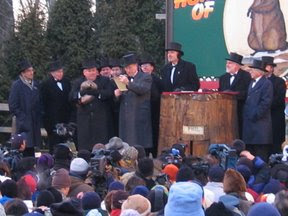
Six more weeks of winter, from Punxsutawney Phil and Jimmy the Groundhog.  Plenty of time, Whitewater, to analyze the mixture of sand and salt for our roads.  Afterward, yet before spring, time to spare for a comprehensive dumpster task force. (Video features Phil.)  Enjoy. 
 

Daily Bread: February 2, 2009 (Holiday Edition)

Good morning, Whitewater

There are no municipal public meetings scheduled for today. You’re on your own today, responsible for your own betterment.

It’s a holiday today, and in Wisconsin, Jimmy the Groundhog, with his own website, will offer his forecast shortly. (The more famous Punxsutawney Phil, of Punxsutawney, Pennsylvania and Groundhog Day move fame, has his own website, too.)

It’s Eagle and Spirit Day at Washington School, home of the Golden Eagles.

It’s a proud day in Wisconsin history, as in 1846 the Territorial Legislature chartered Beloit College, the oldest college in Wisconsin. The Wisconsin Historical Society describes the college succinctly:

“Chartered in 1846, Beloit College resulted from a series of conventions involving both clergy and laity from northern Illinois and southern Wisconsin. Known as the Friends of Education, they accepted an offer of materials and cash from the village of Beloit to build a frontier college.’) More on the history of Beloit College may be found on that school’s website and website archives.