FREE WHITEWATER

Monthly Archives: September 2009

Daily Bread: September 21, 2009

Good morning, Whitewater

Tonight, at 6 p.m., Whitewater’s Planning Commission meets. The agenda is available online.

The History Channel reports that on this date in 1780, Benedict Arnold committed treason:

On this day in 1780, during the American Revolution, American General Benedict Arnold meets with British Major John Andre to discuss handing over West Point to the British, in return for the promise of a large sum of money and a high position in the British army. The plot was foiled and Arnold, a former American hero, became synonymous with the word “traitor.”

Arnold was born into a well-respected family in Norwich, Connecticut, on January 14, 1741. He apprenticed with an apothecary and was a member of the militia during the French and Indian War (1754-1763). He later became a successful trader and joined the Continental Army when the Revolutionary War broke out between Great Britain and its 13 American colonies in 1775. When the war ended in 1883, the colonies had won their independence from Britain and formed a new nation, the United States.

During the war, Benedict Arnold proved himself a brave and skillful leader, helping Ethan Allen’s troops capture Fort Ticonderoga in 1775 and then participating in the unsuccessful attack on British Quebec later that year, which earned him a promotion to brigadier general. Arnold distinguished himself in campaigns at Lake Champlain, Ridgefield and Saratoga, and gained the support of George Washington. However, Arnold had enemies within the military and in 1777, five men of lesser rank were promoted over him. Over the course of the next few years, Arnold married for a second time and he and his new wife lived a lavish lifestyle in Philadelphia, accumulating substantial debt. The debt and the resentment Arnold felt over not being promoted faster were motivating factors in his choice to become a turncoat.

In 1780, Arnold was given command of West Point, an American fort on the Hudson River in New York (and future home of the U.S. military academy, established in 1802). Arnold contacted Sir Henry Clinton, head of the British forces, and proposed handing over West Point and his men. On September 21 of that year, Arnold met with Major John Andre and made his traitorous pact. However, the conspiracy was uncovered and Andre was captured and executed. Arnold, the former American patriot, fled to the enemy side and went on to lead British troops in Virginia and Connecticut. He later moved to England, though he never received all of what he’d been promised by the British. He died in London on June 14, 1801.
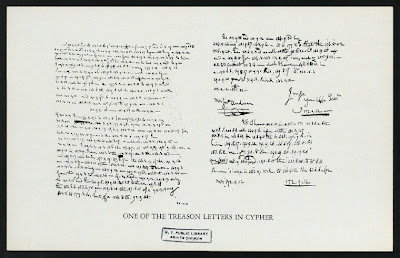
One of Arnold’s letters of treason, in cypher

Here’s today’s almanac:

Almanac
Monday, September 21, 2009 Sunrise Sunset
Official Time 06:40 AM 06:54 PM
Civil Twilight 06:12 AM 07:22 PM
Tomorrow 06:41 AM 06:52 PM
Tomorrow will be: 3 minutes shorter
Amount of sunlight: 12h 13 m
Amount of daylight: 13h 10 m
Moon phase: Waxing Crescent

Update: Rejecting the Referendum: No Increase in Jefferson County Tax Levy Limit

Last week, I posted on the rejection of a Jefferson County referendum to raise the tax levy limit for that county. See, Rejecting the Referendum: No Increase in Jefferson County Tax Levy Limit.

I was opposed to an increase in the tax levy limit. I was also critical of coverage that the Countryside Nursing Home in Jefferson County would be closed, as the referendum had failed. I should have made clear that this coverage was wrong twice over: it portrayed Jefferson County voters as cold-hearted, and it was inaccurate. Countryside was set for sale, in the event the referendum was rejected, not certain closure.

I should have made both points clear; I hit only the first.

I am indebted to a reader for his kind email, regarding my post, and pointing out that I had not clearly indicated sale, rather than closure, as the referendum’s immediate effect.

I found something interesting, but hardly scandalous, while reviewing my original post. The headline to which I linked underwent a title change. The original title, “Countryside Nursing Home will close after referendum fails” was changed to “Countryside Nursing Home will be sold after referendum fails.”

Here’s the original story to which I linked, available still (as of this post) at the LaCrosse Tribune:

Here’s the version at the State Journal, to which I linked, and now modified since I linked to it:

The State Journal indicates the change, in small type, at the bottom of the page, in red. One wouldn’t know, though, what the change represented.

It was a change to the headline and the subheading.

This is no great matter. It reminds me, though, that one can easily make changes on the web — for sound reasons — without readers always knowing what’s changed.

Alzheimer’s Memory Walk — Saturday, September 19th in Lake Geneva

Here’s information that I received in a press release about Saturday’s Alzheimer’s Association Memory Walk.

Alzheimer’s Association Memory Walk Event Fact Sheet

EVENT NAME: Alzheimer’s Association Memory Walk

EVENT DATE: Saturday, September 19, 2009

ADDRESS: Library Park, Lake Geneva. 1200 West Main Street, Lake Geneva

CONTACTS: Andy Kerwin, Co-Chair of Walk Geneva Crossing Retirement Community, 608-575-2075 (cell)

Wendy Betley, Co-Chair of Walworth Alzheimer’s Association 262-210-5288 (cell)

EVENT SCHEDULE:

Registration 9:30 a.m.
Aerobic Warm Up 10:30 a.m.
Opening Ceremonies 10:45 a.m.
Walk Begins 11:00 a.m.
Post Walk event 12:00 p.m. (Noon)

EVENT DESCRIPTION: The 3rd Annual Alzheimer’s Association Memory Walk in Walworth County is a community event to raise awareness and funds for the
5.3 million Americans with Alzheimer’s disease. Dollars raised by walk participants also go toward advancing research into better treatments and a possible cure. The event will host over 400 people and is set to raise more than $60,000.

HONORARY CHAIR: Dr. Britton Kolar, MD, Geriatrician (A family physician who specializes in treating the elderly.)

Feline Friday: Catblogging at FREE WHITEWATER

Here’s the eighth installment of cat blogging.

The Cat Fanciers’ Association of America recognizes about forty breeds of domestic cats, but all cats, single or mixed-breed, are admirable.

Cats have an independent spirit that’s a fine reminder of the individualism which Americans — at their best — so abundantly possess.

Today, I’ve posted a video about BALINESE cats, a recognized CFA breed.


more >>

Daily Bread: September 18, 2009

Good morning, Whitewater

For the third day, there are no scheduled municipal, public meetings for the City of Whitewater today. Less is more.

The History Channel reports that on this day in 1793, George Washington set the cornerstone to the United States Capitol building:

On this day in 1793, George Washington lays the cornerstone to the United States Capitol building, the home of the legislative branch of American government. The building would take nearly a century to complete, as architects came and went, the British set fire to it and it was called into use during the Civil War. Today, the Capitol building, with its famous cast-iron dome and important collection of American art, is part of the Capitol Complex, which includes six Congressional office buildings and three Library of Congress buildings, all developed in the 19th and 20th centuries.

As a young nation, the United States had no permanent capital, and Congress met in eight different cities, including Baltimore, New York and Philadelphia, before 1791. In 1790, Congress passed the Residence Act, which gave President Washington the power to select a permanent home for the federal government. The following year, he chose what would become the District of Columbia from land provided by Maryland. Washington picked three commissioners to oversee the capital city’s development and they in turn chose French engineer Pierre Charles L’Enfant to come up with the design.

However, L’Enfant clashed with the commissioners and was fired in 1792. A design competition was then held, with a Scotsman named William Thornton submitting the winning entry for the Capitol building. In September 1793, Washington laid the Capitol’s cornerstone and the lengthy construction process, which would involve a line of project managers and architects, got under way.

In 1800, Congress moved into the Capitol’s north wing. In 1807, the House of Representatives moved into the building’s south wing, which was finished in 1811. During the War of 1812, the British invaded Washington, D.C., and set fire to the Capitol on August 24, 1814. A rainstorm saved the building from total destruction. Congress met in nearby temporary quarters from 1815 to 1819. In the early 1850s, work began to expand the Capitol to accommodate the growing number of Congressmen. In 1861, construction was temporarily halted while the Capitol was used by Union troops as a hospital and barracks. Following the war, expansions and modern upgrades to the building continued into the next century.
Today, the Capitol, which is visited by 3 million to 5 million people each year, has 540 rooms and covers a ground area of about four acres.

It’s picture make up day at Whitewater Middle School.

Here’s today’s almanac:

Almanac
Friday, September 18, 2009 Sunrise Sunset
Official Time 06:37 AM 06:59 PM
Civil Twilight 06:09 AM 07:28 PM
Tomorrow 06:38 AM 06:58 PM
Tomorrow will be: 2 minutes shorter
Amount of sunlight: 12h 22 m
Amount of daylight: 13h 19 m
Moon phase: New Moon

Reason.tv: No American Should Have to Choose Between Health Insurance and Getting Drunk

Reason.tv observes the stark choice some Americans face, every day — health insurance or getting drunk? Following my earlier post, immediately below, with a video on the large number of uninsured who can afford insurance but choose other purchases instead, I’ve posted this brief video. The short video outlines the choices for some of those who can, in fact, afford insurance but just don’t make that purchase.

Here’s the description accompanying the video:

President Obama’s prime-time health insurance speech underscored an important point: No American should have to choose between health insurance and paying rent, between health insurance and getting groceries–or getting drunk, getting designer jeans, or protein powder.

We hear so much about hardworking Americans who need health insurance, but what about the rest of us? Millions of uninsured Americans could afford health insurance, but it would mean giving up some really cool stuff. Support President Obama’s plan to cover all Americans, because no American should have to choose between health insurance and protein powder.

Approximately 1.10 minutes. “Tough Choices” is written and produced by Ted Balaker. Director of Photography is Alex Manning.

No American Should have to Choose Between Health Insurance and Getting Drunk more >>

Reason.tv: Get Some! How to Fix America’s Health Insurance Crisis

It’s video Thursday at FREE WHITEWATER, and here’s a provocative video from Reason, explaining how the number of uninsured in America could be reduced by half, without a single government program. It’s provocative because the popular notion that all of the uninsured are in the same predicament — they can’t afford coverage.

That’s not true. About half can afford insurance, but choose other expenditures over coverage. I know very well that there are some who’ll bristle even at the suggestion. That’s not kept libertarians from offering a candid assessment before, and it won’t stop us now. To borrow a product slogan, we’d rather be right than switch…

Here’s a description accompanying the video:

Reason.tv’s Nick Gillespie isn’t making a run for the White House, but he knows how to get coverage to at least half of the 45 million Americans who need it.

And while Barack Obama and John McCain argue about who’s got the best health care plan, each ignores the simplest solution.

Call it the Gillespie Plan: If you want health insurance, get some. Of people currently classified as uninsured, a conservative estimate says about 45 percent of them would be able to get health insurance right now if they wanted it, says economist Glen Whitman. That estimate comes from a study headed by a Johns Hopkins University researcher, which separates those who could get insurance into one of two categories: Those who earn enough money to buy it, and those who qualify for existing government programs.

So how about some real straight talk for a change? If we separate those who can’t get coverage from those who can, we can focus more on helping the needy. So if you can get coverage, says Gillespie, don’t wait for Washington. Go on out and get some.

“Get Some” is written and produced by Ted Balaker. The director of photography is Alex Manning.

Get Some!

Reason.tv: Government Providing ‘Country Roads to Serfdom’

It’s video Thursday at FREE WHITEWATER, and here’s a video from Reason.tv’s Rough Cut blog, about the failure of government spending to improve conditions for West Virginia.

Here’s a description accompanying the video:

For decades, West Virginia has looked to the government to solve their economic problems, only to find themselves falling further behind. Today, West Virginia has the lowest economic freedom of any state in America. Regulations and expensive lawsuits have driven businesses out, leaving one last major industry: coal.

As WVU Professor of Economics Russ Sobel says in this video, coal is an industry that’s captive, it can’t “pick up and leave” the state.

What state bureaucrats haven’t done to force coal jobs out of the state, cap-and-trade will accomplish. As coal plants’ operating costs skyrocket, it will be more profitable to provide goods and services in another state or, more likely, overseas. When West Virginia’s last economic lifeline disappears, what will happen to the people who live there?

If cap-and-trade passes, it would be harmful for all of us, but it would be particularly devastating to West Virginia.

The Rough Cut link is available at http://www.reason.tv/roughcut/show/country-roads-to-serfdom more >>

Daily Bread: September 17, 2009

Good morning, Whitewater

As with yesterday, there are no scheduled municipal, public meetings for the City of Whitewater today.

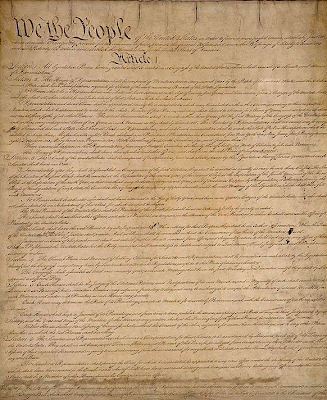
There’s something better, for all America — it’s Constitution Day, the anniversary of the signing of the United States Constitution on September 17, 1787.

The National Constitution Center, a non-profit, non-partisan organization, has a page dedicated to Constitution Day.

Here’s today’s almanac:

Almanac
Thursday, September 17, 2009 Sunrise Sunset
Official Time 06:36 AM 07:01 PM
Civil Twilight 06:08 AM 07:29 PM
Tomorrow 06:37 AM 06:59 PM
Tomorrow will be: 3 minutes shorter
Amount of sunlight: 12h 25 m
Amount of daylight: 13h 21 m
Moon phase: Waning crescent

AP – Dem. Senator: End ‘Bottomless Pit’ Stimulus Projects

Senator Byron Dorgan (D-N.D.) recently said what millions of others know, too: America is awash in wasted stimulus money. Dorgan rightly observes that his state of North Dakota does not need $128 million in stimulus funds for border checkpoints. Border security funds should be spent on areas with high border traffic.

Dorgan might have remained silent while his state received the money, but only at the price of condoning irresponsibility.

Many communities won’t be so principled; cities and states will grab whatever money they can get, even if they’re unprepared to use the money effectively.

See, Senator: End ‘Bottomless Pit’ Stimulus Projects

TV – Newsday – John Stossel from ABC’s 20/20 to Fox Business Channel

John Stossel, a well-known libertarian reporter at ABC’s 20/20, will leave for his own program, with additional airtime, at the Fox Business Channel. (Fox has more than one channel: the business channel is separate from the older news channel.)

Stossel’s a fine reporter; his new program will be well-worth watching.

See, John Stossel from ABC’s 20/20 to Fox Business Channel

Whitewater, Wisconsin: Televise!

We have a fine public access cable channel in Whitewater. That station provides the only full and unedited coverage of our common council, planning, and school board meetings.

Without that programming, we’d have no way to check against ambiguous meeting minutes and cheery spin.

Let’s televise other public meetings: Police & Fire Commission, Community Development, assorted task forces, etc.

That’s a big job: if there are not resources enough to record every meeting, let someone set up a video camera and record it.

If someone in Whitewater complains that this can’t be done, ask him or her to show you, under Wisconsin law, why it can’t be done. Ask for an opinion letter from our municipal administration’s city attorney.

Our city deserves more than some nervous incumbent’s vague pronouncement about possible risks; instead, deliver a clear statement of law.

As policy, public bodies should be proud to have their proceedings recorded, for their fellow residents to see.

Go ahead, Whitewater – embrace this opportunity for open and accountable government.