FREE WHITEWATER

Monthly Archives: November 2010

Institute for Justice: Why Can’t Chuck Get His Business Off the Ground?


The Institute for Justice asks:

How can Americans create private sector jobs?

The solution to America’s jobs problem lies not with budget-busting federally mandated “stimulus” programs.

Instead, what is needed are specific reforms that wouldn’t cost taxpayers, would create a broader tax base for cash-strapped cities and states, and would provide opportunity for millions of Americans who worry where their next paycheck is coming from.

As demonstrated by a series of eight new reports issued in October 2010 by the Virginia-based Institute for Justice, one of the principal obstacles to creating new jobs and entrepreneurial activity in cities across the country is the complex maze of regulations cities and states impose on small businesses. IJ’s “city study” reports are filled with real-world examples of specific restrictions that often make it impossible for entrepreneurs to create jobs for themselves, let alone for others.

Chip Mellor, the president and general counsel of the Institute for Justice, said, “If the nation is looking to the federal government to create jobs in America, it is looking in the wrong place. If we want to grow our economy, we must remove government-imposed barriers to honest enterprise at the city and state levels. Remove those barriers, and you will see a return to the optimism and opportunity that are hallmarks of the American Dream.”

IJ’s eight reports document how irrational and anti-competitive regulations block entrepreneurship. More often than not, these government-imposed restrictions on economic liberty are put in place at the behest of existing businesses that are not shy about using government force to keep out competition. The Institute for Justice’s city studies examine regulations imposed on a wide range of occupations in Chicago, Houston, Los Angeles, Miami, Milwaukee, Newark, Philadelphia and Washington, D.C.

more >>

Whitewater’s Innovation Center: Good for Producing Innovative, ‘International’ Fairy tales

A small town in middle America receives an award from a group, of whom no normal person has ever heard, declaring a town project internationally prestigious.

The project relies on millions in public grants, millions in subsidized public bonds, will use a third of its space for a publicly-funded tenant, has no clear private purpose, violated commonsense competitive principles in awarding contracts, was once shut down for federal violations of obvious competitive rules, takes place in a town that has high poverty that the project has no hope of alleviating, and that’s nearly certain to fail as other projects of its kind typically do.

The world has a population of over 6,876,501,214 people, and the town has a population of only 14,454.

Out of all those people on earth, considering the actual quality and background of the project, wouldn’t the award raise at least a few questions?

Of course it would — and anyone imagining otherwise is hoping – or daring — others to live life unthinkingly, to swallow any tall tale.

This is politics where bureaucrats treat adults as gullible children.

Any yet, for Whitewater, Wisconsin, it may be the future of reporting and public discourse — where officials will say anything and contend it’s all true.

The award story, entitled Tech Park project earns recognition, is available online. I’ve been a critic of the project, but for all that time, there’s never been a better example of what’s wrong with the project than the trumpeting of a so-called international award for it.

Consider these risible, utterly absurd claims:

IEDC’s awards recognize the world’s best economic development programs and partnerships, marketing materials, and the year’s most influential leaders….”

“There were only 28 worldwide, and having Whitewater selected because of the Innovation Center….it is amazing to see how it has come along.”

The world’s best…. Even middling high school debaters would laugh at a claim like this.

On this planet, one does finds genuine international organizations, like the UN or World Health Organization.


For it all, the closest the Innovation Center is likely to come to credible international recognition is a trip by the Tech Park Board to a local restaurant.


Whitewater-Area League of Women Voters November 2010 Newsletter

The Whitewater-Area League of Women Voters’ November 2010 Newsletter is now available, with articles and a calendar of upcoming LWV events. The latest copy of the LWV newsletter is available as a link on my blogroll, and is embedded below, with coding through Google.

Here’s a sampling of upcoming events for the Whitewater-Area League — the newsletter offers much more information —

Jim Stewart to be Honored at League Holiday Dinner – Sun. Dec. 12th

Everyone (League members and non-members) is welcome to join us at the Whitewater Country Club, Sunday, December 12th, for the 2010 League Holiday Dinner. Cocktails begin at 5:30PM. Dinner will be served at 6:00PM with a program to follow at 7PM. Please check your menu choice on the form on the last page of the newsletter and mail this form and your check, payable to Whitewater Country Club, to Julia Ross.

The deadline for reservations is Wednesday, December 1st. The cost is $22.00 per person.

Our guest for the evening will be Jim Stewart whom we will honor with the League’s “Making Democracy Work” award. This award is given to individuals who have contributed to our community in meaningful ways. Through the development of his website Whitewaterbanner.com, Jim envisioned and made real a means to improve how citizens of Whitewater communicate and stay informed, strengthening everyone’s sense of community. Please join us in celebrating Jim Stewart! You do not need to be a League member to attend. The awards program will be preceded by a short campaign stump speech by1860 Wisconsin gubernatorial candidate Harrison C. Hobart, performed by League member Ben Penwell, in honor of the 2010 gubernatorial election year.

Date: November 13 (Saturday)
Event: Whitewater-Area LWV Board Meeting
Where: Public Library, 9:30AM (White Memorial Room)

Date: November 18 (Thursday)
Event: LWV Public Program: “Understanding the Patient Protection and Affordable Care Act” by Jenny Boese, Vice-President of External Marketing and Member Advocacy, Wisconsin Hospital Association
Where: Municipal Building, Council Chambers, 7 PM

Date: December 12 (Sunday)
Event: Holiday Dinner
Where: Whitewater Country Club: 5:30PM Cocktails, 6PM Dinner, 7PM Program (Reservations Required)

Fairhaven Lecture Series

The Fall 2010 Fairhaven Lecture Series, sponsored by the UW-W Office of Continuing Education, will look at biography as a literary form, look at the life and times of some of history?s most famous, infamous, and barely famous figures, and even take a biographical look at the life a famous city. All lectures are open to the public at no charge and are held on Mondays at 3 p.m. in the Fellowship Hall of the Fairhaven Retirement Community, 435 West Starin Road. Guest / street parking is adjacent to the building.

November 15 The Least Dangerous Branch: Justices Who Have Gone Out on a Limb. Jolly Emery, Associate Professor, Political Science Department

November 22 Honest Politicians in Illinois: There Actually Are a Few. Susan Johnson, Associate Professor, Political Science Department

Police search for suspects in potential hate crime involving a UW-Whitewater student – WITI

Officials say on Sunday, November 7th around 6:45 p.m., a female student was approached by two males walking on the sidewalk near the cemetery on the north side of the UW-Whitewater campus. The taller of the two men pushed the victim into a fence and held her there. He made a derogatory statement about the victim’s perceived sexual orientation and let the victim go.

Via Hate crime: Police search for suspects in potential hate crime involving a UW-Whitewater student – WITI.

Daily Bread for Whitewater, Wisconsin: 11-10-10

Good morning,

Today’s forecast calls for a sunny day with a high temperature of sixty-seven degrees.

Book fairs continue at Lakeview School and the middle school.

There’s a tech park board meeting today, at 9 a.m. The agenda is available online. Everyone attending has something better he could be doing. The city’s real problems are elsewhere.

There’s an interesting, if unexpected, story on markets in the animal world posted at sciencenews.org: Will groom for snuggles: Market forces govern a baby’s value among vervet monkeys and sooty mangabeys.

“Do my hair before you touch my baby” is the rule among mother vervet monkeys and sooty mangabeys when it comes to sharing their infants with their neighbors.

Like some other primate infants, monkey babies attract crowds of females eager to touch, hold and make silly lip-smacking noises at the little ones, says primatologist Cécile Fruteau of Tilburg University in the Netherlands. Her novel study of infant-touching etiquette in the vervets and mangabeys adds them to the short list of animals known to have “markets” for baby fondling. The moms have to be groomed for a sufficient time before they let the groomer touch the baby.

What makes this exchange a market is the way sufficient grooming time changes with the baby supply, Fruteau and her colleagues explain in a paper now posted online in Animal Behaviour. The price for access to a group’s solitary infant, measured in grooming time for mom, fell when other females gave birth and increased the number of little cuties available for cuddling.

C. Fruteau et al. Infant access and handling in sooty mangabeys and vervet monkeys. Animal Behaviour. doi: 10.1016/j.anbehav.2010.09.028.

The Not-a-Missile Off the California Coast

There’s some talk that perhaps, just perhaps, a unidentified missile was launched off the California coast on November 8th.

It wasn’t a missile. It was a jet contrail, viewed from an angle. There’s a fine website about contrails, contrailcience.com, with an overflow site that establishes — conclusively — that the supposed missile was a contrail viewed from an angle. See, “Jet contrails from some angles look like missile trails.”

CBS News even ran a story about the supposed missile, with lots of speculation. Lots and lots.

Here’s the local CBS story:


Link:
http://www.cbsnews.com/stories/2010/11/09/national/main7036716.shtml

It’s not a missile, and not a “possible show of U.S. military might.” We’re a powerful nation, but there’s no national display at work here. It’s a natural atmospheric display, of the traces of an impressive, but conventional, jet airliner. Commercial jets are considerable accomplishments in their own right, but they’re commonplace, too.

We’re foolish to jump to wild conclusions when a reasonable — and in this case, definitive (but mundane) — explanation is available.

Libertarian Chair: Time to Re-Legalize Immigration

Indeed. Here’s a press release from the Libertarian Party:


Libertarian Chair: Time to Re-Legalize Immigration

WASHINGTON – Amid controversy over U.S. immigration policy, Libertarian Party Chair Mark Hinkle says the proper way to end illegal immigration is to re-legalize immigration. Hinkle released the following statement today:

“In debate after debate, Democratic and Republican politicians have decried the problem of illegal immigration, called for more border security and employer sanctions, and eagerly searched for evidence that their rivals employed undocumented help. The Obama administration proudly touts the fact that it is deporting more undocumented aliens than George W. Bush, while many of the families they support remain stranded in the United States, and most of whom were guilty of nothing more than the inability to satisfy a nightmarish bureaucracy.

“Our government has made it practically impossible for most would-be immigrants to work legally in America, a fact illustrated by this flowchart from Reason Magazine.

“For most of American history, immigrants streamed into this country, found jobs, and either stayed to build a life or returned to their native country if they couldn’t. America was admired by the world and proudly displayed an ode to immigration on the Statue of Liberty, within sight of the major processing center at Ellis Island. We can and should return to that tradition.

“Every significant problem blamed on immigration in this country is either imaginary or caused by government. In Arizona, where illegal immigrants are being blamed for an increase in violent crime, violent crime has actually been declining for a decade, and declining much faster than the national average. Immigrants (both legal and illegal) commit crimes at lower rates than natives. If you’re worried about gangs, then end the War on Drugs which funds them, just as it did the gangsters under alcohol prohibition.

“Immigrants are often accused of overloading the welfare system. This is again the fault of a government program. But the idea that welfare is a magnet for immigrants is a myth. In an ingeniously designed study by University of Hawaii Professor Ken Schoolland, patterns of migration within the 50 states, which have no travel restrictions between them, were studied. Schoolland found that were was, in fact, a very strong correlation between welfare and immigration: it was strongly negative. All of the states with the highest levels of government welfare benefits experienced net emigration to other states, and all of the states with the lowest levels of welfare experienced net immigration. Arizona, the current focus of anti-immigrant fears, ranks 46th in welfare benefits.

“Immigrants come here to work. Anyone who works and produces makes others better off. And unemployment and immigration actually are another two factors with a negative correlation. There has only been one decade in American history in which we did not have net immigration: the 1930s. If that is your idea of a great decade, you can have it.

“One unintended side effect of border crackdowns is to increase the number of undocumented aliens who remain because of the difficulty and cost of leaving and returning. Another is to create an ‘underground railroad’ that makes it easier for terrorists to enter without detection. The overwhelming majority of immigrants would love to come in through the front door. It is our bad immigration policy that has constructed the back door.

“It is time we stopped scapegoating the people who represent what is most admired about America. When the Libertarian Party was formed in 1971, we selected the Statue of Liberty as our symbol. We’re the only political party that deserves it.”

The Libertarian Party platform includes the following:

“3.4 Free Trade and Migration
“We support the removal of governmental impediments to free trade. Political freedom and escape from tyranny demand that individuals not be unreasonably constrained by government in the crossing of political boundaries. Economic freedom demands the unrestricted movement of human as well as financial capital across national borders. However, we support control over the entry into our country of foreign nationals who pose a credible threat to security, health or property.”

The Libertarian Party platform is available in Spanish.

The Libertarian Party has 21 candidates for U.S. Senate and 169 candidates for U.S. House in the upcoming November 2010 elections.

For more information, or to arrange an interview, call LP Executive Director Wes Benedict at 202-333-0008 ext. 222.

The LP is America’s third-largest political party, founded in 1971. The Libertarian Party stands for free markets, civil liberties, and peace. You can find more information on the Libertarian Party at our website.

What, then?

I’m an optimist about my small town. I have concerns, of course, two of which I mentioned in a post from earlier today:

There are two trends I think well possible for my part of the world, one of which matters, the other not at all. The first, the one that matters, is that Whitewater, Wisconsin is heading toward conditions in which she has a permanent underclass. That’s tragic, for everyone in the city, and a large topic for other days.

The second, the one that doesn’t matter, is that one can expect a lurch in local politics toward an even louder defense of all things status quo, of all things institutional.

I believe that we may yet avert a permanent underclass in Whitewater. That’s what matters most, and I am still hopeful we may succeed.

As for the second trend, well, it’s farther along than the more serious one. Yet, it won’t matter, as the multiplication of error is still error, and one or a hundred Babbitts are still only….on or a hundred Babbitts. One serious man or woman is worth far more than one hundred cheerleaders. We deserve better, but we can manage a pack of Panglosses.

And so, for it all, I’m an optimist.

Whitewater-Area Newspapers, Fall 2010

I follow the several newspapers of our immediate area, and every so often I write a post with thoughts on the lot of them. Many people are interested in newspapers, and I’m no exception.

On the left sidebar of this website, I have a link to the AP Managing Editors’ Statement of Ethical Principles. It’s not there because I’m a reporter — I’m not, and don’t wish to be. It’s because some of what passes as press coverage of our area just isn’t very independent — it’s all too cozy.

There are good newspapers in this state, but not as many as we could use.

Here are a few trends to consider.

Newspapers have been having a hard time for a long time.
Recent years may have been hard on the print press, but challenges are longstanding. See, for a quick overview, Jack Shafer’s The Beginning of the End for Newspapers: It was game over for metro dailies by 1965.

(1. Shafer’s writing about metropolitan papers. 2. He doesn’t mean over-and-out, but merely a decline. 3. I don’t wish for the end of newspapers, but for a resurgence of plucky papers.)

My theory: Most local newspapers gave up on being plucky – if they ever were — long ago.
They’ve made a bad and false bargain with readers: We’ll be boosters, if you’ll keep reading. The newspapers have upheld, for the most part, their end of the bargain. Yet, many readers didn’t know they were part of a bargain, and have walked away.

Online classifieds may have hurt the print business, but that’s nothing compared to All-the News-That’s-Fit-to-Bolster-and-Reelect.

As I’ll show tomorrow about a local story, some reporting’s so odd it seems like science fiction.

Smaller print editions.
Newspapers will be physically smaller. One example is the Whitewater Register. It’s owned by an out-of-town chain, and has less circulation than even a few years ago. Other papers will likely follow the Register‘s lead on print size — newspapers aren’t done shrinking. Expect to see smaller papers.

Reporters.
I’d guess that there will be fewer reporters, and more freelancers. That’s a bad sign, as no freelancer will rock the boat, or report a story that displeases local officials.

Coverage.
There will be no effort to challenge any statistics or contentions that officials make. Expect lots of stories where officials’ remarks are unchallenged, or where the only printed questions officials have to answer are easy ones — “To what do you attribute your remarkable vision, insight, and good looks while in office?” If there’s any follow up, it will be a second, allied official declaring that the first bureaucrat was absolutely, positively right. This will be made plain for readers who might misunderstand: “Yes, that first official was absolutely, positively right about everything he said, and might ever say, for that matter.”

What will coverage look like? These papers will approach issues about the same way that a local politician’s ersatz news site, the Whitewater Banner does; the major differences will be the range of stories and design of the newspaper’s online websites. Professional papers will have a sharper online design, and superior composition, but their perspectives won’t be that much different.

It’s not that the Banner will come closer to journalistic independence (of which it has none, as it’s not journalism); it’s that actual papers in our area will decline.

Circulation.
The future of nearby papers will be ones with less circulation (some of whom will issue dodgy circulation figures), but readers more satisfied with that coverage. That’s where the false bargain with readers leads — continued decline in readership, but a remnant that’s contented. Whether that’s enough to sustain all of the print papers is hard to say.

Already, the online editions of some nearby papers have fewer readers than this website. Over three years ago, when I started out, I would never have thought that possible. I would have expected that this blog would always be smaller than all of them, and smaller than the Banner, too. That’s not true anymore, and hasn’t been for over a year. (The Gazette, though, is larger — by a huge amount — than everyone else.)

A strategy of fawning or narrow reporting will erode, and then permanently limit, readership; that’s a decision these publishers are free to make for themselves. They may conclude that less is more, that a contented remnant is enough. A newspaper from Pleasantville will be interesting only to some from Pleasantville, and then not even most living there. It’s all preaching to the same choir. The financial impact is one that papers can assess for themselves. (As I have no advertisers, and wouldn’t look for them any more than they’d want a controversial site, it’s not a constraint that I have.)

Better results would come through a simpler approach, which some still take, but others have abandoned.

There’s the day-to-day of books, pen, paper, keyboard, time having lived in the world, and principles learned from so living. That’s all anyone and everyone should rely upon — of no single day or season, just a continuing endeavor.


The Return of the Status Quo, Twice as Loud as Last Time

There are two trends I think well possible for my part of the world, one of which matters, the other not at all. The first, the one that matters, is that Whitewater, Wisconsin is heading toward conditions in which she has a permanent underclass. That’s tragic, for everyone in the city, and a large topic for other days.

The second, the one that doesn’t matter, is that one can expect a lurch in local politics toward an even louder defense of all things status quo, of all things institutional. The skepticism that some felt toward government was a temporary one, less a principle, and more a partisan position against incumbents of an opposing party or faction. Expect many who voiced doubts to become, now, defenders of things institutional.

For some others, who always took a fawning posture, there’s nothing left except to repeat the same devotions to the status quo in a louder voice. They’ll falsely insist that they were right all along, and that recent events have vindicated every last thing they ever believed. Criticism will become harder, and less acceptable, than ever before.

For libertarians, there’s always this question: Go it alone, or form alliances with other groups? See, for example, The Case for Libertarian Independence.

In the end, I believe that we should go it alone, welcoming new friends, but not expecting allies, along the way. Books, pen, paper, keyboard, time having lived in the world, and principles learned from so living — that’s what we have, and all we need.

Let others seek partisan gain here or there, we’re better off going it alone, on relying on conscience and principle.

Daily Bread for Whitewater, Wisconsin: 11-9-10

Good morning,

Whitewater’s forecast calls for a sunny day with a high temperature of sixty-seven degrees.

Whitewater’s Urban Forestry Commission meets today, from 4:15 to 6:00 p.m. The agenda is available online.

Book fairs continue at Lakeview School and the middle school today, and there’s a PATT meeting at Washington School tonight at 6:30 p.m.

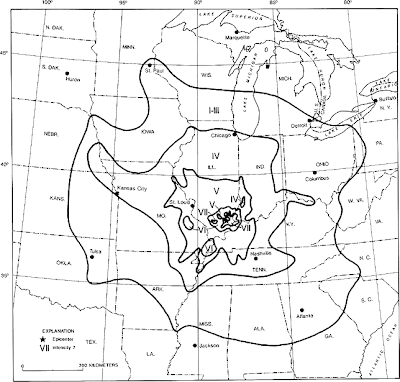
The Wisconsin Historical Society recalls an earthquake from 1968, having taken place on this day —

1968 – Earthquake Shakes Wisconsin

On this date one of the strongest earthquakes in the central United States occurred in south-central Illinois. Measured at a magnitude of 5.3 [5.4 per USGS], press reports from LaCrosse, Milwaukee, Port Washington, Portage, Prairie Du Chien, and Sheboygan indicated that the shock was felt in these cities. [Source: United States Geological Survey]

Here’s a map with lines indicating equal intensity from the earthquake, equivalent to a topographical map showing lines of equal elevation —


1968 Earthquake Abridged from Seismicity of the United States, 1568-1989 (Revised), by Carl W. Stover and Jerry L. Coffman, U.S. Geological Survey Professional Paper 1527, United States Government Printing Office, Washington: 1993