FREE WHITEWATER

Monthly Archives: October 2012

Simple Standards of Political Discourse

One may express a few principles of political discourse succinctly:

1. Don’t destroy property.
2. Don’t use force against political opponents, either immediately or while destroying property.

Over the last two years, countless Wisconsinites have voted, assembled, and protested with scarcely any property damage or violence. In this way, we have been a good example for people across America and abroad. See, along these lines, The Place of Peace and Honesty.

Wisconsin’s peaceful protests these recent years only illuminate by contrast the few, criminal acts that wrongly deviate from the majority’s responsible conduct.

A Libertarian’s View of the WI 43rd Assembly Race

Beginning tomorrow, and continuing (at least) through an October 30th debate between the candidates, I’ll post daily about the 43rd Assembly race between Evan Wynn and Andy Jorgensen. It’s likely to be a close race, between candidates of different views, and for that reason alone it’s worth considering.

Some of those posts will outline the positions of the candidates; others will offer a libertarian perspective on their positions. Thinking about the differences in their views, it’s hard for me to imagine anyone interested in politics being ambivalent of the outcome.

One quick note, about something that I’ve mentioned before: I don’t believe in opinion-making. (See, along these very lines, The Impossibility of Opinion-Making.) People are sharp, informed, and well-able to form their opinions from their own observations, reading, and discussions. One writes from conviction, but as part of a larger – wholly welcome – discussion.

In fact, I’m convinced the only sound arguments come from this idea: that one writes so well as one can on the basis of what one truly believes, tenaciously and diligently argued. Worthiness lies is a committed, sincere effort.

As this series goes on, there’ll be other posts, of course, just as before.

Sign of the (New Media) Times: From the Daily Planet to Blogging

Looks like Clark Kent’s had enough of working at the dead-tree Daily Planet. Metropolis is about to get a new blogger:

In the new issue of DC Comics’ Superman series, out tomorrow [that is, 10.23.12], Clark will stand up in front of staff in a “Jerry Maguire-type moment” which will see him resign from the Daily Planet and mourn “how journalism has given way to entertainment”, writer Scott Lobdell told USA Today.

Clark will also call on his fellow reporters to stand up for truth, justice, “and yeah — I’m not ashamed to say it — the American way,” said Lobdell.

No one should be surprised by this – America had in her earliest days a tradition of vigorous pamphleteering, and it’s toward an electronic version of that tradition to which the comic would be turning.

Via The Guardian.

Daily Bread for 10.23.12

Good morning.

Tuesday in Whitewater will bring mild temperatures, with a high of seventy, but with a likelihood of thunderstorms.

Whitewater’s Urban Forestry Commission meets at 4:15 PM, and Common Council meets tonight at 6:30 PM.

On this day in 1983, “a suicide truck-bombing at Beirut International Airport in Lebanon killed 220 U.S. Marines, 18 sailors and 3 Army soldiers; a near-simultaneous attack on French forces killed 58 paratroopers.”

On this day in 1921, a football first:

1921 – Green Bay Packers First NFL Game
On this date the Green Bay Packers played their first NFL game. The Packers defeated the Minneapolis Marines 7-6, for a crowd of 6,000 fans and completed their inaugural season with 3 wins, 2 losses, and 2 ties.[Source:Packers.com]

From Google’s daily puzzle, a pop culture question: “Whom did John Phillips not want in his band, convinced that her size would stand in the way of the group’s success?”

Daily Bread for 10.22.12

Good morning.

Whitewater’s new week begins with showers and a high of sixty-six.

In Whitewater today, the Emerald Ash Borer Ad Hoc Committee meets at 5 PM, The Planning Commission at 6 PM, and the Whitewater School Board at 7 PM.

On this day in 1962, Pres. Kennedy announced an air and naval blockade of Cuba, following the discovery of Soviet missiles on that island:

Google’s daily puzzle asks about geography: “What famous route originally terminated at Oregon’s first capital city?”

Daily Bread for 10.21.12

Good morning.

Sunday in Whitewater will be mostly sunny, with south winds five to ten mph, and a high of sixty-six.

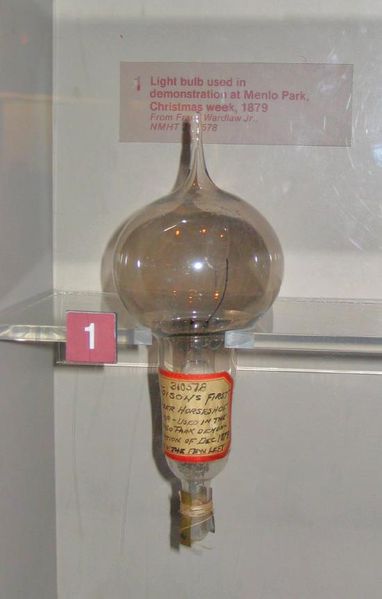
On this day in 1879, Thomas Edison created a working electric light.  The New York Times reported his triumph:

There was no lack of enthusiasm or of confidence about Mr. Edison as he greeted the Times reporter who entered his laboratory at Menlo Park, N. J., yesterday. The inventor, a short, thick-set man, with grimy hands, led the way through his workshop, and willingly explained the distinctive features of what he and many others look upon as an apparatus which will soon cause gas-light to be a thing of the past.

The lamp which Mr. Edison regards as a crowning triumph is a model of simplicity and economy. In the lamp the light is emitted by a horseshoe of carbonized paper about two and a half inches long and the width of a thread. This horseshoe is in a glass globe, from which the air has been as thoroughly exhausted as science is able to do. So good a vacuum is produced that it is estimated that at the utmost no more than a one-millionth part of the air remains. The operation of pumping lasts one hour and a quarter.

At the ends of the carbon horseshoe are two platinum clamps, from which platinum wires run outwardly through a small glass tube contained within a larger one leading out of the glass globe. The small tube contains air. Within it the platinum wires are met by two copper wires connecting with the conductors of the electricity. The air is left in the small tube, because otherwise the copper wires would be fused by the electric current. The carbonized paper is capable of being made incandescent by a current of electricity, and while it allows the current to pass over it, its resistance to the heat is strong enough to prevent it from fusing.

Google’s daily puzzle ask about a place in New York: “What is the nickname of the area located east of Coney Island Beach and west of Manhattan Beach in Brooklyn?”

The City of Whitewater’s 2013 Draft Budget: Crony Capitalism

So a multi-billion-dollar corporation (market cap $1.77 billion) wants thousands of taxpayer-dollars from a small city to fund a bus the corporation uses to shuttle her workers to and from other towns where they actually live.  The city being imposed upon is Whitewater, Wisconsin, a tiny municipality, like many others, struggling just to balance her annual operating budget.

Whitewater’s situation involves juggling to find ways to support her small downtown merchants and to defend against an infestation of pernicious insects that threaten her many ash trees.  Finding the money to do these things while balancing her budget (as she must) requires hard choices.

About taxpayer funding for multi-billion-dollar Generac Power Systems, I’ve written before.  See, for example,  A Local Flavor of Crony CapitalismA little consistency would be in orderA Generac bus by any other name, The Generac Bus and Bottom-Shelf Messaging, and The Innovation Express Generac Bus: ‘Public Transit Is Not Expected to Make Money.’

The City of Whitewater’s entire municipal operating budget is about $9 million, but for Generac Power Systems, that entire city budget is merely a small fraction of corporate quarterly revenue. Generac’s annual net income in 2011: $324 million.  Everything the City of Whitewater spends, in a place of fourteen-thousand people, is a tiny part of Generac’s revenue.

How well is Generac doing lately?  Better than ever.  One knows this because her President and CEO, Aaron Jagdfeld, announced Generac’s better-than-ever success in a recent press release:

We initiated our Powering Ahead strategic plan in 2010 that focused on growing the residential standby market, increasing our share of the commercial and industrial market, diversifying our demand, and expanding into new geographies. As a result of our team’s efforts, we have consistently exceeded our own performance goals associated with Powering Ahead and in fact reached many of those targets a year earlier than we had originally planned. We are currently resetting our goals for the next three years and we intend to share those updated growth rates in the near future when we finalize our long-term strategic plan.”

Generac’s stock has since been upgraded.

Congratulations, Mr. Jagdfeld.  Well done.

I’ve just one question: Why in the world would you think our small city – with real needs of struggling people – owes your cash-rich, multi-billion-dollar corporation even a dime of taxpayer’s money for a bus to shuttle your private workers?

I’ve a proposal.  Here in Whitewater, it’s traditional for applicants for city funds to appear before our common council, during an open session, and explain their need for public money. These sessions are televised and recorded, and applicants speak into an open microphone to the elected representatives of the city, explaining why they want city funds.

Surely you could do the same: if you’ve time to give statements  about the better-than-ever performance of your corporation, you’ve time enough to speak to our common council of your ongoing, aching need for taxpayer money.

I’ll do my part, too.  I will post on my websites, and on YouTube, your remarks, along with a transcription of them.

My pleasure, I’m sure.

Until then, we’re left with this: neither your corporation nor anyone else has offered a satisfactory justification for this request.  It remains as it has been, unworthy of both American private enterprise and municipal finance.

Daily Bread for 10.20.12

Good morning.

It’s a partly sunny Saturday for Whitewater, with a high of fifty-five, and northwest winds at 5 miles per hour.

On this day in 1973, it was a Saturday Night Massacre in Washington: “in the so-called Saturday Night Massacre, President Nixon abolished the office of special Watergate prosecutor Archibald Cox, accepted the resignation of Attorney General Elliot L. Richardson and fired Deputy Attorney General William B. Ruckelshaus.”

In Wisconsin history on this day, a fish tale turned out to be true:

1949 – Really Huge Fish Caught

On this date a record-breaking muskellunge (“muskie”) was caught on the Chippewa Flowage near Hayward. The fish weighed 69 pounds, 11 ounces. The muskie became the official state fish of Wisconsin in 1955. [Source: American Profile Note: Linked picture is not the record breaking fish]

Google’s daily puzzle asks about presidential history: “Who married the grandson of the man to whom her father had served two terms as Vice President of the United States?”

The City of Whitewater’s 2013 Draft Budget: Downtown Whitewater

Under the 2013 draft budget, there’s the possibility of the City of Whitewater increasing the contribution for Downtown Whitewater, Inc., to compensate for the loss of funding via Tax Incremental District 4.

While I’d surely rather the city didn’t prop up businesses, and I’d rather it didn’t fund just one area at that, I candidly think additional funding for the next year is necessary until a combination of zoning and enforcement changes takes hold.

(There’s no good reason whatever to support even temporary funding for a large corporation – that’s not implicated here. These are small merchants.)

If the downtown goes under, the gaping hole will take years to fill, and would make any mere marketing effort on behalf of the city impossible to succeed.

The Importance of a Downtown. Our city has a small downtown, with another retail district on the west beyond the university. There were plans for residential expansion elsewhere (via the Bridge to Nowhere, a local monument to bad planning), but it’s really these two areas for retail.

Here’s Whitewater’s challenge: she’ll attract no one if the downtown goes under. I’ve traveled about this last year, through Wisconsin and places far beyond, but I’ve not once seen a successful small town without a thriving district of quaint shops.

If anyone else has, I’d be happy to hear of it. There are suburbs, naturally, without identifiable downtowns, but I’ve never seen a successful rural community without one. Struggling, half-dead communities, surely; successful vibrant ones, not yet.

Our downtown survived the last recession (no small feat), but it’s hardly thriving. It took considerable work to keep it going even as it is.

The Futility of Marketing (without a Thriving Downtown). You may have seen a marketing video, in the syle of a school’s NCAA promotional announcement, encouraging prospective newcomers to Choose Whitewater. It’s hard to over-emphasize how backwards it is to tout the features of a city if the city’s downtown descends into rows of empty storefronts and discarded beer bottles. One block from Main Street, on Center, we’ve problems even now.

No one will choose this city from a video over his or her personal impressions on a visit. No one will choose this city on a guided tour over his or her own explorations. People who think otherwise are mistaken. The best a marketing effort can do is encourage a visit, and (it’s to be hoped) bolster a positive impression a visitor has after his or her own explorations.

No one will choose from a video, story, or pamphlet alone.

The Longterm Solution. A combination of zoning changes and enforcement changes (different but complementary actions) can lift this city far beyond any marketing effort. Just as the best policy is a sound argument, so the best marketing is an open, dynamic city.

Unfortunately, the benefits of that approach will not take hold by January 2013. The zoning re-write is still in process, and improvements and modernization of enforcement policy will take hold gradually.

When those changes do take hold — and through strenuous promotion of actual policy improvements they will – we’ll have a thriving downtown without the need for municpal subsidies. The City of Whitewater should look ahead, and tentatively propose a tapering level of municipal funding for out years.

Who should promote and advertise these genuine improvements? It should be the business people and city officials who have benefitted from the changes or are responsible for enforcing them. A merchant considering a town cares little what someone unconnected to his immediate work thinks about something – he or she cares about the disposition and policies of those who will be directly connected to his or her own work.

In this way, the best advocates will be those who can say that they’ve made zoning or enforcement better, show how that’s been useful to actual merchants, and how it can be helpful to new ones.

Funding Downtown Whitewater in 2013 to include replacement funding lost via TID 4 is a reasonable bridge toward a place of reformed regulations and requirements.

One might even consider it, just perhaps, a Bridge to Somewhere.

Tomorrow: About funding for the Generac Bus.