There have been many fine Super Bowl games, and quite a few fine Super Bowl commercials, too. Commercial advertising’s an art form, and tomorrow, Americans will recall both the game and its commercials. I’m not sure if I have an all-time favorite ad, but this one would be near the top of any list I’d make. Enjoy.
There’s much charm in living in a small rural town, in a dairy state. One would wish, I am sure, that every post could be about topics as happy, sincere, and admirable as this one, of a press release from the Wisconsin Potato & Vegetable Growers Association. Congratulations, and best wishes to all.
WPVGA Presents Annual Industry Awards
In addition to its annual Hall of Fame induction, the Wisconsin Potato & Vegetable Growers Association presented several other annual industry awards at a banquet held February 3, 2010 in Stevens Point.
Brenda Bula of Bula Potato Farms, Antigo, was named the WPVGA Volunteer of the Year.
Brenda has served for many years on the Wisconsin Potato Growers Auxiliary Board of Directors, including serving as President. She has also served as the coordinator of the Auxiliary’s largest annual project, the Wisconsin Potatoes booth at the State Fair. She also works tirelessly on the farm with her husband Dennis at Bula Potato Farms of Antigo, which raises certified seed potatoes.
The WPVGA Young Grower of the Year Award was presented to Jon Hamerski of Hamerski Farms, Plover. Jon works with his father, Don, and cousin, Dale O’Brien at Hamerski Farms, Plover. The farm raises 1,000 acres of potatoes for the fresh market along with 1,300 acres of sweet corn, snap beans and field corn. Jon readily embraces change, and is constantly looking to improve his farming operation with the latest, state-of-the-art technology and equipment. In 2008, Hamerski Farms was the first farm in the Midwest to use the Fuji Ace robotic palletizer. His packing shed also utilizes a Lectro-Tek automatic sizer and an x-ray machine for hollow heart detection, and this past fall they became the first potato farm in the US to use an electronic grader for russet potatoes. Also in 2009, the farm added the country’s first ozone generator with water injection system.
The WPVGA Researcher of the Year Award was presented to Dr. Russell Groves of the University of Wisconsin-Madison. Groves works in the Department of Entomology. His area of expertise is insect management. He has conducted outstanding potato research in areas such as Long Term Storability of Potato Virus Y infected tubers; and the differential impact of PVY-O and the new PVY-N: O strain. He recently gave a presentation at the 2010 Potato Expo on Controlling PVY levels in seed potatoes; and PVY N-T-N eradication. He also reported on his research on Managing Aphid-Transmitted Viruses.
The WPVGA Associate Division presented the Associate Division Business Person of the Year Award to Tom Domaszek of M&I Bank, Stevens Point. Tom is a long-time member of the Associate Division and served a five-year term on the Associate Division Board of Directors. He held the position of Secretary on the Associate Division Board for several years and was highly regarded for his accurate note-taking. He was instrumental in helping the WPVGA obtain a loan for the Storage Research Facility as well as getting M&I Bank to make a very generous donation toward the facility.
The Wisconsin Potato Growers Auxiliary named Sara Stelter of Stelter Farms, Wautoma, the Potato Industry Woman of the Year. Ten years ago after her husband died, Sara decided to keep farming and convinced his brother that, together, they could continue. Her children were 10 and 11 years old at the time. The farm consists of about 800 crop acres raising potatoes, sweet corn, beans, peas, #2 yellow and soybeans, as well as beef. Now the farm is changing again as Sara’s brother-in-law and his wife recently passed away. Wisconsin Potato Growers Auxiliary Past-President Lynn Isherwood said, “Sara is a prime example of a farm woman … she is the farm. She is determined to keep going, as she says ‘You do what you have to do.’”
The Agri-Communicator Award, sponsored by Agri-View newspaper, was presented to Mike Finnessy of Okray Family Farms, Plover. Finnessy has been involved in virtually every aspect of the Wisconsin Potato & Vegetable Growers Association. He served on the WPVGA Board of Directors. He serves on the Marketing Committee. He serves on the Governmental Affairs Committee and is the leading fundraiser of that group year in and year out. He also serves the industry on a national level as one of Wisconsin’s delegates on the National Potato Council. He serves on the NPC Legislative Affairs Committee as well as the Disease Management and Seed Certification Sub-committee. He also has served on the NPC’s Time-Zone Research – Review Committee. He is politically active locally in Plover and is an international ambassador for the potato industry, recently attending the World Potato Congress in New Zealand.
2009 WPVGA President Kevin Sigourney of Kevin Sigourney Farms, Coloma, did not present an individual President’s Award. He said there were many individuals deserving of recognition. He gave special thanks to his father, his wife, Jackie, the WPVGA staff and many of the growers in his area who have helped him throughout his career in the potato industry.
Special Industry Appreciation Awards were presented to Chuck Kostichka of Hazelhurst and Heartland Farms, Inc. of Hancock. Kostichka recently retired after three decades of administering University of Wisconsin agricultural research facilities and programs. The former Superintendent of the UW-Hancock Agricultural Research Station, Chuck made exceptional contributions to supervising and managing staff, developing short- and long-term management plans, enhancing communications and outreach activities, and managing station finances.
In 2009, Heartland Farms was instrumental in helping with an off-gassing study of metam sodium which could have far-reaching implications for the potato industry throughout the United States. Heartland Farms was also cited for its contributions to the Storage Research Facility at Hancock. Accepting the award on behalf of Heartland Farms were Dave Knights, Jeremie Pavelski, T.J. Kennedy, Brian Wysocki and Charlie Higgins. Heartland Farms, Inc. President Richard Pavelski was also recognized.
The Whitewater-Area League of Women Voters’ February 2010 Newsletter is now available, and the latest issue includes a calendar of upcoming LWV events. The latest copy of the LWV newsletter is available as a link on my blogroll, and is embedded below, with coding through Google. I like the simplicity that the Google Document Viewer offers, with features including a larger-screen mode, and a link to the document, from which one can view, print, or share it.
Here is a sampling of upcoming events mentioned in the February newsletter:
2009-2010 Contemporary Issues Lecture Series
The College of Letters and Sciences at the University of Wisconsin-Whitewater is once again offering the Contemporary Issues Lecture Series. All lectures will be in the Young Auditorium at 7 p.m. and are free and open to the public. Contact Susan Johnson (johnsons@uww.edu or 472-4766) for further information.
Monday, February 15th 2010 — “Naked Trends: What Can Basic Economics Tell Us About the Future”– Charles Wheelan
“Charles Wheelan, a faculty member at the Harris School of Public Policy at the University of Chicago and a former Midwest correspondent for The Economist, writes Yahoo!‘s popular “Naked Economics” column. Prior to joining the faculty at the University of Chicago, Wheelan was Director of Policy and Communications for Chicago Metropolis 2020, a business-backed civic group promoting healthy regional growth in the Chicago area. He has written for the Chicago Tribune, the New York Times, the Wall Street Journal and other publications. His 2003 book, Naked Economics: Undressing the Dismal Science, seeks to make economics accessible, comprehensible and appealing.”
Fairhaven Lecture Series
All lectures are open to the public at no charge on Mondays at 3 p.m. at the Fellowship Hall, located at the Fairhaven, 435 West Starin Road, Whitewater, WI 53190. Sponsored by the UW-Whitewater Office of Continuing Ed.
8 February—Putting the Bayeux Tapestry in its Place. Chris Henige, Associate Professor and Chair, Art Department
15 February—Competitive Speaking Examples from the UW-Whitewater Forensics Team. Jeanine Fassl, Senior Instructor and Director of Forensics, Department of Communication
22 February—Narrative in Music from Around the World. Alena Holmes, Assistant Professor, Department of Music
1 March —What Costumes Say to an Audience (Part I). Marshall Anderson, Professor and Chair, Theatre / Dance Department
The more one hears about the candidates for Walworth County circuit judge, the more one comes to see that only two of the candidates seem to understand the office for which they are contesting. Along the way, one has no trouble seeing that the Whitewater Register doesn’t understand the role, either.
Yesterday, I had fun teasing about the campaign signs for the circuit judge candidates for Walworth County.
(Quick note: I think the candidate’s sign on the lawn of the Whitewater city attorney’s firm is a matter of bad form reflecting on the city attorney, not the candidate. Then, a more important question is the quality of legal opinion the city receives, a subject for another day.)
There’s more about these candidates, over at the Whitewater Register, in its February 4th edition. On page eight of that formerly local newspaper, there’s an article entitled, “Candidates connect: Q & A with the Walworth County Circuit Court judge contenders.” The story asks seven questions of the candidates:
1. How do you differ from your opponents?
2. What is your favorite thing to do or place to visit in Walworth County?
3. What do you see as the most pressing issue facing the Walworth County judicial sysem?
4. Do you think that Walworth County is tough enough on sex offenders? Would you like to see any changes in prevention, prosecution or sentenciong with regard to sex offenses in the county? If so, what?
5. County officials are currently examing the possibility of jail expansion, which could cost taxpayers millions. How would you work to keep the jail population down, while staying tough on crime?
6. Walworth County jail is said to be the “Beverly Hills” of jails — because inmates have the ability to order food, among other comforts. Is Walworth County jail too cozy?
7. Who is your favorite TV judge?
Two of the questions — what to do in Walworth County, and favorite TV judge — are just frivolous. One silly question might make sense, but I’d guess the Register thinks only the question about a favorite TV judge is silly. They’re wrong — there’s a diminuition of the judicial role when prattling along like a candidate for town council about one’s favorite activites in Walworth County. The candidates all talk about loving their families, with mentions of the county fair, picking strawberries, boating, etc.
One of the questions is simply false, and absurdly so — the idea that the Walworth County jail might be the “Beverly Hills’ of jails, or the implication that inmates are ordering takeout. The question is oddly ignorant of how the jail operates, suggests a nickname for the jail that only a buffoon would use, and is easily and correctly dismissed by all of the candidates as false and misleading.
Of the seven questions printed for publication, two are silly and irrelevant to the judicial role, and one is simply erroneous.
Consider, though, the question about a true concern — sex offenders. The question poses a problem for society, but an even bigger problem for these candidates. As candidates Reddy and Letteney correctly note, there are limits on judicial candidates’ answers to open-ended questions like this, under Wisconsin rules of conduct. Reddy observes that
It would be irreponsible to answer the question the question as phrased. Every defendant should be sentenced based upon the specfic facts presented to a court. The law requires that a judge consider the gravity of the offense, the offender’s character and the
public’s need for protection.
Letteney notes that
This is a difficult question to answer, because under the Wisconsin Supreme Court Rules of Judicial Conduct, judges and judicial candidates are not permitted to state how they would rule in certain cases. In addition, law enforcement is primarily responsible for crime prevention and the District Attorney is responsible for prosecution.
Only Reddy and Letteney seem to have understood the obligations of a judicial candidate, at least in these published remarks, in answering the question. A version of what they said should have been the first words of any judicial candidate in reponse to a question like this.
Answering this way implies no weakness toward crime — on the contrary, it’s evidence of a much needed respect for the nature of a judicial role. I have no sympathy for violent criminals, nor other
crimes against people or property. Judges are not, however, and cannot be, prosecutors or defense attorneys. Wisconsin rules of conduct for judges and judicial candidates address the unique role of judge, apart from advocate.
Some of these answers are more political than judicial. One might at least have hoped, though, that all those answering a question would understand the simple, clear rules by which judicial candidates should be bound. Perhaps we should be fortunate, in Walworth County, that even half the candidates did.
The 23rd Annual Wisconsin Troopers’ Art & Essay Contest is accepting entries through February 14th. I have included the contest rules, and an entry form, immediately below. The forms can be viewed in a full screen mode, and are available for downloading and printing. Best of luck to all contestants.
Updated: 2/6/10 — updated to Google Documents Viewer for a cleaner format.
Whitewater’s forecast calls for a chance of snow, of little accumulation, with a high of thirty-two degrees.
Our city one public meeting listed for today: the Whitewater-University Tech Park Board meets at 2 PM. The agenda for the meeting is available online. The meeting will go into closed session to consider “[p]otential tenants and lease rates.”
In our schools, it’s Spirit Day at Washington School, and at the Middle School, there’s a student council pep assembly at 2 PM.
The Wisconsin Historical Society recalls that this day in 1849 was an especially historic one for our state:
1849 – University of Wisconsin opens
On this day in 1849 the University of Wisconsin began with 20 students led by Professor John W. Sterling. The first class was organized as a preparatory school in the first department of the University: a department of science, literature, and the arts. The university was initially housed at the Madison Female Academy building, which had been provided free of charge by the city.
The course of study was English grammar; arithmetic; ancient and modern geography; elements of history; algebra; Caesar’s Commentaries; the Aeneid of Virgil (six books); Sallust; select orations of Cicero; Greek; the Anabasis of Xenophon; antiquities of Greece and Rome; penmanship, reading, composition and declamation. Also offered were book-keeping, geometry, and surveying.
Tuition was “twenty dollars per scholar, per annum.” For a detailed recollection of early UW-Madison life, see the memoirs of Mrs. W.F. Allen [Source: History of the University of Wisconsin, Reuben Gold Thwaites, 1900]
A sharp reader wrote, and asked me about the upcoming Walworth County election, as judge Michael Gibbs is retiring from office. There are four candidates in the race: Mark Bromley, David Danz, Scott Letteney, and David Reddy. The Judgepedia has a page that lists candidates for judgeships across the state.
Wisconsin has a spring primary election on February 16th, and a spring general election on April 6th.
Whoever wins this race will have to work in Elkhorn, our county seat, and a place that brings to mind Ben Kenobi’s description of Mos Eisley: “You will never find a more wretched hive of scum and villainy.” Some of these candidates already work in Elkhorn, and yet they are willing to stay even longer. At its most charitable, that’s confirmation that the Stockholm Syndrome is more than just a theory. County government is a place of mediocrity and mendacity matching that of my own town of Whitewater. No easy feat, but there must have been enough self-important, selfish bureaucrats left over after Whitewater’s leadership payroll was set, and I suppose they wound up in Elkhorn.
Mark Bromely is an attorney in private practice, and a member of the Walworth County Board. He’s from Whitewater, and is the only candidate living in this part of the county. He’s a private practitioner, and a graduate of the University of Wisconsin Law School.
I first noticed his campaign signs in December, I think, before any of the other candidates. Ironically, despite the early campaign presence (he had a car in the Whitewater Christmas Parade, too), I could not find one of his signs in our downtown when looking for one last night.
I thought there were quite a few at one time, but I couldn’t find one in town yesterday. Perhaps I was looking in the wrong spots. In any event, residents are likely to recall them: blue and red, and a larger, blue version with Bromley’s picture. They’re sharply done, and are the only signs in the race give voters a picture of the candidate.
Scott Letteney is a municipal judge in the county for Geneva Township, and works as a deputy city attorney in the city of Racine. I haven’t seen any signs for him, that I can recall. I am sure he has some; I just don’t recall. It’s also possible that he has placed many of them in parts of the county that I avoid. Letteney is a graduate of Marquette Law School.
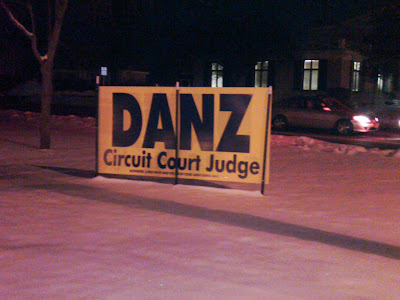
Candidate David Danz is a private practitioner in Elkhorn, and a graduate of the University of San Diego Law School. You have surely spotted his signs, if you’ve walked about Whitewater, and don’t require a seeing eye dog.
They’re unmistakable. It’s not really a matter of asking for one’s vote, as much as insisting upon it. If signs could talk, this one would be shouting.
The same sharp reader who asked me to comment on the judicial candidates also correctly observed how this town will hector every private merchant who’d like to put up a sandwich board, but candidates for the public payroll can put up huge signs without challenge. I favor a rule that allows merchants the same opportunities as candidates. If there are to be large signs, they should at least be for productive private citizens trying to make a living on their own, as much as candidates looking for a salary and benefits from the taxes of others.
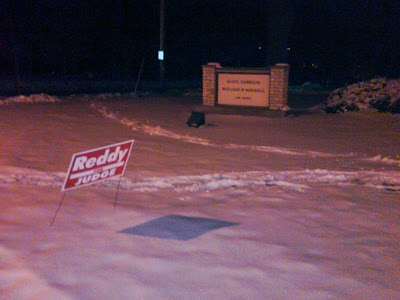
The fourth candidate is David Reddy, a Walworth County Court Commissioner, who has worked in private practice and another county’s district attorney’s office. Reddy was graduated from the Thomas Cooley Law School. Reddy has a conventional campaign sign, a photograph of which appears below:
Totally apart from Reddy, look carefully at the location of the sign. It’s a familiar location to anyone in Whitewater — the law firm of which Whitewater’s city attorney, Wally McDonell, is a named partner. That’s his name, McDonell, listed as the final in the sequence of names on the firm’s sign.
McDonell’s been city attorney for a long time, and I believe that he’s actually paid as a city employee now, as a municipal cost-saving matter.
It would, and should, be obvious to anyone that this sign creates the appearance of a conflict of interest. The named partner of this firm, the city attorney, should not be displaying a sign with his preference in this race, on the firm’s lawn. It doesn’t matter that McDonell would insist that he doesn’t think it’s a conflict — reasonable people can easily see as much.
There’s so much talk about what the city manager and others ‘appreciate,’ and what’s ‘appropriate,’ etc. These gentlemen fuss over propriety only for trivial matters when it suits them.
I surely don’t expect these insiders to change, or do what’s right; they shouldn’t — and can’t — expect that I’ll not mention as much.
On Saturday, February 27, 2010 the Madison Area Woodland Owners Conference will feature presentations in the morning that examine invasive species identification and management, continued care for established trees in woodland and an update of emerald ash borer and how to best manage for it. The afternoon program will highlight how to conduct a successful timber sale and explore woody biomass harvesting and markets. The day will close with a presentation on Wisconsin bats. In addition to the program there will also be educational and commercial exhibits to view. If you are interested in being an exhibitor, contact the number given below.
The February 27th conference runs from 8 a.m. to 3:30 p.m. and includes coffee and rolls, lunch and handout materials. The registration fee is $35 (couples are $65) if you register before February 17th and $40 (couples are $75) for a late or onsite registration. The conference will be held at the American Family Insurance Headquarters Training Center which is located between Madison and Sun Prairie, off of Highway 151 on American Parkway.
The sponsors for the conference include Dane County UW-Extension and Wisconsin Department of Natural Resources. If you have questions about the conference, would like to receive a registration brochure, or are interested in having an exhibit at the conference; contact Mindy Habecker at Dane County UW-Extension (608)224-3718.