Tuesday in Whitewater will be cloudy with a high of 63. Sunrise is 7:01 and sunset is 7:05, for 12 hours, 4 minutes of daytime. The moon is a waning gibbous with 84.3 percent of its visible disk illuminated.
Whitewater’s Alcohol and Licensing Committee meets at 5:30 PM. The Whitewater Common Council meets at 6:30 PM.
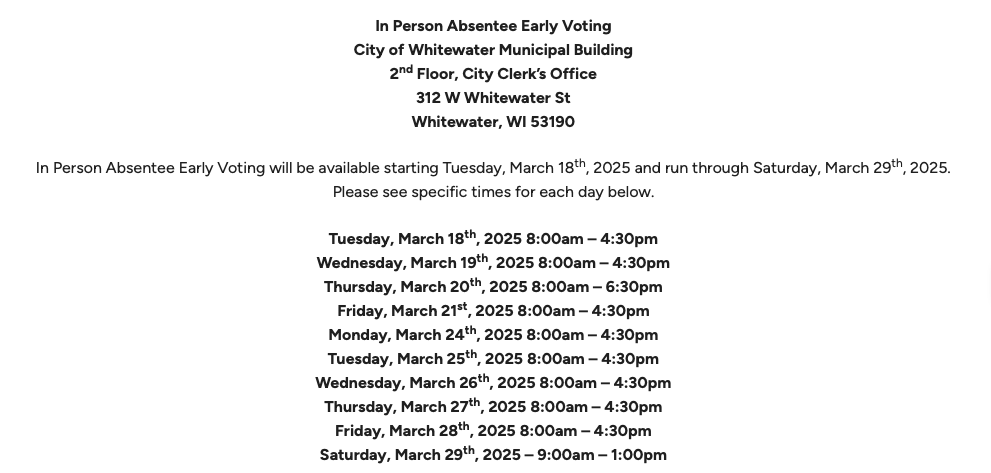
Republicans and Democrats fighting for control of the Wisconsin Supreme Court will get a sense Tuesday of how energized their sides are with the start of early in-person voting for the hotly contested race.
Voting begins two weeks before the April 1 election between Republican-backed Brad Schimel and Democratic-supported Susan Crawford in a race for an open seat that will determine whether liberals will continue to have a slim majority on the highest court in a crucial presidential battleground.
The race, which has drawn the attention of President Donald Trump’s adviser Elon Musk and attracted tens of millions of dollars in spending, is seen as a litmus test of how voters are responding to the first months of Trump’s Republican presidency.
Sunday in Whitewater will see light snow, mostly cloudy conditions, and a high of 38. Sunrise is 7:04 and sunset is 7:02, for 11 hours, 58 minutes of daytime. The moon is a waning gibbous with 95.1 percent of its visible disk illuminated.
On this day in 1935, Hitler orders Germany to rearm itself in violation of the Treaty of Versailles. Conscription is reintroduced to form the Wehrmacht.
And for years, Judge Schimel has repeated some of Mr. Trump’s talking points about Wisconsin elections.
During an April 2018 interview with one of the state’s leading conservative talk-radio hosts, Judge Schimel said it was not clear that Mr. Trump, who carried the state in 2016 by fewer than 23,000 votes, or Senator Johnson, who won by about 99,000 votes that year, would have prevailed had the state’s voter identification law not been in place.
In January, he said he did not object to Mr. Trump’s pardons of supporters who attacked the Capitol on Jan. 6, 2021.
Two days later, when Judge Schimel’s cover band, 4 on The Floor, played a Halloween gig at Michael’s Funky Monkey bar in Waukesha, he wore a reflective vest just like Mr. Trump’s and rocked out while playing the Rolling Stones classic “Sympathy for the Devil.”
See Reid J. Epstein and Steve Eder, The Trump Loyalist Aiming to Swing Wisconsin Back to the Right (‘Brad Schimel, a judge who is so supportive of the president that he dressed up as him for Halloween, is hoping to flip the Wisconsin Supreme Court for conservatives’), New York Times, March 13, 2025.
There are many ways to describe Schimel’s costume choice, some supportive (identifying with his political hero and that hero’s supporters who believe they’ve been insulted), some not (a weak man’s choice, identifying with an autocrat who stokes the narcissistic insult that a populist horde too quickly feels).
Both can be true, but the latter tolls more strongly.
______
The link to the New York Times story is open, and one can play the clip of Schimel with maracas standing around awkwardly groovin’ to the vibe. ↩︎
Thursday in Whitewater will be partly sunny with a high of 60. Sunrise is 7:09 and sunset is 6:59, for 11 hours, 50 minutes of daytime. The moon is a waxing gibbous with 99.6 percent of its visible disk illuminated.
Several times, Crawford accused Schimel of saying different things to broader audiences than to audiences made up of his political allies. She called attention to reporting by the Washington Post that Schimel said Trump was “screwed over” by the Supreme Court in its decisions regarding the 2020 election, and reporting by the Wisconsin Examiner that he had told a group of canvassers he’d be a “support network” for Trump.
“He is not impartial, and he says different things in front of a broad audience like this, where he knows it’s going to be televised, than he’ll say when he’s talking to his political allies,” she said. “He is not trustworthy.”
On the campaign trail, access to abortion has been one of the most prominent issues. The Court is currently considering a lawsuit that would have the state’s 1849 law declared invalid, while another lawsuit is pending in the lower courts asking if the state’s Constitution grants a right to abortion access.
Schimel has said he personally opposes abortion, that both of his daughters are adopted and he believes the 1849 statute is a “valid law.” In the debate he repeated what he’s said during the campaign on the issue — that it should be up to the state’s voters. Wisconsin doesn’t allow voters to influence state law through a referendum process.
Schimel likely knows, if he’s worked up the energy to read the law after his habitually light work schedule, that a voters’ referendum would be advisory,1 and to overturn Wisconsin’s 1849 statutory abortion ban would require a proposed state constitutional amendment2 that the WISGOP legislature would never put before voters.
Look to the sky late Thursday evening to spot a rare blood moon lunar eclipse. The total lunar eclipse will be visible in North America, South America, western parts of Europe and Africa from Thursday, March 13 to Friday, March 14. As the moon passes through the Earth’s innermost shadow, light from the sun passing through the Earth’s atmosphere will be filtered in just the right way to bathe the moon in a reddish, orange hue. Totality – when the moon is completely within the Earth’s inner shadow and turns reddish – will start at 12:26 a.m. EDT and 11:26 p.m. PDT and last about 65 minutes. The phenomenon is visible by the naked eye, but for the best viewing experience, find a dark environment and grab a pair of binoculars or a telescope. According to NASA, another total lunar eclipse won’t be visible in the U.S. until March 2026.
Wednesday in Whitewater will be sunny with a high of 55. Sunrise is 7:11 and sunset is 6:58, for 11 hours, 47 minutes of daytime. The moon is a waxing gibbous with 97.5 percent of its visible disk illuminated.
On this day in 1989, Sir Tim Berners-Lee submits his proposal to CERN for an information management system, which subsequently develops into the World Wide Web.
“Conservative Brad Schimel will support President Trump’s agenda!” says the new flyer. “Together, we won the White House. Now it’s time to win the courthouse!”
The campaign literature features a picture of Trump being sworn in as president with his hand upheld and a second photo of Schimel with the Wisconsin Capitol in the background. It then urges voters to elect Schimel to the Supreme Court next month.
America PAC, the Musk super PAC, and a second Musk group, the nonprofit Building America’s Future, have reported spending more than $10 million on TV ads, digital ads, mailers, voter turnout and canvassing.
Brad Schimel, circuit court judge, isn’t running for a seat on the Wisconsin Supreme Court; Trump’s dutiful foot soldier is running for a seat on the Wisconsin Supreme Court.
Thursday in Whitewater will be sunny with a high of 40. Sunrise is 6:21 and sunset is 5:50, for 11 hours, 29 minutes of daytime. The moon is in its first quarter with 49.7 percent of its visible disk illuminated.
Whitewater’s Public Arts Commission meets at 5 PM.
On this day in 1967, Joseph Stalin‘s daughter Svetlana Alliluyeva defects to the United States. (She later moved to Wisconsin, and passed away in Richland Center.)
Wisconsin Supreme Court candidate Brad Schimel told a group of canvassers in Waukesha County last weekend that he needs to be elected to provide a “support network” for President Donald Trump and shared complaints about the 2020 election that have been frequently espoused by election deniers.
In a video of the remarks, Schimel is speaking to a group of canvassers associated with Turning Point USA — a right-wing political group that has become increasingly active in Wisconsin’s Republican party.
….
“Donald Trump doesn’t do this by himself, there has to be a support network around it,” Schimel said.
Schimel pointed to the issue of special voting deputies in nursing homes as a major problem.
Because of the COVID-19 pandemic, officials known as special voting deputies who normally go into nursing homes to help residents cast absentee ballots were unable to enter those facilities.
Republicans have claimed that decision allowed people who should have been ineligible to vote because they’d been declared incompetent to cast a ballot. Conspiracy theorists have pointed to affidavits filed by family members of nursing home residents that their relatives were able to vote. Only a judge can declare someone incompetent to vote, however.
The issue led to the Republican sheriff of Racine County to accuse members of the Wisconsin Elections Commission (WEC) of committing felony election fraud and became a target in former Supreme Court Justice Michael Gableman’s widely derided review of the 2020 election.
Schimel also blamed the election commission’s decision to exclude the Green Party’s candidates from the ballot that year for Trump’s loss. WEC voted not to allow the party on the ballot because there were errors with the candidate’s addresses on the paperwork. The party sued to have the decision overturned, but the Supreme Court ruled 4-3 against the party because it was too close to the election.
While conservatives held the majority on the Court at the time, Schimel blamed liberals.
Wednesday in Whitewater will be rainy with 42. Sunrise is 6:23 and sunset is 5:49, for 11 hours, 26 minutes of daytime. The moon is a waxing crescent with 38.6 percent of its visible disk illuminated.
The Starin Park Water Tower Committee meets at 6 PM and the Landmarks Commission meets at 7 PM.
On this day in 1770, at the Boston Massacre, five Americans, including Crispus Attucks, are fatally shot by British troops in an event that would contribute to the outbreak of the Revolutionary War five years later.
The Democratic Party of Wisconsin is working to tie state Supreme Court candidate Brad Schimel to Elon Musk with an ad campaign titled the “People v. Musk.”
The move comes as Musk’s prominence has grown in national politics for his role cutting government spending under President Donald Trump, and after groups backed by Musk have spent millions attacking Schimel’s opponent, Dane County Judge Susan Crawford.
The first ad from what the state Democratic Party is calling a “seven-figure” campaign references the firing of air traffic controllers and federal funding cuts initiated by Musk’s Department of Government Efficiency, or DOGE. The ad repeatedly shows video of video of Musk making a straight-armed gesture on the day of Trump’s inauguration.
Tuesday in Whitewater will be cloudy with afternoon showers and a high of 52. Sunrise is 6:25 and sunset is 5:48, for 11 hours, 23 minutes of daytime. The moon is a waxing crescent with 27.4 percent of its visible disk illuminated.
The Whitewater Common Council meets tonight at 6:30 PM.
Wisconsin is a small Midwestern state of under six million people. She’s also a state that punches far above the weight of a small Midwestern state of under six million people. It’s true yet again:
President Donald Trump and adviser Elon Musk’s policies will get their first major test at the ballot box this spring in an election that will determine who controls the Wisconsin Supreme Court and shape the future of abortion rights and union power in the swing state.
Two years ago, liberals gained a 4-3 majority on the court after 15 years of conservative control. They threw out legislative maps that gave Republicans commanding majorities in the statehouse, reinstated the use of absentee ballot drop boxes and accepted cases that will decide whether abortion remains legal in the state.
But with a liberal justice retiring this year, conservatives now have a shot at regaining the majority. If they do not, liberals are poised to control the court until at least 2028, and interest groups are expected to file redistricting litigation that could give Democrats one or two more seats in Congress.
Firefighters are struggling to contain a wildfire in north-eastern Japan which has been burning for seven days. A number of homes have been burned in a small coastal town near Ofunato city in Iwate prefecture, and thousands of people have been evacuated. Largest wildfire in decades rages in Japan as authorities warn it could spread.
Monday in Whitewater will be cloudy with a high of 51. Sunrise is 6:26 and sunset is 5:46, for 11 hours, 20 minutes of daytime. The moon is a waxing crescent with 17.7 percent of its visible disk illuminated.
[At Brad] Schimel’s “Hispanic roundtable” Thursday, the state Republican Party was fully engaged. Republican Party of Wisconsin Executive Director Brian Schimming and former Republican candidate for attorney general Eric Toney were in attendance, rubbing elbows with the John Birch Society members.
“Because people in this state and people in this city and people on the South Side need somebody who’s gonna have them top of mind and protecting victims and doing the right thing, stand up for the rule of law, all the things that we all want,” Schimming said. “And you would expect that would be easier for people to do, but it really takes somebody of great courage, somebody who’s honest and somebody who’s forthright, to step up at times like this.”
One attendee, filming Schimel’s remarks, wore #LoomersArmy hat, merch that can be purchased on the website of the Laura Loomer Fan Club. Loomer is a right-wing media personality and activist whom U.S. Rep. Marjorie Taylor Greene has called “extremely racist.”
Schimel was introduced at the event by Marty Calderon and Mariano Garcia, two pastors on Milwaukee’s South Side who have been involved in the creation of the Republican Party’s office in the neighborhood.
In his opening prayer, Garcia criticized Black, Hispanic and LGBTQ people.
Schimel’s campaign is wholly political, and he’ll win or lose based on his strength with MAGA, Dark MAGA, Burnt Orange MAGA, Mango Tango1 MAGA, whatever.
Sunday in Whitewater will be partly sunny with a high of 35. Sunrise is 6:28 and sunset is 5:46, for 11 hours, 18 minutes of daytime. The moon is a waxing crescent with 9.2 percent of its visible disk illuminated.
Brad Schimel’s political positions shift audience to audience, but he attracts a crowd among which expressions like ball and chain, little woman, the wife, and hausfrau are, let’s say, probably not uncommon. That’s his crowd, those are his people. He needs them in April.
And so, and so, there’s no surprise that he sees liberal women on the Wisconsin Supreme Court as overly emotional. Here’s Schimel on a radio show recorded in November:
“The other thing that I noted, there were times that when that camera went on several of the liberal justices, they were on the brink of losing it. You could see it in their eyes, and you could hear it in the tone of their voice,” he told conservative talker Meg Ellefson on WSAU-AM (550) and its sister stations in Wausau and Stevens Point. “They are being driven by their emotions. A Supreme Court justice had better be able to set their personal opinions and their emotions aside and rule on the law objectively. This is — we don’t have that objectivity on this court.”
“It’s plainly clear that that one of the justices, at least, was not able to stay objective. She had lost control of her emotions,” Schimel said after a roundtable talk at the GOP’s Hispanic center in Milwaukee. “Men do that, too, but she could not stay objective. In that case, she was literally yelling at an attorney.”
And which justice was that? Schimel clarified, “The one that was yelling at the attorney was Justice Karofsky. She was plainly yelling.”
It’s only ‘plainly clear‘ in Schimel’s mind, and the minds of those who share his outlook. Schimel knows that few in his crowd will review the full recording of oral argument at the court, and even if they were to do so, they’d not have a statewide or national context for what they saw.
They’ll simply take Schimel’s unreliable word for it.
Friday in Whitewater will be windy with a high of 53. Sunrise is 6:31 and sunset is 5:43, for 11 hours, 12 minutes of daytime. The moon is a waxing crescent with 0.6 percent of its visible disk illuminated.
On this day in 1844, a gun explodes on board the steam warship USS Princeton during a pleasure cruise down the Potomac River, killing six, including Secretary of State Abel Upshur. President John Tyler, who was also on board, was not injured from the blast.
Brad Schimel, a judge and candidate for a place on the Wisconsin Supreme Court, is pickled in politics. There’s not much more to him. And so, and so, he’ll say what he feels he needs to say, one audience to the next:
Schimel’s exposition of his judicial philosophy has shifted when he speaks to different audiences.
Speaking to law students and Milwaukee voters at the Marquette event, when asked about federal judges’ role in thwarting Trump’s executive orders to end birthright citizenship, give Musk access to massive troves of personal data and stop congressionally appropriated funds from being disbursed, Schimel said it’s a judge’s role to define the limits of executive authority.
“When there’s a dispute about whether that exercise of power is legitimate or not, well, then it may have to be the court that resolves that dispute,” he said.
However, in a radio appearance with right wing host Vicki McKenna, he accused federal judges of “acting corruptly” for issuing temporary restraining orders against the dismantling of federal agencies.
Firefly Aerospace’s Blue Ghost lander captured stunning views of the moon from about 62 miles (100 km) above the surface. The footage, sped up 10 times, was captured on Feb. 24, 2025 during its third orbital maneuver.
Tuesday in Whitewater will be sunny with a high of 49. Sunrise is 6:36 and sunset is 5:39, for 11 hours 3 minutes of daytime. The moon is a waning crescent with 7.6 percent of its visible disk illuminated.
On this day in 1947, Soviet NKVD forces in Hungary abduct Béla Kovács — secretary-general of the majority Independent Smallholders’ Party — and deport him to the USSR in defiance of Parliament. His arrest is an important turning point in the Communist takeover of Hungary.
Perhaps after at least thirteen children with four women, and who knows how many failed dalliances, furtive assignations, and meaningless encounters, Elon Musk1 doesn’t care much for telling one woman apart from another. It’s probably especially difficult for him when he’s asked to identify an accomplished professional woman (or any woman) in daylight.
And so, and so, predictably Musk’s political action committee has confused Judge Susan Crawford of Dane County with another woman of the same name:
One of the first attack ads launched by a Elon Musk-backed group in the hotly contested state Supreme Court race has landed with a resounding thud.
That’s because the ad that Building America’s Future is currently running on social media doesn’t feature Susan M. Crawford, the liberal Dane County judge running for the high court against conservative Brad Schimel.
Rather, the digital ad has a large photo of Susan P. Crawford, a law school professor at Harvard University. It appears Building America’s Future lifted her picture from her Wikipedia profile.
“Susan Crawford: Wrong for Wisconsin,” the ad says.
Ok, but which Crawford?
Perhaps, more accurately, it should read, “Wrong Susan Crawford for Wisconsin.”
One brown-haired woman’s like another, right? All women lawyers are the same, don’t you know? The name on a Wikipedia page matters more than the bio from that page, isn’t it obvious? Massachusetts and Wisconsin are so similar, aren’t they?2
That’s top-notch discernment from America’s shadow president.
Top notch.
______
Musk is a petulant man — more needy adolescent than worthy adult — an appetitive boy. ↩︎
Monday in Whitewater will be windy with a high of 53. Sunrise is 6:38 and sunset is 5:58, for 11 hours 0 minutes of daytime. The moon is a waning crescent with 15 percent of its visible disk illuminated.
Whitewater’s Urban Forestry Commission meets at 5:30 PM. The Whitewater School Board goes into closed session shortly after 6 PM, and resumes open session at 7 PM.
On this day in 1917, the U.S. ambassador Walter Hines Page to the United Kingdom reports to Pres. Wilson on the contents of the German Zimmermann Telegram, in which Germany pledges to ensure the return of New Mexico, Texas, and Arizona to Mexico if Mexico declared war on the United States.
Populism is a restless and relentless group movement, historically sometimes of the left, sometimes of the right. In our time, we have conservative populists, Trumpists, MAGA, or however else they choose to describe themselves. Their restlessness, their insatiability for ever-purer expressions of the movement, leads to splintering into new factions. (Dark MAGA is like this: Trump no longer gives some of these gentlemen the thrill that Musk now does.)
Nor does a moment like this does respect institutional boundaries; on the contrary, it seeks to overturn institutional standards no matter how sound.
WASHINGTON – At a recent campaign stop, conservative state Supreme Court candidate Brad Schimel acknowledged a “turf war” playing out among Wisconsin Republicans.
He said the party is “at risk of becoming divided” but suggested the time to have those discussions is after the high court election on April 1.
“This battle is going on,” Schimel said, according to audio obtained by the Milwaukee Journal Sentinel. “My message to everybody is … I need 100% of the conservative vote. We all have to grab an oar and work at this. If we don’t, we lose.”
“So can you shut it down for 49 more days, and let’s win this race,” he added. “And then you know what? Then duke it out.”
The infighting Schimel referenced is a behind-the-scenes clash between the conservative dark money group Turning Point Action and the Republican Party of Wisconsin.
The simmering tensions between the two camps are largely over the party’s infrastructure and leadership in the key battleground state. It’s a spat that has grown increasingly public following the November election and appears to be coming to a head as county parties and congressional districts elect their leadership for the next two years.
In his plea, Schimel reveals himself a nervous politico first, and a judge second. That’s unsurprising, because he admits that as a judge, he’s been slothful. SeeBrad Schimel’s Work Ethic (“I’m home for dinner most nights now,” he said. “I shoot in two sporting clays leagues. Or I was until I made this announcement (to run for the Supreme Court). I was shooting in two shooting clays leagues a week. I was doing all this, playing band rehearsals.”)
From an October 2015 tweet by Adrian Bott (@cavalorn) that went viral: “I never thought leopards would eat MY face,” sobs woman who voted for the Leopards Eating People’s Faces Party.
Researchers have been eavesdropping on an unusual family of crows in Spain, collecting data on hundreds of thousands of different sounds the birds made. Small microphones recorded a variety of soft calls, far quieter than the familiar ‘caws’ people usually hear. The team then used AI to analyse the sounds and group them together. The researchers hope is to one day be able to understand the meaning of the birds’ vocalizations and perhaps even try to speak their language.
Wednesday in Whitewater will be cloudy with a high of 13. Sunrise is 6:45 and sunset is 5:32, for 10 hours, 46 minutes of daytime. The moon is a waning gibbous with 60.5 percent of its visible disk illuminated.
Whitewater’s Parks & Recreation Board meets at 5:30 PM.
On this day in 1878, Thomas Edison patents the phonograph.
Selected area election results (unofficial) among three candidates in the race for Wisconsin Superintendent of Public Instruction:
Underly
Kinser
Wright
City of Whitewater
335
223
183
Town of Richmond
61
129
122
Town of Whitewater
48
64
34
Obvious limitations: these are (1) unofficial results, (2) from selected areas, (3) in a primary, (4) on a cold day in February.
The statewide figures, with almost all precincts reporting, are Underly @ 38% of the vote and Kinser @ 34.5% of the vote, with Wright @ 27.5% of the vote.
Underly and Kinser will advance to the April General Election.
Valentine’s Day in Whitewater will be cloudy with a high of 25, and snow likely this evening. Sunrise is 6:53 and sunset is 5:25, for 10 hours, 33 minutes of daytime. The moon is a waning gibbous with 96 percent of its visible disk illuminated.
Kinser leads the field in campaign fundraising thanks to a flurry of contributions in January from big-dollar Republican donors. She had raised $316,000 through Feb. 3, compared with $123,000 for Wright and $121,000 for Underly.
In 2021, Underly narrowly topped the seven-candidate primary field with 27% of the vote. Six candidates were aligned with Democrats, but none emerged as the clear alternative to Underly among Democratic voters. That helped the sole Republican-backed candidate that year, Deborah Kerr, to nab the second spot on the general election ballot with 26% of the vote. Underly went on to win the general election that year with 58% of the vote in a one-on-one contest with Kerr.
This year, three candidates are competing for two spots, and the primary has become several contests stuffed into a single race: one between Underly and Wright among Democratic-leaning voters, another with Kinser trying to consolidate enough support among Republican-leaning voters to outperform one or both of her rivals, and another with all three candidates competing for independent and crossover voters to tip the scales in their favor.
With only two candidates this year to potentially split the support of Democratic-leaning voters, Kinser would likely need to far outperform Kerr’s 26% in the 2021 primary to earn a spot on the April ballot, assuming a competitive contest between Underly and Wright.
If the split between Democratic-leaning voters and Republican-leaning voters in this race is like 2021, then, yes, Kinser would likely need to outperform Kerr’s 2021 vote share.
It would be surprising, however, if the balance between ideologies is like that of 2021. At least, it would be surprising to me. If the conservative1 candidate cannot place comfortably in one of the two spots in this race, then conservatives wasted a campaign on a weak candidate or weak messaging. This environment, Spring 2025, is as much of a high-water level as the conservative populists in Wisconsin may ever have.
I’d guess Kinser will exceed 26 percent easily, and find herself in the Spring General Election against Underly.
We’ll know Tuesday night, and likely early Tuesday night.
______
Conservative as an ideology in American is now synonymous with conservative populist. There are still a few different individual conservatives, but there is only one ideological movement: populism. ↩︎