
Good morning.

Saturday in Whitewater will be cloudy with a high of 24. Sunrise is 7:25 and sunset is 4:33 for 9 hours 8 minutes of daytime. The moon is full today. It’s the January Wolf Supermoon.
On this day in 1777, American forces under General Washington defeat British forces at the Battle of Princeton, helping boost Patriot morale.
It’s a full moon today, and the moon will be large for the next few days. (While it’s cloudy now, it may yet be clear later in the evening.) So, so… what’s all the talk about (1) a full moon, (2) full moons with different names for different months, and full moons that are also called (3) supermoons?
It’s a simple three-step process to determine if a moon is a supermoon. Cultures for thousands of years have been noting when the moon is full, and which full moons are larger in appearance than others. There’s nothing difficult about it.
Here’s a quick primer:
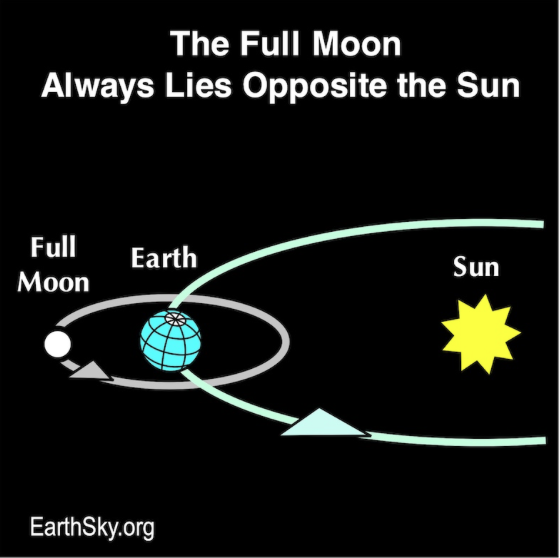
The full moon. A full moon is easy to describe — it occurs when all of the moon’s visible disk is illuminated. That happens a bit more than every 29 days, and takes place when the moon and the sun are on opposite sides of the Earth, a position called opposition:
Monthly names for the full moon each month. The names are applied to a full moon in a given month aren’t the creation of astronomers, but are simply traditional cultural descriptions people apply to a moon in a particular month. (Different cultures have different names.)
Here’s one list of those names, by month:
| Month | Moon Name |
| January | Wolf Moon |
| February | Snow Moon |
| March | Worm Moon |
| April | Pink Moon |
| May | Flower Moon |
| June | Strawberry Moon |
| July | Buck Moon |
| August | Sturgeon Moon |
| September or October | Harvest Moon1 |
| September | Corn Moon |
| October | Hunter’s Moon |
| November | Beaver Moon |
| December | Cold Moon |
Supermoons. When the full moon is closer than normal to Earth, a position called perigee, then it’s called a supermoon. Supermoons are simply full moons that are closer than average to Earth. Any month’s moon could be a supermoon, depending on whether that moon is closer to the Earth (perigee) than on average in that month and year.
This January, the Wolf Moon is closer to Earth than average, so it’s a Wolf Supermoon.
See Marta Hill, The Year’s First Bright Supermoon and the Colorful Quadrantid Meteor Shower Coincide This Weekend, Smithsonian Magazine, January 2, 2026.
_____
- “Technically, the Harvest Moon is the Full Moon closest to the September equinox around September 22. The Harvest Moon is the only Full Moon name determined by the equinox rather than a month. Most years, it’s in September, but around every three years, it falls in October.” See Anne Buckle, Aparna Kher, and Vigdis Hocken, Traditional Full Moon Names, timeanddate.com ↩︎
See also What Makes a Supermoon Super? (Animation):