Wednesday in Whitewater will be cloudy with a high of 39. Sunrise is 7:00 and sunset is 4:23 for 9 hours 23 minutes of daytime. The moon is a waxing crescent with 33 percent of its visible disk illuminated.
On this day in 1941, the Hull note is given to the Japanese ambassador, demanding that Japan withdraw from China and French Indochina, in return for which the United States would lift economic sanctions. On the same day, Japan’s 1st Air Fleet departs Hitokappu Bay for Hawaii.
The Wisconsin Supreme Court has appointed judicial panels to hear two lawsuits challenging the state’s congressional districts, a move that could lead to the Republican-leaning map being redrawn ahead of the 2026 midterms.
In twoorders issued Tuesday, justices established separate three-judge panels to hear the cases, implementing a process that was created by Republicans 14 years ago.
Under that procedure, the lawsuits against the maps will proceed in Dane County Circuit Court, where they’ll be presided over by panels of judges from multiple counties.
It’s a process that’s never been used, and until Tuesday’s orders, it was unclear whether justices would turn to it here. While the court has a 4-3 liberal majority, it has declined to hear other challenges to Wisconsin’s congressional map.
Plaintiffs in these cases, however, argued the court had no choice [but] to set those wheels in motion once their lawsuits were filed, and the court’s liberal majority agreed. Each complaint, justices wrote, constituted an “action to challenge the apportionment of a congressional or state legislative district” under the law.
“This court is required to appoint a three-judge panel,” the court’s majority wrote.
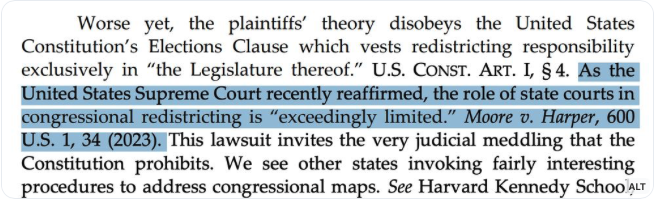
Two of the court’s conservatives — Justices Annette Ziegler and Rebecca Bradley — dissented, accusing their liberal colleagues of working to deliver partisan, political advantage to Democrats.
Does this quote actually appear in Moore v. Harper? Did Moore say that state courts’ role in congressional redistricting is “exceedingly limited”? I don’t think it did!…To the contrary: In Moore v. Harper, the majority acknowledged that state courts may play a legitimate, meaningful role in congressional redistricting. Ziegler seems to have made up a quote that (a) doesn’t appear in the opinion and (b) contradicts its holding.
Stern is right: the U.S. Supreme Court’s opinion in Moore v. Harper, 600 U.S. 1 (2023), never uses the expression “exceedingly limited.” The Court applies no such concept, expressly or implicitly. There is no circumstance in which a Wisconsin court’s opinion — or any party’s brief or other pleading — should cite that expression as though it’s part of Moore.