Good morning.

Tuesday in Whitewater will be cloudy with a high of 56. Sunrise is 6:49 and sunset is 5:29 for 10 hours 40 minutes of daytime. The moon is new with none of its visible disk illuminated.
Whitewater’s Ethics Committee meets at 4 PM and the Whitewater Common Council at 6 PM.
On this day in 1965, the Ranger 8 probe launches on its mission to photograph the Mare Tranquillitatis region of the Moon in preparation for the crewed Apollo missions. Mare Tranquillitatis, or the “Sea of Tranquility,” would become the site chosen for the Apollo 11 lunar landing.
On December 16, at public comment during a meeting of the Whitewater Common Council, a longtime resident (and current candidate for the council) spoke to oppose a possible use for Whitewater’s Innovation Center. One portion of his remarks lingers in memory.
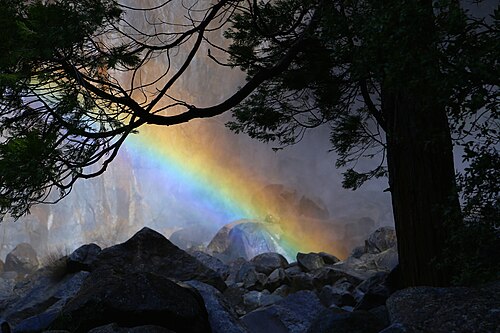
CLAIM: In his remarks, the commenter expressed concern that a proposed use might be decorated in “a bunch of rainbow colors and indoctrinate our kids right out of the womb.”
ASSESSMENT:
Now, now: What to make of this? One begins by noting that the proposal itself made no mention or claim of indoctrination of any kind, let alone about the colors of the visible spectrum.
More particularly, there are three ways one can think about rainbow colors, should they appear to adults and children. Each way is uplifting and inspirational.
As a religious matter, rainbows are, in both Jewish and Christian traditions, meant as a sign of divine reassurance. The rainbow appears, after all, as the sign of God’s covenant with Noah after the Flood: “My bow I have set in the clouds to be a sign of the covenant between Me and the earth,” Genesis 9:13. Later, the rainbow is used symbolically to describe divine radiance: “Like the look of the rainbow that is in the clouds on a day of rain, this was the look of the radiance all round, the look of the likeness of the glory of the LORD. And I saw and fell on my face and heard a voice speaking,” Ezekiel 1:28. Mention of rainbows in these passages is wholly positive (and, in Ezekiel, descriptive of divine beauty).
As a matter of science, it was Newton who demonstrated that white light is composed of seven visible colors, establishing our scientific understanding of the spectrum. See a nice summary of Newton’s insight (overturning Aristotle’s view of color) at Smithsonian Institution Libraries, The Science of Color: Newton’s Rainbow. Newton’s discovery is enlightening.
As a matter of rights, merely stating the natural diversity among people and expressing a freedom of association among equals in society, the LGBTQIA+ community uses the rainbow as a symbol. (This is merely how I would describe their use of a rainbow in my own ideological terms — fundamentally, it’s how that community defines and describes itself that matters.) Their use of the rainbow as a symbol is positive and affirming.
And look, and look — one can see the symbol of a rainbow in all three ways, together. How odd, indeed, to see rainbows in one way, exclusive of other beautiful and symbolic ways.
Rainbows?
Yes and yes again — we could, truly, benefit from seeing a few more.
.jpeg)