Sunday in Whitewater will be rainy with a high of 72. Sunrise is 6:18 and sunset is 7:33 for 13 hours 15 minutes of daytime. The moon is a waning crescent with 27.4 percent of its visible disk illuminated.
On this day in 1945, the U.S. Ninth Army under General William H. Simpson crosses the Elbe River astride Magdeburg, and reaches Tangermünde — within 100 miles of Berlin.
If consumer sentiment is down — and it is — then what condition, what variable, explains the low level of consumer confidence? Writing in Strength in Numbers, G. Elliott Morris has a plausible theory:
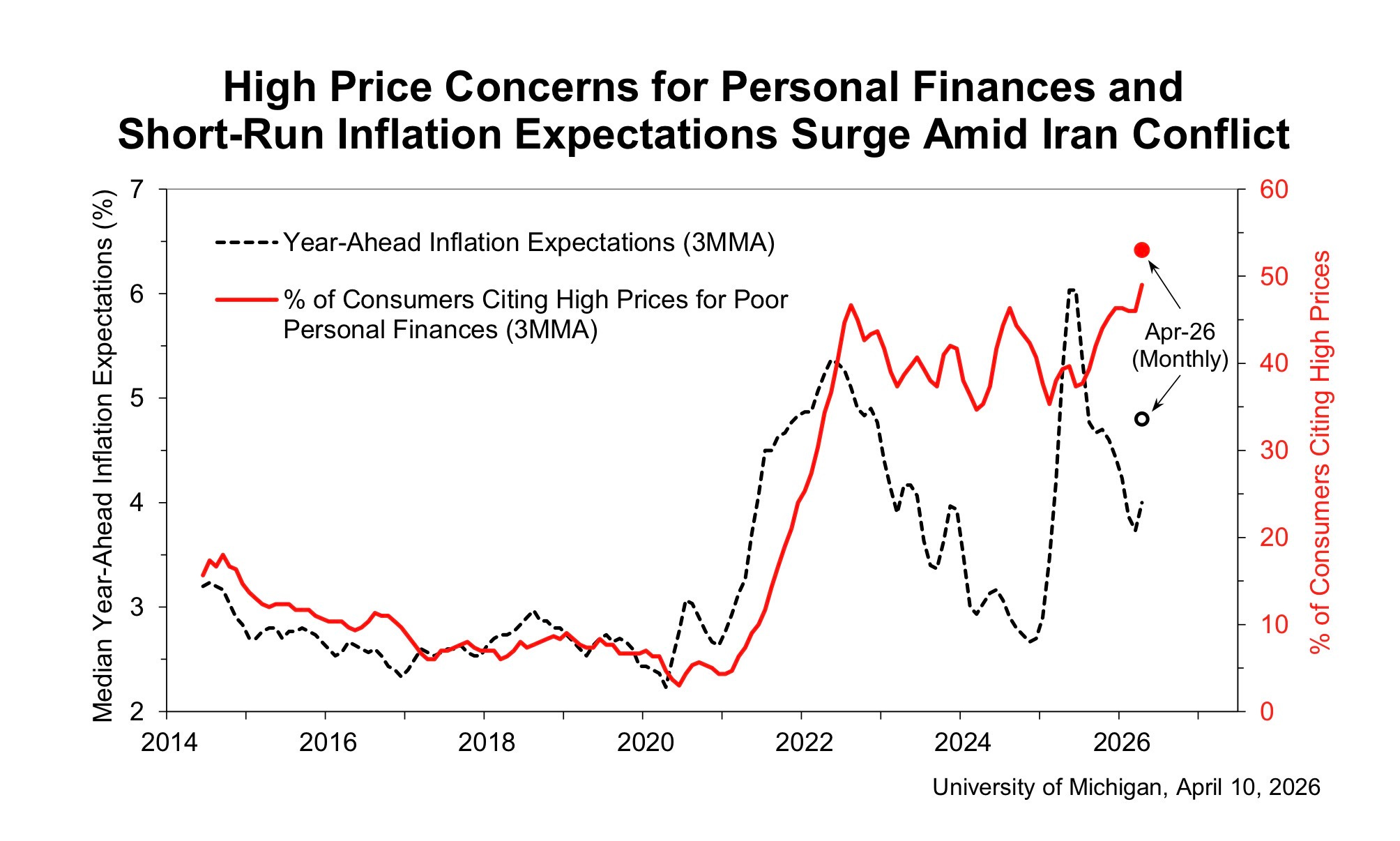
I’ve got some data I’m going to dig into next week that speaks to this more directly. But for now, look at the following chart from the Michigan survey itself. It tracks the share of consumers who cite high prices as the reason they are personally struggling financially.
Before 2021, this number hovered near zero percent. Empirically speaking prices were a non-factor in how people viewed the state of the economy.
Then, everything changed. The share of adults citing high prices as a source of anxiety went exponential during the 2021-22 inflation spike and never came back down. It’s now above 50%, likely because of the gas prices spike from the war in Iran.
[…]
While inflation dropping from 8% to 3% reflects a “cooling off” of the economy, but evidently people still mostly just see high prices for things and get upset about that. And fair enough!
My theory is that price levels account for much to most of the “puzzle” of why consumer sentiment is lower than you would predict based on the historical relationship between CPI, unemployment, the cost of money and etc.
There are many measures of economic performance, but American consumers have settled on inflation (rather than other measures like unemployment, interest rates, etc.). While there are relationships (of course) between all these measures, ordinary Americans have made high prices their high priority.
This focus on higher prices places a federal administration that is pushing higher tariffs and struggling to assure the resumption of tanker transit in the Persian Gulf in a notably weak position with consumers.
There’s a longstanding claim that Trump cheated to get into Wharton (from Trump’s own niece and aunt!). I’ve no idea about his conduct back then, but his grasp of economics is below that of an ordinary person. Here’s Trump contending that because it’s hard to get oil from the Persian Gulf, nations are sending their empty tankers to America and fill up on American oil:
“Massive numbers of completely empty oil tankers, some of the largest anywhere in the World, are heading, right now, to the United States to load up with the best and “sweetest” oil and gas anywhere in the World.”
This libertarian blogger has no idea whether Trump’s lying yet again about current events, but anyone sensible can say what increased demand for a product in one place means during a shortage in a global market: higher prices for whatever is still available. Competition over scarce oil will drive up prices for domestic and foreign buyers. This is Trump telling people they’ll pay more for oil without expressly telling people they’ll pay more for oil.
Honest to goodness.
Upcomingposts (in no decided order): The Regents, Economic Demand, Trump on Daycare, Claims of Legacy, a Particular Species of Democrat, and a Whitewater Comparative Analysis.
Lava poured from Kilauea on Thursday. It was the 44th time the Hawaiian volcano has erupted. The lava fountain reached a peak of 800 feet, according to the United States Geological Survey.