
Good morning.

Sunday in Whitewater will be sunny with a high of 77. Sunrise is 5:24 and sunset is 8:20 for 14 hours 56 minutes of daytime. The moon is a waxing gibbous with 62 percent of its visible disk illuminated.
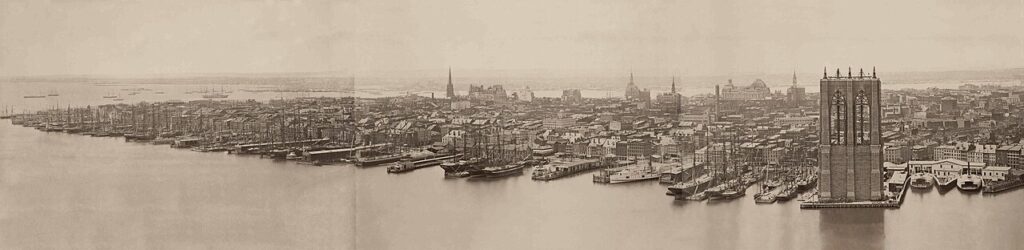
On this day in 1883, the Brooklyn Bridge, connecting Brooklyn and Manhattan, is opened to traffic after 14 years of construction.
Catherine Rampell, writing in The Bulwark, nicely describes the consequences of a pro-tariff policy:
The cost of Trump’s trade wars is often measured in the dollar value of the tariffs remitted to Customs and Border Protection—i.e., the roughly $166 billion in tariffs struck down by the Supreme Court. But in reality, the cost is much greater, and often harder to quantify.
It includes lost sales; soured relationships with longtime customers, both domestically and abroad; and the endless resources spent securing warehouses, or canceling and uncanceling production orders, or scheduling and rescheduling container shipments. It includes travel spent scouting out new factory locations in lower-tariff countries, only to find that Trump has picked a fight with those places, too. Then there are the employees who were laid off and contracts that were severed as companies tried to offset their higher costs from materials, equipment, and finished goods they import.
Layer onto that the paralyzing uncertainty caused by an ever-changing set of rules, which make it hard to plan any kind of investment or expansion. And finally, not least, there is the lingering, corrosive fear of retaliation—the concern that a company might accidentally displease the president while trying to do right by their customers and shareholders.
It is for this last reason that some firms are forgoing refunds entirely, despite being entitled to them. And no wonder: Trump himself has suggested the tariffs are part of his protection(ist) racket. “If they don’t do that [refrain from lawful compensation], I’ll remember them,” [Trump] told CNBC last month, after being informed that some large companies like Amazon were not applying for refunds.
If they remain reluctant to seek compensation, Amazon would be leaving a tremendous pile of cash on the table. In response to the company’s inaction, last week consumers filed a class-action lawsuit against the company to demand that it apply for rebates and pass along the refunds to customers. General Motors, which expects $500 million back, also reportedly considered opting out, but ultimately did apply for a refund.
See Catherine Rampell, Trump’s Tariffs Have Created an Economic Sh*tshow Beyond Your Wildest Imagination, The Bulwark, May 24, 2026.
Trump imposed unlawful tariffs and now uses coercion to prevent businesses from seeking lawful compensation.
Trump has held an obsession with tariffs almost his entire public life. He has been sure — which should make sensible people doubtful — that tariffs would restore domestic manufacturing. That restoration has not happened:
Wisconsin lost thousands of manufacturing jobs in 2025, driven in part by an aging workforce and hesitancy to expand hiring in an uncertain economy.
Between January 2025 and January 2026, the state’s manufacturing workforce shrank by about 9,500 jobs, falling from 461,100 workers to 451,600, according to data from the U.S. Bureau of Labor Statistics compiled by the Federal Reserve Bank of St. Louis. The manufacturing workforce nationally declined by about 91,000 jobs over the same period.
Industry leaders say the job losses were driven more by worker retirements than widespread layoffs, though shifting tariffs and broader economic uncertainty have made some manufacturers more reluctant to hire.
See Joe Schulz, Wisconsin lost thousands of manufacturing jobs in 2025, Wisconsin Public Radio, May 4, 2026.
In eighteen months or eighteen years, tariffs will produce only higher costs and a declining global position.
_____
Upcoming posts (in no decided order): A Whitewater Comparative Analysis, Whitewater’s Workforce, and Outcome-Driven Argumentation.
NASA’s new telescope aims for a fresh look at the Universe: