Good morning.

Saturday in Whitewater will be partly sunny with a high of 71. Sunrise is 5:20 and sunset is 8:25 for 15 hours 5 minutes of daylight. The moon is a waxing gibbous with 99.3 percent of its visible disk illuminated.
On this day in 1911, the first Indianapolis 500 ends with Ray Harroun in his Marmon Wasp winning the 500-mile auto race.

On Friday, the Wisconsin Supreme Court accepted an appeal challenging the boundaries of Wisconsin’s eight congressional districts. Two judicial panels considered separate challenges to those congressional maps, but dismissed the complaints in both cases. See Wisconsin Supreme Court Appoints Redistricting Panels and Plaintiffs in Wisconsin Congressional Redistricting Cases Propose Different Timelines. Wisconsin’s high court has now accepted an appeal from the panel’s decision in Wis. Bus. Leaders for Democracy v. Wis. Elections Comm’n. (This is the case in which Law Forward represented the plaintiffs.) Henry Redman reports:
The Wisconsin Supreme Court will hear a challenge to the state’s congressional maps on the grounds that they’re an anti-competitive gerrymander, the Court ruled Friday afternoon.
In an order that again showed the Court’s partisan divide spilling out into the public, the Court’s four liberals voted to accept the case while Justices Rebecca Bradley and Annette Ziegler accused the majority of acting as tools of the Democratic party.
The lawsuit against the maps was brought last summer by a bipartisan business group, Wisconsin Business Leaders for Democracy Coalition, represented by the progressive nonprofit Law Forward. Rather than challenging the state’s congressional maps on the grounds that they’re an unconstitutional partisan gerrymander — a tactic that has repeatedly failed — the lawsuit argues the maps purposefully protect incumbents from realistic challenges.
Because of a state law passed by Republicans in 2011, the lawsuit was first heard by a panel of three circuit court judges. In a ruling late last month, the panel dismissed the lawsuit, finding that the claims were essentially the same as those made in a partisan gerrymander challenge and therefore a question for the executive and legislative branches.
The panel’s ruling was immediately appealed to the Supreme Court because the 2011 law states that appeals of these panel rulings can’t be heard by the Court of Appeals.
While accepting the case, the Court denied a request that it be heard on an expedited schedule. With candidates for this fall’s midterm elections required to file ballot access signatures by June 1 and ballots are set to be printed shortly after, it’s unlikely the case will be concluded in time to change the state’s maps before November.
See Henry Redman, Wisconsin Supreme Court agrees to hear congressional maps lawsuit, Wisconsin Examiner, May 29, 2026. See also Wis. Bus. Leaders for Democracy v. Wis. Elections Comm’n, No. 2026AP1008, slip op. at 1 (Wis. May 29, 2026) (order):
Two observations push themselves forward. First, this case will be decided on a conventional rather than an expedited schedule:
The rules that ordinarily govern procedures in appeals to the court of appeals will apply to this appeal, including the procedures for filing a docketing statement, for filing a statement on transcript, for establishing the deadlines for the filing of briefs, etc., unless otherwise ordered by this court in a future order. See WIS. STAT. § (Rule) 809.63.
Id. at 2.
And so, Redman’s reporting on the timing of a decision is accurate: “it’s unlikely the case will be concluded in time to change the state’s maps before November.” ‘Unlikely’ here may be safely defined as ‘will not happen before November.’
A second point is that the Wisconsin Supreme Court has a lawful power of discretion to take this appeal:
The court has not previously had an opportunity to interpret the language of WIS. STAT. § 751.035(3). Although no motion is presently before us, we acknowledge that there is an unresolved question as to whether an appeal from a final decision or order of a panel in an apportionment challenge is a matter of right or a matter of this court’s discretion. We conclude that it is not necessary to resolve this issue in this case because it will not affect the outcome. See, e.g., State ex rel. Greenway v. Cnty. Ct. of St. Croix Cnty., 32 Wis. 2d
6, 10, 144 N.W.2d 569 (1966) (unnecessary to decide which version of statute applied, since the result would be the same under either version). Even if an appeal from a final decision of a panel in an apportionment challenge under WIS. STAT. § 751.035 is a matter of this court’s discretion, the court has decided that this appeal will be heard.
Id.
Of course — there is no insuperable principle of Wisconsin law that prevents the high court’s consideration of this appeal. Justice Zeigler, in her dissent, contends no more than that taking an appeal is “questionable.” Id. at 3. Questionable is no barrier to consideration; in many ways, it’s the reason for consideration.
On the contrary: questions of law, described colloquially as questionable, are presumptively — to speak in the very language of the law — justiciable. This principle would fit nicely on a 3×5 card, with room to spare: questions of law are presumptively justiciable.
The majority opinion in the court’s May 29 order rests on solid ground.
_____
Upcoming posts (in no decided order): A Whitewater Comparative Analysis, Whitewater’s Workforce, and Outcome-Driven Argumentation.
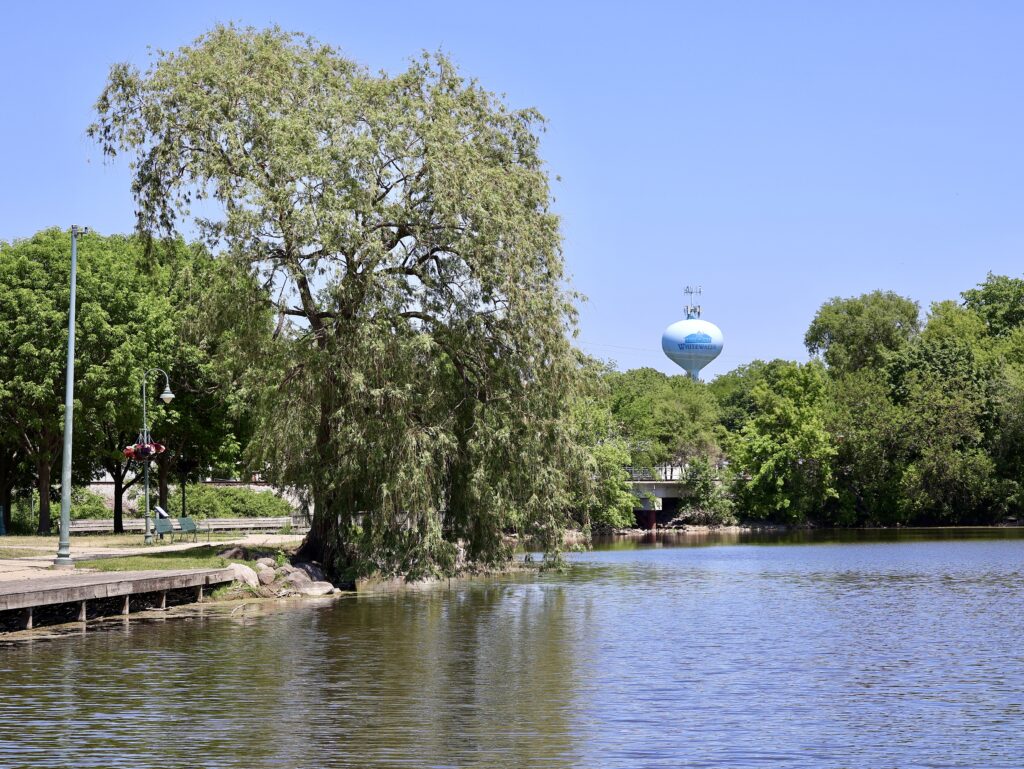
Cravath looks lovely: