
Good morning.

Saturday in Whitewater will be partly sunny with a high of 76. Sunrise is 5:18 and sunset is 8:37 for 15 hours 19 minutes of daylight. The moon is a waxing gibbous with 94.5 percent of its visible disk illuminated.
On this day in 1905, during the Russo-Japanese War, sailors start a mutiny aboard the Russian battleship Potemkin.
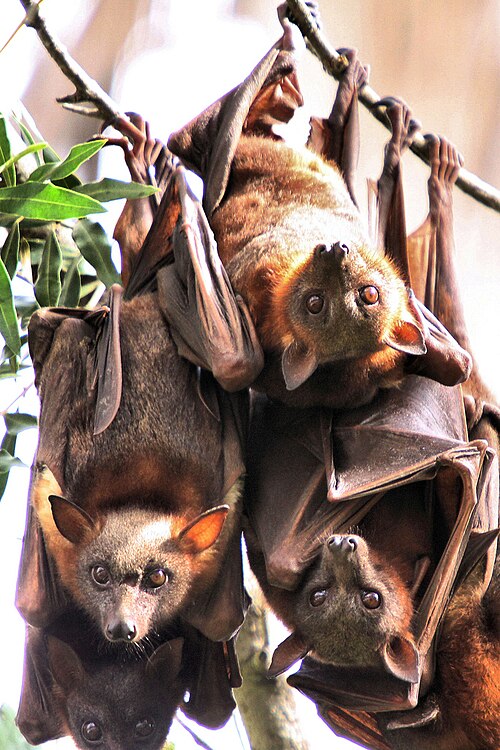
Many insects are pollinators, and among those invertebrates honey bees receive the most attention. (Indeed, they receive so much attention that one often hears nothing except honey bee, honey bee, honey bee. That repetition doesn’t capture the diversity of pollinators — it simply repeats the common name of one insect three times.)
Let’s fix that. Fortunately, this libertarian blogger subscribes to the newsletter of Bat Conservation International, this planet’s leading bat preservation society. In their latest edition, Alyson Brokaw writes of bats’ key role in pollination:
Who clocks in when the birds and bees clock out? To celebrate Pollinator Week, let’s follow the night as it travels westward around the globe to meet just some of the bats working the pollinator night shift.
[…]
Across Australia, bats are the main characters of pollination for the iconic eucalyptus forests. Bats like the little red flying fox (Pteropus scapulatus), spectacled flying fox (Pteropus conspicillatus), and grey-headed flying fox (Pteropus poliocephalus) roam long distances in search of blooming flowers. The resulting ecological and economic “bat ripple” effects are staggering: the median contribution of grey-headed flying fox pollination services to Australia’s eucalypt timber industry has been estimated at over $600 million AUD per year (with seed dispersal services contributing to recruitment of 13.9 million trees annually). The bats’ collective ‘service area’ spans up to 41 million hectares, an area roughly the size of Sweden!
Meanwhile in the northern hemisphere, the lush hills of Okinawajima Island, Japan rise dark and dense against the last wash of daylight. Beneath the canopy, pendulous bunches of purple and green flowers hang from the vines of rusty-leaf mucuna (Mucuna macrocarpa) and a Ryukyu flying fox (Pteropus dasymallus) has found them. The bat hooks a clawed thumb around a flower, pulling it closer. As the bat pushes its nose into the base of the flower, a tiny trigger at the base of the flower fires, hitting the bat’s face with a big puff of pollen. This “explosive opening” gives the bat access to the nectar within and bats may be the only visitors who can set it off, making them critical partners in this plant’s reproduction.
Across the world, in deserts and rainforests, on remote islands and over farmlands, bats have been hard at work while other pollinators sleep.
See Alyson Brokaw, World Tour of Bat Pollination: Meet the bats working the pollinator night shift, Bat Conservation International, June 24, 2026.
_____
Upcoming posts (in no decided order): A Whitewater Comparative Analysis, Whitewater’s Workforce, and a New Ethics Ordinance.
FIFA World Cup 2026 ball goes to space – Astronauts play: