I posted on May 18th about an Environmental Protection Agency contest, entitled “Rulemaking Matters,” that offers twenty-five hundred deficit-financed dollar ($2,500) prize “for the public to explain federal rulemaking and motivate others to participate in the rulemaking process.” The libertarians of Reason.tv submitted three videos to the EPA, one of which I embedded before. See, Reason.tv: Federal Regulations and You – Partners in Democracy.
Here’s another of those videos, entitled (and subtitled!) Rulemaking Matters! Enjoy.
Our forecast calls for a day of gradual clearing with a high of eighty-two degrees.
Rousseau thought that animals showed simple pity toward each other, and perhaps, after all, he was right. Wired writes about a study of ravens, in story entitled, “Ravens Console Each Other After Fights,” observing that
After ravens see a friend get a beat down, they approach the victim and appear to console it, according to new research.
Orlaith Fraser and her co-author Thomas Bugnyar watched the aftermath of 152 fights over a two year period between 13 hand-reared young adult ravens housed at the Konrad Lorenz Research Station in Austria. What they found was the first evidence for birds consoling one another.
“It’s not a good thing for your partner to be distressed,” Fraser explained. “It’s interesting to see these behaviors in animals other than chimpanzees. It seems to be more ingrained in evolutionary history.”
And there might be a bit of self-interest embedded in the birds’ actions, too. “Maybe if you are involved in a fight they might come and console you,” Fraser said.
Ravens are one species of corvid, a famously smart group of birds, so they are natural study subjects for researchers probing the uniqueness of mammalian behaviors like empathetic consolation. The consolation of fight victims has only been definitely shown in chimpanzees and bonobos. Recent studies show similar behaviors in dogs and wolves, but how consolation works in those animals hasn’t been tested.
(Citation: “Do Ravens Show Consolation? Responses to Distressed Others,” by Orlaith Fraser and Thomas Bugnyar. PLoS one Vol. 5 Iss. 5. DOI:10.1371/journal.pone.0010605)
Ravens have an august and worthy history in recorded human affairs, too. Ravens are mentioned more than once in scripture: a raven is the first to look for dry land after the flood (Gn 8:7), they serve to feed the prophets (1 Kgs 17:4-6) , God may use them to afflict the wicked (Prv 30:17), and they may not be eaten (Lv 11).
Impressive, isn’t he?
The Wisconsin Historical Society recalls that on this date in 1844, a
Utopian Community [was] Founded Near Ripon
On this date the first settler moved to the Fourierite utopian community in what is now Ripon. This communal society was based upon the teachings of Charles Fourier, a French Socialist, who urged the rebuilding of society from its foundation as the only cure for economic hardship. This especially appealed to those suffering from the 1837 Depression. The communal village was named Ceresco after the goddess of agriculture, Ceres. Also known as the Wisconsin Phalanx, the community thrived for six years, with membership reaching 180 in 1845.
The community officially disbanded in 1850 after many members decided to farm for their own profit. Families gradually left the commune to work and live on their own property. The center of the commune, the “Long House,” remained vacant until the 1930s when people suffering from the Great Depression found shelter and comfort there. Community founder Warren Chase said of the failed community “It was prematurely born, and tried to live before its proper time, and of course, must die and be born again. So it did and here it lies.” [Source: Wisconsin Saints and Sinners by Fred L. Holmes, pg. 94-104]
Here’s a video from Reason.tv’s Meredith Bragg. Entitled, “A Delicious Free Enterprise Contest Entry,” it’s one of the finalists in the the U.S. Chamber of Commerce’s “I Am Free Enterprise” video contest.
Yesterday, I posted about Whitewater local government’s unfortunate (and likely cynical) embrace of one side concerning competition between types of local businesses. See, Whitewater Local Government’s Favoritism of Some Local Businesses Over Others. This is a legitimate, private debate that Whitewater’s local government should not have embraced — this city administration over-reaches when it favors some businesses over others.
I mentioned that this city manager probably doesn’t understand these limits on government; on the contrary, he acts as a kind of third-tier, taxpayer-funded developer all too often, picking supposed winners, and rejecting supposed losers. He draws his salary from, and uses the receipts of, taxpayers’ earnings. Not one of his grand projects involves his own money; he risks the money of others, acquired not voluntarily from investors, but through taxation. There is no easier, more risk-free way, to be a wheeler-dealer.
(Wisconsin should enact a law that, for each grand project, an otherwise uninvested city bureaucrat should have to put up ten-percent of his personal wealth. We’d have fewer white elephants, failed tax incremental districts, etc.)
Setting aside city government’s illegitimate adoption of a legitimate private campaign, one finds in this Whitewater’s much greater problem: the general desire to use government for favoring of some local groups over others.
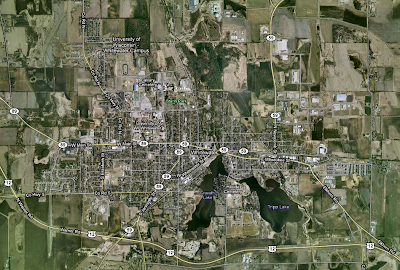
Consider the following map, of Whitewater, from Google Maps:
Who lives here? Thousands of people, and I would say — insist really — that each and every one of them who lives here is local, as government and the law should define the term. Private parties may decide for themselves, but government should not — must not — choose preferentially for some over others.
Yet, is that not one of the chronic diseases that afflicts our local government, that it favors some over others, though they are all residents?
When government itself considers some businesses — although all are within our city limits, all paying taxes — more local, then who doubts that this sends a message that some residents are more local than others?
This is not a city manager, nor is this a city administration, with a ‘common touch.’ On the contrary, this is an administration that vacillates wildly between different factions among a small, stodgy, dissipated group. There one finds this administration’s supposed leadership. If our municipal manager had a symbol, it would be the weather vane, favoring and spinning toward one faction within our small group of town squires. These town squires preside over a town beset with real problems, of which they are more responsible than everyone else, combined.
Where a sensible person sees only residents, all local by their residency here, Whitewater sees those who are truly local and those who aren’t. In enforcement, in attention, in direction, Whitewater’s government is lousy with a short-sighted bias for a few over others. So opportunistic is this city manager, so vacillating between one project to the next, that he cannot see the damage this does to principle and fairness.
The most some of these short-sighted, and mediocre, few think is that the cure for bias is to include a few more in their circle. That’s their idea of inclusion: that you, too, might be one of their small circle! No person who values the political traditions of this beautiful republic should be inclined to sit at table or trough with that ilk. The price of admission into that society is a lemming’s heart; that’s a price no one should, or need, pay.
One may talk about diversity and inclusion all one wishes. We will have neither until we have a new and better understanding of the proper, limited role of government in Whitewater: serving all equally, favoring none.
Our forecast calls for a day of thunderstorms, with a high of eighty-one degrees.
There are no municipal, public meetings scheduled for today.
In Wisconsin history on this date, the Wisconsin Historical Society recalls an event showing how ridiculous some people can be:
1997 – Sixty Arrested at Weedstock Festival
On this date sixty festival attendees were arrested at the 8th annual Weedstock Festival, a pro-marijuana event in Ferryville. [Source: Timeline Wisconsin]
Although I support changes in Wisconsin’s laws to make medical marijuana legal, I do not support illegal drug use. Really, though, whatever you think of marijuana, do you want to be the kind of person who thinks it’s trendy to go to an event like Weedstock? You must be kidding if you say you do. That’s you must be kidding, as a sober reader.
There were at least 97 people who initially thought going to Weedstock was a good idea. It’s a bad idea for lots of reasons, not the least of which being that you can expect headline-grabbing attention to the event, and lots of arrests. Now, I don’t think Weedstock was Wisconsin’s biggest crime problem, by any means. It wasn’t our one-thousandth biggest crime problem. It was, however, a great chance for public officials to grandstand, arrest people, and make a show.
No one is served through that waste of public resources. Anyone going merely abets that kind of public dog-and-pony show, the wasting of public time and effort while real problems are ignored.
On Saturday, June 12th, Whitewater will see its 13th Annual Bethel House Golf Event. I received the following letter and flyer about the event, that I am happy to post. The full letter and brochure may be viewed, downloaded, and printed through the links below.
The proceeds from this fundraiser are used entirely to support Bethel House, an ecumenical project with six housing units for families in need of shelter and providing other support services in the Whitewater area. During the last fifteen years, Bethel House has provided 75 families with housing and helped many more families with financial assistance for rent or utilities, household items, food, or referral services.
This year’s Golf Event will be held on Saturday, June 12, 2010. The day’s special activities will include golf, lunch, prize drawing, and awards ceremony. Participating as a sponsor or golfer is very important to Bethel House. This major fundraiser helps cover the costs of operation. Your contribution, large or small, will help to make this a special day for Bethel House. Sponsors for the respective holes will have their names prominently displayed at the tee for the hole that they are hosting.
We are looking forward to a great day on the course with a 9:00 AM shotgun start using a best ball scramble format. This year’s event features a $10,000 Hole-In-One prize provided by Binning and Dickens Insurance, as well as many other hole prizes for the participants. Foursome prizes for 1st, 4th, 7th, & 11th place will also be awarded. Costs for this year’s event are $50 of which $19 is tax-deductible. Fees include the 9 holes of golf, many individual and team prizes, and buffet lunch. Every golfer that registers by June 5th will be entered into a drawing for a special grand prize.
Nine Whitewater area churches, the Whitewater community, and the United Way of Jefferson and North Walworth Counties support Bethel House through subscriptions, grants, donations, and time and talents. In addition, many individuals, businesses, and organizations support Bethel House through their generous donations and efforts. For an overview of the Bethel House mission and stories of families whose lives have been helped, please see our website at www.bethelhouseinc.org. It is easy to donate via the website, as well as learn of other ways you can help.
The sponsors and volunteers of this year’s Golf Event hope that this year’s effort will result in a significant contribution towards the funds needed to annually operate Bethel House.
Come join in the fun! We look forward to seeing you and thank you for your continued support.
In towns across America, private businesses and groups compete for support. This is to be expected and defended in a free society. That competition for support need not — and should not — receive a preferential boost from local government. It’s only in a community where bureaucrats are confused about the limits of government that one sees city hall trying to boost one private effort, at the expense of other efforts. In doing so, government turns legitimately private efforts into objects of political favoritism.
Whitewater now has a Buy Local campaign, established to encourage not merely local shopping, but a particular kind of local shopping: for Mom & Pop stores over chain stores. I’m not part of this campaign, but I’d be the first to encourage merchants to organize privately as they might wish. Make no mistake: the campaign isn’t simply about encouraging shoppers to frequent merchants located within the City of Whitewater, but certain merchants over others. The City of Whitewater has endorsed this campaign, on its website, and in the remarks of her city manager, Kevin Brunner.
Here’s a Buy Local campaign emblem that now appears on the city’s municipal website:
Here are the remarks Whitewater’s city manager in support of the campaign:
The Whitewater Chamber of Commerce and Downtown Whitewater Inc. formally unveiled its “Think Whitewater-Buy Local” campaign.
The benefits of spending more of our dollars locally can’t be underestimated. The 2008 Retail Coach Study of the Whitewater Market Area showed that over $400 million “leaks” out of our community and is spent in other retail markets each year, most notably to Janesville. National studies too have shown that for every $100 dollar spent in independently owned stores, $68 returns back to the community through payroll taxes, payroll and other expenditures. If that same $100 is spent in a national chain, only $43 stays locally. If it is spent on-line, nothing comes home!
Special thanks to downtown business person Ron Binning for his leadership and dogged determination to start this program in our community, as well as the many others who have worked on developing it—good work!
For every $100 spent at a locally owned store, $45 remains in the local economy
For every $100 spent at a chain store, $13 remains in the local economy Source: BusinessWeek
“People ask if we are really local. We have to prove it to them. My response is, ask other bankers what their stock symbol is. If they have an answer, they’re not locally owned.”
Art Johnson, chief executive of United Bank of Michigan
The study that the Buy Local website cites is not, by the way, from Bloomberg’s Businessweek. It’s really from the Institute for Local Self-Reliance, a group that includes tool kits with anti-Walmart propaganda.
(See, http://www.bigboxtoolkit.com. ILSR is hardly an objective, unbiased business publication, the way one might think of Bloomberg’s publications.)
There’s a difference between starting and building a local campaign and receiving not merely community support, but the endorsement of local government. I don’t think it’s a distinction that would be apparent, or mean anything, to Whitewater’s city manager.
The whole municipal history of these last years involves intervention for ineffectual project after project, Next Big Thing after Next Big Thing, while child poverty and unemployment in the city remain above-average, and storefronts are still vacant. (There will be rationalizations and disappointments yet ahead, too: the catalogue of failed municipal projects will only grow over the next year.)
It’s also too funny to write that the “benefits of spending more of our dollars locally can’t be underestimated.” I think the city manager meant to say can’t be overestimated. In any event, that’s silly — of course the number can be either over-estimated or under-estimated. That’s why one commissions a study about it. It’s too funny to see the Retail Coach study back from the dead — how odd that it’s finally getting some use; here one sees another fine municipal investment.
Proponents of the campaign should not look favorably on the city’s endorsement, however: Whitewater’s municipal government is fickle in her devotions, has a limited attention span, and poor track record. I’d guess that the endorsement is simply government’s lip-service to the effort, all the while paving the way for an expanded Walmart.
If it should be true that every consumer in Whitewater chose to stop buying at chain stores, I would not object. That’s a free decision that each person should make on his own.
I see no reason for Whitewater’s government to interfere in that process, with a preference for some shops over other Whitewater tax-paying businesses. Walmart and Walgreen’s are located with the City of Whitewater just as much as other shops. When municipal government says says “Think Whitewater – Buy Local,” where local expressly excludes chain stores, the city is effectively saying: you’re not the “real” local.
It’s not the place of Whitewater’s city manager — no matter how many pies into which he wants to stick his fingers — to say that the thousands of people who shop in those chains weekly, and scores who work there, aren’t being locally supportive.
That’s an effort for a truly private campaign, and for private citizens, to contend about, and to decide, on their own.
Consumers should be able to decide for themselves without the misuse of government’s imprimatur.
On Saturday, June 12th, Whitewater will see its 13th Annual Bethel House Golf Event. I received the following letter and flyer about the event, that I am happy to post. The full letter and brochure may be viewed, downloaded, and printed through the links below.
The proceeds from this fundraiser are used entirely to support Bethel House, an ecumenical project with six housing units for families in need of shelter and providing other support services in the Whitewater area. During the last fifteen years, Bethel House has provided 75 families with housing and helped many more families with financial assistance for rent or utilities, household items, food, or referral services.
This year’s Golf Event will be held on Saturday, June 12, 2010. The day’s special activities will include golf, lunch, prize drawing, and awards ceremony. Participating as a sponsor or golfer is very important to Bethel House. This major fundraiser helps cover the costs of operation. Your contribution, large or small, will help to make this a special day for Bethel House. Sponsors for the respective holes will have their names prominently displayed at the tee for the hole that they are hosting.
We are looking forward to a great day on the course with a 9:00 AM shotgun start using a best ball scramble format. This year’s event features a $10,000 Hole-In-One prize provided by Binning and Dickens Insurance, as well as many other hole prizes for the participants. Foursome prizes for 1st, 4th, 7th, & 11th place will also be awarded. Costs for this year’s event are $50 of which $19 is tax-deductible. Fees include the 9 holes of golf, many individual and team prizes, and buffet lunch. Every golfer that registers by June 5th will be entered into a drawing for a special grand prize.
Nine Whitewater area churches, the Whitewater community, and the United Way of Jefferson and North Walworth Counties support Bethel House through subscriptions, grants, donations, and time and talents. In addition, many individuals, businesses, and organizations support Bethel House through their generous donations and efforts. For an overview of the Bethel House mission and stories of families whose lives have been helped, please see our website at www.bethelhouseinc.org. It is easy to donate via the website, as well as learn of other ways you can help.
The sponsors and volunteers of this year’s Golf Event hope that this year’s effort will result in a significant contribution towards the funds needed to annually operate Bethel House.
Come join in the fun! We look forward to seeing you and thank you for your continued support.
The forecast for Whitewater calls for a chance of thunderstorms with a high of eighty-six degrees.
I know of no public, municipal meetings of the City of Whitewater today. The coast is clear for private endeavors and accomplishments.
On this day in 1926, Miles Davis was born. Sixty-five years later, upon his death, the New York Timeswrote of Davis’s many accomplishments:
Mr. Davis’s unmistakable, voicelike, nearly vibratoless tone — at times distant and melancholy, at others assertive yet luminous — has been imitated around the world.
His solos, whether ruminating on a whispered ballad melody or jabbing against a beat, have been models for generations of jazz musicians. Other trumpeters play faster and higher, but more than in any technical feats Mr. Davis’s influence lay in his phrasing and sense of space. “I always listen to what I can leave out,” he would say.
Equally important, Mr. Davis never settled into one style; every few years he created a new lineup and format for his groups. Each phase brought denunciations from critics; each, except for the most recent one, has set off repercussions throughout modern jazz. “I have to change,” he once said. “It’s like a curse.”
Here’s a tribute to one of Davis’s most popular works, Kind of Blue:
I see that in Nevada, Democrats have been teasing a Republican
candidate for U.S. Senate, Sue Lowden, by hiring people to walk around in chicken suits at her campaign stops. They hit upon the idea after Lowden said that perhaps voters should barter for health care, as when “our grandparents would bring a chicken to the doctor.” The Democrats call their effort “Chickens for Checkups.”
Lowden is one of a dozen Republicans vying for the Republican nomination to face Senate majority leader Reid in the fall.
Nevada officials have now banned the wearing of chicken costumes within 100 feet of polling places, on the theory that wearing those chicken suits would constitute issuing a political message too near a polling place. See, Chicken costumes banned at Nev. polling places.
Okay. Let’s say that makes sense, as of the political message directed against a single candidate.
What about apolitical costumes? What if someone in Wisconsin wanted to wear a badger suit? That’s no partisan message — this is the Badger State. Why not be able to dress like one? What about a dairy cow costume? We’re also America’s Dairyland. Why do so? Just for the sheer joy of dressing like a badger, I’d say.
I’ll have to see if anyone has tried something like that in Wisconsin. If not, it just might represent someone’s great opportunity…
I posted not long ago on the Innocence Project’s use of DNA identification to exonerate an innocent man, and direct prosecutors toward a guilty one. Tragically, Robert Lee Stinson spent twenty-three years in prison for a crime he did not commit, until being exonerated. For all those years, an actual killer, Moses Price, was uncharged for the killing that led to Stinson’s wrongful conviction. (Price now admits through an affidavit that he was the real killer.) See, DNA to Exonerate the Innocent (and Identify the Guilty).
The Milwaukee Journal Sentinel has a more recent story with a similar result: a man wrongly convicted is to be released based on DNA evidence, evidence that implicates someone else, an accused serial killer, of the crime. William Avery spent five years in prison for allegedly killing Maryetta Griffin. Accused serial killer Walter Ellis is a match for the DNA found on that victim, as well as several other victims. See, Man convicted in 1998 killing to be released.
These cases represent failures of justice: for failing to identify the likely (and in one case, the admitted) killer, and worse still for accusing, charging, trying, convicting, and imprisoning two innocent men.
And yet, during the many years when these men were imprisoned, were the respective prosecutors not confident, insistent, sure of themselves? For every claim of certainty, for every declaration of confidence, for every strident remark, something else lay beneath, to be revealed: the truth, that Stinson and Avery were innocent, and that Price was, and Ellis may be, truly guilty of these killings.
We are told that those who serve in government, those high officials who wield power, are public servants. I think the term, truly, is merely self-serving. A man’s skill, insight, judgment, and character are not made better through a taxpayer-funded salary. When, so very often, such a man will imply that they are, he asks you to become a fool, believing him an angel. God has all the messengers He needs; a high public office creates not one more.
There’s a brief article in New York Magazine about libertarian John Stossel. Stossel now has his own show on the Fox Business Network, after almost thirty years at ABC. (Fox Business and Fox News are different channels.)
The article shares a few tidbits that one may not have heard before, including the enmity that the late Peter Jennings held for Stossel, disliking Stossel’s advocacy journalism. (Too funny, really, that Jennings saw advocacy in Stossel, but didn’t seem to notice his own consistent advocacy, including a lamentable bias against Israel, the Middle East’s only democracy. Here, I am quite sure the advantage is Stossel’s.)
What’s on the calendar for Stossel? The article mentions that he’s “editing an upcoming special called What’s Great About America, in which he celebrates, among other things, racial tolerance and the entrepreneurial spirit.” Stossel has critics, too:
A guy came up to me recently and said, “I hope you die soon,” Stossel says. “A lawyer from Legal Aid. He viewed my reporting as an attack on the poor because I said government doesn’t help. I find that interesting. People forget that before we had a welfare system there were these mutual-aid societies that were ethnically exclusionary: Koreans helping Koreans, blacks helping blacks. They knew better who needed help and who needed a kick in the ass.”
Stossel’s show airs Thursdays at 7 p.m. central on the Fox Business Channel.
See, Tea-Vee Time. (The title’s an anachronism: most libertarians easily pre-date the Tea Party movement, a movement that is, in any event, only partly libertarian.)