
Public Meetings
Tech Park Board
by JOHN ADAMS •
Public Meetings
Alzheimer’s Association Support Group Facilitator Training
by JOHN ADAMS •
Alzheimer’s Association to Offer
Support Group Facilitator Training
Help Others! Become a Support Group Facilitator
Milwaukee, WI – February 25, 2010 – The Alzheimer’s Association is offering training for individuals interested in becoming a facilitator of an Alzheimer’s Association sponsored support group. The Alzheimer’s Association sponsors over sixty support groups in southeastern Wisconsin for family caregivers who are providing care or support to persons with memory loss, Alzheimer’s disease and other types of dementia. Training to become a facilitator for one of these support groups will be held from 8:30 a.m. to 4:30 p.m. on Tuesday, March 23, 2010 at the Alzheimer’s Association, 620 S. 76th Street, Suite 160, in Milwaukee.
To inquire about this free training and to receive an application to become a volunteer support group facilitator, please contact Krista Scheel, Alzheimer’s Association, at 414-479-8800 or via email at krista.scheel@alz.org.
The Alzheimer’s Association is a national non-profit organization whose mission is to eliminate Alzheimer’s disease through the advancement of research, to provide and enhance care and support for all affected and to reduce the risk of dementia through the promotion of brain health. For more information about Alzheimer’s disease or local programs and services visit www.alz.org/sewi, call the 24/7 Helpline at 800-272-3900 or the Spanish line at 414-750-6640.
Economy
Do We Really Want to Mimic Western Europe’s Stagnant Welfare States? – Cato @ Liberty
by JOHN ADAMS •
Less productive, growing more slowly over time, and more likely to fall back into recession – Western Europe is a bad example, not a model, for America.
Only for those erroneously seeing an economy as a fixed pie could Western Europe’s redistribution schemes make any sense.
See, Do We Really Want to Mimic Western Europe’s Stagnant Welfare States?
City, Police
Whitewater, Wisconsin’s Tiny Chameleon
by JOHN ADAMS •
Whitewater’s police chief, Jim Coan, is a candidate for the director of public safety position in Mankato, Minnesota. I’ve written about his candidacy before, in a post entitled, Whitewater Chief Coan’s Interview with the Mankato Free Press: Dodgy! after reading his answers to questions from the Mankato Free Press.
(Readers who’ve emailed remarking that Coan’s answers were likely written are surely right. Some are also right to note that this makes the deceptiveness of his answers even more egregious, as he had time to think about what he’d write; there’s no ‘slip of the tongue’ excuse available.)
I recently teased about Coan as a chameleon who thinks he’s genuinely yellow if he sits on a banana. Coan’s an opportunist that way, crafting statements that he perhaps thinks will be effective in the moment. He seems to react, without true understanding of his reaction, or appreciation of others’ situation. That’s why, time after time, Coan says something foolish, that embarrasses Whitewater.
There’s more to Coan’s empty and ham-handed opportunism, though. He’s not just a chameleon, but a particularly tiny one: he’s small and light, buffeted by the wind from plant to plant, landing here or there, and reacting to each new destination. Landing on an apple, he’s red for a while, and during that time, red is the most highly special and excellent color in all the world. Carried off to a pear, Coan’s quick to proclaim the superiority of all things green.
(There’s your pun: Coan was himself green for a bit, advocating foot patrols opportunistically only when gas prices were high. Chief for years by that time, but a staple of community policing in a small town only came about after Coan saw the chance for a headline. People in town new better, and saw Coan’s effort for what it was — the superficial over the substantive.)
Sitting in a basket of apples, Coan must think that red’s the color to extol; nestled in a bushel of pears, Coan must assume that it’s advantageous to talk about green. In this, one finds only an ineffectual leader with no core principles except the insistence that mere words professed with sincerity are, themselves, principles.
Look back, just two short years, and one finds clearly what Coan’s leadership has meant. The paper that so servilely flacked Coan’s leadership in the face of ridicule from all sides offered a three-part police series that nicely summarized what Coan has done to Whitewater.
The second part of the Register‘s series was entitled, “A Diverse Community Presents Challenges.” (See, my post, The Register’s Three-Part Police Series, Part 2.)
From my post:
The Register lists three groups as contributing to the diversity of
our community: (1) Hispanics, (2)students, and (3) juveniles.The inclusion of juveniles as a category constituting diversity is unusual. Every community in America has juveniles; if they’re a category leading to diversity, then there is no place on earth that’s
not diverse. When a category applies to everyone, it’s unique to no one, and useless as a distinguishing characteristic.That leaves us with two groups that make us diverse, by that reckoning: Hispanics and UW-Whitewater students. Those groups do contribute to our diversity. I would not think, though, the most telling attribute of either group is that it presents a challenge.
Imagine how this sounds to someone not trapped in the town faction’s echo chamber: “Minorities and College Kids Present Challenges for the Rest of Us.”
That would be a headline that’s false and insulting simultaneously.
Diversity — and the official conduct that supports diversity is tolerance — has taken a bigger hit from Coan’s action and inaction as police chief than from any other cause. Coan has tolerated the
intolerance that led to federal lawsuits, a destructive raid, and intrusive questioning of motorists. I am absolutely convinced that we would have had neither federal lawsuit had Coan not led poorly, bungled thoroughly, been obstinate to the plaintiffs’ concerns, and had he not defended obvious misconduct so zealously.
In doing so, he disgraced himself, our city, and burdened many good officers on our police force with his mediocrity and mendacity. He has put his own selfishness ahead of the American political tradition of individual liberty and fair, honest conduct.
Diversity is a challenge (the weakling’s word for a problem) to those who don’t believe in it, those who support it opportunistically.
It’s not a challenge for the rest of us — it’s a consequence of the natural liberty that America recognizes.
When one sees young people or minorities as a challenge, one treats them as a problem, and to treat them as a problem is to mistreat them.
To see where that leads, one could look toward England, and see how English officials treat young people people they fear may cause problems. In a story entitled, Weaponzing Mozart, Brendan O’Neill shows how treating ordinary groups of people as a problem leads to mistreatment:
In recent years Britain has become the Willy Wonka of social control, churning out increasingly creepy, bizarre, and fantastic methods for policing the populace. But our weaponization of classical music?where Mozart, Beethoven, and other greats have been turned into tools of state repression marks a new low.
We’re already the kings of CCTV. An estimated 20 per cent of the world’s CCTV cameras are in the UK, a remarkable achievement for an island that occupies only 0.2 per cent of the world’s inhabitable landmass.
A few years ago some local authorities introduced the Mosquito, a gadget that emits a noise that sounds like a faint buzz to people over the age of 20 but which is so high-pitched, so piercing, and so
unbearable to the delicate ear drums of anyone under 20 that they cannot remain in earshot. It’s designed to drive away unruly youth from public spaces, yet is so brutally indiscriminate that it also drives away good kids, terrifies toddlers, and wakes sleeping babes.Police in the West of England recently started using super-bright halogen lights to temporarily blind misbehaving youngsters. From helicopters, the cops beam the spotlights at youths drinking or
loitering in parks, in the hope that they will become so bamboozled that (when they recover their eyesight) they will stagger home.And recently police in Liverpool boasted about making Britain’s first-ever arrest by unmanned flying drone. Inspired, it seems, by Britain and America’s robot planes in Afghanistan, the Liverpool cops used a remote-control helicopter fitted with CCTV (of course) to catch a car thief.
Britain might not make steel anymore, or cars, or pop music worth listening to, but, boy, are we world-beaters when it comes to tyranny.
And now classical music, which was once taught to young people as a way of elevating their minds and tingling their souls, is being mined for its potential as a deterrent against bad behavior.
In January it was revealed that West Park School, in Derby in the midlands of England, was “subjecting” (its words) badly behaved children to Mozart and others. In “special detentions,” the children are forced to endure two hours of classical music both as a relaxant (the headmaster claims it calms them down) and as a deterrent against future bad behavior (apparently the number of disruptive pupils has fallen by 60 per cent since the detentions were introduced.)
One news report says some of the children who have endured this Mozart authoritarianism now find classical music unbearable. As one critical commentator said, they will probably “go into adulthood associating great music – the most bewitchingly lovely sounds on Earth- with a punitive slap on the chops.” This is what passes for education in Britain today: teaching kids to think “Danger!” whenever they hear Mozart’s Requiem or some other piece of musical genius.
Readers of this website know that I have sometimes been critical of England. Critical, truly out of sadness: England has become a place less recognizable each year to a free and decent people. I know in my heart — I am absolutely convinced — that America will never make the terrible mistakes England is making. We will never be less than a free people. We will never treat each other the way the English treat their children.
Whitewater has the advantage that Chief Coan’s just not as shrewd (nor as resolute) as English officials, so he’s yet to hit upon the schemes they’ve used. Our burden is this: he is a factory of small regulations, small-minded thinking, and self-praise.
Coan’s leadership may always represent a lawsuit waiting to happen, a gaffe or indifferent remark to correct, and embarrassments to overcome. That’s our singular burden, ours to carry.
Charity, Press Release
Press Release: Alzheimer’s Association to Offer Support Group Facilitator Training
by JOHN ADAMS •
I received the following press release that I am happy to post:
Support Group Facilitator Training
Milwaukee, WI – February 25, 2010 – The Alzheimer’s Association is offering training for individuals interested in becoming a facilitator of an Alzheimer’s Association sponsored support group. The Alzheimer’s Association sponsors over sixty support groups in southeastern Wisconsin for family caregivers who are providing care or support to persons with memory loss, Alzheimer’s disease and other types of dementia. Training to become a facilitator for one of these support groups will be held from 8:30 a.m. to 4:30 p.m. on Tuesday, March 23, 2010 at the Alzheimer’s Association, 620 S. 76th Street, Suite 160, in Milwaukee.
To inquire about this free training and to receive an application to become a volunteer support group facilitator, please contact Krista Scheel, Alzheimer’s Association, at 414-479-8800 or via email at krista.scheel@alz.org.
The Alzheimer’s Association is a national non-profit organization whose mission is to eliminate Alzheimer’s disease through the advancement of research, to provide and enhance care and support for all affected and to reduce the risk of dementia through the promotion of brain health. For more information about Alzheimer’s disease or local programs and services visit www.alz.org/sewi, call the 24/7 Helpline at 800-272-3900 or the Spanish line at 414-750-6640.
Daily Bread
Daily Bread for Whitewater, Wisconsin: 2-26-10
by JOHN ADAMS •
Good morning,
Whitewater’s forecast — weather, not politics — calls for an increasingly cloudy day, with a high temperature of twenty-nine degrees.
There’s no school today. For all the free-range students in Whitewater, today — have fun, be responsible. Everyone says that you’re our future, and of course, you are. You’re also part of our present, and some of us are stodgy, cranky, and irritable — best way to enjoy the day is to avoid running afoul of those who’ve become more even more restrictive over time. We were all young once; some of us have just forgotten.
Today’s a historic anniversary in the drive for more liberty and equality, as the Wisconsin Historical Society recalls:
1912 – Rock County Women’s Suffrage League Formed
On this date local women met at the library and formed the Rock County Women’s Suffrage League. The group elected Mrs. A.P. Lovejoy as their president. [Source: Janesville Gazette]
One can have both more liberty and more equality, as the fight for universal suffrage shows.
Poverty
Increases in Wisconsin Poverty: A Sad Circumstance Familiar to Whitewater, Wisconsin
by JOHN ADAMS •
Over at the online Capital Times, there’s a story entitled, Despite Madison’s Relative Affluence, Poverty Rate Growing Rapidly.
Here’s an excerpt:
Being poor, hungry or unemployed is a world far removed for many in Wisconsin’s capital city, where arguments over passenger rail, Badger sports or high-rise hotels can dominate the news.
But the reality is Madison’s poverty rate is climbing – rising nine times faster than the rate of other U.S. cities, according to a new report from the liberal-leaning Brookings Institution.
Since 2000, the poverty rate (defined as a family of four with an income under $21,800) in Madison has jumped from 15 percent to 17.7 percent. That?s one in every six residents.
Perhaps more significantly, the city has seen an explosion in the number of low-income children as measured by participation in subsidized or free-lunch programs. One of every two students in the Madison Metropolitan School District is now considered ?low income? using the lunch standard. In 1990, just one in five Madison school kids qualified.
“It’s very much a part of the changing demographics in the district,” says Madison school Superintendent Daniel Nerad.
And the overall picture is not improving. In its report, Brookings predicts Madison will likely see its poverty rate jump another 1.1 percent this year, surpassing the average poverty rate for the 95 largest U.S. cities.
It’s a complicated issue. Certainly, the slumping economy has strained many family budgets. Others point to overwhelmed social services and a lack of job-training programs. Some blame an influx of low-income residents from the big cities of Chicago or Milwaukee.
But one thing is clear to Elizabeth Kneebone, senior researcher at Brookings, one of the nation’s oldest think tanks: “Madison has historically done better than a lot of places but we are seeing a significant increase in poverty,” she says.
Measuring poverty in college towns can be somewhat misleading, researchers caution, since many students live below the poverty line and are counted by the U.S. Census Bureau as officially “poor” even if they come from wealthy families.
But Kneebone says students don’t account for the growing number of poor residents in Madison. According to the American Community Survey, an annual estimate from the Census Bureau, Madison added nearly 8,400 residents living below the poverty line between 2000 and 2008, a 29 percent increase….
There’s little argument the recession has pushed more Wisconsin families into poverty. The state’s overall poverty rate has climbed from 8.7 to 10.7 percent since 2000. The national rate also increased, from 12.4 to 13.1 percent over that same period.
The focus on child poverty is sound, as children are particularly vulnerable, and that focus on family and children in Whitewater is one that I’ve written about consistently. See, the focus on family poverty from a series I previously even posted.
We have a campus, but college students are not the reason we have an above-average poverty rate for Whitewater. We have a high-rate of family and child poverty.
Although we’re a small town, and poverty statistics are not compiled so frequently for us as they are for larger towns, our high rate must be higher still since the recession.
Sadly, Madison faces a problem we also face: talk about big projects while large numbers of children are impoverished, and as poverty rates increase. The coexistence of big-ticket construction projects while many are indigent is a sign of a disordered and diseased economy.
It’s more common in the third world than elsewhere, a sign of unproductive economic relationships and the vanity of project-hungry bureaucrats. It might seem odd, that Whitewater’s bureaucrats talk with sanctimoniously about their work, its supposed uniqueness and extraordinary nature, while so many in this rural town struggle, if only one would consider the contrast between words and conditions.
These projects don’t improve life for ordinary people the way free, mutually beneficial exchange in the marketplace does; they are ornaments mostly to the pride of managers and planners.
We have no reason to scoff at Madison, or the third world — our own small community makes similar mistakes.
Daily Bread
Daily Bread for Whitewater, Wisconsin: 2-25-10
by JOHN ADAMS •
Good morning,
Whitewater’s forecast calls for a mostly sunny day, with a high temperature of twenty-six degrees.
In our schools, it’s Beach Day at Lincoln Elementary School, proud home of the Leopards. A Book Fair continues today at Washington School.
There’s an update, of sorts, on Whitewater Police Chief Coan’s candidacy for the public safety director’s post in Mankato, Minnesota: one of the other candidates has dropped out of the running. The Mankato Free Press, in a story entitled, “Public Safety Finalist LaDue Says I Don’t Want Job,” reports that
One of four finalists for Mankato’s public safety director job has withdrawn.
Owatonna Police Chief Shaun LaDue sent notice to the city that he no longer wants to be considered as a candidate for the position, being vacated at the end of March by Jerry Huettl’s retirement. LaDue said information he received while visiting Mankato with the other three candidates last week made him realize he wasn’t the right person for the job.
“A significant part of that thought process had a lot to do with the responsibilities within the Fire Department — an area that I have little or no experience with,” LaDue said in an e-mail.
Another candidate “would be a stronger choice based on the immediate priorities and demands of this position,” he added.
“The department has not had much of any change for several decades and, as a result, I feel that I simply am not the right candidate at this time,” La Due said. “As I look toward the final one-third of my law enforcement career, I envisioned something different.”
It’s the last paragraph of the excerpt that offers an indication (as did an earlier story in the Free Press on Mankato’s Joint Civil Service Commission) about how the search will likely go.
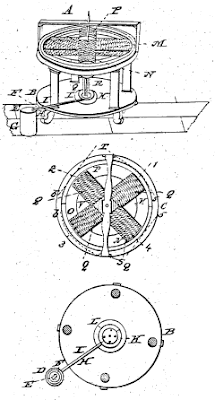
Today’s a historic day in American — and world — science. On this day in 1837, Thomas Davenport received a patent for the electric motor. In Feb. 25, 1837: Davenport Electric Motor Gets Plugged In, Wired describes Davenport’s remarkable achievement:
Davenport was a Vermont blacksmith and an amateur tinkerer, not a trained scientist or engineer. When he heard about a machine that used an electromagnet to separate high-quality iron ore from the lower-grade stuff, he became intrigued. Unable to meet with the inventor, he sold his brother’s horse and a number of other possessions to buy an electromagnet of his own.
Like many Wired readers, Davenport then proceeded to take apart the nifty gadget he’d just bought in order to find out how it was made. Soon he was making his own batteries and electromagnets, and in half a year had come up with a motor powered by direct current from a galvanic wet cell.
Davenport’s wife, Emily, maintained notes for him and even suggested modifications and materials to be used in his experiments. She also contributed strips of silk from her wedding dress to use as insulation for the wires.
The brush-and-commutator scheme Davenport invented is still used in electric motors today. Current flows through electromagnets mounted on a wheel, causing them to move towards fixed permanent magnets, rotating the wheel through a half turn. As the wheel turns, its motion breaks the circuit powering the magnets and connects a new circuit with opposite polarity. That in turn reverses the polarity of the electromagnets, pushing each one away from the magnet it’s just passed while pulling it towards the next magnet in the circle, thus pushing the wheel through another half turn. The process repeats, and the wheel on the motor goes round and round.
Laws/Regulations
Dallas Bans Useful Signs for Small Business
by JOHN ADAMS •
Whitewater, Wisconsin’s a small town, but it has a big city’s thirst for regulation. We’ve had more than one fuss over whether a sign is acceptable, or a sandwich board in compliance, etc. Our town fathers have expended considerable effort on these concerns. Imagine their surprise when they learn that Dallas, Texas has jumped ahead of Whitewater in the race to regulate, restrict, and control whenever possible.
Hey, Whitewater’s town fathers — show Dallas who the real regulators are!
City of Dallas Bans Window Signs for Small Business
(h/t — Reason.com) more >>
City, Planning
Haste Makes Waste
by JOHN ADAMS •
Whitewater’s City Manager, Kevin Brunner, trumpets what he considers a speedy advancement of a publicly-funded tech park for Whitewater. Brunner considers this a sign of accomplishment. He’s wrong, twice over. First, there’s less to Whitewater’s supposed accomplishments than meets the eye. Second, and even more important for our town, is the fundamental understanding among successful managers that a rapid pace for developing a tech park is a bad idea. Brunner may think that rushing though a project shows talent, but some tasks deserve more care & consideration than a hurried approach.
Earlier this month, the Daily Union wrote unquestioningly about Whitewater’s tech park in a story entitled, Whitewater Tech Park advances; panels to study second building. The story was, in the main, more dictation than reporting. I wrote on that newspaper story, and our tech park, in two posts entitled, On Whitewater’s “Advancing” Tech Park, Part 1 and On Whitewater’s “Advancing” Tech Park, Part 2.
(I offered several points in those two posts: (1) the story touted officials’ unverifiable claims, (2) one would expect some advancement with millions in public money, (3) there should be even more tenants by now, (4) the anchor tenant selected is unsuitable for a tech park, (5) current lack of a strategic plan is cavalier and embarrassing, (6) the building is ordinary, not unique in design, and (7) there’s nothing green about an office building, and it’s insulting to environmental concerns to pretend otherwise.)
Last week, the Journal Sentinel‘s Kathleen Gallagher wrote about successful tech parks in a story entitled, The Business of Growing Up: Madison pays attention to its young companies.
Two truths stand out prominently from her story: successful tech parks require careful thought over an extended period, and they’re filled with private ventures, not taxpayer-funded agencies.
Madison’s tech parks and the rest of its entrepreneurial infrastructure grew out of a unified strategy and long-term cooperation among the city, the state, the university and business people.
“This hasn’t happened overnight,” said David Linz, southeast regional director for the Wisconsin Entrepreneurs’ Network. “It’s been 25 years in the making.”
The list also reveals private companies after private companies that have used these tech parks to get started — even when the term ‘incubator’ isn’t used, that’s a common use for a successful tech park. These parks “…have helped breed companies including Jellyfish.com, Mirus Bio Corp., NimbleGen Systems Inc., Third Wave Technologies and TomoTherapy Inc., which have become some of Wisconsin’s biggest entrepreneurial success stories.”
Even without seeing how others have carefully, thoughtfully, and deliberately planned tech parks, one could sense that Whitewater’s park began as a slapdash effort — a scramble after federal money, a rush to issue public debt (bonds) to pay for a building or two.
That’s why a story that simply repeats what local leaders say isn’t much of a story. It’s more stenography than reporting, dutifully recording local bureaucrats praising themselves for accomplishments that simply aren’t very accomplished.
Daily Bread
Daily Bread for Whitewater, Wisconsin: 2-24-10
by JOHN ADAMS •
Good morning,
Whitewater’s forecast today calls for a chance of snow, with a high temperature of twenty-five degrees.
This may be a day without a public meeting for the City of Whitewater. There’s our mid-week respite. Enjoy.
When one starts a timeline, it helps to start from the beginning. It helps even more when the timeline is a genuine one, not something still being ‘finalized.’ Finalized is just another word for incomplete. That beginning — when need became apparent, was August 2008, not January 2010.
That’s eighteen months ago, not merely one month ago. If Whitewater’s bureaucrats would only try harder, they could count that far back — fingers and toes would be more than enough to get Whitewater’s leaders to 18, with 2 to spare.

The Gazette reports that the urban chicken movement took a hit in Janesville, with a measure for urban chickens being defeated, 5-2 before the Janesville Common Council. They’ll be back:
Resident Diane Van Horn said she was disappointed by the decision but predicted the issue wouldn’t go away.
“We’re not done yet,” she said, noting chicken advocates now are organized and have a leader in Allison Rollette.
The idea of raising chicken in cities is spreading, she said.
Yes, it is. Go chickens, go!