FREE WHITEWATER

Daily Bread for Whitewater, Wisconsin: 1-26-10

Good morning,

The forecast for Whitewater calls for flurries and a high temperature of about nineteen.

Our school district will hold a public listening session this afternoon, on charter schools. Here’s the announcement in full:

Dear Members of the Whitewater Community:

As we continue exploring building a 21st century learning community, we are ready to look more closely at each of the variety of options that were addressed in our panel discussion on December 16. Included in that discussion were charter schools, curriculum foci in the areas of science, technology, engineering and math (STEM), world languages, entrepreneurship, and post secondary educational opportunities. We will specifically be looking at charter schools at our next listening session as this option is the most time sensitive due to application deadlines.

We have invited back the two statewide experts, Mr. Barry Golden from the Wisconsin Department of Public Instruction and Mr. John Gee from the Wisconsin Charter Schools Association, to continue to share specifics related to charter schools.

Please consider attending on Tuesday, January 26 from 4:00-6:00 at the University of Wisconsin Whitewater University Center (UC) upstairs ballroom. Free parking is available in Lot 7.

We look forward to having you continue this exploration with us.

Sincerely,

Suzanne M. Zentner, Ph.D.   Mary Whitrock
District Administrator Curriculum/Staff Development Coordinator

Whitewater Community Development Authority Meeting

The Community Development Authority meets this afternoon, at the municipal building, beginning at 4:30 PM.

The agenda for that meeting, and a list of upcoming meetings, is available online.

See, CDA agenda.

If there are groups in the city that deserve more scrutiny, the CDA, along with the Police and Fire Commission, would be at the top of any reasonable person’s list.

A small town should be a more open place, but the tendency to staff board after board with the same people, either dependable or compliant depending on one’s view, leaves a small town with less openness than many big cities.

And yet, in time, this too shall change.

Inbox: Reader Questions, Comments, Etc.

Here a sampling of some questions and comments from recent email messages, to which I have responded privately, but will summarize and answer here.

For those faraway who once asked me how many cows are in Whitewater

I’m tardy in answering that question, as you have reminded me. In fact, I took a cow-searching drive through Whitewater in December, and recorded remarks along the way for subsequent transcription and posting.

There’s a regulatory angle in it all, too.

I promise to put it up tomorrow.

Why have I posted about televised meetings, and why do I now have a film reel/video icon on the right side of my website?

Because televised meetings are a great benefit to the city, offering the most accurate account of what actually happens at one of our public meetings.

Unfortunately, our public access cable team cannot be everywhere at once. Fortunately, they don’t have to be: Wisconsin law allows ordinary citizens to record public meetings, and requires accommodation of ordinary citizen recording.

In 2010, beginning in a few months, I wouldn’t wonder, we will see the exercise of these rights in Whitewater. Just as important, our small town will see the defense of these rights at law.

Legal justifications for decisions in this town are often thin and flimsy. An American town deserves better, and we will only get something better if someone exercises his rights, and defends that exercise at law. One always prefers an easier route, but it is better to prepare for a harder one.

The days of poorly publicized meetings, with little more than a few vague lines as minutes, will end for this town. Some of our public meetings have never seen the light of a movie lens, so to speak. For everything I have ever written, there’s a dozen times as much to be done.

In all of it, there’s the great adventure of being an American citizen.

I’ll post much more about this as the time gets closer.

Why no Facebook page?

Facebook seems like too much to me; I like having my own website, set up the way I like, and a second Facebook page would be too fancy for FREE WHITEWATER.

This website does have a Twitter account, and I like the simple, succinct format of Twitter. I learn a lot from others’ tweets, and enjoy following them.

Here’s a question that just came in today, to which I quickly replied: I was wondering what is your opinion of the recent Supreme Court decision regarding campaign funding?

Here was my brief reply:

I think it’s a great victory for free speech. I will post on it this week, and I will write about how local – not federal – enforcement of campaign finance laws is often biased and used to penalize dissenters, to the benefit of incumbents.

The fewer restrictions on speech, the better.

Will catblogging be back, why did it go away, have I stopped liking cats, etc.?

I like cats a great deal. I won’t say I love them, because if I did, I know one particular reader who would quickly ask, “Well, if you love them, why don’t you marry one?”

It may seem surprising, but for some people, a line like that still seems new. There are a lot of surprises in correspondence; I enjoy the unexpected range of opinion very much.

I enjoy reading what others write more than writing, myself — much appreciated, and many thanks.

Daily Bread for Whitewater, Wisconsin: 1-25-10

Good morning,

It’s likely to be a snowy day today, with little or no accumulation, and a high of about 32 degrees.

There’s no school today.

But there is dancing, probably, somewhere in the city: unplanned, unscheduled, unsupervised, and unregulated.

One could not say the same, on January 25th, 1932 in nearby Janesville, as the Wisconsin Historical Society recalls:

1932 – Janesville Prohibits Sunday Dancing

On this date the Janesville council deadlocked, 3-3, on an ordinance that would have permitted public dancing on Sundays. [Source: Janesville Gazette]

Here’s a video, from 2006, of dancers having fun at a jitterbug camp:

Link: http://www.youtube.com/watch?v=Ht5d8zSYbYA

They’re having a great time. The sky hasn’t fallen. On the contrary — we’re better for it. more >>

The Libertarian Vote

Blogger and law professor Ilya Somin has a post up called ‘The Libertarian Vote,’ in which he describes recent findings on the number of libertarians in America:

David Kirby and David Boaz have published a new Cato Institute study estimating the size of the “libertarian vote.” They conclude that about 14% of American voters are libertarian in the sense of broadly opposing government regulation in both the economic and social realms. As a libertarian think tank, Cato obviously has a strong interest interest in coming up with a high estimate of the number of libertarian voters. However, Boaz and Kirby rely on polling questions from the National Election Study, a widely respected comprehensive survey of American political opinion developed by primarily liberal political scientists. They also note that other research by Gallup and Zogby comes up with higher estimates for the number of libertarian voters (20 to 25 percent). Other recent surveys show that the vast majority of Americans prefer smaller government with fewer services to larger government with more services (58 to 38 percent), and that trust in government is generally low.

Somin offers much more in the post, including whether actual membership in the LP is a good idea (he says no) and whether the Tea Party movement offers libertarians promise (he says it’s a good start).

NASA and the Free Market

Not long ago, I wrote that it would be a good idea to turn human space exploration from NASA’s responsibility to the private sector.

Imagine how happy I was to see a blog post from Dallas entitled, NASA Believes in the Free Market.

The headline promised auspicious news – another efficiency from free exchange – the adoption of an idea that libertarians have long supported. We believe in exploration, and that human space exploration and travel will develop most robustly with private incentives.

I was disappointed when I read the post: NASA is trying to sell some of its aging space shuttles. That’s hardly the the privatization of space exploration; it’s more like government as flea market and yard sale.

Optimist that I am, I had hoped the headline meant more; optimist that I yet remain, I believe even this step is a step in the right direction.

NPR.org – For This Libertarian, Obama’s First Year Looks Grim

David Boaz, executive vice president of the libertarian Cato Institute, offers thoughtful remarks on where the Obama Administration has gone wrong, and what the president might do about it.

By pressing such a big-government program, Obama has energized a small-government element in the electorate that had been demoralized and pushed aside by a big-government Republican president. Right now, that movement looks likely to turn a lot of Democrats out of office this fall….

Some people point out that Ronald Reagan had low approval ratings after a year. But his policies then produced a strong recovery, and there’s no reason to expect that imposing more burdens on a struggling economy will have good results.

Obama has several models to choose from: He could reverse his tax-spend-and-regulate policies and hope for the same economic and political results that Reagan achieved. He could, like Bill Clinton, recognize the political obstacles to his sweeping ambitions and learn to work with Republicans on modest reforms. He may well end up like Lyndon Johnson, with an ambitious domestic agenda eventually bogged down by endless war. But I don’t think his wished-for FDR model – a transformative agenda that is both popular and long-lasting – is in the cards.

See, NPR.org – For This Libertarian, Obama’s First Year Looks Grim

Yes, despite my platform from my imaginary campaign for Congress, I’m willing to quote from NPR. It’s not that NPR is terrible, it’s that it shouldn’t be government-funded.

Until then, any port in a storm!

Daily Bread for Whitewater, Wisconsin: 1-22-10

Good morning,

Today’s Whitewater forecast calls for a cloudy day, with a high of thirty-three degrees.

There’s no school today, leaving the community to face free-range juveniles throughout the city. We’ll muddle through, I’m sure.

On this day in 1950, according to Wired, a true innovator is acquitted: “Jan. 22, 1950: Jury Acquits Tucker of Fraud.”

Along with seven business associates, Preston Tucker — founder and namesake of the Tucker Car Corporation and the creator of the ultramodern Tucker ’48 sedan — is found not guilty of 25 counts of mail fraud, five counts of violating SEC rules and a single count of conspiracy to defraud.

The company, however, would not survive the bad press and production delays that the trial imposed. The name “Tucker” would become synonymous with a failed business dream….

Tucker, an automotive enthusiast and charismatic entrepreneur, had promised the public something pretty radical: a new car that was to be a total departure from prewar designs. The sedan would have a rear engine, a laminate windshield, side-impact protection and a trademark center headlight that turned with the front wheels — a feature that became a trademark of the Tucker’s appearance….

The SEC raided the Tucker plant on May 28, 1948, forcing Tucker to cease production and lay off 1,600 employees. The trial began October 4, with the prosecution trying to prove that Tucker never meant to build a car and that the sole intent of Tucker Car Corporation was to defraud investors.

Tucker’s defense attorneys argued that the Tucker was ready for mass production and that the company would have never built a plant and hired employees if it had only been a fraud. A former Tucker dealer, while testifying for the prosecution, inadvertently won favor for Tucker when he said his own ’48 sedan was the “finest car I have ever driven.” Attorneys even parked eight Tucker ‘48s in front of the courthouse and offered jurors the opportunity to take a ride.

After 28 hours of deliberation, the jury returned a verdict of not guilty on all charges. The unflappable Tucker famously told the press that “even Henry Ford failed the first time out.” Sadly, though Tucker would attempt to build another sports car with investors from Brazil, he died of lung cancer in 1956. Today, fewer than 50 complete Tuckers still exist, most of them in private collections.

Conspiracy theories surrounding the investigation abound, many of which added to the drama of the mostly historically accurate Tucker biopic, Tucker: The Man and His Dream. While a David-versus-Goliath story always makes a good movie, many people today think the Tucker Car Corporation always intended to build a car, and that the Big Three automakers — fearing competition from an upstart competitor — were behind the SEC’s investigation of Tucker.

Here’s the trailer from Tucker: The Man and His Dream:

Link: http://www.youtube.com/watch?v=mL-AFSAIln0 more >>

On Whitewater, Wisconsin’s Recent Bond Rating

Whitewater City Manager Kevin Brunner recently touted an A2 rating from Moody’s Investor Services. It’s what he didn’t say that’s most telling.

In his January 15th Weekly Report, Whitewater City Manager Kevin Brunner announced an affirmation from Moody’s Investor Services of the city’s A2 bond rating. The city’s rating is assigned to the sale of million dollars in bonds, of two different types. The bonds are public debt, that the city must repay with interest. Brunner included the Moody’s announcement, with his own preface, in his weekly report.  

Here are my remarks, with the full announcement from Brunner appearing at the bottom of this post, for reference.

Moody’s rating of ‘A’ is actually a common rating — over half of municipalities rated have received it over a thirty-year period.

The A2 rating that Whitewater received (as re-affirmation) isn’t exceptional — it’s common. Moody’s rates municipal bond investments on a broad category scale as follows: Aaa, Aa, A, Baa, Ba, and so on. Within a category, such as ‘A,’ there’s additional differentiation between A1, A2, etc.

In the thirty-year period between 1970 and 2000, of the municipal bond investments Moody’s rated, over 54% were rated as ‘A.’ That’s right — over half. It’s hardly an exceptional rating — ‘A’ is the most common rating as a broad category across an entire generation of Moody’s ratings. See, Moody’s US Municipal Bond Rating Scale.

Here’s Moody’s own distribution chart, reproduced as Fair Use commentary:
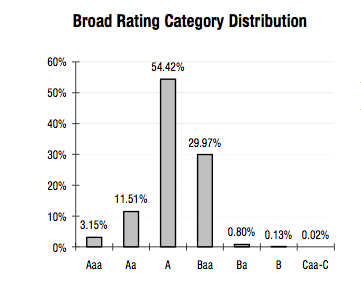
Whitewater’s in the middle, with a rating like most others.  It’s certainly not exemplary.

Not only that, but Whitewater’s investments received an A2 rating, less than some others (that is, A1) within the most common category of ratings. We’re in the middle of the middle, so to speak — no better than typical.

That’s how Whitewater rated, but the Whitewater city manager’s announcement tells nothing of the the commonplace nature of the rating. On the contrary, one would think that the city had won some sort of prestigious honor.

Even a steak sauce does better:


There’s a habit in Whitewater to insist that pig’s ears are silk purses. No bother trying to make one from the other – here insistence alone is enough.

Moody’s — receives compensation for any solicited rating — only unsolicited ratings require no payment to Moody’s.

There’s much that has been written about the benefits and risks of solicited and unsolicited sets of ratings. Of this one can say with certainty that where the rating is solicited, the firm has received compensation for its services, but gains access to records it requests. Where the rating is unsolicited, the firm rates without financial interest, but bases the rating only on public information.

A solicited, and supposedly objective analysis in these issues comes for a price; the success of an issue may depend on the rating. Everybody involved in these transactions knows as much.

The bond rating depends most on the city’s ability to repay the bond issue with interest. Analyses of the actual conditions of residents are secondary to the ability of the city to tax to repay the debt with interest.

In this regard, Brunner’s like a man who buys a pricey suit and assumes that the purchase proves he’s in good health.  There is, of course, more room to tax – after all, it was Brunner who recently proposed an increase in the tax levy, in the middle of a deep recession, until Common Council saw better than to heap burdens on the city’s residents.  Residents would have been worse off if he had his way.

Moody’s analysis shows how much Whitewater depends on the university, rather than city-sponsored projects, for its stability and survival.

Even a casual glance at the Moody’s report — and Brunner must have done as much — reveals that Moody’s fundamentally bases its rating on the obvious truth that

city’s economy is dominated by the University of Wisconsin-Whitewater campus. While the associated property is tax-exempt and consequently unavailable as a taxable resource, Moody’s believes that the stability and employment opportunities that it affords local residents are significant positive credit factors. The university is by far the largest employer with over 1,000 employees and enrollment has hit a record level of approximately 11,000 students. The school continues to expand and, as evidence, has recently opened a new business school and residence halls this fall. In 2008 the value of the city’s building permits swelled due to a $30 million university construction project.

These aren’t accomplishments of city government — the campus props up the town.  I’ve argued as much for years.  The City of Whitewater may thank the State of Wisconsin for whatever opportunity we have.  These are not accomplishments of the city’s politicians and bureaucrats.

The rating’s analysis shows that we lag Wisconsin and America.

Both Madison and Milwaukee — even Milwaukee, with all her troubles – have higher ratings.   Whitewater’s median family income trails Wisconsin, and unemployment is over the state average.  No mention of child poverty, by the way — a figure that would not be affected by the presence of students (the presence of which Moody’s uses as an excuse to explain Whitewater’s below-average income statistics.)

Our rate of child poverty is astonishingly high — about one in four children.  A taxpayer funded tech park that relies on a taxpayer-funded agency as an anchor tenant will do nothing for them.

The rating ignores alternatives to borrowing.

Understandably, Moody’s merely reviews if the city can pay back a multi-million obligation, even if it has to tax more to do so.  I am sure that there is more to take from common residents — even the Sheriff of Nottingham could find an additional farthing or two from some ordinary person in Sherwood Forest.

There’s no analysis of whether this is the right plan and course for Whitewater.  The alternatives to the plan of a few middling bureaucrats’ vain ambitions to gobble as much stimulus money as possible, with additional debt heaped on the city as a result, are beyond Moody’s scope.

About Whitewater’s “successful use of tax increment districts (TIDs), including five additional TIDs established in 2007…”

Did someone write Moody’s analysis on April 1st?  It’s not even a suitable fool’s day joke.  If all the tax incremental districts were so successful, why would city manager Brunner bother to write, in his preface to his proposed 2010 budget, that “I also want the Finance Director to evaluate possible city debt savings through restructuring/refinancing. This will be especially critical in the next few months if the distressed TID legislation is approved by the State Legislature as expected and we will be look at how TID #4 could be extended beyond its current life.”

Moody’s analyst, you might want to call 911: Whitewater TID 4 may need a defibrillator, a distressed TID bill, something…

The local press coverage of the bond rating.

One can see an unquestioning view of public officials over at a local newspaper.   (Too funny, especially, is Brunner going on about how it would be unrealistic to expect the rating to be higher. Well, he’s right about at least one thing.)

Ultimately, crowing over a commonplace rating, and ignoring the very words that show Whitewater lags behind, serves not Whitewater, but advances only one bureaucrat’s overweening vanity.

From the city manager’s Weekly Report:

City Receives A2 Bond Rating for Upcoming Borrowing for Technology Park Development

Earlier this week, Moody’s Investor Services issued the following report on the city’s finances and continued to assign an A2 rating to the city bond issues that are scheduled for sale next Tuesday. Given the current economy and municipal financial difficulties, maintaining existing bond ratings can be difficult with a number of downgrades and only a very few upgrades occurring. Reading the report is very interesting and provides a good objective review of our community and its financial condition.

NEW YORK, January 13, 2010 —

Moody’s Investors Service has assigned an A2 rating to the City of Whitewater’s (WI) $3.3 million Taxable General Obligation Community Development Bonds, which will be offered as Build America Bonds, and $2.1 million General Obligation Refunding Bonds. Concurrently, Moody’s has affirmed the A2 rating on the city’s outstanding general obligation debt affecting $14.1 million. Both the taxable and tax-exempt bonds are secured by the city’s general obligation unlimited tax pledge. The community development bonds will finance infrastructure improvements within the city’s technology park (tax increment financing district four). The tax-exempt bonds will refinance three state loans and two privately placed loans for a net present value savings. The A2 rating reflects the city’s sound financial position, stable local economy significantly anchored by a state university, and manageable debt profile.

LOCAL ECONOMY DOMINATED BY STATE UNIVERSITY EXPECTED TO REMAIN STABLE

Whitewater is favorably located 45 miles southeast of Madison (general obligation rated Aaa/stable outlook) and 55 miles southwest of Milwaukee (rated Aa2/negative outlook). The city’s economy is dominated by the University of Wisconsin-Whitewater campus. While the associated property is tax-exempt and consequently unavailable as a taxable resource, Moody’s believes that the stability and employment opportunities that it affords local residents are significant positive credit factors. The university is by far the largest employer with over 1,000 employees and enrollment has hit a record level of approximately 11,000 students. The school continues to expand and, as evidence, has recently opened a new business school and residence halls this fall. In 2008 the value of the city’s building permits swelled due to a $30 million university construction project.

The city’s tax base is moderately-sized at $639 million, though this excludes the university campus, and growth over the last five years has been somewhat measured, averaging 5.1% increases annually. The city has encouraged diversity and growth through the successful use of tax increment districts (TIDs), including five additional TIDs established in 2007. Wealth indices are skewed downward given the presence of the large student population which accounts for 78% of the population. While the per capita income figures reflect the impact of the substantial student population (65.7% of the state average), the median family income is much stronger at 91.1% of the state average. Walworth County’s (general obligation rated Aa2) unemployment rate of 7.8% in October 2009 was slightly higher that than of the state and nation.

SOUND FINANCIAL POSITION SUPPORTED BY CONSERVATIVE MANAGEMENT

Moody’s expects the city to maintain a sound financial position due to prudent management evidenced by relatively healthy reserves. Over the last five years, the city has maintained essentially balanced operations with the exceptions of fiscal 2004 and 2008. In fiscal 2004, the city drew down its reserves by $584,000 due to a one time expenditure of $623,770 to retire the city’s unfunded pension liability. In fiscals 2005, 2006 and 2007 the city’s General Fund balance remained stable at $2.5 million, equal to 29.5% of fiscal 2007revenues. The city realized a deficit of $197,000 in fiscal 2008 due to higher than expected expenditures related to snow and ice removal early in the year and flood clean-up over the summer. While the city did receive about $100,000in Federal Emergency Management Agency (FEMA) reimbursement, the funds did not cover the entire out-of-pocket amount spent by the city. Officials report that fiscal 2009 year-end results will likely reflect a slight deficit of up to$68,000, though a portion of this is expected to be offset by unspent contingency funds. The city had budgeted the use of about $68,500 in reserves in fiscal 2009 to meet operational costs. Notably, the city did not implement any staff reductions or furloughs. In fiscal 2010 the city’s state shared revenue is expected to decline by $68,000, the city reduced its General Fund levy, and $75,000 of General Fund reserves were applied to the budget. Favorably, over $90,000 was budgeted as a contingency expenditure (equal to 1% of the budget) and, due to unused taxing margin year after year, the city can roll forward about $360,000. Although the city applies a modest amount of reserves to the budget each year, management expects to adhere to its General Fund balance policy of maintaining a minimum of 20% of the subsequent year’s budget.

more >>

Wall Street Journal: The U.S. Isn’t as Free as It Used to Be

No, it’s not, is it?

The United States is losing ground to its major competitors in the global marketplace, according to the 2010 Index of Economic Freedom released today by the Heritage Foundation and The Wall Street Journal. This year, of the world’s 20 largest economies, the U.S. suffered the largest drop in overall economic freedom. Its score declined to 78 from 80.7 on the 0 to 100 Index scale.

The U.S. lost ground on many fronts. Scores declined in seven of the 10 categories of economic freedom. Losses were particularly significant in the areas of financial and monetary freedom and property rights. Driving it all were the federal government’s interventionist responses to the financial and economic crises of the last two years, which have included politically influenced regulatory changes, protectionist trade restrictions, massive stimulus spending and bailouts of financial and automotive firms deemed “too big to fail.” These policies have resulted in job losses, discouraged entrepreneurship, and saddled America with unprecedented government deficits.

See, The U.S. Isn’t as Free as It Used to Be.

Shelby Steele on Reagan

From Shelby Steele’s essay, “Obama and Our Post-Modern Race Problem,” where Steele comments on Reagan:

Reagan reached the White House through a great deal of what is called “individuating”—that is he took principled positions throughout his long career that jeopardized his popularity, and in so doing he came to know who he was as a man and what he truly believed.

He became Ronald Reagan through dissent, not conformity. And when he was finally elected president, it was because America at last wanted the vision that he had evolved over a lifetime of challenging conventional wisdom. By the time Reagan became president, he had fought his way to a remarkable certainty about who he was, what he believed, and where he wanted to lead the nation.

So very true: In this was the strength of Reagan, and an example for common people.

Daily Bread for Whitewater, Wisconsin: 1-21-10

Good morning,

The forecast for Whitewater calls for a chance of freezing drizzle, and a high of thirty-one degrees.

It’s market day pickup at Lincoln School today.

Tonight, at 7 PM, the League of Women Voters will have a program on the U.S. Census, in the Common Council chambers in the municipal building.

In Wisconsin History on this date, the Wisconsin Historical Society recalls a particular crime spree from 1935, from nearby Janesville:

1935 – Five Janesville Youths Arrested

On this date five Janesville boys, ages 13-16, were arrested for a string of burglaries, including the thefts of cigarettes, whisky and blankets. While in the police station, one of the boys tried to crack the safe in the chief’s office. [Source: Janesville Gazette]

The account offers no additional detail; we don’t know what happened to the would-be safe cracker, or the others. For the safe-cracker — a combination of audacity and foolishness that one seldom sees.

On the Innovation Center’s Anchor Tenant

Small-town Whitewater is spending about eleven million dollars in federal money and municipal debt for a Technology Park, with a showcase Innovation Center. The amount is more than the annual budget of the city, and it’s federal deficit spending, and municipal public debt, that will make this project possible.

(Note: I will comment generally on the bond issue for the project, and the rating attached to it, tomorrow.)

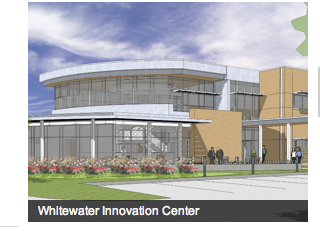
Here’s an artist’s depiction of the planned Innovation Center:

It’s stylish in a contemporary way.

The Innovation Center has been looking for an anchor tenant, and now it has one: CESA 2, a Cooperative Educational Service Agency.

Here’s the announcement from Whitewater’s city manager, Kevin Brunner:

Anchor Tenant for Whitewater Innovation Center Confirmed This Week

The Cooperative Education Services Administration (CESA) District 2 Board approved a ten-year lease this week for space in the new Whitewater Innovation Center. CESA 2 will be an anchor tenant for the Center and will lease about 10,000 square feet in the new building which is scheduled for construction beginning in early spring.

CESA 2, which is currently leasing space in Milton, provides educational support and training services for over 70 school districts in southern Wisconsin. CESA 2 is expected to bring over 50 full and part-time employees to work at the Innovation Center as well as host daily teacher and administrator training sessions that typically have between 20 and 100 attendees.

As a member of the Whitewater Technology Center Board of Directors, I am very excited about having CESA 2 come to Whitewater and the new Innovation Center. CESA 2 will bring a lot of economic activity and jobs to the community as well as the Whitewater University Technology Park.

What’s CESA? It’s a forty-seven year old state-created agency “to assist districts in providing quality educational opportunities for students….[to] help school districts share staff, services and
purchasing, and provide a link between local districts and the state.”

Much of the work that CESA performs concerns laudable services to schools, including special education students. The CESA branch serving our community is CESA 2. Our CESA serves a large number of districts.

More about CESA is available at the following link:

http://www.cesa2.k12.wi.us/about/

A few observations on choice of this anchor tenant, for the Tech Park’s Innovation Center.

What’s an Innovation Center and Tech Park?

When one thinks of technology, and innovation, one typically thinks of pioneering American companies, that created products or services that were attractive, and from that attraction, whole new fields and opportunities arose. There’s a good reason for this — America has excelled at this sort of private, entrepreneurial initiative time and again.

For it, we are the envy of the world.

It distorts and stretches the meaning of both innovation and technology to apply it to any organization, anywhere, at any time.

There’s a way, of course — empty and thin — that one might describe most activity as technology-related. One might say that because a taxi company uses two-way radios, it’s a technology-based company.

One might also say that a company whose employees have found a better use for a photocopier in their building has been innovative. Before, they might have stapled documents after copying them; now, they’ve discovered that the photocopier can staple documents for them. That’s hardly an innovation as one would reasonably define it.

In the end, calling something an Innovation Center, or a Technology Park, does not make it so. Yet, the name sounds fancy, surely. The value of the park should depend on the work done, and not the name.

The City of Whitewater might as well have produced an even grander name, something like Genius Enclave, if inapplicability were the goal.

It’s so very characteristic of a limited perspective that one hears about jobs (in this case relocated, not new ones) but not about the cost of those jobs, and whether this community benefits from this multi-million dollar projects as against other possibilities (e.g., tax reduction, reduction of regulations).

There’s also something insubstantial about a bureaucrat insisting that a tenant will produce a ‘synergy’ – that is, literally, interaction of two elements such that the total result is greater than the sum of the two. (See, Brunner’s comments in the interview to which I link, below.)

Easy to say, of course, and saying so sounds very modern. It’s much harder to verify.

Without verification, it’s just another smooth-sounding word, unsubstantiated.

CESA 2 is not a Reasonable Choice for a Tech Park Anchor Tenant

CESA is, I am sure, a fine organization. It’s just not a technology concern, and it never will be, by any reasonable definition. It’s not even a private organization — CESA itself discloses that

“[t]he leading source of CESA funds, in all cases, was revenue from member school districts which totaled $68.1 million, or 63% of all monies received. Revenue from federal ($16.7 million, 15% of the total) and state governments [sic] ($14 million, 13%) were the other major sources of funds.”

CESA isn’t a technology concern — not one bit. It’s a state-mandated agency, feeding from tax dollars, that will fill up space in a technology park built on tax dollars and public debt. I’m sure they do good work; it’s just not a tech enterprise.

Our great find of an anchor tenant amounts to giving a taxpayer-dependent agency about one-quarter of the space in a taxpayer-funded Innovation Center.

We’ve created nothing new and innovative — we’ve relocated an agency from its current location in Milton, Wisconsin. I would say that their loss is our gain, but then Milton’s not spending millions for all of this.

Carts Before Horses.

When a park for technology comes before the demand of technology companies for space in Whitewater, bureaucrats will scramble to fill the place with any tenant. Having departed from a commitment to following private demand, and thus addressing true community needs, the City of Whitewater embarks on a presumptuous project from a few middling bureaucrats and their back-patting supporters.

There’s a story about all this, over at the Daily Union. See, CESA 2 tenant for Tech Park. The story mentions other matters, some of which I will address tomorrow. The story presents unquestioningly Brunner’s opinions on the topics therein. This is unsurprising: it’s part of our sad, local tradition toward officials, and what one fading paper did for so long another now does.

There’s nothing surprising in this – it’s very much to be expected, about the project, its description from Whitewater officials, and in press accounts.