FREE WHITEWATER

Daily Bread for Whitewater, Wisconsin: 11-30-09

Good morning,

There’s a forecast for partly sunny skies, with a high of forty.

There’s a half day of school today, for students, beginning in the afternoon. It’s a transition back to a single month of school before Christmas Break.

You’d likely be unaware only if you’re from far away: it’s been a great season for our college campus’s football team: “Whitewater continues to be amazing.” (UW-Whitewater 45, Illinois Wesleyan 7.)

Today’s an odd day in Wisconsin history: the incorporation in 1837 of a bank that never truly came into existence:

1836 – Bank of Milwaukee Incorporated

On this date the Wisconsin Territorial Legislature passed into law legislation incorporating the Bank of Milwaukee. The bank never opened its doors for business due to the panic of 1837 and other events.

More on the blank is available online at the Wisconsin Historical Society website.

Daily Bread for Whitewater, Wisconsin: 11-27-09 (Spotted Cow Edition)

Good morning,

There’s a forecast for mostly sunny skies, with a high of thirty-nine. The ‘mostly sunny’ or ‘partly sunny’ forecast is a standard in Wisconsin — the skies just aren’t as sunny as other places in America. There’s extraordinary natural beauty in Wisconsin, but one often walks under a slightly clouded sky.

There’s no school today, and no public meetings scheduled for the City of Whitewater, either. In that, one might find an excellent question for students when they return to school next week:

Without any public meetings in the city, without a single committee, task force, or project being planned, do you now feel 1/365th less well-off? Do you feel that, without that guiding hand, you and your families lost something, as though the day were, in some way, taken from you?

One can be very sure of the answer, and still have little hope that its meaning will register on those in public office so certain of their indispensability.

New York’s loss is our gain — those in New York don’t know what they’re missing: They don’t deserve our beer: Spotted Cow confiscated in NYC.

They do know, though, why they’re missing it — a law that diminishes choice by requiring a tavern to purchase only from a state-approved wholesaler.

Happy Thanksgiving

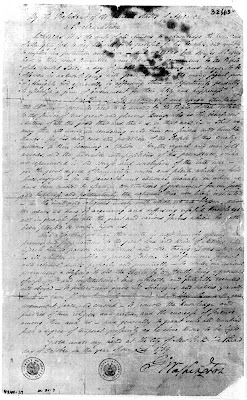
George Washington issued the first presidential, thanksgiving proclamation, long before Thanksgiving Day was a federal holiday, acknowledging a holiday already established in American tradition.

[New York, 3 October 1789]

By the President of the United States of America. a Proclamation.

Whereas it is the duty of all Nations to acknowledge the providence of Almighty God, to obey his will, to be grateful for his benefits, and humbly to implore his protection and favor–and whereas both Houses of Congress have by their joint Committee requested me “to recommend to the People of the United States a day of public thanksgiving and prayer to be observed by acknowledging with grateful hearts the many signal favors of Almighty God especially by affording them an opportunity peaceably to establish a form of government for their safety and happiness.”

Now therefore I do recommend and assign Thursday the 26th day of November next to be devoted by the People of these States to the service of that great and glorious Being, who is the beneficent Author of all the good that was, that is, or that will be–That we may then all unite in rendering unto him our sincere and humble thanks–for his kind care and protection of the People of this Country previous to their becoming a Nation–for the signal and manifold mercies, and the favorable interpositions of his Providence which we experienced in the course and conclusion of the late war–for the great degree of tranquillity, union, and plenty, which we have since enjoyed–for the peaceable and rational manner, in which we have been enabled to establish constitutions of government for our safety and happiness, and particularly the national One now lately instituted–for the civil and religious liberty with which we are blessed; and the means we have of acquiring and diffusing useful knowledge; and in general for all the great and various favors which he hath been pleased to confer upon us.

And also that we may then unite in most humbly offering our prayers and supplications to the great Lord and Ruler of Nations and beseech him to pardon our national and other transgressions–to enable us all, whether in public or private stations, to perform our several and relative duties properly and punctually–to render our national government a blessing to all the people, by constantly being a Government of wise, just, and constitutional laws, discreetly and faithfully executed and obeyed–to protect and guide all Sovereigns and Nations (especially such as have shewn kindness onto us) and to bless them with good government, peace, and concord–To promote the knowledge and practice of true religion and virtue, and the encrease of science among them and us–and generally to grant unto all Mankind such a degree of temporal prosperity as he alone knows to be best.

Given under my hand at the City of New-York the third day of October in the year of our Lord 1789.

Go: Washington

Letter image courtesy the George Washington Papers at the Library of Congress.

Come on, Wisconsin Politicians! You can lie at least as well as anyone in California or New York!

Here’s the link to a map of Stimulus Jobs Inflated by State.

In nationwide totals, this private tracking effort has uncovered reports amounting to 90,489 bogus stimulus jobs — and still counting.

What’s Wisconsin show?

1. C3T Construction Co. in Milwaukee claimed to have created 24 jobs on projects that have not begun and for which it has received no money.

2. Statewide, 17 different Head Start programs gave raises to their employees and counted them as new or saved jobs.

3. In Milwaukee, United Migrant Opportunity Services claimed to have created 113 jobs with just $18,000.

4. In Fort McCoy, JRC Inc. reported creating 10 jobs on a project that has not started and which has still received no stimulus money.

5. In Madison, housing complexes, normally covered under Section 8, were instead counted as stimulus recipients this year and claimed to have saved 49 jobs. The Obama administration has said that such contracts will no longer be counted in stimulus job numbers in the future.

What?!!?? That’s it? What are the Badger State’s politicians, bureaucrats, lobbyists, and non-governmental agencies doing with their time? Look at the map — in big states, politicians are lying like crazy to impress the Administration and Congress, and get more money. The least our leaders could do is to fabricate creatively like other places.

Yet, perhaps, I’m not being fair. After all, the absence of entries may indicate that Wisconsin’s politicians are more clever than the rest of America’s politicians, and are harder to expose as frauds, liars, and cheats. Years of bipartisan corruption across Wisconsin, in Madison, Milwaukee, and in counties big and small, may finally be paying off.

Shrewd, very shrewd.

Daily Bread for Whitewater, Wisconsin: 11-25-09

Good morning,

One often hears that Wisconsin must be a cold and snowy place, but it’s only true in part. Much of our year, in spring and fall, in cold and rainy, not quite cold enough for snow, but instead warm enough only for a cold rain. That’s been our weather yesterday, and perhaps today: a forecast for rain with a high in the upper forties. The National Weather Service depicts the day ahead like this:

I don’t know of any public meetings for the City of Whitewater today, and there’s gain in fewer. People complain that bureaucrats and public officials work too little; it’s just as much the case that they don’t work as little as they might, little being to the community’s benefit.

It’s the last day before Thanksgiving break in our schools. Some students from the high school have a field trip to Mexican stores and restaurants in town. One could schedule all sorts of trips, but this is probably one of the best that one could schedule. Interesting, close at hand, and as much Whitewater as any other part of town.

If there are two local stories about Whitewater to read today, consider these:

Whitewater school board adopts contract for district support staff. If an open meeting is closed in the woods, and no one comes by, does it make a sound?

One more in Walworth County judicial race. Where a sitting district attorney perhaps ponders whether a judgeship might be more valuable than a gold watch, or productive, private employment.

In Wisconsin history, the Wisconsin Historical Society recounts the birthday and adventures of Governor Albert George Schmedeman, someone of whom I had never heard previously:

1864 – Governor Al Schmedeman born today

On this date Albert George Schmedeman was born in Madison, Wisconsin. In 1913 Schmedeman was appointed the United States foreign minister to Norway under President Woodrow Wilson. He served in this capacity until 1921. In 1925 Schmedeman was elected mayor of Madison, a post he held for 4 terms until his election as governor in 1932. In 1934 Schmedeman lost a leg in a tragic accident, and failed to win reelection as governor in 1935. He died in Madison on November 25, 1946. [Source: First Ladies of Wisconsin, The Governors’ Wives by Nancy G. Williams, p. 168,261]

Walworth County’s Justice Can’t Be Blind — She’s Looking for a Victim’s Wallet

We often hear that justice, personified as Justitia, is blind: that she is impartial, temperate, and reasonable. Blind, perhaps, but only to the superficial, the emotional, or the self-interested. A statue of Justitia so sculpted sits before many court houses.

I don’t recall a similar statue in Walworth County, our county seat, and it’s probably better if we don’t have one; why give someone a false impression?

There’s a story from Fox 6 Milwaukee about Walworth County’s lawsuit against a crime victim to collect part of the cost of an expert the county hired to aid in the prosecution of those who victimized her.

It’s — how should one say? — an astonishing and disgraceful departure from legal custom in Wisconsin.

Here’s a video tape of the Fox 6 television report, with my remarks thereafter —

Link: FOX6 Investigators: The Price of Justice– Victim of crime pays unusually high price

Speaking to the Press. If a decision is important enough to file suit, then it should be important enough for a sit-down interview. Walworth County contends that a crime victim broke an oral promise, and that over eleven thousand is owed to the county. If it’s that important that a promise has been broken, can we not expect that the district attorney who runs the office seeking its enforcement will speak conventionally on the matter? Must he stand there, looking to my mind neither convincing nor comfortable, and explain the matter from the middle of an office?

Why So Little Support for Taxpayers? In his on-camera remarks, D.A. Koss contends that “taxpayers don’t have a lot of money.”

After taxes, that’s true.

Let’s assume – and it need be assumption alone – that this declaration from the D.A. is a genuine consideration of taxpayer needs.

One might consider D.A. Koss’s remarks laudable, were one not to learn from the Fox 6 reporter that Walworth County was willing to reduce its claim by — wait for it — 90% after the matter aired on television. What then, to make of Koss’s implication that he and Walworth County are the champions of the taxpayers’ money?

It’s an uncertain champion who sacrifices 90% of his charge’s claim. When America’s thirteen colonies sought independence from England, America did not offer to settle the conflict for 1.3 colonies. One might — just might — have doubted the resolution behind the effort.

One might – just might – doubt the claim now.

A Purse String is Showing. Why, then, use the power of the office, if not for a principled resolve? There’s the risible complaint that all this wasn’t in the budget.

Please. That a long standing incumbent miscalculated his budget does not — should never — justify suing a crime victim for the money. It should never be a matter of an official’s accounting miscalculation that justice should be distorted to penalize a victim. There’s more than enough money in Walworth County government.

I have been to Elkhorn countless times, and among the many bureaucrats and high-placed county officials who work there, I have yet to see one who looked to be going hungry.

Worse still, by far: No one should ever charge a victim for these expenses. It’s a shameful distortion of our understanding of justice, as we do not compel those criminally injured to pay a prosecutor’s expenses – including experts – for prosecution of wrongdoing.

Who in the Wisconsin Attorney General’s office supported a lawsuit against a crime victim? Well, I’m not sure.

Although D.A. Koss contends that his office checked with the Wisconsin Attorney General’s Office, and Asst. D.A. Madson contended that the approving official might have been Asst. A.G. Weber, that state office has denied either approval or even discussion of the matter, as Fox 6 has reported.

Consider Fox 6’s reporting, transcribed:

“A spokesman for the Attorney General’s Office says Weber never even discussed the case with Walworth County, much less approved of the arrangement…and no one else did, either.”

Elkhorn may be the county seat of Walworth County, but it is also, sadly, the seat of shamelessness and embarrassment.

Note: I have no connection to the victim being sued in this matter; my remarks are based on public reporting. more >>

About Daily Bread

I wrote a few weeks ago that I would replace my morning ‘Daily Bread’ feature with something new. I didn’t properly consider that I’m not a writer, have no skill at composition, and wouldn’t possibly conjure a better name for the morning feature than the one a reader kindly suggested. I will keep the clever name someone suggested, and just tinker a bit with format.

(My most recent course in literature and writing took place during my first year away at school: a required seminar in poetry. The curriculum comprised a few Shakespearean sonnets, some Milton, and a smattering of contemporary poetry not worth reciting. The professor was a young woman from the South, with all of the efficiency of the region, but sadly none of its charm. We all did well, but she presented the material in so mechanical a fashion that, had she been Verse itself, there never would nave been a Romantic era.)

I’ve enjoyed this November, with the chance to digress as I might like, a bit of something here, something else there, these last few weeks.

October, November, December — of this year or next — nothing will change a few truths about Whitewater, Wisconsin’s situation. Planning will harm more than help, incumbents’ cheerleading is a vain and dishonest exercise, and nothing is better for what ails Whitewater than the American principles of individualism, free enterprise, and limited government.

I never — ever – expect to be more than one common voice among many. More important still, I am convinced and confirmed in the view that limited government offers this city vastly more than the arrogance of planning, the vanity of political projects, and the pride of bureaucratic schemes. That’s true independently of the writing of it; the alternatives differ merely in the degree of their disappointment.

So, back to the business of digging into any number of political and economic issues in this small, rural town.

The (New) Prisoner: Episode Six, Checkmate

Spoiler Alert – this review will reveal sundry details of the episode.

The Prisoner, in the form of AMC’s new series, ends with epispde six, Checkmate. Much of what one might have suspected is confirmed: The Village is a place in one’s mind, we learn that Number 6 has the chance to run The Village, and he takes that opportunity, replacing the community administrator, Number 2.

(Number 2, by the way, lives in Palais Two, while many other residents of this imaginary place live in much smaller A-frame cottages; the imaginary Village is no egalitarian dream.)

Number 6, at the end of the episode having chosen to run The Village, commits himself to making it a better place.

And here is how the new version of The Prisoner differs from the old: the old community was a real place, and Number 6 had no interest in running it. In this way, I think the old series was actually brighter, and the new one a darker vision.
Now I know that the community in the new miniseries is meant to be a therapeutic place, but therapy so coerced and controlled is the definition of a dystopia. It’s hardly a place one would wish to live.

Ask yourself: if you could run a community, and shape the lives of all its residents with only your judgment of their betterment, would you do so?

The answer tells much about a person. To answer yes is to assume a God-like judgment. One often thinks about what one might do, what powers one might have, without considering how these powers would vastly exceed one’s judgment, even if one should magically acquire them.

And yet, it’s certainly intoxicating, for some, the thought of shaping a political community, of directing it in a particular way, through one’s vision.

The insistence that a political community requires a political leader who will bend and twist and cajole and exhort is mere pride.

Hayek was right, about order: apart from minimal rules of law and organization, one should strive for a spontaneous order. The free and voluntary transactions and associations among common people will produce a better community than any politician’s proud vision, any bureaucrat’s smug assertion of tenure and authority.

I’ve had fun blogging about The Prisoner. That imaginary world may be dark, but our own experiences offer lots of light moments. It could only be a free and optimistic society – just like America – that would develop and protect blogging, about any number of ideas, stories, and topics.

A blogger can sit at a computer, at a time of his choosing, and write on any topic he wants, as often as he wants. There’s freedom and optimism in that – The Prisoner one day, or for several, and something different thereafter.

One of the many reasons – from among others far more precious – to be grateful in America this Thanksgiving.

The (New) Prisoner: Episode 5, Schizoid Man

Spoiler Alert – this review will reveal sundry details of the episode.

In this episode, the Prisoner meets a version of himself, a version of The Village Administrator, and learns that The Village is a a created place. By the end of the episode, he has enough information to how The Village is artificial in a particular way. Some in The Village, it turns out, just can’t leave, for reasons beyond physical compulsion.

That’s one of the ways that The Village in this miniseries departs from the one in the original British series from the 1960s.

The original occupied a place alongside Thirty Six Hours, for example, as a place that wasn’t what it seemed. In that film, James Garner finds that the place he’s recovering isn’t the hospital, in the time, it seems to be.

A film like Dark City has a similar theme: is the 1940s era city in which everyone lives, and where it’s always dark, really a 1940s American city?

But this new miniseries of The Prisoner imagines a town like something out of The Matrix.

There are times in any real town, like Whitewater, Wisconsin when experiences seem out of joint, contrary to what one might expect.

That’s true of us, here, when we place the superficial and ephemeral ahead of the fundamental and enduring. Not all ways of living are the same; the long and principled American political, legal, and economic tradition will always trump public relations and an incumbent’s self-interest.

When we seem artificial, I think that’s why – the recognition that there’s a contradiction been superficial conditions and the fundamental principles of the culture in which we live.

We have in this town only limited participation in local elections, but a greater turnout for state and federal races. There’s a puzzle in this, that cannot be answered by saying that some temporary residents have a greater interest in state or federal affairs.

The opposite should be true – rationally, voters should see that they have a greater chance to influence events when the total electorate is smaller.

Yet, despite all the talk about local exceptionalism, it is state and federal races that attract greater participation. Even where a voter’s impact may seem less, those races draw greater participation.

I’ve contended consistently, from the first publication of this website, that our politics in this small town are distorted, as is a culture – the product of only several hundred – that insists on cheerleading rather than describing honestly.

It is this situation that seems artificial, a distortion, I think, from what so many more hope and admire about small town America.

It’s a temporary distortion, though; this present distortion will fade away, as Whitewater reconciles herself to trends and principles of America beyond. Those principles will, in their way, restore and reinforce the benefits of our small town experience.

Who Killed Bambi?

Like all libertarians, I recognize the clear Second Amendment right of individuals to bear arms. Although I’m not heading out to hunt this weekend, I wish those who do so a good time and good prospects.

I also know that our hunting culture – very much a part of our heritage on this continent – is now unknown to many in urban areas, where firearms are restricted (often ridiculously) and where hunting land is far away (regrettably).

No better time than today for a little bit of teasing toward those who are squeamish about hunting. Who better to help than a punk rock group from another era?

Here’s that classic from the 70s, Who Killed Bambi?

(Roger Ebert even wrote a script for a film based on the song, but sadly financing fell through.)

Enjoy.

Link to Video on YouTube, uploaded by a connoisseur of fine music and film.

Note to the Wisconsin Department of Natural Resources: No actual deer were killed during the making of this video. more >>

The (New) Prisoner: Episode Four, Darling

Spoiler Alert – this review will reveal sundry details of the episode.

The fourth episode of the remake involves the effort of The Village’s administrator to sign Number 6 up with a dating service. The theory, one supposes, is that it will help to learn more about 6.

Fortunately, I know of no analogous program in Wisconsin; I have never heard of a city official in our state trying to arrange a dating service appointment for a resident. (There was once a report of a police sergeant from Pewaukee, Wisconsin directing someone to look up the phone number in a police database of a suspect she found attractive, but the sergeant was demoted. She has since appealed the demotion; sometimes desire doesn’t know when to stop, and walk away quietly.)

There’s enough information by now – about two-thirds through the miniseries – to question whether The Village is a real and physical place. It may be real, it seems, only in the way that thoughts are considered real. One might not doubt that a person thinks certain things, but instead question whether those thoughts correspond with the world beyond one’s head.

The residents of The Village have reason to wonder, too: unexpected sinkholes keep popping up throughout the town, large enough to swallow a person.

What to make of the holes? Well, The Village puts out a message over town loudspeakers that the sinkholes are ‘weather anomalies’ and that the best defense is a pig in every home. (Apparently pig breath is believed to improve the atmosphere, and prevent anomalies like sinkholes.)

Now, it’s a ridiculous plan, and one might suppose that I would criticize Whitewater’s politicians and bureaucrats for coming up with similar and absurd proposals.

I won’t, as they haven’t. Our small town’s leaders do not begin with absurd proposals, but with rational ones that are often ill-fitting or contradictory to policy elsewhere, beyond the city.

No one begins with the absurd; we’ve no alchemy here. Those living elsewhere would not find people – or at least no more than elsewhere – casting spells or administering leeches.

In most respects, we’re easily as modern as other places, watching the same programs, music, and films as others do though satellite television, Netflix, and the Internet. There’s nothing different about many of the products we buy.

A rural community is different in experiences and culture, but not for isolation from America.

We’re hardly primitive rustics. On the contrary, if anything, we are too quick to adopt and embrace the same management theories and practices used elsewhere, believing in them even when misapplied. Even believing in them longer than we should, and more deeply than will ever be justified.

Along the way, clear and profound principles are sometimes lost, swept aside for convenience, or distorted. Those principles are not ones of management, but of rights and liberties, of opportunities and prosperity.

The (New) Prisoner: Episode 3, Anvil

Here’s commentary on the third episode of AMC’s The Prisoner.

Spoiler Alert – this review will reveal sundry details of the episode.

A man called Number 6, rather than a name, finds himself in a community called The Village, wondering where he is, how he got there, and trying to return to a place called New York.

Most of the residents would tell Number 6 that there is no New York, and that he’s simply mad to imagine that there is, and that he once lived there.

In the third episode, Anvil, the community administrator, Number 2, gives Number 6 a chance to become a spy for The Village surveillance, and to observe those dissenters the authorities consider dreamers – the madness of believing in something beyond The Village, or questioning ideas about the community.

Number 6 sees that the administrator cannot be trusted, but he agrees to be part of a two-man surveillance unit, in the hope that he might learn more about the origins and truth of the place.

There are some striking scenes in the episode, especially how children are taught, from their early school years, to observe and record their parents’ behavior, and to identify any anomalies in their parents’ routines.

As one could guess, the children lack an adult’s discernment, so even commonplace changes in routine – such as a skipped exercise class – suggest something sinister in an adult’s behavior.

The sensible conclusion, of course, is that small changes are only small; there’s no grand conclusion to be drawn. The children don’t see it that way, and they are encouraged to see minor changes as suggestive of big events and motivations.

How does that suspicion come about? The Village’s society must encourage and reinforce the notion that questions, contrary opinions, and novel ideas are both wrong and mad.

The natural, rational faculty of a person drifts into both suspicion of motivation and discomfort with contrary opinions only through tutelage.

So how does this happen? In The Village it happens because children are indoctrinated. In a small community, in rural America, I think it happens when adults set aside American individualism for a sense of order, control, comfort, and familiarity.

The description of these impulses, when they become overbearing, is telling. One will not hear someone declare, ‘this is what America expects, or requires.’ Instead, the need for order is expressed in local, seemingly practical ways, but almost always terms without reliance on the principles of this state or country.

The local convenience or need that regulators assert often has no foundation in American principle; an authority in a vulgar and unprincipled place abroad could assert something similar.

(When those who attempt to regulate locally do so with reliance on a supposed American standard, they typically misconstrue that standard. Usually, they don’t even make the effort.)

It’s not that they favor government intrusion; it’s that they favor governmemt’s support of their views as a defense of the community itself.

The community began, flourished, and would go on well with far less government, regulation, or planning, and the insistence that these three are indispensable to life. Of all the conversations, meetings, and moments between people in our town, only the smallest number depend on government.

Every encroachment from meddling bureaucrats further undermines positive and voluntary private activity.

Civil society is fundamentally a private, unregulated, uncontrolled set of associations. The number of things people do apart from government puts lie to the notion that government is necessary for community prosperity.

Yet, wherever he goes, Number 6 finds others who share his convictions, and the presence of so many hidden dreamers is reassuring to him. He’s resolute in his individualism, and comes to see that even with The Village, others share his view.


The (New) Prisoner: Episode Two, Harmony

Here’s a review of episode two of AMC’s Prisoner. Spoiler Alert – this review will reveal sundry details of the episode.

There are differences from the original series and this remake, the first involving the administrator of The Village, Number 2. In the original series, there was a different Number 2 in each episode; in this version, Number 2 (played by Ian McKellan) is the same man in every episode (at least, I assume he stays the same).

I think, too, that The Village seems considerably bigger than in the original program. It must be fairly large, the size of a small city – thousands – rather than hundreds.

A clue to the size of the community comes when a family watches a televised soap opera, and refers to all the characters by their numbers, e.g., 2343, or large numbers of that kind.

(No one in The Village has anything other than a number for a name.)

Numbers for names may be recycled, of course, but other details – like the presence of an exclusive resort, or a tour bus line – suggest a large place.

We learn two new things about the community in this episode: Number 6 is supposed to have a brother, and he is recommended for psychiatric care (called the talking cure) because he persists in his conviction that he’s not just a number, The Village’s supposed harmony is a fraud, and there’s a wider world beyond.

I’ll not mention too much about the supposed brother, Number 16. There is, though, a telling scene where Number 2 draws the winner of a contest to a resort within The Village, and it just happens, just by chance, surely, that the winner is Number 6’s purported brother.

No one seems shocked, at least to let on, that the winner is the relative of the one person the community’s administrator is trying to pacify.

A small town tends toward this risk: that with a small range of people involved in projects, committees, etc., people will tend to favor those they know, rather than treating all – from a much larger and unfamiliar number – equally. In a community where familiarity matters, bias remains a constant risk.

After a while, as in The Village, it’s not even recognizable as bias.

There’s another telling segment, where administrator Number 2 recommends Number 6 for the talking cure – psychotherapy – because Number 6 persists in the conviction that there’s a world beyond The Village. To think so, and to question policy, seems like madness.

It’s not long before we learn that the administrator doesn’t believe in the talking cure, but merely sees it as a way to pressure and dupe Number 6.

It’s simultaneously funny and disturbing: dissent is treated as madness, but those who so contend know that’s not true. It’s just one more arrow in a quiver of blame shifting.

If you’re reading from California, you know very well that editorials, radio programs, magazines, and television programs cover every inch of your city’s politics. What passes for acerbic here would be mild where you are. It’s not that you’re naturally different for us; it’s that you’re socially different.

Our early time as a people, through the nineteenth century, saw robust commentary that still flourishes in many parts of America. For reasons partly inscrutable, the same robust commentary did not survive here.

On the contrary, it came to be depicted as an anti-community impulse. The irony of a nation and town founded on individualism insisting on quiet or agreement as a community requirement is lost on some in Whitewater, Wisconsin and other small towns.

It’s no irony at all in The Village, as residents there are denied knowledge of an outside world. We have no similar constraint. We have, instead, a certain and powerful tradition of individual liberty as part of a vast republic, free and exceptional, all around us, now and for centuries past.

Disingenuous and Trivial Complaints from the Freedom from Religion Foundation

Recently, our local college campus, the University of Wisconsin-Whitewater, passed along information about a prayer vigil to honor a senior, Amy Krueger, who was killed at Fort Hood, Texas.

The Freedom from Religion Foundation, based, I think, in nearby Madison, objected to the email, on the contention that the email supposedly should have read ‘memorial service’ rather than ‘prayer vigil.’

Oh my – the objection from the Freedom From Religion Foundation is both trivial, thin-skinned, and if taken seriously would be an infringement of liberty for those participating.

A private group, of the kind that organized the event, may communicate its event without violating the Establishment Clause, university policy, or common sense.

There are any number of religious groups on campuses across America, and they should not find themselves with fewer opportunities for transmission of simple emails than secular groups.

It should not involve a violation of federal or state law to place a group in the same place as environmental activists, political clubs, or social groups of all number of views.

The particular disadvantage of those who might wish only to have a message forwarded, with the term prayer vigil, would itself bind the university to a particular message, or endorsement of one.

Failure to permit mere transmission of a third-party message would unfairly restrict religious liberty in any institution the state funded.

The expansive power to tax and build public colleges in competition with private schools gives astonishing reach to government. That power does not imply the power of government to permit transmission of a special class of messages over others. To find otherwise is to make the state a censor.

I don’t doubt the right of the State of Wisconsin to build a large and admirable university system; having built the system, the state must not be in the position of censoring third party communications.

(It may be imprudent to build so much, but it is not unlawful. It’s simply wrong to allow the state to censor.)

There will be many who will contend, once on campus, that there are messages they don’t ‘appreciate’ or don’t want to hear.

I’m sure they don’t. I’m equally sure they should not be in the position of arguing for the power to tax everyone for what they want to build, but use what they have built only for a few, with scrubbed and antiseptic messages.

Finally, there is the claim that one might consider that transmission of the notice suggested that attendance might be mandatory. It’s merely overreaching to suggest that the notice of something is a requirement to attend. There was no reason to think so in this case, and no reason to think that the dozens of emails the university sends weekly on gatherings imply compulsory attendance. A person confused over this message, in particular, would hardly be reasonable.

This forwarded notice, about this prayer vigil, on a campus of adults, facilitates speech without establishing any particular faith, or endorsing – if the word is to have any meaning – any creed. To find otherwise would impair and unfairly burden both speech and free association on campus.