FREE WHITEWATER

Daily Bread: April 2, 2009

Good morning, Whitewater

The Wisconsin Historical Society notes an anniversary of political progress, marking a date in 1963, in nearby Rock County — Rock County’s First Female Assembly Member

On this date Carolyn Blanchard of Edgerton won an election to fill the state Assembly seat left open by the death of her husband, David. In doing so, she became the first woman from Rock County to serve in the Wisconsin Assembly. Blanchard’s election increased the number of women serving in the Assembly to two. [Source: Janesville Gazette]

On the School Administrator Candidates: Websites, &c.

Here are a few additional links and comments on the search for a new WUSD Administrator. 

First, thanks very much to all those who’ve written, or spoken to me, about yesterday’s posts on the WUSD search, public forums, and candidate receptions.  I get a good bit of mail, but I cannot often tell beforehand which posts will spark correspondence.  The public forums yesterday and today, and particularly my remarks on the venue, led to lots of correspondence.  Thanks, Whitewater.  My pleasure, I’m quite sure.   

Some have asked, today, about the April 1st post on yesterday’s reception, not at FREE WHITEWATER, but another local website.  I’ll answer your general question about those photos — although I cannot be sure, I do not think either the photos or commentary at that other site are meant to be April 1st teasing.  I think they’re meant to be serious, actually.  The lack of any irony — that’s a place where irony dare not tread — is noticeable. 

It’s a perspective much in keeping with this town’s past, but — as you well know — often derided outside of a small circle.  

Some additional links, not found on the WUSD website — of the candidates’ current districts — 

The Round Lake School District, at which Dr. Dennis Pauli is employed, and the Isaac School District, at which Dr. Suzanne Zentner is employed.   

Then, an endorsement from the editorial board of the Daily Herald, of school board candidates, and mentioning the financial status, of the Round Lake School District, “Support incumbents in Round Lake Area District 116.” 

From that editorial, some remarks on the condition of Round Lake School District 116:

Round Lake Area Unit District 116 is on the comeback trail. Taken over by the state in 2002 after it almost collapsed under $14 million in short-term loans, District 116 could be the first such district ever to earn its way back to local control after the 2009-2010 school year.

School board incumbents have worked hard with schools CEO Ben Martindale to make that happen and have built their own skills through programs offered by the Illinois Association of School Boards.

They deserve to be re-elected to help District 116 face its next set of challenges….

I’ll leave it to others to consider what all this means; I offer no suggestion that any of the problems the Illinois district has faced are the responsibility of Dr. Pauli.  On the contrary, in fact, based on his current area of responsibility. 

I have a different point to make here — information on the status of the Round Lake School District 116 has not been widely reported locally.  Has its condition had an impact on teaching, curriculum, etc., and what lesson might we learn from this, in Whitewater? 

Neither of these candidates is chief administrator of his or her district — Dr. Suzanne Zentner serves as associate superintendent of teaching and learning for the Isaac School District, and Dr. Dennis Pauli is assistant superintendent for curriculum and instruction for Round Lake Area Schools District 116. 

What they’ve done recently will always matter more than a tie to Whitewater, or Wisconsin, generally.  That once, thirty-two years ago, one of the candidates ate a brat, or drew a lovely picture of a badger, is just too funny. 

Daily Bread: April 1, 2009

Good morning, Whitewater

It’s a busy day today in Whitewater, with a greater number of public meetings than yesterday. I’ll set out the schedule, as I’ve learned it. All meetings on the agenda, with one exception, take place at the Municipal Building, 312 W. Whitewater Street.

Beginning at 9 a.m., in the City Manager’s Conference Room, City Manager Kevin Brunner offers a sixty-minute seminar entitled, “It Takes a Vision: Running a City through Committees, Commissions, Task Forces, Ad Hoc Groups, Surveys, and Long-Range Studies.” Brunner will talk about solving problems challenges through words alone, with special emphasis on quotations in a weekly report, and use of PowerPoint presentations to convey a sense of achievement.

Later, at 10:30 a.m., with no particular stopping point, Council member Dr. Roy Nosek will speak to law-abiding, mature, serious, good people from across Whitewater on the topic, “Persuasion through Sensitivity.” Reportedly returned after an extended visit to an ashram in Oregon, Nosek will explain his new-found desire to speak softly, and pleasingly, to all people, as we’re all part of one circle of life. Particularly, Nosek will remark on his respect for the contemporary college experience, love of students, and need to just, well, reach out and show you care.

At noon, Council member and would-be town historian, Marilyn Kienbaum, will address residents of this unique community on the topic, “Remember when …. Reflections on the Whitewater origins of the Cotton Gin, Electric Lightbulb, and Horseless Carriage.” For those interested, Kienbaum will explain the origins of the term “Smart Growth,” one she personally coined, along with tips for how she drafted 17 Smart Growth plans, the Marshall plan, and Plan 9 from Outer Space, all on one side of a cocktail napkin.

At 2 p.m., Whitewater Police Chief Jim Coan will show slides, from his carrousel slide projector, of his recent (and self-funded) trip to Las Vegas, Nevada. Entitled, “My Highly Special Excellent Adventures in Policing,” Coan’s slides will provide never-before seen glimpses of Las Vegas. For a mere $5.00 per attendee, Coan will offer reproduced and autographed photographs of himself sitting in the audience of Siegfried & Roy’s ‘Masters of the Impossible‘ show, from the Bellagio.

Finally, at 3 p.m., from an undisclosed location, blogger John Adams, along with former Vice President Dick Cheney, will speak on the topic, “Damn-it, It’s Hard to be Misunderstood,” “Clarity in Writing: How We’ve Tried to Make Our Meaning Plain.” Both will recount their life-long struggles to write, and say, what they really mean, without ambiguity. Cheney and Adams will offer attendees a card with 10 easy-to-remember steps for feeling confident about expressing themselves.

On the School District Administrator Candidates: Press Coverage

There have been a few newspaper stories about the two final candidates for our next school district administrator. At both the Janesville Gazette and the Daily Union, there were mid-March announcements of the two finalists. See, in the Janesville Gazette, “Whitewater superintendent finalists announced,” and from the Daily Union, “Whitewater picks two superintendent finalists.”

The Daily Union story never follows up on the odd description of the Whitewater Country Club venue for the forums as a ‘neutral’ location. Nor does the reporter explain a favorable remark from the WUSD Board President to the effect that ‘the board was very impressed by the number of applicants, adding that Dennis Richards, a Wisconsin Association of School Boards representative, said that is a very high number and it reflects well on the district.’

The unexplained background on the remark makes Richards seem unaffiliated with the selection, like some kind of observer. He’s not.

Who’s Dennis Richards? He’s from the consulting group the WUSD hired to conduct the candidate search. One might expect Richards to speak well of the district that hired his organization. I know who Richards is because the Janesville Gazette reported on the selection of his organization, the Madison-based Wisconsin Association of School Boards, in a December story. See, “Whitewater school district hires firm to find new superintendent.”

Yet more recently, the Gazette offered a detailed story, asking questions of the two finalists (Dr. Suzanne Zentner and Dr. Dennis Pauli), themselves. See, “Two remain in running for Whitewater superintendent.” Far as I can see, it’s the only local story that involves reporting of the candidates’ statements. One learns more there, at the Gazette, than from the WUSD website.

Our district might have posted more information on its website than it has, that others might have more background. A serious press will ask questions, but a tame press will avoid meaningful examination of public institutions and officials.

On the School District Administrator Candidates: Location and Timing of a Public Forum  

On the Timing and Location of the Reception and Public Forum.  It’s one each day, for two days, from 4:30 p.m. to 6 p.m., at the Whitewater Country Club, on March 31st and April 1st, for the administrator candidates. 

One could not offer better evidence of the failed culture of our community.   

(A matter-of-fact email sent days ago to the Board president, at the address listed at the WUSD website, asking about the timing of the public forums, went unanswered.) 

Who, possibly, thinks that 4:30 p.m. to 6 p.m. offers convenience to anyone except teachers, administrators, local politicians, city bureaucrats, and other local hangers-on? 

The group that might find this schedule difficult would be parents who who work inside the city privately, work or outside the city (and there are many residents like this).  If part of these events includes a public forum, which part of the public did district expect to attend easily?  

Listing all the places that the candidates will visit during the day is useless to those not teachers or administrators. A public forum, afterward, should have been more reasonably scheduled with the true public (not a smaller group of the same supposedly important people) able to attend conveniently. 

Who, possibly, thinks that the Whitewater Country Club is the right place for this public forum, or even a reception?  (I’m sure it’s a fine club, but that’s hardly the point.)  Other than the same group of people who talk to each other too often, how many others, just as much of the community, will drive out to a small, private club they’ve likely never before attended?  

We need no small, private place to host a reception for a public school district.  We need not pretend, falsely, how fancy we are. 

Cast those silly notions aside, and embrace a new and more open culture.  

We might have had a truly open reception, in any weather, right on the lawn of our high school.  Many events set up suitable reception tents, heated at any time, where food, conversation, and a public presentation can easily be held. 

Instead of a meeting at a private club — a genuinely welcoming forum and reception in the center of the city.  

In that place, there would be no need for important people, ‘dignitaries,’ etc.  Those elected to serve might serve others, offering simple food, from their own hands, at their own effort.  Members of the public would, in that better gathering, sit in the very front; those who held office, or had paid positions for the district or city, would sit in the very back, in seats farthest from notice or hearing.  Those who struggled with private employers, out of town work, daycare, and the many pressures of daily life, would be treated as honored guests, and in that way feel special.  Those who proudly claimed themselves public servants would truly be as much.    

This community, this state, this republic, will never be special, nor truly unique, because of the things that fancy people like.  America is special and unique for her liberties, the envy — even in these sad times — of all the world.  

An open meeting on asphalt, in the most undistinguished place, means more than the finest event at a private club, on the loveliest floor.    

I spoke to someone from the WUSD yesterday, who talked to me at length about all this: “This is the way it’s done here.” 

Yes, I know.   

On the School District Administrator Candidates: District Information

Over the next two days, two candidates, Dr. Suzanne Zentner of Arizona, and Dr. Dennis Pauli of Illinois, will visit our city as candidates for District Administrator of the Whitewater Unified School District.  I know as much, from announcements in newspapers, private websites, and our own district’s announcement. 

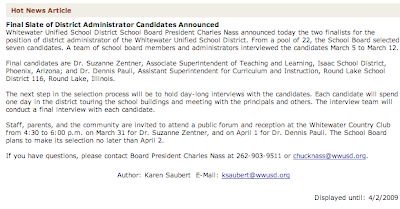
One can find that announcement through a link on the district’s main page.  Here’s the announcement, as a screen shot: 


Here’s the text of that announcement: 

Final Slate of District Administrator Candidates Announced Whitewater Unified School District School Board President Charles Nass announced today the two finalists for the position of district administrator of the Whitewater Unified School District. From a pool of 22, the School Board selected seven candidates. A team of school board members and administrators interviewed the candidates March 5 to March 12.

Final candidates are Dr. Suzanne Zentner, Associate Superintendent of Teaching and Learning, Isaac School District, Phoenix, Arizona; and Dr. Dennis Pauli, Assistant Superintendent for Curriculum and Instruction, Round Lake School District 116, Round Lake, Illinois.

The next step in the selection process will be to hold day-long interviews with the candidates. Each candidate will spend one day in the district touring the school buildings and meeting with the principals and others. The interview team will conduct a final interview with each candidate.

Staff, parents, and the community are invited to attend a public forum and reception at the Whitewater Country Club from 4:30 to 6:00 p.m. on March 31 for Dr. Suzanne Zentner, and on April 1 for Dr. Dennis Pauli. The School Board plans to make its selection no later than April 2.

If you have questions, please contact Board President Charles Nass at 262-903-9511 or chucknass@wwusd.org.

A quick comment, regarding the District’s announcement — 

Additional WUSD Website Information.  There’s none, so far as a search of the WUSD site reveals.  No information on candidates’ backgrounds, by district, community demographics, summary of career accomplishments, etc. 

One hears so very much about parents, and non-parents, in the community being stakeholders, from the current District Administrator.  If that’s true, and if that means anything, then why not more detail on the website, well in advance so the community might have time to consider these candidates.  Not merely a reception and public forum held at the last hour, but more time for reflection?   

One may find this information, of course, but an open district — a truly open culture — would share these vital facts without hesitation.  Why so reluctant?  Those who will decide will still be able to do so, having had so much time as they like for lawful, closed-session deliberations. 

A candid district is a better, stronger district.  

Daily Bread: March 31, 2009

Good morning, Whitewater

There’s a reception tonight, from 4:30 p.m. to 6:00 p.m. for one of the two school district administrator finalists, Dr. Suzanne Zentner. The reception’s at the Whitewater Country Club, “located on Hwy 89 just South of the intersection of the Hwy 89 and Hwy 12 Bypass on the south edge of the City of Whitewater.”

From the Wisconsin State Journal, an unexpected find, on the origin of the word ‘bubbler’

MADISON, Wis. (AP) — One of Wisconsin’s most prominent regional terms – calling a drinking fountain a bubbler – probably comes from a 1910s corporate marketing campaign.

Usage of the term is concentrated in southeast Wisconsin, where the Kohler Co. marketed its early drinking fountains around 1917, said Joan Hall, editor of the Dictionary of American Regional English.

Those porcelain bowls contained “bubbling valves” that made the water bubble as it came through. Pretty soon, Hall said, the valves became known as “bubblers.” Then, people started calling the whole product by that name.

“And as they changed to look more like drinking fountains, the name stayed the same,” Hall said.

Register Watch™ for the March 26th Issue of the Paper.  

Here’s my coverage of the paper that, well, supposedly covers Whitewater.  First, though, a trenchant observation from the Phantom Stranger, received over the weekend.  Always my pleasure to hear from him, and here’s what he had to say about recent issues of the Whitewater Register:

…and to make matters worse, their news is two weeks old…I mean, the Wisconsin slogan story as a headline on the March 26 edition (story happened March 16); and the March 14 candidates forum is the most recent story on the website — 2 weeks later, still—!!!

He’s right.  Until today, March 30th — two weeks’ time later — the candidates forum still led Whitewater news stories at mywalworthcounty.com. 

The banner headline of the Register‘s March 26th issue, entitled, “Wisconsin is the Place to ‘Live Like you Mean It’ refers to a new state slogan covered elsewhere far earlier.  The story, from correspondent Amber Benson, oddly acknowledges that the slogan was unveiled on March 16th.  The slogan is not, itself, a Whitewater story, and deserves less coverage in a paper that proudly places Whitewater in its title.     

Inside, on page 2, the Register acknowledges reporting that Associated Press reporter Ryan Foley, a prominent reporter, has written about others who have used this slogan already.  Foley’s reporting, entitled, “Originality rules in Wisconsin? Not in new slogan,” deserves more than an inside-the-paper mention. 

(See, at Forbes.com, Foley’s fine reporting: http://www.forbes.com/feeds/ap/2009/03/23/ap6201724.html.)   

The Register‘s headline story is neither timely, nor unique to our city, nor curious about how a slogan that so many others have used before would be launched as though it were fresh.  That’s the kind of curiosity that makes for good reporting.  Curiosity about those in power, how politicians and bureaucrats present themselves, and what lies behind their statements. 

One notes, too, how variable the number of pages in the front section of the Register can be — in the March 26th issue 14 pages, in others, as few as 10.  That’s a big shift in potential ad space, or copy space.  Most papers try, even in this recession, to keep page space more fixed, issue to issue.  It’s not a good sign for the Register.   

Another more telling sign, at the my.walworthcounty.com website:  when I clicked on “Whitewater news” on that page, I found that the ‘site sponsor’ was…wait for it, Whitewater…myracinecounty.com.  

Too funny – not even a fine out-of-town sponsor connection, like Madison, Cambridge, or Williams Bay.  Instead, a sponsor connected to a different kind of place, Racine County.    

Prisoner Monday

Continuing for the next several weeks, it’s Prisoner Monday here at Free Whitewater. Why? Because a longtime reader previously suggested to me that being in Whitewater sometimes felt like living the plot of The Prisoner.

It’s a great British series, that tells the story of a secret agent who resigns from his agency, only to find himself in a mysterious place called The Village.

AMC has the full episodes of the original series online, and also offers one-minute summaries of those original episodes. I’ve previously posted the first five videos.

Here’s the sixth, one-minute summary, of an episode entitled, “The General.” (“With the aid of an unseen General, a professor develops a subliminal process for educating the population of The Village. Number 6 must discover the identity of the General, and prove that knowledge is not wisdom.”)

Be seeing you….

The full video is also available at AMC.

Enjoy.

more >>

Daily Bread: March 30, 2009

Good morning, Whitewater

The Community Development Authority meets today at 4:30 p.m. at the Municipal Building.

School’s back in session, at the university, and in our school district.

Over the the right, on my calendar of meetings, I have listed the receptions for school district administrator candidates, one each, on Tuesday and Wednesday of this week. (More on that, later today.)

In Wisconsin history, according to the Wisconsin Historical Society, marking March 28, 1933:

On this date a group of women paid thanks to the inventor of the typewriter, Milwaukee’s C. Latham Sholes, in a national radio program. Amelia Earhart, Anna Boettinger (Franklin Roosevelt’s daughter), Mrs. Robert E. Speer, the president of the National Young Women’s Christian Association, all participated in the program.

Emphasis added.

Impressive invention, and impressive, too, that Amelia Earhart was part of the program. Quite something, really…one could not ask for a better tribute.

Register Watch™ for the March 19th Issue of the Paper

The March 19th issue of the Register reveals both the dependency of the paper as part of a chain, and how poor writing leads to bias or uninformed reporting.

Supreme Court Race. Consider the above-the-fold story on our Supreme Court race, “Judging the Judges.” The story describes a forum before the Milwaukee Press Club at which both Wisconsin Supreme Court candidates spoke.

(Quick note: I am an Abrahamson supporter; Koschnick made a mess of judicial administration in Jefferson County, is running a political rather than judicial race, and has the lesser support among associations of lawyers in the state.)

Look, though, how staff writer Andrew C. Westbrook describes the positions of the candidates — in just under two dozen paragraphs, Westbrook typically leads with Koschnick’s contentions, and leaves Abrahamson in the position of replying to him. Westbrook adopts this technique throughout the article – first Koschnick’s position, and only afterward Abrahamson’s reply. (Thus, Koschnick on judicial activism, on criminal defense rulings, on political contributions, on the supposed anti-police tendency of the sitting Chief Justice of our court, and only after Koschnick’s charge does Westbrook recount Abrahamson’s reply.)

Why does Westbrook write this way? Perhaps, it’s merely a technique, and these accusation-and-reply exchanges never took place. If so, then Westbrook’s distorted the nature of the forum, for a rhetorical device, and a biased one at that.

Alternatively — and those who have followed the campaign know full well — this is how Koschnick presents himself, more politician than judicial candidate. (Judge Gableman became Justice Gabelman this way, just last year.)

Westbrook owes it to his readers to explain this manner — that Koschnick attacks by nature — calling into question his judicial temperament. His manner, and Gabelman’s, is a significant departure from the dispassion one hopes for in a judge, on any court. Westbrook’s story is ultimately uninformative, and reporting that relied on academics in law (or political science) would have offered readers some valuable background.

It’s not as though there was not room in the paper for more detail, and real reporting — the story continues inside, on page 5. There was plenty of room for more.

Westbrook covers this race like it’s a town council contest; it’s not. We’re supposed to be — but are less so each day — a non-partisan, good government state. One hopes for more from a front page, banner story.

(Is not, by the way, Westbrook an editor elsewhere in the Southern Lakes chain? The chain uses, I think, editors at one paper as staff writers, elsewhere. It’s a possible sign of how feeble this chain has become, that it must scrimp at every opportunity.)

Federal Funds for Whitewater. Also above the fold is a story entitled, “City Officials Optimistic about Federal Funding.” One learns that there may be a few possible sources for federal funding, including Milwaukee Street, and a technology park.

(On a technology park — all the funding in the world doesn’t change the sad truth that this town lacks the culture for a thriving technology park, and all the money in the world won’t make tender plants grown among our two or three hundred weeds. Brunner sees this as a ‘tremendous marriage,’ but Whitewater needs more than a Dolly Levi in the Municipal Building.)

Here’s how Editor Schwenke tells the tale:

After instituting a hiring freeze on full-and part-time City of Whitewater job positions earlier this month due to state and general economic concerns, City Manager Kevin Brunner announced the city could likely receive grants for various major development and reconstruction projects in the city.

Quick replies:

1. Does Schwenke think that his readers have short-term memory failure? Only two weeks’ time earlier, Schwenke reported — accurately — that City Manager Kevin Brunner went to council for cover support and approval for a several months’ hiring freeze. (Brunner feared ‘polarizing’ others over a hiring freeze of city workers.) See my earlier post, “Register Watch™ for the March 5th Issue: Hiring Freeze” for more details.

Writing that this was Brunner’s action — as one normally defines the term among the clear, resolute, firm — is risible. Brunner sought cover then, on an obvious mater; he shouldn’t be credited with action now, two weeks’ time later.

2. Imagine being optimistic about federal funding — Why does the city need this federal funding, after all? Because without it, our fiscal condition is dire, not merely for 2009, but beyond. That’s why some of the projects about which Schwenke writes in the story are pushed out so far — 2013 might as well be 2023 — it’s a budgetary device to say some day, some how…

If we are optimistic about federal funding — the tax receipts (or interest bearing debt) from others in America to pay our way — it is because we have failed to budget for ourselves properly. We seek now the last resort of every local official who cannot pay his own way — money from the state, or federal government. State funds are unavailable — Wisconsin’s struggling — and so our City Manager turns his gaze toward … Washington. They’ve billions in deficit spending ready for distribution; Brunner may yet find a place at the trough.

Schwenke’s article asks not a single question, though, about why federal money might be necessary for us, or whether it’s a good idea. It’s so much easier to write his way, but after decades of similar writing, we find ourselves in a situation where we need others so far away, and no one bothers to write about what this may mean.