FREE WHITEWATER

Daily Bread for 6.27.14

Good morning, Whitewater.

Friday brings us a partly sunny day, with a high of eighty-four, and a one-third chance of afternoon showers.

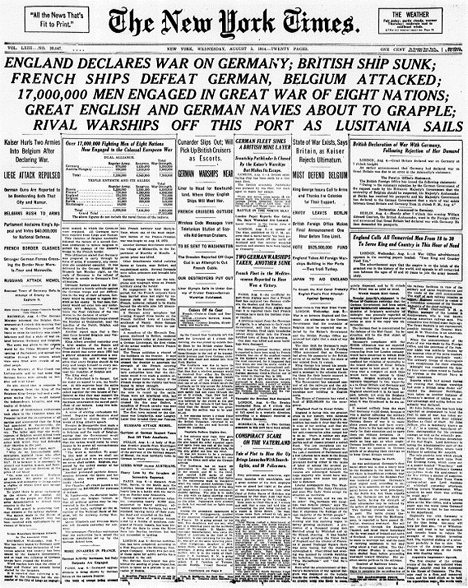
On this day in 1950, following a Communist invasion of the south, Pres. Truman orders U.S. forces to defend South Korea. The New York Times reported his decision:

Washington, June 27–President Truman announced today that he had ordered United States air and naval forces to fight with South Korea’s Army. He said this country took the action, as a member of the United Nations, to enforce the cease-fire order issued by the Security Council Sunday night.

Then acting independently of the United Nations, in a move to assure this country’s security, the Chief Executive ordered Vice Admiral Arthur D. Struble to form a protective cordon around Formosa to prevent its invasion by Communist Chinese forces.

Along with these fateful decisions, Mr. Truman also ordered an increase of our forces based in the Philippine Republic, as well as more speedy military assistance to that country and to the French and Vietnam forces that are fighting Communist armies in Indo-China.

Puzzability‘s Camp Out series ends with Friday’s game:

This Week’s Game — June 23-27
Camp Out
Hey, take a hike! For each day this first week of summer, we started with a phrase, removed the four letters in CAMP, and rearranged all the letters to get a new word or phrase. Both pieces are described in each day’s clue, with the longer one first.
Example:
Automobile that your employer lets you use; preschool writing implement
Answer:
Company car; crayon
What to Submit:
Submit both pieces, with the longer one first (as “Company car; crayon” in the example), for your answer.
Friday, June 27
Quintessentially British late afternoon refreshments; make something sound less important than it is

Show Your Work

We’re in a new round of big-project proposals for Whitewater.

Here’s a suggestion, that this municipal administration would do well to follow, for any large-scale proposal:

(1) Release any feasibility study, analysis, or performance contract on the city’s website a month (thirty calendar days) before Council consideration.

(2) Hold a public hearing specifically and exclusively on any major proposal.

(3) For proposals with a long-term environmental impact upon current residents and the next generation of residents, submit a final proposal to a city-wide vote no earlier than two months’ time after the release publicly of all feasibility studies, analyses, and performance contracts, etc.

If municipal leaders believe in their proposals, they will submit them into the marketplace of ideas with ample time for public consideration.

That’s not what’s happened with the initial performance contract from Trane, for example: that company didn’t have its document ready for the respective meeting packet at which it was to be discussed.

No doubt, a hungry pooch foiled that vast corporation’s original plan. They would have provided their documents sooner, I suppose, if only those papers hadn’t found themselves in a canine’s tummy.

(On a smaller financial scale, Dave Mumma of Janesville Transit has done the same thing to Whitewater: he’s sometimes held back his shoddy work until the last minute, literally bringing documents to Council just before he was about to speak.)

It’s a convenient way for a big vendor, etc., to conceal its work from those who will foot the bill.

Watching this municipal administration, one sees a contrast with the last one. Our former municipal manager was his own cheerleader, boosting ill-considered projects as though civilization depended on them. (He collected a few of similar ilk along the way.)

Our current municipal manager is better educated and more affable than his predecessor, and more outwardly cautious, too. He holds back at meetings, allowing his department heads to do the cheering for him.

Cheer they do – watching some of them, one might be forgiven for thinking that those department leaders worked for the very vendors whose projects the city administration should be scrutinizing.

They are so very eager, and at least one so callow, that one wonders: do you not understand these matters, or do you hope that others won’t?

It’s worthwhile to approach these proposals methodically and dispassionately. Here’s my method for blogging on a topic: (1) read, (2) walk around, (3) write initially, (4) ask informally of government (if useful), (5) submit formal requests if necessary, and (6) consider action at law as a regrettable but necessary last recourse.

(See, for an elaboration of these steps, Steps for Blogging on a Policy or Proposal.)

Deliberate, disciplined, determined.

If these gentlemen believe in their ideas – and they very much want the city to believe they do, and to support them – then surely they have the confidence to show their proposals to others for consideration.

It’s a simple suggestion:

Show your work.

Daily Bread for 6.26.14

Good morning, Whitewater.

Thursday will be mostly cloudy, with a high in the upper seventies, and winds from the east at 5 mph.

C-54landingattemplehof
Berliners watch a C-54 Skymaster land at Tempelhof Airport, 1948.
Via Wikipedia.

On this day in 1948, the United States and her allies begin the Berlin Airlift in response to a Soviet blockade of West Berlin:

The Berlin blockade (24 June 1948 – 12 May 1949) was one of the first major international crises of the Cold War. During the multinational occupation of post–World War II Germany, the Soviet Union blocked the Western Allies‘ railway, road, and canal access to the sectors of Berlin under allied control. Their aim was to force the western powers to allow the Soviet zone to start supplying Berlin with food, fuel, and aid, thereby giving the Soviets practical control over the entire city.

In response, the Western Allies organized the Berlin airlift to carry supplies to the people in West Berlin.[1][2] Aircrews from the United States Air Force, the British Royal Air Force, the Royal Canadian Air Force, the Royal Australian Air Force, the Royal New Zealand Air Force, and the South African Air Force[3]:338 flew over 200,000 flights in one year, providing up to 4700 tons of necessities daily, such as fuel and food, to the Berliners.[4]

By the spring of 1949 the airlift was clearly succeeding, and by April it was delivering more cargo than had previously been transported into the city by rail. The success of the Berlin Airlift brought embarrassment to the Soviets who had refused to believe it could make a difference. The blockade was lifted in May 1949 and resulted in the creation of two separate German states.[4] The Federal Republic of Germany (West Germany) and the German Democratic Republic (East Germany) split up Berlin.[4] Following the airlift, three airports in the former western zones of the city served as the primary gateways to Germany for another fifty years.[5]

Here’s Thursday’s Puzzability game:

This Week’s Game — June 23-27
Camp Out
Hey, take a hike! For each day this first week of summer, we started with a phrase, removed the four letters in CAMP, and rearranged all the letters to get a new word or phrase. Both pieces are described in each day’s clue, with the longer one first.
Example:
Automobile that your employer lets you use; preschool writing implement
Answer:
Company car; crayon
What to Submit:
Submit both pieces, with the longer one first (as “Company car; crayon” in the example), for your answer.
Thursday, June 26
Performer at The Punch Line or Carolines; price cut

Feasting on Wholly Unjustified Insecurities

I don’t know – truly – what need or desire causes a few people to yearn for the mere things of other places. 

Whitewater’s goal should be not a collection of objects, but an embrace of standards.  This should be so very clear: we don’t need to build new buildings, we need to assure sound institutions in conformity with America’s highest standards. 

What do you have, how do you look? 

No, and no again — a different question matters: What do you believe? 

(See, along these lines, How Many Rights for Whitewater?, What Standards for Whitewater?, and Why Whitewater?)

These local men who prey on the unjustified insecurities of others, or suffer an insatiable need to exaggerate to satisfy their own pride, are ignorant of what makes our city, state, and country exceptional: our liberties and the sound institutions flourishing through them. 

I think, sometimes, that such hucksters would try to sell ice to an Inuit if they had the chance.

We don’t need the buildings of Los Angeles; we need the best practices of America.

In any event, there is no fashion, no striking beauty of Los Angeles, and few objects therefrom that would not fade in our Wisconsin climate. 

We may be grateful for it. 

So much of policy here depends on convincing people that they need a particular project, all the while neglecting both those truly distressed and the higher standards that are the sound foundation of a better, more prosperous life.

We can and will do better.  One may be very sure of it.

Why Not Build Another Los Angeles (by the Bridge to Nowhere)?

image

Typical Los Angeles Resident

Los Angeles is America’s second-largest city, and is world-renowned for her diverse economy and global role in commerce, entertainment, and art.  All its people are reputed to be exceptionally beautiful, talented, and clever (at least by their own, uniform accounts).

If Los Angeles should be so valuable – and it is – why not build a second Los Angeles just outside Whitewater?  We could start the gateway to the project at the very spot where the Bridge to Nowhere ends.

If one city of the angels is good, wouldn’t two be far better

What if, since this project would be pricey, the U.S. Government would lend us the money?  Let’s say Uncle Sam would lend us a trillion dollars ($1,000,000,000,000.00) to start.  After all, America spent well over a trillion dollars in Iraq over the last decade. 

Should we start a Los Angeles 2.0?

If we build it, will they (super-smart, trendy people) not come to us in wave after wave?

There’s the big-talking developers’ problem: it’s only worthwhile if the gain (accurately measured) is more than the expense (fully calculated) of L.A. Part Deux. 

If simply building more of an expensive thing brought prosperity, every Whitewater resident would be building Phantoms, Ghosts, and Wraiths – and every resident would be prosperous by consequence.  

The climate of these times is filled with ‘if you build it, they will come’ projects. 

It’s so easy to say, so simple to talk up, and so few people press for details.

So, why not, big talkers? 

Just apply for some federal money.

If you don’t try to build another Los Angeles on the taxpayers’ tab, some other community might get that money.

Hurry now, there’s no time to lose…

Daily Bread for 6.25.14

Good morning, Whitewater.

Midweek brings an even chance of thunderstorms with a high of seventy-six.

Whitewater’s Community Development Authority Board meets today at 5 PM.

Today is the anniversary, from 1876, of the Battle of the Little Bighorn:

The Battle of the Little Bighorn, previously referred to as Custer’s Last Stand, and observed by Lakota tribes as Lakota Victory Day[1], was an armed engagement between combined forces of the LakotaNorthern Cheyenne, and Arapaho tribes, against the7th Cavalry Regiment of the United States Army. The battle, which occurred June 25–26, 1876, near the Little Bighorn River in eastern Montana Territory, was the most prominent action of the Great Sioux War of 1876. It was an overwhelming victory for the Lakota, Northern Cheyenne, and Arapaho, led by several major war leaders, including Crazy Horse and Chief Gall, inspired by the visions of Sitting Bull (T?at?á?ka Íyotake). The U.S. 7th Cavalry, including the Custer Battalion, a force of 700 men led by George Armstrong Custer, suffered a severe defeat. Five of the 7th Cavalry’s twelve companies were annihilated; Custer was killed, as were two of his brothers, a nephew, and a brother-in-law. The total U.S. casualty count, including scouts, was 268 dead and 55 injured.

Public response to the Great Sioux War varied at the time. The battle, and Custer’s actions in particular, have been studied extensively by historians.[2]

Although he was celebrated by many at the time,  I’d say we’ve come to see Custer today, correctly, as reckless and undisciplined.

Here’s the Wednesday game in the Camp Out series from Puzzability:

This Week’s Game — June 23-27
Camp Out
Hey, take a hike! For each day this first week of summer, we started with a phrase, removed the four letters in CAMP, and rearranged all the letters to get a new word or phrase. Both pieces are described in each day’s clue, with the longer one first.
Example:
Automobile that your employer lets you use; preschool writing implement
Answer:
Company car; crayon
What to Submit:
Submit both pieces, with the longer one first (as “Company car; crayon” in the example), for your answer.
Wednesday, June 25
Major French news and pop culture magazine; Warren Beatty and Dustin Hoffman bomb


‘There’s Somebody for Everybody’

Former Sen. Neal Kedzie, a Republican from Elkhorn, will become the new president of the Wisconsin Motor Carriers Association on July 1. The move to the commercial motor carriers association had been rumored since Kedzie resigned from the Senate earlier this month.

Kedzie, 58, in April told his constituents he would run for re-election, but only a few months later said he would not seek another term after all. He said then he wanted to explore opportunities outside of government after serving more than 17 years in the Senate and Assembly.

Via Kedzie, former senator, to head trucking group @ JS All Politics Blog.

See, earlier, State Sen. Kedzie Rushes the Exits

Looking to Rehabilitate Someone Politically? You’re Going to Need a Better Patient

I’ve written previously of one of my favorite political quotes, from Franklin Roosevelt. Roosevelt was asked if, somehow, Herbert Hoover might play a role after Pearl Harbor.  Roosevelt accurately assessed the impossibility of political rehabilitation:

Not even the Japanese attack on Pearl Harbor could bring Hoover back into the mainstream of official Washington, D.C. Within days of the attack, Roosevelt summoned Bernard Baruch to the White House for a discussion of how best to organize the home front for victory.

Courageously, Baruch said that the best man for such an effort was Herbert Hoover. What’s more, Baruch knew him to be available. FDR shot down the idea with devastating sangfroid. According to one who was there, the president said, “I’m not Jesus Christ. I’m not raising him from the dead.”

A few gentlemen of this city are free to tout the last municipal administration’s record of wasteful projects and serial mendacity, so much as they should like.  It’s their right, after all. 

But if Franklin Roosevelt wouldn’t (knowing he couldn’t) rehabilitate Hebert Hoover, how well will these few do with their local version of that task? 

Public Spending on Infrastructure

A simple rule about public spending on infrastructure, that some forget, and others would prefer remained that way: adding infrastructure is only beneficial if a resulting economic gain (should there be one) is greater than the cost of its acquisition (capital, labor, etc.).

There is no way around this. 

Just about everything one hears about local pump-priming, sparking investment, getting things going, etc., ignores this truth, or rests on shoddy, inadequate reasoning to justify the expenditure. 

If this were not so, Whitewater would already be, after all, far better off than the Lost City of Gold legendarily was.

She’s not.

One of the reasons that she’s not is that what passes for economic policy, business policy, and marketing is erroneous.

Not just erroneous, but erroneous in a silly, superstitious way.  Nothing else worked, so this must be the thing.

We’ve poured a fortune into the ground, and yet we do not have any meaningful results. 

These tired gentlemen cannot enumerate their supposed gains, lest the city see that they’re not truly gains at all. 

Time’s running out, across America and in Whitewater, on a generation of puffery and self-promotion.