FREE WHITEWATER

‘Best Practices, Fair Treatment, Transparency’

Writing about the city requires reading the public documents of local government, even if one chooses not to write about what one’s read.  Reading and observing come well before writing.  

Daily observation inclines an observer not to the immediate, but the distant – one takes a longer view of things.  

Along the way, sometimes one reads something that’s a harbinger of our city’s future.  

While reviewing the Common Council packet for Tuesday’s scheduled meeting, I saw a resident’s application for a prominent commission.  At the end of the application, in her own hand, she wrote that she hoped to continue her work toward “best practices, fair treatment, and transparency.”  

One day, resting on that present hope, we will have a new and better city. If we were to have a motto, ‘best practices, fair treatment, and transparency’ would be a good one.  

That’s not this time, but a future one.  From now until then will require hard and relentless work.  We will find, I’m sure, that ‘kind words and a real good heart‘ will not be enough.  

To bring about a better, fairer, more transparent city will require of us what Nietzsche felt necessary of an advocate — “A very popular error: having the courage of one’s convictions; rather it is a matter of having the courage for an attack on one’s convictions.”

We’ll have that better city (I’ve no doubt), but it will require tenacity.

Nothing less will do.    

Note on the Whitewater Schools’ Budget Cuts

I’ve received emails asking if I’ll comment on the Monday, April 28th WUSD board meeting, during which dozens of residents spoke in person about proposed budget cuts (among other topics). 

I will write about the meeting and cuts, but I’ll wait to see if the district’s board modifies the current proposal. 

There’s a lot to consider – on its own – about the process, but it’s well-worth waiting to see the outcome before doing so. 

Daily Bread for 4.30.14

Good morning.

Mid-week in Whitewater will be cloudy, with a one-third chance of daytime showers, and a high of fifty.

00000196

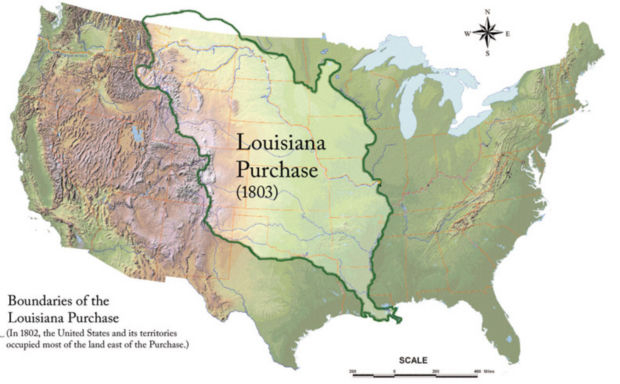
On this day in 1803, negotiations conclude successfully to add vast territory to the United States:

On April 30, 1803, representatives of the United States and Napoleonic France conclude negotiations for the Louisiana Purchase, a massive land sale that doubles the size of the young American republic. What was known as Louisiana Territory comprised most of modern-day United States between the Mississippi and the Rocky Mountains, with the exceptions of Texas, parts of New Mexico, and other pockets of land already controlled by the United States. A formal treaty for the Louisiana Purchase, antedated to April 30, was signed two days later.

On this day in 1845, Wisconsin adopts public education:

On this date, under the leadership of Michael Frank, Wisconsin adopted “free” education for its residents. Frank’s plan narrowly passed the legislature by a vote of 90 to 79. Frank’s motivation for free education in Wisconsin was partially inspired by a similar campaign, promoted by Horace Mann in Massachusetts. On June 16, 1845 the first free school opened in Wisconsin. It was one of only three free schools in the country, outside the New England states. By August 1845, Wisconsin had five free schools in operation. [Source: Badger Saints and Sinners, Fred L. Holmes, pg 78-92]

Here’s the Wednesday game in Puzzability‘s Lone Ranger series:

This Week’s Game — April 28-May 2
Lone Rangers
Welcome to the Daily Hitching Post. For each day this week, we started with the name of a well-known person from the days of the Old West and removed all the letters that appear more than once, leaving just the singly occurring letters. Each day’s clue gives the unique letters in order (with any spaces removed), along with the lengths of the name components in parentheses.
Example:
CHIAY (3,8)
Answer:
Doc Holliday
What to Submit:
Submit the full name (as “Doc Holliday” in the example) for your answer.
Wednesday, April 30
BSTA (5,5)

The Gazette’s Ideological Albatross

It was Carl Denham who once declared, famously, that “It was beauty killed the beast.”

In the same way, nothing matters more for a publication of news and opinion than its ideology, its intellectual outlook.  A misguided outlook will prove debilitating, if not fatal. 

A strong set of principles helps a publication steer true in good weather or bad.

Here’s FREE WHITEWATER’s ideological position, simply and confidently stated on this website’s About page:

FOR FREE MARKETS in CAPITAL, LABOR, & GOODS, INDIVIDUAL LIBERTY, LIMITED & OPEN GOVERNMENT,
and PEACE

Like many papers, the Gazette also has a set (ten in number) of editorial principles.

One may find them online.  (See, subscription required, Our Views: 10 principles guide Gazette viewpoints.)

Of these principles, many are typical and laudable conservative ideals. 

The first of the paper’s principles, however, is a debilitating one, an ideological albatross:

1.  The Gazette supports economic development and policies that promote growth of small businesses and jobs. We oppose rules that unnecessarily impede business expansion.

A principle like this seems sensible to many, but it rests on a pro-business, rather than a free market, foundation. 

These two foundations are not the same.  A free-market position (in capital, labor, and goods) is impartial between big and small, young or old, new or tenured, and between races, religions, and genders. 

The Gazette‘s pro-business position, by contrast, allows for support of insiders’ deals, favored players, and public subsidies for wealthy private interests, all in the name of supposed economic development. 

No, and no again. 

The most wide-reaching and efficient development comes from a market of voluntary transactions without public-private schemes bolstered with taxpayers’ earnings, without white-collar welfare, without crony capitalism, and without state capitalism. 

A paper taking this position will shy from standing up to powerful market manipulators, in favor of getting along, fitting in, and being a supposed player in its community.

In fact, influential and scheming members of that paper’s community will ignore its advice, and ordinary readers will see that the paper hesitates in the face of powerful but greedy, market-manipulating interests. 

Under the supposed principle of economic development, the Gazette‘s editorialist has supported – repeatedly – millions; in public money to a landowner for a park in the name of philanthropy, and offered excuses; for a bureaucrat’s lies and fumbling about a bus line for a multi-billion-dollar corporation. 

It’s all ‘development,’ you see.

I’m a libertarian, and there was a time when Republicans and libertarians, conservatives and libertarians, were closer ideologically. 

We haven’t changed; they did.  They abandoned markets and limited government for development projects for their friends, at public expense. 

They’re simply small-town versions of big-government conservatives.  In Whitewater, many of these men have never met a white-collar welfare deal they wouldn’t support.

Deals, deals, deals – and always for their connected friends.  

With the millions they’ve wasted in Whitewater, for example, we might have taken a portion and supported the truly needy, and returned an even larger remainder to taxpayers. 

(I see that some of these deals were grants for a purpose, of course.  That’s a greater shame, as the express terms of these grants have been ignored here, and they might have been of true and better use to other communities.  Grab it or lose it is a glutton’s motto.) 

As for the Gazette, their present concerns stem not from style, design, or tone, but from an ideological albatross that debilitates the paper with its readers and within its own community (as it would debilitate any paper in any community).

The Gazette’s Impossible Task

Not long ago, the Gazette‘s editor and vice-president for news, Scott Angus, wrote about a mistake that newspaper made when it reprinted an old section of the paper in a current edition (See, subscription required, Editor’s Views: Wrong page prompts headscratching, thorough review.) 

Mistakes of proofreading and printing happen from time to time, even a newspaper that employs dozens.  No human institution runs to perfection — this truth is both to the Gazette‘s consolation and remorse. 

It’s a consolation because readers understand that, occasionally, a paper (or website) will make publishing errors. Workers in any field, no matter how committed to quality, make occasional mistakes. 

It’s true of advanced fields like aerospace, and it’s true of local newspapers and websites.

Understandably, Mr. Angus worries that readers will doubt that his paper cares about them, but I’d guess most people are forgiving of mistakes now and again.  The Gazette has, therefore, reason for consolation. 

They’ve also reason for concern: in an undertaking in which style matters more, and substance less, readers will be unforgiving of mistakes. 

A newspaper standing on sound principles, first and foremost, can weather typographical errors, as substance trumps printing.  By contrast, in conditions where clear positions are less evident, operational mistakes become more noticeable and damaging by proportion. 

Here’s an easy proof, concerning the Constitution.   Consider, from Dr. Henry Bain’s essay, some typographical mistakes in early copies of that federal document:

A close study of the way the Constitution has been put on paper—either written or printed—during its long life is sure to call our attention to its smallest faults—its errors of penmanship and typography.

It is not surprising that a few such errors have crept in during all these years, while the original Constitution and an ever-growing body of amendments were written out on a few occasions and printed thousands of times. Most of the errors of the scribes and the typesetters were promptly corrected before we, the reading public, had a chance to notice them, but a few have endured in successive publications.

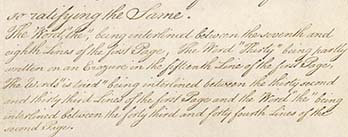
In fact, Jacob Shallus, assistant clerk of the Pennsylvania legislature and scribe for an early copy of the document, even listed mistakes he’d made:

const-errors-errata-m

No one blames, Shallus, though, because he was working hard under a demanding deadline, and even more because the substance of the document is what matters most.

Substance mitigates occasional procedural or mechanical errors.

Now Scott Angus has been at the Gazette for years, is well-regarded as smart and dedicated, and comes from a newspaper background (his father was a newspaperman).  But one such editor or a dozen like him couldn’t achieve a perfect paper. 

It’s not to procedure, operations, or mechanics that a publication should look for strength; it’s substance that carries the day. 

Next: The Gazette’s Ideological Albatross

Daily Bread for 4.29.14

Good morning.

We’ll have a rainy day again today, with thunderstorms, and a high of sixty-two.

Common Council meets tonight at 6:30 PM.

On this day in 1862, U.S. Marines take the Confederate flag from the New Orleans city hall, after a successful naval campaign against that city:

From April 18 to April 28, Farragut bombarded and then fought his way past the forts in the Battle of Forts Jackson and St. Philip, managing to get thirteen ships up river on April 24. Historian John D. Winters in The Civil War in Louisiana (1963) noted that with few exceptions the Confederate fleet at New Orleans had “made a sorry showing. Self-destruction, lack of co-operation, cowardice of untrained officers, and the murderous fire of the Federal gunboats reduced the fleet to a demoralized shambles.”[10]

….Despite the complete vulnerability of the city, the citizens along with military and civil authorities remained defiant. At 2:00 p.m. on 25 April, Admiral Farragut sent Captain Bailey, First Division Commander from the USS Cayuga, to accept the surrender of the city. Armed mobs within the city defied the Union officers and marines sent to city hall. General Lovell refused to surrender the city, along with Mayor Monroe. William B. Mumford pulled down a Union flag raised over the former U.S. mint by marines of the USS Pensacola and the mob destroyed it. Farragut did not destroy the city in response, but moved upriver to subdue fortifications north of the city. On April 29, Farragut and 250 marines from the USS Hartfordremoved the Louisiana State flag from the City Hall.[13] By May 2, US Secretary of State, William H. Seward, declared New Orleans “recovered” and “mails are allowed to pass”.[14]

Here’s Tuesday’s game in Puzzability‘s Lone Rangers series:

This Week’s Game — April 28-May 2
Lone Rangers
Welcome to the Daily Hitching Post. For each day this week, we started with the name of a well-known person from the days of the Old West and removed all the letters that appear more than once, leaving just the singly occurring letters. Each day’s clue gives the unique letters in order (with any spaces removed), along with the lengths of the name components in parentheses.
Example:
CHIAY (3,8)
Answer:
Doc Holliday
What to Submit:
Submit the full name (as “Doc Holliday” in the example) for your answer.
Tuesday, April 29
UAICDY (7,4,4)

Could the Koch Brothers Dominate Whitewater’s Politics?

Assume for a moment that Charles and David Koch decided to use their vast billions to dominate Whitewater’s local politics.  They’d spend whatever they had, under this hypothetical, to put their hand-picked candidates in office, for advertising, public relations, goodwill community events, and lobbying to get their way in elections, appointments, and in pressuring local officials over policy.

(Two disclosures are in order.  First, as the Koch bothers are former libertarians, having abandoned our movement for big-party politics, they seem misguided and repulsive to old-family – movement – libertarians like me.  Second, though I find them repulsive schemers, still they have a right to spend to influence politics; in fact, restrictions on that right seem even more repulsive to me than political apostates like Charles and David.)  

Let’s suppose, though, that they decide to move to Whitewater, and to wield their influence over our small town. 

So the question: Could the Koch brothers dominate Whitewater’s politics?

The answer is no, they could not.  No matter how hard they tried, at whatever expense, a campaign in opposition would defeat them, so often in the polls and so often in popular opinion that they’d fail in their attempt. 

Our conditions are unsuited to the Kochs. 

Even a few people, arguing in opposition diligently, day-in, day-out, would overcome them in Whitewater’s marketplace of ideas.  Anyone in Whitewater who tried sincerely and repeated to argue against them would prevail.

And yet – and yet – this inspires a further question: if all the vast power of the Koch brothers would not be enough to dominate our city’s politics against opposition, what chance would a smaller, local pressure group have?   

In this, one finds a political question for the next few years. 

Low Comedy in 3, 2, 1…

Democrats have three choices for the 15th District Senate Primary: Evansville’s Assembly Rep. Janis Ringhand, Janesville-native Austin Scieszinski, or former Assembly Speaker Mike Sheridan. 

One sometimes encounters a politician who simply refuses to remain a former politician, and when one encounters such a person, that discovery probably sounds like Mike Sheridan. 

(He’s reportedly walking about, and hinting now and again, that GM may return to Janesville. See, State Senate candidate Mike Sheridan: ‘GM could return’.)

Even funnier, Sheridan is a paid consultant for the businessman (Bill Watson) who’s infamous; as the I’ll-disclose-what-I-want-about-my-supposedly-amazing-project-when-I-damn-feel-like-it developer who’s caused so such concern and outcry in Milton.   

The 15th is a heavily blue district, but if anyone could make the race closer for Republicans, it’s Democrat Mike Sheridan.

For prior FW posts on Sheridan, here’s a helpful link.