FREE WHITEWATER

Daily Bread for 7.12.13

Good morning.

Whitewater’s Friday will be sunny with calm winds and a high of eighty-two. Sunrise was 5:28 a.m., and sunset will be 8:33 p.m. The moon is a waxing crescent with 17% of the its visible disk illuminated.

On this day in 1990, Boris Yeltsin resigns from the Society Communist Party:

Just two days after Mikhail Gorbachev was re-elected head of the Soviet Communist Party, Boris Yeltsin, president of the Republic of Russia, announces his resignation from the Party. Yeltsin’s action was a serious blow to Gorbachev’s efforts to keep the struggling Soviet Union together….

During the next year and a half, Gorbachev’s power gradually waned, while Yeltsin’s star rose. In December 1991, Gorbachev resigned as president of the Soviet Union and the Soviet Union officially dissolved. Yeltsin, however, retained his position of power as president of Russia. In their own particular ways, both men had overseen the dissolution of the Soviet Union and the end of the Cold War.

Yeltsin remained president of Russia until December 31, 1999, when he resigned. Despite his attempts at economic reform, his tenure in office saw the country’s economy falter badly, including a near-complete collapse of its currency. His administration was also marked by rampant corruption, an invasion of Chechnya and a series of bizarre incidents involving Yeltsin that were reputedly a result of his alcoholism. Yeltsin’s opponents twice tried to impeach him. With his resignation, Prime Minsiter Vladimir Putin became acting president until new elections could be held. On March 26, 2000, Putin became Russia’s new president.

On this day in 1995, a deadly heatwave afflicts Wisconsin:

From July 12-15, 1995, the Midwest was subjected to a deadly outbreak of hot and humid weather responsible for 141 deaths in Wisconsin. According to the Milwaukee Journal-Sentinel, this was the “greatest single event of weather-related deaths in Wisconsin history.” Most of the fatalities happened in the urban southeast counties of the state, and at one point several Milwaukee-area hospitals were unable to admit more patients.

Milwaukee Temperatures (from the Milwaukee Journal Sentinel): July 12: Hi=91, Lo=65 July 13: Hi=103*, Lo=78 July 14: Hi=102, Lo=84 July 15: Hi=92, Lo=69 July 16: Hi=88, Lo=68 *Some communities reported highs as high as 108. Heat Index values were 120-130 degrees.

NOAA’s Natural Disaster Survey Report on the outbreak is available at http://www.weather.gov/os/assessments/pdfs/heat95.pdf [Source: Milwaukee Journal Sentinel]

Puzzability‘s Fruit Salad series concludes today:

Fruit Salad
For a refreshing summer dessert this week, just mix and serve. For each day, we’ve taken the name of a kind of fruit, added a letter, and scrambled all the letters to get a new word. The answer phrase, described by each day’s clue, is the new word followed by the fruit name.

Example:
Citrus fruit turned to a lava-like liquid

Answer:
Molten lemon

Here’s the puzzle for Friday:

Treating a citrus fruit with worshipful respect fit for a saint

Daily Bread for 7.11.13

Good morning.

Thursday in Whitewater will be sunny and warm, with a high of eighty.

It’s Family Fun Night at the Cravath Lakefront from 5:30 – 7 PM tonight.

On this day in 1804, Aaron Burr shoots Alexander Hamilton in a duel:

In a duel held in Weehawken, New Jersey, Vice President Aaron Burr fatally shoots his long-time political antagonist Alexander Hamilton. Hamilton, a leading Federalist and the chief architect of America’s political economy, died the following day….

Few affairs of honor actually resulted in deaths, and the nation was outraged by the killing of a man as eminent as Alexander Hamilton. Charged with murder in New York and New Jersey, Burr, still vice president, returned to Washington, D.C., where he finished his term immune from prosecution.

In 1805, Burr, thoroughly discredited, concocted a plot with James Wilkinson, commander-in-chief of the U.S. Army, to seize the Louisiana Territory and establish an independent empire, which Burr, presumably, would lead. He contacted the British government and unsuccessfully pleaded for assistance in the scheme. Later, when border trouble with Spanish Mexico heated up, Burr and Wilkinson conspired to seize territory in Spanish America for the same purpose.

In the fall of 1806, Burr led a group of well-armed colonists toward New Orleans, prompting an immediate U.S. investigation. General Wilkinson, in an effort to save himself, turned against Burr and sent dispatches to Washington accusing Burr of treason. In February 1807, Burr was arrested in Louisiana for treason and sent to Virginia to be tried in a U.S. court. In September, he was acquitted on a technicality. Nevertheless, public opinion condemned him as a traitor, and he fled to Europe. He later returned to private life in New York, the murder charges against him forgotten. He died in 1836.

On this day in 1839, the U.S. Patent Office issues the first patent to a Wisconsinite:

1839 – First patent issued to Wisconsin resident
On this day Ebenezar G. Whiting of Racine was issued patent #1232 for his improved plow, the first patent issued to someone from Wisconsin. Whiting’s improvements consisted of making the mold-board straight and flat which, when united in the center with the curvilinear part of the mold-board, would require less power to drag through the dirt. Whiting went on to serve as Vice President of the J.I. Case Plow Company and received another patent for a steel plow in 1876. [Source: United States Patent and Trademark Office]

Puzzability‘s series, called Fruit Salad, continues:

Fruit Salad
For a refreshing summer dessert this week, just mix and serve. For each day, we’ve taken the name of a kind of fruit, added a letter, and scrambled all the letters to get a new word. The answer phrase, described by each day’s clue, is the new word followed by the fruit name.

Example:
Citrus fruit turned to a lava-like liquid

Answer:
Molten lemon

Here’s the puzzle for Thursday:

Often-dried fruit that sings like Renée Fleming

Credibility on Spending

There’s much to be said about fiscal policy in Whitewater, and plenty of time to say it. In my previous post, The Crazy-Wrong Argument on Taxes, I addressed the ludicrous & selfish argument that public grants (in this case, for needless parkland purchases) would have no tax impact. Of course they would.

Now people are free to complain about taxes all they want, but they’d have more credibility if they hadn’t spent years flacking for wasteful spending, totaling in the millions in this city over the better part of a decade, on failed and underperforming ventures like Tax Incremental Districts, an Innovation Center, a Generac Bus, and crony-capitalist WEDC white-collar public grants.

There’s a fit series waiting to be written about a decade of waste and sub-par results on this score.

Like many others in the city, I read in the Gazette yesterday that school taxes for Whitewater will likely rise. Like many others, I’d prefer they didn’t. I’d guess there will be quite the concern on that account.

Yet, for it all, I’d suggest that those who have flacked every one of the wasteful, water-on-sand municipal spending schemes I’ve mentioned above are not the ones now in a credible position to complain about taxes.

We would be in a markedly better position today if we hadn’t spent so much, on so little, truly benefitting so few, for those empty city projects.

School finances are a legitimate concern, but our problems are far deeper than that, and we’ll not improve our situation if we ignore municipal big-ticket mistake after mistake so close at hand, yet apart from our schools.

The Crazy-Wrong Argument on Taxes

A succinct truth: money doesn’t grow on trees.

Local government funds municipal projects in one of three principal ways: through local taxes & fees, local borrowing (debt in the form of bonds), or public money from other jurisdictions (grants from the state or federal government).

These grants of state or federal public money are, themselves, from taxes or borrowing (at the federal level, this includes the reckless, inflationary option of simply printing more greenbacks).

In no case, however, in not a single one, do these grants come to a community without a tax impact.

And yet, and yet, official after official will contend that one can take state or federal money without a local consequence, with ‘zero tax impact’ (in the words of a poorly-reasoned newspaper editorial about purchasing expensive farmland as parkland). Residents of a Wisconsin county are simultaneously residents of the state and of America, after all.

(Those who talk about grabbing state and federal grants mean that they’ll take all of the supposed benefits but apportion the costs not merely to their own constituents but to a larger number elsewhere, who will receive no benefit at all.)

Even libertarians, as I am, accept that there will be some public spending, and that there should be some. The key questions are (1) on what objects will we spend? and (2) at what cost, immediately and in alternatives left unfunded?

Exhorting a county’s residents, for example, to “grab” state money now, for whatever silly project, is an exhortation to unthinking selfishness.

It’s all just stuffing more in, and more still, while others go without anything, as though there were no consequence to taking in whatever one can, or whatever comes by on a plate:

Daily Bread for 7.10.13

Good morning.

Midweek in Whitewater will be sunny with a high of seventy-nine, with northwest winds at 10 to 15 mph.

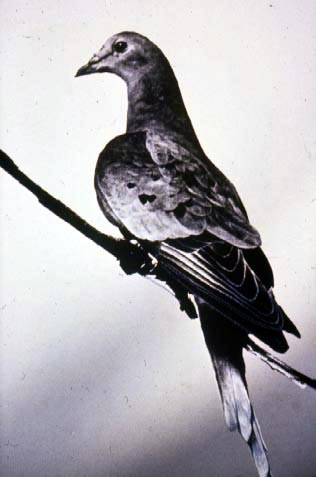
Martha_last_passenger_pigeon_1914

Martha, the last passenger pigeon, 1914

Revival of the Passenger Pigeon? is a post over at the History Channel’s website. Sarah Pruitt writes about the possibility of reviving that now-extinct species:

The passenger pigeon (Ectopistes migratorius) was once one of North America’s most abundant bird species, numbering some 3 to 5 billion at the time European settlers first set foot on the continent. Early explorers and settlers wrote of their sheer numbers; the 17th-century Massachusetts minister Cotton Mather once described a flock stretching one mile across and taking more than an hour to pass by. Yet thanks to rampant overhunting in the 1800s, as well as loss of its natural forest habitats, the pigeon had disappeared from the wild by 1900. The last known passenger pigeon, named for Martha Washington, died in captivity in the Cincinnati Zoo in 1914….

Now, nearly a century after Martha’s death, scientists believe they can bring her species back to life, using techniques worthy of the 1990s science-fiction/action blockbuster “Jurassic Park.” With funding from Revive and Restore, a group dedicated to the de-extinction of recently lost species, the young biologist Ben J. Novak is spearheading efforts to use DNA taken from passenger pigeon specimens in museums and fill it in with fragments from a living species, the band-tailed pigeon. The reconstituted genome would then be inserted into a band-tailed pigeon stem cell, creating a germ cell (an egg-and-sperm precursor). When the germ cell is injected into young band-tailed pigeons and these pigeons reproduce, their offspring would come as close as possible to expressing the passenger pigeon genes. The “de-extinction” process is different from cloning, in that it uses a variety of DNA from different passenger pigeons, meaning that the offspring produced would be as unique as any bird from an original passenger pigeon flock.

Most experts acknowledge that recreating the passenger pigeon in this way is technically possible, based on the success scientists have had mapping the woolly mammoth genome by using elephant DNA, among other experiments. But significant challenges still exist, particularly when it comes to reintroducing the passenger pigeon into the wild, given the vastly different ecosystem it would encounter in the modern world….

There will never be flocks as there once were, but it’s still an effort, I think, worth undertaking to revive even small numbers of the species.

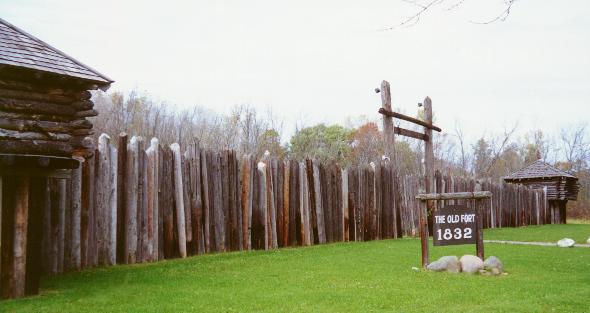
Rock_River_Fort

Replica of early 19th century army fortification, photo by Gail Seavert, via Wikipedia

On this day in 1832, General Atkinson begins construction of a fort during the Black Hawk War:

On this date General Henry Atkinson and his troops built Fort Koshkonong after being forced backwards from the bog area of the “trembling lands” in their pursuit of Black Hawk. The Fort, later known as Fort Atkinson, was described by Atkinson as “a stockade work flanked by four block houses for the security of our supplies and the accommodation of the sick.” It was also on this date that Atkinson discharged a large number of Volunteers from his army in order to decrease stress on a dwindling food supply and to make his force less cumbersome.

One of the dismissed volunteers was future president, Abraham Lincoln, whose horse was stolen in Cold Spring, Wisconsin, and was forced to return to New Salem, Illinois by foot and canoe. [Sources: History Just Ahead: A Guide to Wisconsin’s Historical Markers edited by Sarah Davis McBride and Along the Black Hawk Trail by Willilam F. Stark]

Puzzability‘s series this week is called Fruit Salad:

Fruit Salad
For a refreshing summer dessert this week, just mix and serve. For each day, we’ve taken the name of a kind of fruit, added a letter, and scrambled all the letters to get a new word. The answer phrase, described by each day’s clue, is the new word followed by the fruit name.

Example:
Citrus fruit turned to a lava-like liquid

Answer:
Molten lemon

Here’s the puzzle for Wednesday:

Burn up a peach-like fruit

Film: Glas

The 1958 documentary Glas is an Oscar-winning film about glass-making. It’s also captivating. Enjoy.

Daily Bread for 7.9.13

Good morning.

It’s another rainy day for Whitewater, with a high of eighty-seven and afternoon showers and thunderstorms. Rainfall accumulation will be between a quarter and a half of an inch.

On this day in 1877, Wimbledon begins:

On July 9, 1877, the All England Croquet and Lawn Tennis Club begins its first lawn tennis tournament at Wimbledon, then an outer-suburb of London. Twenty-one amateurs showed up to compete in the Gentlemen’s Singles tournament, the only event at the first Wimbledon. The winner was to take home a 25-guinea trophy….

Twenty-two men registered for the tournament, but only 21 showed up on July 9 for its first day. The 11 survivors were reduced to six the next day, and then to three. Semifinals were held on July 12, but then the tournament was suspended to leave the London sporting scene free for the Eton vs. Harrow cricket match played on Friday and Saturday. The final was scheduled for Monday, July 16, but, in what would become a common occurrence in future Wimbledon tournaments, the match was rained out.

It was rescheduled for July 19, and on that day some 200 spectators paid a shilling each to see William Marshall, a Cambridge tennis “Blue,” battle W. Spencer Gore, an Old Harrovian racket player. In a final that lasted only 48 minutes, the 27-year-old Gore dominated with his strong volleying game, crushing Marshall, 6-1, 6-2, 6-4. At the second Wimbledon in 1878, however, Gore lost his title when his net-heavy game fell prey to a innovative stroke developed by challenger Frank Hadow: the lob.

Puzzability‘s series this week is called Fruit Salad:

Fruit Salad
For a refreshing summer dessert this week, just mix and serve. For each day, we’ve taken the name of a kind of fruit, added a letter, and scrambled all the letters to get a new word. The answer phrase, described by each day’s clue, is the new word followed by the fruit name.

Example:
Citrus fruit turned to a lava-like liquid

Answer:
Molten lemon

Here’s the puzzle for Tuesday:

Fruit grown in the capital of the Czech Republic that comes in bunches

Daily Bread for 7.8.13

Good morning.

We’ll have a day of showers and thunderstorms in Whitewater, with a high of eighty-seven.

The city’s Planning Commission meets tonight at 6 PM.

It’s the 1947 anniversary of the Roswell Incident, and Google’s commemorating the event with a doodle that’s an interactive game (screenshot below, game at Google.com):

Screen_Shot_2013-07-07_at_6.13.34_PM_610x344

Was it an aircraft, weather balloon, or flying saucer piloted by aliens that was spotted crashed near Roswell, N.M., exactly 66 years ago?

It appears Google may be placing its bets on the flying saucer. In a tongue-in-cheek Doodle commemorating the anniversary of Roswell’s UFO incident, the Web giant has created a game that involves an alien spaceship wreck.

In 1947, a local claimed to have found the remains of a crashed UFO in field near Roswell. Subsequently, a handful of people also said they witnessed a flying disc hurtling through the night sky in the same area. The event made headlines around the world, but the U.S. military clamped down and denied it was anything other than a downed weather balloon.

The Google Doodle game loosely follows this same storyline. The game starts with an alien crash-landing its spacecraft in a Roswell-like landscape. The goal is for the alien to find the correct puzzle pieces to be able to get back on its saucer and fly home. To play the game, users click their mouse to walk around and solve certain riddles.

Puzzability has a new series this week, called Fruit Salad:

Fruit Salad
For a refreshing summer dessert this week, just mix and serve. For each day, we’ve taken the name of a kind of fruit, added a letter, and scrambled all the letters to get a new word. The answer phrase, described by each day’s clue, is the new word followed by the fruit name.

Example:
Citrus fruit turned to a lava-like liquid

Answer:
Molten lemon

Here’s the puzzle for Monday:

Citrus fruit for Panamanian dictator Manuel

Recent Tweets, 6.30 to 7.6