
FREE WHITEWATER

Daily Bread for 10.21.11

Good morning.

It’s a partly cloudy Friday ahead, with a high temperature in the mid-fifties.  Indian summer now having passed, fall seems like fall.

In the city today, there will be a public meeting of the ‘CDA Special Director Review Committee’ at 4 PM. The agenda for the meeting is available online.

It’s all part of a CDA director search process.  Our community should have had an independent CDA director all of these recent years. Our chosen alternative, to use the city manager in a de facto role, along with a CDA coordinator, has been the wrong approach. We have only too much press, too little true development, and a failed tax incremental district to show for our efforts and spending.

On this day in 1879, Edison invented a workable electric light at his laboratory in Menlo Park, N.J. Here’s part of the description from the New York Times story on his accomplishment:

There was no lack of enthusiasm or of confidence about Mr. Edison as he greeted the Times reporter who entered his laboratory at Menlo Park, N. J., yesterday. The inventor, a short, thick-set man, with grimy hands, led the way through his workshop, and willingly explained the distinctive features of what he and many others look upon as an apparatus which will soon cause gas-light to be a thing of the past. The lamp which Mr. Edison regards as a crowning triumph is a model of simplicity and economy. In the lamp the light is emitted by a horseshoe of carbonized paper about two and a half inches long and the width of a thread. This horseshoe is in a glass globe, from which the air has been as thoroughly exhausted as science is able to do.


Example of Edison’s Original Bulb

Rejuvenation is one of a few companies that sell replicas of Edison’s original bulb, and a listing of their bulbs is available online.
Whitewater’s Municipal Administration Reports that North Street Will Be Closed Through Winter

Of course it will be; if it takes years to install an adequate traffic signal near campus, one could not expect quick headway on the North Street Bridge. They’ll resume in the spring.

The delay itself is not the biggest problem here. Note, instead, how odd is the delay when considered after reading the Walker Administration’s prior justification for spending hundreds of thousands on the bridge (after the city had to borrow yet hundreds of thousands more):

North Street is a vital thoroughfare for the City of Whitewater,” said Governor Walker. “Our assistance in this project is an important investment in the infrastructure, economic development and safety of the community and its residents.”

The grant will help finance a $1.5 million project to replace two bridges on North Street, a major roadway in the community. Pedestrian sidewalks will be constructed on both sides of each bridge. In addition, the plan involves installation of storm and sanitary sewer lines as well as water mains in the project area. Construction and installation is expected to be completed by the end of November.

Gov. Walker and his Wisconsin Economic Development Corporation describe this project in the grandest terms; non-residents could be forgiven for thinking he was describing our own version of the Champs-Elysees. If every municipal project across the state, and the government spending to support it, were truly as vital as Gov. Walker says, crews would be working around the clock, exhausted and nearly broke.

See, City of Whitewater news release.

Changing Fashion in Automobiles

Just a few years ago, one heard how important it was to have a green automobile, a hybrid of some sort, and the Toyota Prius was the standard for many. ‘Many,’ as I write it here, would include many on the left, who while driving a Prius could claim they were ecology-minded (and so suitably fashionable in progressive social circles).

A few years later, and that’s no longer true: the Occupy Wall Street and broader trade-union movement now expect an American car, on the theory that it’s better to buy local. Out with Toyota or Honda, and in with American-made.

Those doubting the change in tastes should consider how progressive writer and newspaper editor John Nichols and John Sly Sylvester consider the buy-American preference. (Audio here. The discussion about cars takes place beginning at 15:52 in the audio clip to which I lave linked.)

It turns out Democratic Congressional candidate Helen Kelda Roys showed for an interview in her Prius, only to find that a hybrid foreign car was no longer the progressive’s choice. She was, it seems, behind the ever-changing times. She should have had arrived in a Chevy Volt, I’d guess.

As for me, I’d say one should buy and drive whatever car one wants, with only one exception. One should avoid driving an expensive car (of whatever provenance) to a gathering of the poor or disadvantaged. Just as one shouldn’t wear a mink to a clothing drive, one shouldn’t drive something fancy (or wear something fancy) when the occasion calls for simple and subtle.

Otherwise, I’d say, do what you want, drive what you want, from anywhere, to anywhere.

Politics have changed, though, and chronically difficult economic times have forced the substitution of one value with another.

Activists, and candidates, take note.

Daily Bread for 10.20.11

Good morning.

Thursday in Whitewater looks to be a windy and rainy day, with a high temperature of fifty-two.

The Wisconsin Historical Society notes that on this day in 1856,

On this date Frederick Douglass arrived in Beaver Dam and spoke about the brutality and immorality of slavery. His speech was also intended to generate support for the abolitionist movement in Dodge Co. and Wisconsin. A former runaway slave and leading orator and author of the abolitionist movement, Douglass is regarded as one of the most influential Americans of the 19th century. [Source: Wisconsin Local History Network]

Embedded below, Prof. Robert McDonald of West Point discusses Frederick Douglass and the Movement for Liberation.

Pervasive and Pernicious Crony Capitalism

For some in the Tea Party, and for just about everyone with the Occupy Wall Street movement, there’s a problem with capitalism. I’ve not the slightest problem with either of these groups protesting, and doing so in large numbers.

(Congressional Majority Leader Eric Cantor’s correct about wanting to cut spending; he’s wrong to worry about the OWS group as a mob. They’re peaceful protesters, with only a few exceptions. Like the protests at the state Capitol building in the winter and spring, the OWS protesters have often gathered in the tens of thousands without any trouble ensuing.)

These protesters are wrong — very much so — if they think free markets in capital and labor are America’s problem. Our problem is not free markets, but the cronyism between government and business, a cronyism and favoritism that distorts markets to the advantage of a few. The so called government-business partnership is a bad deal, one in which a few well-placed businesspeople rig the markets in their favor through government intervention. The bigger government is, the more effective its use a weapon against business competitors.

There’s a solution, of course: a much smaller, more limited government that refrains from easily-manipulated interventions in the free and voluntary transactions between businesses and consumers, and labor and capital. Where government is small, limited, and responsible, it will not be the instrument of plutocrats’ secretive and selfish ambitions. A free people will require an open and responsible government, if they are to remain free.

Here are two quick messages that make this point, simply and plainly.

First, from the Libertarian Party, and then from the Atlas Network’s Tom Palmer:

Libertarian Party Chair Mark Hinkle released the following statement today:

“I have been following the Occupy protesters, who call themselves the ‘99%’, with interest.

“It’s true that 99% of Americans do not enjoy the special benefits of crony capitalism. Crony capitalism is very different from real capitalism. In crony capitalism, government hands out special favors and protections to politically well-connected businesses.

“The TARP bailouts, Solyndra, and the military-industrial complex are all facets of crony capitalism.

“Libertarians love free markets and hate crony capitalism.

“Unfortunately, hypocritical Republican politicians have taught a lot of Americans to think that ‘free markets’ means freedom for government and big business to engage in crony capitalism.

“That’s not what free markets are. A free market is where the government leaves businesses alone, does not attempt to pick winners and losers, does not stifle competition, does not hand out corporate welfare, and does not absolve businesses of liability for their actions. Most of our economy today does not resemble a free market at all.

“It’s unfortunate that so many businesses today go to the government begging for handouts and special treatment. I wish they wouldn’t. But the real problem is the politicians who choose to give those favors to them, at everyone else’s expense.

“I hope the Occupy protesters will start to direct their anger away from Wall Street and big businesses, and toward our government, which has done so much to destroy free markets and entrench crony capitalism.”

Daily Bread for 10.19.11

Good morning.

It’s a day of high winds and showers in store for Whitewater, with the temperature topping out at about 50 degrees.

If you were looking for microbial life beyond Earth but elsewhere in the solar system, where might you look? Planetary scientists think the answer is somewhere other than Mars:

Scientists are now debating which might be best for a life-seeking mission. Their attention is focused on a frozen trio: Titan, Enceladus and Europa.

For centuries, these satellites appeared in the sky as mere points of light. Now, the three moony musketeers have personalities. Enormous Titan is exotic, the home of hydrocarbon lakes and a thick atmosphere. Tiny Enceladus spits salty water into the void around Saturn. And deceptively placid, ice-crusted Europa probably hosts a sloshing ocean so deep it tickles the moon’s rocky mantle.

Scientists don’t expect to find Europan plesiosaurs or Titanian redwoods, of course. But some experts think these moons may be the best chance for turning up tiny, animated microbes — or at least their footprints.

“It’s worth noting that the three strongest candidates are all in the outer solar system,” says Alan Stern of the Southwest Research Institute in Boulder, Colo. Indeed, these far-flung worlds might even trump Earth’s nearest planetary neighbors. “The inner planets are not such good candidates. Venus, Mercury — not even on the list. Mars? Not as high as these three.”

See, Fertile Frontiers: Alien-life hunters focus on moons in outer solar system. This exploration is worthy in-and-of itself, but there’s the added bonus that perhaps, just perhaps, we’ll learn something that will lead to the cure to the common cold, or some other equally practical application.


Gallup Reports Record Number in Favor of Legalizing Marijuana Use

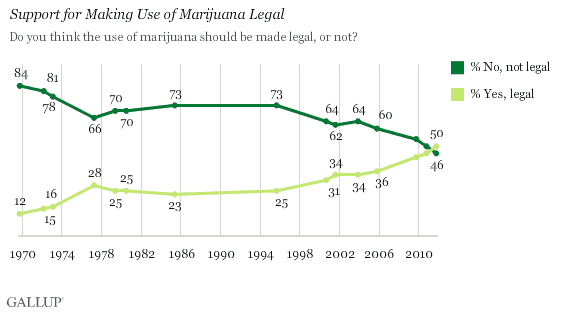
Respected polling-firm Gallup reports that for the first time, half of all Americans support legalizing marijuana use. Fifty-percent of all Americans favor legalization; that’s a huge jump from forty years ago. The ongoing trend is also clear: younger Americans are more likely to support, and senior citizens more likely to oppose, legalization.

In another twenty years’ time, proponents will probably be an even larger share of the public.

I don’t smoke, and most of those who favor some kind of legalization don’t smoke either. (The poll numbers are much too high for everyone favoring to also be smoking pot.) Fully one-third of conservatives and Republicans favor legalization, and even three-in-ten senior citizens do.

Why does a majority, most of whom are certainly non-smokers, favor legalization? I’ve no single answer, but one can guess one reason is that the amount of time and money poured into marijuana prohibition no longer seems reasonable. (After all, in was National Review in 1996 that came out against the entire Drug War.)

Gallup’s poll won’t end the debate about marijuana legalization, but the trends the poll captures will eventually lead to a change in policy: those favoring continuing criminalization are an ever-smaller group.

On Poverty Spending

Libertarians believe in ‘limited government, individual liberty, free markets, and peace.” Limited government means less spending (and so fewer taxes, and a lower public debt). That doesn’t mean there should be no spending. People have a right to defend themselves (defense, policing) even if we may spend too much in those areas (influential defense contractors or equipment vendors being among the causes of over-spending).

There’s a second area – beyond personal safety – that’s worthy of consideration: limited, necessary aid to the poor and disabled. The best way to alleviate poverty is to unleash the power of free markets to improve everyone’s standard of living. Still, not everyone feels that uplifting power (in part because the state wrongly restrains and restricts markets).

Although one would prefer private charitable solutions for those mired in poverty, traditionally libertarians are not opposed to this kind of public spending. That may seem contrary to what many have heard about libertarians, but that’s because they haven’t heard the straight story about libertarians.

Over a year ago, Edward Glasser, at the New York Times’s Economix Blog, correctly noted the libertarian willingness to consider public aid to the poor:

Libertarianism rests on two bedrock beliefs: human freedom is a great good and the public sector tends to screw things up. The first belief is based more on faith than empirical result; the second derives from millennia of human experience. The increased appeal of libertarianism today reflects a nonpartisan view that the public sector has been deeply problematic under either party. It is a backlash against President Bush as well as President Obama. (Ron Paul was, after all, the only Republican to vote against the 2002 Iraq war resolution). Libertarians tend to think that the Bush years taught that all governments were flawed, not that everything would be better with a new leader who would expand the public sector….

Libertarians are rarely anarchists. Almost all of them believe in some form of state power, at the very least the protection of private property and the enforcement of contracts. Many of them, including Milton Friedman, are quite comfortable with larger exercises of state power, including the redistribution of resources to those who have less. Professor [Jeffrey] Miron writes that “antipoverty spending is the most defensible kind of redistribution,” because “the goal of this redistribution – helping the poor – is reasonable and the costs of a well-designed limited antipoverty program (e.g., a negative income tax set on a state-by-state basis) are modest.”

See, http://economix.blogs.nytimes.com/2010/06/15/the-economics-of-libertarianism-revealed.

That’s a fair assessment, all around. Of all the kinds of objectionable public spending — and that’s most public spending — spending on the poor remains an exception: it’s not objectionable. By contrast, spending is worst when it benefits established people, who use the state to tax others to divert others’ earnings toward themselves. For successful people, government acts as a shakedown artist, or a reverse Robin Hood, taking from common people to feed the appetites and egos of established ones.

Daily Bread for 10.18.11

Good morning.

Whitewater’s Tuesday forecast calls for a mostly cloudy day, with high temperature of fifty-four degrees.

There are two principal public meetings scheduled for Whitewater today.  At 4:15 PM, there will be a meeting of Whitewater’s Urban Forestry Commission.  Later, at 6:30 PM, there will be a meeting of Whitewater’s Common Council.  The Common Council agenda is available online.

Much of the Council sessions over these coming weeks will address Whitewater’s 2012 municipal budget. A copy of the budget proposal is online.

I’ve commented on past budgets and budget processes, and this year will be no different. Expect from a few a reflexive defense of whatever this municipal administration proposes, as though every word were etched in stone at Sinai. Even before deliberations begin, there will be a rush to crow about how skillfully prepared the budget is, how strong is the condition of our small city,  and how right is everything in town.

It’s false, as anyone who lives here knows. Demonstrating as much is the least a sensible person could do.  Conditions will not be made better by pretending all is well.

It’s not well, for so very many people here.

There’s a context to this, and so an order: what matters most, conditions as they are, and what should be done about them. There’s plenty of time to make that case.

There may be a context to our conditions, but some things – and some animals – start out fresh. (There’s my poor effort at a transition.) Here, via the Huffington Post, something delightful:

Rights-Oriented and Consequences-Oriented Libertarians

Prof. Jeffrey Miron describes broadly the differences between rights-oriented (philosophical) and consequences-oriented (practical) libertarians. The video is a fair description of both, and one can easily guess from both the title and order of his presentation which Miron supports.

Still, the distinction is, itself, not so significant in day-to-day debates, as almost all libertarians will use practical justifications, with some also advocating philosophical ones as fundamental to their views. (The consequentialists won’t use the language of rights theory, but the philosophical libertarians will use both arguments.)

Those from old movement families, especially families without economists among their ranks, are more likely to be philosophical, rights-oriented libertarians. That’s a topic for another day; for today, here’s Miron on the two schools:

Lots of links and embedding? I’m not a bit surprised.

I’ve read that Whitewater’s switch to Vimeo for posting videos affords the city more information about how many times a video is viewed, and whether viewers linked, embedded, or downloaded the program. Some of the Whitewater videos recently uploaded have been viewed, linked, embedded, or downloaded many times.

(I’ve posted a few videos to YouTube, but the stats there are limited, and often inaccurate. For now, it’s still adequate for my needs. More citizen-recorded video would have been necessary if the city had not moved, as it rightly did, toward greater openness through more recordings of meetings.)

I’m not a bit surprised about how rapidly these videos can catch on – when people have a chance to see something on their own, and talk about and share what they’ve seen with others, news travels far and rapidly. For most people, it simply doesn’t make sense to create a separate website (like FW), as there are other powerful ways to share videos apart from blogs or standalone sites. Facebook, for example, lets people say what they want, when they want, and spread messages quickly. Between Facebook, Twitter, email, and texting, messages sail swiftly through a town (and to places distant).

It’s encouraging that some videos are catching on, as favorable stats confirm what’s been happening in towns across America: residents communicate electronically among themselves, expressing their own opinions, rather than relying passively on official or status quo publications.

There’s no stopping this trend – it has grown more powerful in spite of (or perhaps because of) a difficult economy. What’s significant isn’t solely the message in a video, but what people say to each other about that message. What residents say is beyond the control of local officials, as it should be, as an exercise of these citizens’ rights of expression.

Note to newspaper editors: if you’re editorials aren’t online, you’re missing out on shaping a very big conversation, one that’s swirling beyond your office doors. The online audience is vast, and when one looks toward it, one looks toward the future.