FREE WHITEWATER

Unfounded Charges Against the Tea Party Movement

Yesterday, at its annual convention in Kansas City, the NAACP issued a resolution condemning elements of the Tea Party movement as racist. It’s an over-reaction to that movement, and debases legitimate charges of racism. No matter how controversial or unwelcome the Tea Party wave is for the left, it’s not a racist movement, and certainly no more of its members are bigoted than other large protest groups.

It its false, undeserved, and likely unavailing, for the NAACP to accuse these disparate groups of racism. It’s also sly and insidious to accuse not the whole group, but elements of it, of racism. In any group of so many, there’s likely to be an elements of racism, unfairness, happiness, confusion, coin collecting, and card-playing. Take a million people, and one will find any element one wants.

On the left, someone not disposed to the Tea Party movement, like Mary Curtis of Politics Daily, sees how futile this resolution against the Tea Parties is:

But every charge by the NAACP will be answered by denials and statements by black Tea Party members, such as the Bishop E. W. Jackson, president of STAND (Staying True to America’s National Destiny) or Rev. C.L. Bryant, a former president of NAACP’s Garland, Texas, chapter, who is now a Tea Party activist.

You can forget about that common ground, over a broken economy, a government — big or small — that works and justice for “real Americans” (you know, the ones who live on farms as well as inner-city apartments)?

Better to argue over a resolution that won’t change one mind.

She’s correct — progressives should be out campaigning for their views, not issuing resolutions like the one from Kansas City.

I am not a member of this movement, but I did once attend a Tea Party rally in Jefferson, Wisconsin, and have followed the effort ever since. See, Scenes from a Tea Party Protest, Jefferson, Wisconsin. (A libertarian has an odd, shifting feeling when watching a Tea Party event — one feels in agreement sometimes, but disagreement in others.)

I found that I agreed with them on some issues (small government) disagreed on others (immigration), but felt that there was nothing racist about their protest. Not at all. Nationally or locally, charging as much is wrong and counter-productive.

The left will one day have its version of these sort of protests, and until they do, they’ll not make ground by false accusations against others.

Daily Bread for Whitewater, Wisconsin: 7-14-10

Good morning,

Whitewater’s forecast for today calls for a hot day, with temperatures in the 90s, followed by thunderstorms this evening.

There’s a meeting today, at 9 a.m., of the Whitewater-University Tech Park Board. The agenda is available online.

The French have two big events today. It’s Bastille Day, commemorating the storming in 1789 of a vast fortress to free seven people:

Bernard-Jordan de Launay, the military governor of the Bastille, feared that his fortress would be a target for the revolutionaries and so requested reinforcements. A company of Swiss mercenary soldiers arrived on July 7 to bolster his garrison of 82 soldiers. The Marquis de Sade, one of the few prisoners in the Bastille at the time, was transferred to an insane asylum after he attempted to incite a crowd outside his window by yelling: “They are massacring the prisoners; you must come and free them.” On July 12, royal authorities transferred 250 barrels of gunpowder to the Bastille from the Paris Arsenal, which was more vulnerable to attack. Launay brought his men into the Bastille and raised its two drawbridges.

On July 13, revolutionaries with muskets began firing at soldiers standing guard on the Bastille’s towers and then took cover in the Bastille’s courtyard when Launay’s men fired back. That evening, mobs stormed the Paris Arsenal and another armory and acquired thousands of muskets. At dawn on July 14, a great crowd armed with muskets, swords, and various makeshift weapons began to gather around the Bastille.

Launay received a delegation of revolutionary leaders but refused to surrender the fortress and its munitions as they requested. He later received a second delegation and promised he would not open fire on the crowd. To convince the revolutionaries, he showed them that his cannons were not loaded. Instead of calming the agitated crowd, news of the unloaded cannons emboldened a group of men to climb over the outer wall of the courtyard and lower a drawbridge. Three hundred revolutionaries rushed in, and Launay’s men took up a defensive position. When the mob outside began trying to lower the second drawbridge, Launay ordered his men to open fire. One hundred rioters were killed or wounded.

Launay’s men were able to hold the mob back, but more and more Parisians were converging on the Bastille. Around 3 p.m., a company of deserters from the French army arrived. The soldiers, hidden by smoke from fires set by the mob, dragged five cannons into the courtyard and aimed them at the Bastille. Launay raised a white flag of surrender over the fortress. Launay and his men were taken into custody, the gunpowder and cannons were seized, and the seven prisoners of the Bastille were freed. Upon arriving at the Hotel de Ville, where Launay was to be arrested by a revolutionary council, the governor was pulled away from his escort by a mob and murdered.

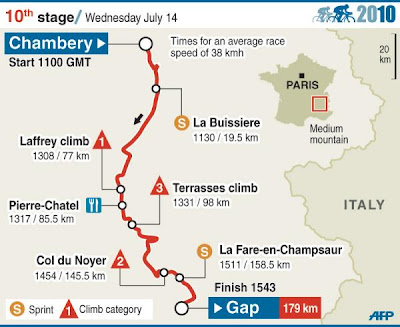
But there’s another event, too, that involves neither fortresses nor gunpowder. Stage 10 of the Tour de France takes place this morning,


Much better.

Eleven Fifty-Nine for 7-13-10

Good evening,

It’s a party cloudy night, with a low temperature that will be in the low sixties.

The results of the ninth stage of the Tour de France, following a rest day, seemed to make clear that the battle was down to two riders:

And in a sign of what to expect over the course of the next 12 days, Andy Schleck (Saxo Bank) earned himself the overall race lead following his mano-a-mano exploits with Alberto Contador (Astana) that began on the slopes of the Col de la Madeleine. There’s no doubt that the touch paper which was ignited today will result in an explosion for the maillot jaune once the race hits the Pyrenees.

One fact became glaringly obvious, however: this year’s Tour de France has become a battle between Schleck, winner of Sunday’s stage to Morzine-Avoriaz, and reigning champion Alberto Contador. There’s already two minutes between second-placed Contador and third-placed Samuel Sanchez, and each has the team to help them remain at the head of proceedings….

There’s sound reasoning in all this, but it’s still early. After all, at least one publication saw a different possibility, before the race began:


There’s more information now, by far, than there was just nine stages ago, but there’s still much that’s unknown.

Do desperate times call for desperate measures? One of the wealthiest school districts in Wisconsin, in Williams Bay, is looking to ask voters to support a referendum to “to exceed state revenue caps by $498,000 for the next two school years and by $890,000 for the school years after that.” See, Williams Bay School District sets referendum for September.

One could say that our difficult times call for even wealthy districts to fund operations by raising additional revenue — taxes — to keep going. Alternatively, it’s possible that some school boards, no matter how well off their districts, simply cannot imagine not asking residents for still more revenue.

I’ll end the day on a fine, reassuring note, of possibility. Here’s Duke Ellington, from a clip as he plays Take the A Train. Enjoy.


Link: http://www.youtube.com/watch?v=bHRbEhLj540 more >>

The Congressman’s Constituents

There’s a video making its way through cyberspace that’s sure to the the first of many like it this election year. The video shows the reaction of participants in a town hall meeting to Congressman Brad Sherman’s declaration that he knew nothing about a Department of Justice dismissal of a case against of voter intimidation filed against the New Black Panther Party. One attendee asks Sherman a question, and others react, vociferously. He answers her question generally, as one would expect, but he makes the mistake of contending that he knows nothing about the dismissed case. Many in the audience react unfavorably to his denial of knowledge.

Here’s the two-minute video:


Link: http://www.youtube.com/watch?v=UymN7t1kX3Q

The Congressman is Brad Sherman, Democrat of California’s 27th Congressional District. (Sherman won his district easily in 2008; he’s been in Congress since first winning the seat in November 2002.)

Sherman stays calm, but seems surprised at the reaction. The situation he faces will prove an increasingly common one, where a someone takes a video camera, someone else asks a question, and members of an audience react. Admittedly, some attendees are surely activists aware beforehand of some of these questions, but that does make the questions, or answers to them, any less legitimate.

For many politicians and bureaucrats, being challenged like this will prove new and uncomfortable, as a sycophantic press would not have reported an encounter like this. Now, these encounters are just a camera and a website away from widespread publication.

A few more episodes like this, and communities may be spared any number of lies or self-serving exaggerations.

Note to the Left — You’ll find yourselves using techniques just like this when conservatives are back in power. What some of you foolishly revile now, you’ll embrace when the balance of political representation shifts.

Hat tip to Powerline.com more >>

Daily Bread for Whitewater, Wisconsin for 7-13-10

Good morning,

Today’s forecast calls for a chance of thunderstorms with a high of eighty-two degrees.

In the City of Whitewater today, there’s a meeting of the Urban Forestry Commission at 4 p.m. The meeting agenda, for a group that would more simply be called a tree commission, is available online. Having abolished the former commission, the city chose to find a new, if less apt, name for the new commission.

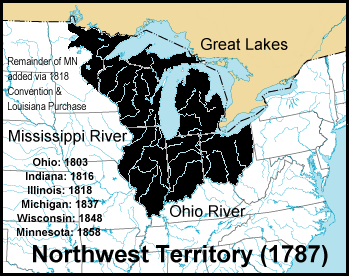
The Wisconsin Historical Society recalls that on this date in 1787, the

Northwest Territory [was] Established

On this date the Northwest Ordinance was passed by the Continental Congress. The ordinance provided for the administration of the territories and set rules for admission as a state. The Northwest territory included land west of Pennsylvania and Northwest of the Ohio River, which encompassed present day Ohio, Indiana, Illinois, Michigan, parts of Minnesota and of course Wisconsin. [Source: Indiana Historical Bureau]

And there we are …


Map from Wikipedia

Eleven Fifty-Nine for 7-12-10

Good evening,

It’s a slightly overcast evening, with a low of about sixty degrees for the overnight temperature.

I blogged on Whitewater’s Planning Commission meeting earlier this evening, and I will later update that post with a few additional remarks. See, Whitewater’s Planning Commission Meeting for 7-12-10 (Live Blogging). Much of that meeting concerned residential housing (and the difference, that eluded so many, between enforcement of an existing ordinance and adoption of another, more restrictive one on the number of unrelated persons who may live together in a home in a residential neighborhood).

There’s a story in the Journal Sentinel about tiny homes, not now particularly historic, not part of ‘historic neighborhoods,’ but interesting nonetheless. In Tiny House, Big Questions, Mary Louise Schumacher writes that

While architectural bravado tends to grab headlines, some of the most extraordinary architecture being made in the world today are small, adventurous structures, transitory buildings that take little from the Earth and give more than seems possible in return.

At their best, these pocked-sized projects, sometimes called “micro architecture,” do more than set standards for sustainable practices. They challenge the way we live.

One such project is the EDGE (Experimental Dwelling for a Greener Environment), designed by a small Stevens Point firm, Revelations Architects. The abode is so bitty, in fact, that it doesn’t qualify as an actual house in much of Wisconsin, where 750 or 800 square feet of floor space is required.

The JS also has a link to a video that shows the house in greater detail. A commenter to the story writes that it’s a “[n]ice little house. Just the right size for one person and a cat.”

Here’s a video of a different, micro house, to get an idea of how small they are:


Link: http://www.youtube.com/watch?v=FTF9PfDFv_c

I don’t think these micro homes are superior as a principle (although the architect thinks so, rather smugly) — I simply think they’re interesting.

Homes this small, though, at 500 square feet, for example, would settle many questions about the permissible number of unrelated occupants of a dwelling. more >>

The Worst Ecological Disaster Ever? Looking Beyond the Gulf

I’m sure that I’ve thought, of the oil spill in the Gulf, that it must be the worst ecological disaster in our history. At Commentary, John Steele Gordon asks the question, “The Worst Ecological Disaster Ever?” and concludes that the Gulf spill’s not our worst experience.

He offers some experiences far worse:

….how about the Aral Sea, where the Soviets diverted for agricultural use all the water that had flowed into it, destroying what had been the fourth largest lake in the world (26,000 square miles), as well as the vast ecosystem (and fishing industry) it had nurtured?

Or how about the London killer smog of 1952 that is thought to have killed upwards of 12,000 people, more than a thousand times as many people as have died in the Gulf Oil spill?

In this country, the worst man-made ecological disaster was, by order of magnitude, the Dust Bowl of the 1930s. Drought and poor farming practices in an area that should never have been farmed at all destroyed 100,000,000 acres. One dust storm that started on the high plains on May 9, 1934, dumped an estimated 6,000 tons of dust on the city of Chicago alone — four pounds per person. New York had to turn on the streetlights in broad daylight the next day. Two and half million people fled the area over the decade. Hundreds, perhaps thousands, died of dust pneumonia. Many more, especially children, died of malnutrition. Others were blinded when dust got under their eyelids.

I’m sure he’s right. There are valuable reminders of economics and history in his examples: one doesn’t always assess costs correctly from appearances, and one understandably but erroneously considers present disasters worse than distant, ill-remembered, earlier ones. More than one book has been written on these subjects, so to speak.

(The reverse is surely true, as well — that supposed cost savings from green technologies are sometimes exaggerated, omitting costs of adoption not properly considered. Worse, some of these terms are used like incantations, as though saying green or sustainable about a project makes it a genuine conservation effort.)

Do Libertarians Like Their Message? You Bet We Do

There’s a story from Indiana about how libertarians are fairing in that traditionally Republican state. Entitled, Libertarians Like Their Message, it describes a libertarian candidate as knowing that “your chances of winning are remote, but your goal is to finish as strong as possible and keep building for the future.”

That’s true for those libertarians who run as Libertarians; there are far more libertarians who are independents and swing voters.

There’s a good feeling about advocating something because one believes it and not simply running for personal ambition, hoping to work out a plan only after getting through the door. My preceding post, about how Wisconsin‘s major-party gubernatorial candidates have offered flimsy and incredible solutions, sometimes leads people to a libertarian alternative.

That’s why Chris Spangle, a libertarian from Indiana, can forthrightly say that “[t]here’s no party that represents true fiscal responsibility as much as Libertarians,” he said. “Republicans and sometimes even Democrats talk about libertarian values of fiscal responsibility, but once they get into power, they don’t follow though on all the promises they made.”

Politicians are wrong to blame voters for being apathetic, skeptical, or cynical. People aren’t born that way; if anything, people are too trusting. It’s the emptiness of political promises that leaves people justifiably weary and jaded. A more informed and energetic electorate would develop in a more honest, less selfish political culture. A smaller government would produce a better politics, less attractive to gluttonous politicians.

Years of the major parties pretending that sows’ ears are really silk purses, all the while living as pigs, has taken its toll.

Smaller and limited government, individual liberty, free markets, and commerce with friendly countries.

So, do libertarians like their message? Oh yes, very much indeed.

Walworth-Big Foot Historical Society Farm & Place Tour: July 28, 2010

I received the following press release that I am happy to post:

The Historical Society of Walworth & Big Foot Prairie will conduct their Third Annual Farm and Place Drive-by Tour. The event will occur on Wednesday, July 28 at 6:30 PM with the participants meeting in the parking lot of the Agape School at 215 South Main Street, Walworth. (This is the site of the former Seventh Day Baptist Church.)

The tour will include the farms and homes where the Seventh Day Baptist Society members lived, Cobblestone Cemetery, farms on a route to Zenda, a farm museum tour and South Shore Geneva Lake historical sites. Each family will receive a free map and tour book, then proceed on the tour lead by Co-chairwomen Virginia Hall and Mary Kaye Merwin of Delavan. The tour committee consisting of Virginia Hall, Mary Kaye Merwin, Nancy Lehman, Mike Palmer, Denise Woods, Terry Woods, William Wendeberg, Mary Jordan, Beth Shodeen and Jennifer Coon has worked for months acquiring historical information and personal interviews for the tour. For additional information please call 262-275-2426.

Daily Bread for Whitewater, Wisconsin: 7-12-10

Good morning,

Whitewater’s forecast calls for a chance of thunderstorms with a high of eighty degrees.

The City of Whitewater has a busy municipal calendar today. At 4 p.m., there were be a meeting of the Parks & Recreation Board. The meeting agenda is available online.

At 6 p.m., there will be a meeting of Whitewater’s Planning Commission. The agenda, with a packet of documents related to the meeting, is available online. It’s an improvement for Whitewater over past practice, and brings our city into alignment with the sound practice of putting documents online, in advance of the meeting, for residents to review and consider. I’ve written about this previously. (See, It’s In Your Packet and It’s Online for All: The City of Beloit’s Good Government Example.)

I’ll blog on tonight’s Planning Commission meeting, with topics at that meeting including a residential zoning overlay for the Starin Park neighborhood, and a proposed expansion of our Walmart.

At 6:30 p.m., there will be a meeting of Whitewater’s library board. The agenda for the meeting is available online.

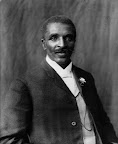
It’s the anniversary of George Washington Carver’s birthday — he was born in 1865, and died in 1943. Upon his death, the New York TImes published an obituary describing his life’s accomplishments, albeit a description that was informative yet deeply condescending:

Dr. George Washington Carver, noted Negro scientist, died early tonight in his home at Tuskegee Institute. His age was 78.

Dr. Carver had been in failing health for some months and was confined to his bed for the last ten days.

He became a member of the Tuskegee Institute faculty in 1894 and had been attached to the Negro institution ever since.

Dr. Carver was recognized as one of the outstanding scientists in the field of agricultural research. He discovered scores of uses for such lowly products as sweet potatoes, peanuts and clay. From the South’s red clay and sandy loam, he developed ink, pigments, cosmetics, paper, paint, and many other articles.

No Ambition for Riches

Dr. Carver, paying no attention to his clothes and refusing to make money on his discoveries, simply devoted his life to scientific agricultural research, to enable his colored brethren to make a better living from the soil in the South.

He became such an authority on cotton, the peanut and the sweet potato that he ended with a place among important white men. His name is in “Who’s Who in America,” and he was accorded a membership in the Royal Society of London.

“Who’s Who” lists him as an educator and follows immediately with the information, which he supplied, that he was “born of slave parents on a farm near Diamond Grove, Mo., about 1864; in infancy lost his father and was stolen and carried into Arkansas with mother, who was never heard of again; was bought from captors for a race horse valued at $300 and returned to former home in Missouri.”

Because he was a puny boy who got his growth late, he was allowed to run around as a household pet without being put to heavy work. Outdoors he learned about trees, shrubs and insects and liked to paint and draw them. In the kitchen he picked up much knowledge of cooking and of canning fruits and vegetables which later was to serve his people. In the parlor he learned something of music.

It’s also the anniversary of the Etch A Sketch. Wired offers a story entitled, Etch a Sketch? Let Us Draw You a Picture that describes the device:

The technology behind this children’s toy is both simple and complex. Simple, in that an internal stylus is used, manipulated by turning horizontal and vertical knobs to “etch a sketch” onto a glass window coated with aluminum powder.

Complex, because the Etch a Sketch employs a fairly sophisticated pulley system that operates the orthogonal rails that move the stylus around when the knobs are turned. The stylus etches a black line into the powder-coated window to create the drawing.

Along with the aluminum powder, the guts of the toy include a lot of tiny styrene beads that help the powder flow evenly when the sketch is being erased (by shaking), recoating the screen for the next drawing. As for how the aluminum powder sticks to the window, well, it pretty much sticks to everything.

Arthur Granjean, a Frenchman, was the Etch a Sketch’s inventor (he called it L’Ecran Magique, or “The Magic Screen”). After failing to get some of the bigger toy companies to bite, he sold his invention to the Ohio Art Company, which has manufactured it ever since.

Walworth-Big Foot Historical Society Farm & Place Tour

The Historical Society of Walworth & Big Foot Prairie will conduct their Third Annual Farm and Place Drive-by Tour. The event will occur on Wednesday, July 28 at 6:30 PM with the participants meeting in the parking lot of the Agape School at 215 South Main Street, Walworth. This is the site of the former Seventh Day Baptist Church. The tour will include the farms and homes where the Seventh Day Baptist Society members lived, Cobblestone Cemetery, farms on a route to Zenda, a farm museum tour and South Shore Geneva Lake historical sites. Each family will receive a free map and tour book, then proceed on the tour lead by Co-chairwomen Virginia Hall and Mary Kaye Merwin of Delavan. The tour committee consisting of Virginia Hall, Mary Kaye Merwin, Nancy Lehman, Mike Palmer, Denise Woods, Terry Woods, William Wendeberg, Mary Jordan, Beth Shodeen and Jennifer Coon has worked for months acquiring historical information and personal interviews for the tour. For additional information please call 262-275-2426.