FREE WHITEWATER

Update: How Long Does It Take a Whitewater, Wisconsin Bureaucrat to Screw in a Traffic Light?

Update to the update:

I’m getting reader suggestions for limiting traffic from the university side of this intersection via signage or a permanent end to travel as an alternative to junking the gateway.

As you can see below, I’d forget about the gateway before I’d delay a pedestrian solution. I’m not concerned about that proposal riling people. (One can guess that I’m not much worried about that risk.)

If there’s a much easier solution, then that’s surely preferable.

Delay is the worst choice of all.

The disparity in city management’s urgency about this project and others is noteworthy.

A reader wrote in concerning yesterday’s post, How Long Does It Take a Whitewater, Wisconsin Bureaucrat to Screw in a Traffic Light?

He wrote with a fair question: What would I suggest? I’ll list remarks and suggestions immediately below.

Bureaucrats and Daily Responsibility. In my post, in both the title and text, I was intentional in mentioning Whitewater’s bureaucrats, those who are daily paid to manage the city. I see a significant difference between elected members of Council who meet periodically and those who are paid for conventional, full-time work for the city.

It’s not a small distinction — those working full-time to trouble-shoot, solve problems, and spot difficulties are the ones who bear principal responsibility for a delay like this. Elected politicians who work full-time jobs or with other full-time duties cannot be expected to be involved in the day-to-day management of this project.

Full-time bureaucrats, like Whitewater’s city manager, her director of public works, or consultants who are well-paid to see and flag problems, bear the principal responsibility for delays like this. When they speak only after a Common Council vote, and then only in vague terms, they ill-serve residents of the city.

Those who are paid for full-time management, or those compensated consultants who are paid to assess construction requirements and timelines, are the ones about whom I am most concerned.

These men were quick to declare in the press how easy this would be, as I quoted from their own words.

True Monuments. In his remarks from his weekly report of April 30th, the city manager writes that “Due primarily to a need to move the historic gateway and entrance walls to the UW-Whitewater campus at the Whiton Street entrance as an integral part of the project, the construction of the long planned improvements to the Main and Whiton Street intersection will now be delayed until next spring.”

Here’s a suggestion, about which I am entirely sincere — abandon the stonework, discard it entirely, and install the traffic signal without regard to the gateway. No historic past should be allowed to trump or delay present human needs.

Any city or university bureaucrat who cares more about these stones than about people in town is gravely misguided.

Let me remind these would-be guardians of the past that a more recent past involved more than aesthetics — someone was struck at this intersection.

That the city manager writes about the need to preserve the gateway over human safety does not redound to his credit; it’s a shameful lack of priority. A shallow and middle-brow deference to this gateway over human need is both risible and wrong.

When there was concern last year about our former tree commission, the city manager insisted that he would not tolerate rudeness toward city workers. He should show at least the same energy on behalf of the safety of common pedestrians.

There was much concern over how tree branches might, just might, impede rapid travel of emergency vehicles through automated intersections. No one could show proof of an actual harm, but the mere possibility was raised, by more than one person.

Well, the significance of this traffic signal is no mere possibility. Whitewater already knows that traffic does impede pedestrians across Main — we know this because there have been actual, not possible, injuries.

If there should be a single administrator in the university insisting for the preservation of the gateway over a rapid installation of the traffic signal, then I would suggest that he may not have been at the university long enough. It’s a school for people in the present, not for monuments to those from the past.

If anyone would fight to preserve the gateway over the rapid installation of the traffic signal, including through a lawsuit, let them try. That’s a challenge that a decent group would welcome — let someone argue for stones over people. That’s a claim worth resisting, resisting confidently and zealously.

A traffic signal, installed promptly, would be its own monument, to the legitimate needs of the present. The steel and aluminum of a signal would be more beautiful than any stone gateway. This is true in the deepest way, just as a small & humble church will always be more beautiful than Rome’s ancient Colosseum.

A plaque could be applied to the new signal, to reflect the right priorities for our city, as confirmation of Whitewater as a truly worthy place:


THIS SIGNAL IS A MONUMENT OF OUR DEDICATION TO PUBLIC SAFETY

CONCERN FOR OUR FELLOW CITIZENS IS OUR FINEST ART

RESPECT FOR THEIR BASIC WELL-BEING IS OUR MOST ADMIRABLE DESIGN

Even without the plaque, our deeper meaning would be clear.

True Accountability. If it should be true that this is a matter primarily of the regulations affecting the gateway — as the city manager’s own words contend — then why was this not seen by the city’s manager, its director of public works, or its consultant?

The gateway did not magically appear. Either those with daily responsibility for this project have not assessed the risks and impediments properly, or have not candidly shared those risks already known to them. Either way, they have failed the pedestrians of the city.

They have no need to mention problems beyond the city limits. The only problem here is not acknowledging lack of foresight within our city limits.

Why not admit as much? Why is that so hard? The bureaucrats of this city should look to themselves.

This project won’t attract cameras and cheerleading publicity as the taxpayer-funded, multi-million dollar Innovation Center will. It won’t offer a chance for bureaucrats to spend millions and feel like wheeler-dealers. There will be no opportunity for flowery talk about the future, progress, dynamism, synergies, whatever.

There will, instead, be something much better. Setting aside superficial concerns and impediments, and by embracing a worthy goal — we will accomplish the simple task of advancing public safety.

That should be the only history that matters.
Daily Bread for Whitewater, Wisconsin: 5-4-10

Good morning,

Whitewater’s forecast calls for a mostly sunny day, with a high of eighty degrees.

There will a Common Council meeting tonight at 6:30 p.m. The agenda (pdf) is available online.

At Lakeview School today, there’s a PTA meeting at 6 p.m.

In Wisconsin history on this date, the Wisconsin Historical Society recalls the birthday of progressive Republican James Blaine:

1873 – Progressive Governor John James Blaine Born

On this date John James Blaine was born in the town of Wingville in Grant County. A politician, governor, and U.S. Senator, Blaine attended public schools in Montfort, and received a law degree from Northern Indiana University. He was admitted to the Wisconsin bar in 1897 and practiced briefly in Montfort before settling in Boscobel. A Progressive Republican, he served as Boscobel’s mayor for four terms and was elected to the State Senate in 1909. It was there that he gained prominence by leading investigations into the campaign expenditures of Wisconsin Senator Isaac Stephenson, attempting to block Stephenson’s re-election.

A zealous advocate of progressivism and the ideals embraced by Robert M. La Follette Sr., Blaine was one of the organizers and vice-president of the Wilson National Progressive Republican League. After running unsuccessfully for governor in 1914, Blaine was elected state attorney in 1918. In 1921, he became governor and held this office for three consecutive terms. During his tenure Blaine promoted progressive labor legislation, fostered a campaign to eradicate bovine tuberculosis, and signed the nation’s first law giving equal rights to women.

In 1926, he won the Republican nomination for U.S. Senate where he served from 1927 to 1933, becoming one of the leaders in the effort to repeal prohibition. He died on April 16, 1934. [Source: Dictionary of Wisconsin Biography, SHSW 1960, pg. 39]

Madison’s Isthmus: Janesville on the Brink

From Madison’s Isthmus, one reads a story about hardship in nearby Janesville, hardship that should be of concern to those in Whitewater, too.

No matter how dire the conditions for Janesville now, I believe that an abandonment of virtually every aspect of commercial and business regulation, along with drastic reductions in government spending except principally for police and fire, could yet make the city attractive as one large enterprise zone.

(I think the Isthmus‘s description is accurate, but it’s implied prescription of a public works solution is mistaken. Local press and business ideas relying on private solutions are more realistic.)

One thing’s certain – incremental efforts and conventional solutions will not be enough to mitigate current suffering from poverty and unemployment.

See, Janesville on the Brink.

How Long Does It Take a Whitewater, Wisconsin Bureaucrat to Screw in a Traffic Light?

  • Delay
  • Blame-shifting
  • Supposed, speedy solution
  • Approval of supposed, speedy solution
  • Bureaucrat’s comment immediately after approval of supposed, speedy solution.
  • Delay
  • Blame-shifting

FREE WHITEWATER, February 17, 2010, from Traffic Lights and Limelights in a Small Town:

Like many small towns, Whitewater, Wisconsin has one main thoroughfare through town, past our college campus, connecting the east and west sides of the city. At the campus, there’s a street named Whiton that runs into Main. At the intersection of the two streets, many college students, faculty, and workers cross from campus to homes. It’s a busy intersection, and has been the site an accident at which a pedestrian was hit by a car.

One solution would be to install a traffic stoplight, and that will, eventually, happen. I write eventually because a pedestrian was hit in August 2008, and there have been nearby accidents since, but we still have no conventional traffic light, to stop traffic. There’s a flashing sign, but no conventional red light that would signal to stop traffic so that one could walk across the street more safely.

Just a moment ago, I wrote that this problem became apparent no later than August 2008, and if that date caught one’s notice, it should have. It’s a year and a half ago.

Predictably, local political leaders want to blame our governor, in Madison, for delaying signing off on an approval for a traffic light. It’s a shameful exercise in blame-shifting. See, Whitewater still waiting on Gov. Doyle to sign off on Main Street traffic light.

Got that? Of course you did – Whitewater would have a light by now, if only Gov. Doyle had been more attentive!

Whitewater Public Works Director Dean Fisher, and Luke Holman, Strand Associates consultant, quoted February 2, 2010, in Whitewater Studies Traffic-Control Devices for Main-Whiton Crossing:

What type of traffic-control device will best ensure pedestrian safety at the intersection of Main and Whiton streets?

That was the main question when the City of Whitewater held a public hearing about upgrades to the crosswalk at Main/Whiton streets.

The session was led by Luke Holman of Strand Associates, the city’s consultant on the issues, with additional information provided by Whitewater Department of Public Works director Dean Fischer….

The intersection project has received a federal grant under the American Recovery and Reinvestment Act to cover the estimated $138,000, which is about 90 percent of the project. The city has to cover the other 10 percent, as well as any cost over that 90-percent estimate.

Fischer said the devices cost $270 and need another $2,100 for the computerized controller. The intersection would need a total of eight devices, so the total estimate is about $4,560 if these devices are approved by the council.

Holman said that as soon as the council decides on which device to use, the final project must be reviewed by the Department of Transportation. Next, the project would go out to bid for construction.

Holman estimated it would take about two months to complete the project. The timeline the city is operating under has construction beginning as early as late August.

“Typical signal jobs like this it takes six to 10 weeks to complete,” Holman said.

“Because we are getting federal funds, we have to follow their rules,” Fischer remarked about the timeline after an audience member asked if construction could be completed before school starts in the fall. “Luckily, this is a relatively simple project and we have been able to move this project along by this summer.”

Approval of Traffic Solution, Whitewater Common Council, March 16, 2010:


Remarks from Public Works Director Dean Fisher, immediately after March 16, 2010 Common Council approval of traffic signal, beginning at 46:30 minutes:

Could I make one more comment as long as we’re on that agenda item? It wasn’t in the memo, but there, obviously, the existing pillars and walls as they exist in front of Hyer Hall are very close to the sidewalk and the university has taken it upon themselves to figure out a way to move those, move those out and widen the driveway just a tad, but there is still the significance of the walls that are there, given by a [sic] Class of 1938, and so they’re really looking at some way to move them back so that we can make that whole intersection a whole lot safer for pedestrians and vehicle traffic. I just wanted to make you aware of that.

(Emphasis added.)

Whitewater City Manager Kevin Brunner, from his April 30, 2010 Weekly Report:

Main/Whiton Intersection Work Will be Delayed until Next Spring

Due primarily to a need to move the historic gateway and entrance walls to the UW-Whitewater campus at the Whiton Street entrance as an integral part of the project, the construction of the long planned improvements to the Main and Whiton Street intersection will now be delayed until next spring.

A couple of months ago while final design plans and specifications were being prepared for this intersection improvement project, both the city and University realized that in order to fully provide for both future pedestrian and vehicular safety at the intersection the gateway and attached walls would need to be moved further north of the intersection. This change in project scope along with a change in the Wisconsin Department of Transportation?s (WisDOT) consulting engineer on this project has pushed back WisDOT?s necessary approvals several months. While the project can still be let for bids this coming fall, there will not be enough time to complete the planned work this year.

Notes:

1. Watch the video immediately before the Council votes, and before Fisher speaks after the vote — there’s a statement that there will be time after installation but before fall budget deliberations to address additional costs from installation, etc. Fisher says nothing before the vote, and nothing concretely afterward, to dispel that notion.

2. Governor Doyle (!), the university, the Wisconsin Department of Transportation, etc., — the city’s running out of scapegoats. The installation of this traffic signal will take another year, after a year and a half of waiting already.

3. One should expect more excuses, blame-shifting, and so-called explanations yet to come. more >>

Daily Bread for Whitewater, Wisconsin: 5-3-10

Good morning,

Today’s forecast for Whitewater calls for a chance of thunderstorms and a high of sixty-eight degrees.

There’s a late start for schools in our district today. Students can sleep in a bit.

There are some notable, local stories you may have missed worth reading:

From mid-April, the Gazette published a story on the fortunes of the Walworth County Economic Development Alliance, entitled, “Future promising for economic development alliance.” The story offers lots of detail and remarks from those connected to WCEDA.

From just last week, there’s a story about the investigation of a local crime, entitled, “Stalking suspect lived upstairs.” The account is notably chilling. The story offers expert information about, and suggestions for reducing the risks, of the harassment that stalkers inflict.

Also from mid-April, the Wisconsin State Journal has a truly moving story about Stalin’s daughter, who settled in Wisconsin, entitled, “Lana about Svetlana: Stalin’s daughter on her life in Wisconsin.”

The Wisconsin Historical Society reports that on this date, in 1898, a famous Wisconsin resident was born:

1898 – Golda Meir Born

On this date, Golda Meir (nee Mabovitch) was born in Kiev, Russia. Economic hardship forced her family to emigrate to the United States in 1906, where they settled in Milwaukee. She graduated from the Milwaukee Normal School (now University of Wisconsin-Milwaukee) and joined the Poalei Zion, the Milwaukee Labor Zionist Party, in 1915. In 1921, she emigrated to Palestine with her husband, Morris Myerson, where they worked for the establishment of the State of Israel. Meir served as Israel’s Minister of Labor and National Insurance from 1949 through 1956 and as the Foreign Minister until January of 1966. When Israeli Prime Minister Levi Eshkol died suddenly in 1969, Meir assumed the post, becoming the world’s third female Prime Minister. She died in Jerusalem on December 8, 1978. [Source: Picturing Golda Meir]

Daily Bread for Whitewater, Wisconsin: 4-30-10

Good morning,

Whitewater’s forecast calls for a slight chance of thunderstorms today, but a probability of storms tonight.

At Lakeview School, it’s Coffee with the Principal from 8:30 to 9:30 this morning. It’s Spirit Day at the Middle School.

The Wisconsin HIstorical Society recalls an accomplishment of engineering skill in defense of the Union from this day in 1864:

1864 – Joseph Bailey Saves Union Fleet

On this date Joseph Bailey began to direct the men of six regiments, including the 23rd Wisconsin, in a dramatic attempt to save the heart of the Union fleet during the Civil War. Bailey, who was from Wisconsin Dells and an experienced lumberjack, served as an engineer in the 4th Wisconsin Cavalry.

In a doomed campaign against the Confederates on the Red River in Louisiana, Union warships found themselves trapped by low water and the rocky river bed. As Confederate soldiers approached, Bailey employed water control techniques used by loggers to construct a series of dams that successfully narrowed the river, raised the water level by six feet, and provided enough surge to free the trapped fleet of gunboats. For his role in this rescue, Bailey was promoted to the rank of brigadier general. He also received a Tiffany punch bowl from his fellow officers. [Wisconsin Lore and Legend, pg. 18.]

CNN: Rights Groups Say They Will Challenge New Arizona Immigration Law

A legal challenge is right and inevitable: Arizona’s law will lead to abuse of citizens and non-citizens, and will inhibit a free market in labor, making Arizonans poorer and life there harsher.

The law is destined for failure and obloquy, as were the restrictive efforts in California under Gov. Pete Wilson years ago. (That’s something former Bush official Michael Gerson noted in the Washington Post yesterday. The California Republican party is only now recovering.)

See, Rights Groups Say They Will Challenge New Arizona Immigration Law.

Whitewater’s Innovation Center Groundbreaking

I’ve written before about Whitewater’s tech park and Innovation Center, and some of the coverage it’s received. The groundbreaking ceremony for the Innovation Center, held this Tuesday, is another opportunity to review officials’ flimsy claims. Statements at the event were sadly, but predictably, empty.

Prior Posts. I’ve written about the Tech Park and Innovation Center before. See, On Whitewater’s “Advancing” Tech Park, Part 1, On Whitewater’s “Advancing Tech Park, Part 2, On the Innovation Center’s Anchor Tenant, and On the Innovation Center’s Anchor Tenant, Part 2.

Press Release and Story. There’s both a press release and a story, Ground broken for Whitewater Innovation Center.

A 125-Acre Park. One learns that the Innovation Center will be the first building in a “125-Acre Whitewater University Technology Park.” It certainly sounds impressive, until one realizes that the 125 acres are empty, and that the large size of the field is no assurance, or even probability, that the rest of the space will fill up.

Of course it’s the “first building,” but similarly, the presence of one does not show — no matter how much the use of the word “first” is meant to imply — that there will be others.

There should be other buildings — millions of dollars in taxpayers’ stimulus money and public debt went into financing this project. That kind of subsidy at taxpayers’ expense should have led by now to lots of tenants!

There’s mention of “preliminary talk of a second building.” There might just as well be preliminary talk of cold fusion, for all the difference it makes. Repeating the insubstantial and unsubstantiated claim serves an official line, while revealing not the least skepticism.

If I put a postage stamp on an open, green field, I’d still have a postage stamp on an open, green field.

The Business Park Nearby. Look less than a thousand yards from the site of the new tech park, and you’ll find our old business park. They have lots of space, too; quite a few acres, actually.

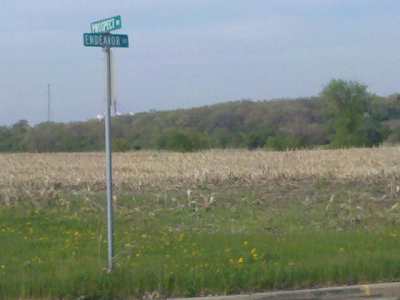
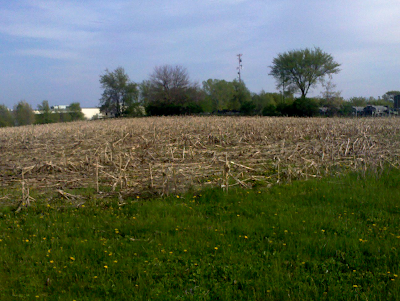
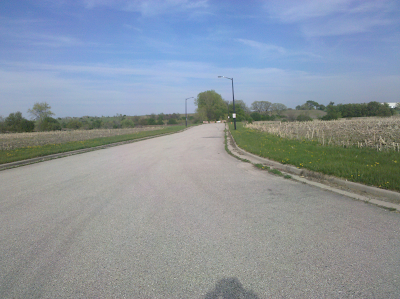
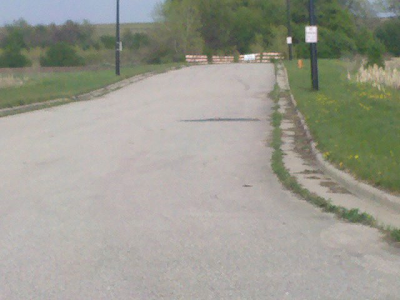
Go to the corner of Prospect & Endeavor, and here’s what you’ll find:

That’s a lot of space, too, but those expansive plots didn’t lead to buildings; they lead to a bumper crop of weeds and grass.

I’m not sure how many jobs these now-ignored plots were supposed to produce, but they’ve probably been good for at least one job — someone has to mow the grass now and then.

Jobs Mentioned Repeatedly, but Quantified Never. Look at coverage of the groundbreaking, and one hears claims of that the project will “create jobs and foster economic development,” but one never hears an estimate of how many. All these clever people, and not a single concrete number. One assumes that job creation is meant to be more than jobs for the contractor, etc., from the public dime.

When these politicians, bureaucrats, and sycophants talk about all that’s being spent, it’s not their money they’re investing . They didn’t contribute a dime of this — they took tax receipts and incurred public debt for this project.

Google, 3-D Television, Whatever. Imagine being at an event like this, where everything’s about “the future,” “jobs,” and “economic development,” and as concrete an idea as one hears is that

I understand that Google is looking for new headquarters, and wouldn’t this be a wonderful place for them. I tell you this because so many of us use technology, and technology is just zooming in places we cannot imagine, like 3-D television.

Too funny — “so many of us use technology” — not all, but at least so many!

Nice Digs. The Innovation Center’s anchor tenant, CESA 2, is rather thrilled: “…. a tremendous opportunity to partner with a university.”

Yes — much nicer than CESA 2’s current building in Milton, Wisconsin, I’m sure. I know that CESA 2 does good work — still, it was unnecessary and laughable that a publicly-funded educational agency would get upgraded accommodations as an anchor tenant in this tech park.

Collaboration. One learns, finally, that this is a “collaboration,” that there were individual thanks offered to “city and UW-Whitewater staff members, architects, consultants, state and federal personnel, and construction companies who have helped in the process of creating the Innovation Center.”

Every one of those named is either on the public payroll as an employee, or receiving federal funds or money from local debt for this project.

This collaboration was hardly a private, charitable venture, and speaking of it as though it were a community charity drive, or a church fundraiser, is both arrogant and misleading. There’s a common practice among managers, bureaucrats, and politicians, to talk about collaboration, etc.

By the way, there’s a place where there are millions of collaborative transactions each hour — it’s called the free market. Buyers and sellers come together, and freely decide whether to sell or purchase goods at a mutually agreed upon price.

It’s not collaboration to take money from productive private citizens, by power of taxation or issuance of debt, then spend it on flashy public projects, while mugging for the camera.

Where’s the Community? The photos of the groundbreaking are unintentionally funny. The closest that Whitewater will come to its own version of A Chorus Line: a group of mostly aging politicians, bureaucrats, and hangers-on, wearing ill-fitting construction hats, and posing as those they might possibly know how to did a proper hole.

For all the talk of innovation, this is a conventional group shot, dull and predictable, a staple of every groundbreaking one might ever see — hats and shovels, coats and ties.

The line of officials looks little like the city itself. They could scarcely be more unrepresentative as a sample.

Where are ordinary people, gathered to celebrate a supposedly epic event? If this project is all that these town squires say it is, why has the community not poured out in interest and appreciation? I’m sure one bureaucrat or another will whine that people just don’t understand, or need to be led, etc.

Nonsense, twice over. These self-important few are no better than anyone else in talent or accomplishment. They’re likely less so, because common people aren’t airy in their descriptions.

It’s also nonsense because most people know where to look to see how this grand project of tomorrow is likely to turn out.

They need go no farther than the corner of Prospect & Endeavor, where they’ll find the remains of yesterday’s grand project of tomorrow.

Daily Bread for Whitewater, Wisconsin: 4-29-10

Good morning,

Today’s forecast for Whitewater calls for a slight chance of showers and a high of seventy-two.

It’s Market Day at the High School, from 4 to 5:30 p.m.

In Wisconsin history on this date, the Wisconsin Historical Society reports that in 1959, the “Railroad Historical Society of Milwaukee Incorporated On this date the Railroad Historical Society of Milwaukee was incorporated as a not-for-profit organization. [Source: Mid-Continent Railway Museum].”

The 2010 the Mid-Continent Railway Museum’s season opens on May 8th, and much more information about the group is available at their website, linked above.

Note: This post didn’t originally load when it was scheduled. I’ve now published it to the proper place in the order.

A Proper American Response

Over at the Washington Post, columnist Michael Gerson summarizes nicely what’s wrong with Arizona’s anti-immigration law:

This law creates a suspect class, based in part on ethnicity, considered guilty until they prove themselves innocent. It makes it harder for illegal immigrants to live without scrutiny — but it also makes it harder for some American citizens to live without suspicion and humiliation. Americans are not accustomed to the command “Your papers, please,” however politely delivered. The distinctly American response to such a request would be “Go to hell,” and then “See you in court.”

The government of Arizona, it turns out, has been ambushed by its own legislature. If this vague law is applied vigorously, the state will be regularly sued by citizens who are wrongfully stopped….

All of this will be wrong, and a shame, for Arizonans, and an example of what not to do for the rest of America. (Gerson also points out how ruinous an anti-immigration stand has been for some of his fellow Republicans.)

(Hat tip to Jennifer Rubin of Commentary.)