“Maximize Your Memory” Workshop Offered by Alzheimer’s Association
Tips and Strategies for Keeping Fit from the Neck Up!
The Alzheimer’s Association will present an interactive workshop called “Maximize Your Memory” on Thursday, July 8, 2010 from 10:30 a.m. to 12:00 p.m. at Hawks Inn Visitor Center, 426 Wells Street in Delafield. The “Maximize Your Memory” workshop will offer participants information on how memory works, and what factors affect it both positively and negatively. Techniques for improving and maintaining memory through health and lifestyle choices will also be presented. This program is open to all members of the community and is being presented free of charge.
The presenter will be Judy Gunkel, Regional Services Coordinator, Alzheimer’s Association. Registration is required; please contact 262-646-6230.
The Alzheimer’s Association is a national non-profit organization whose mission is to eliminate Alzheimer’s disease through the advancement of research, to provide and enhance care and support for all affected and to reduce the risk of dementia through the promotion of brain health. For more information about Alzheimer’s disease and local services visit www.alz.org/sewi or call the Alzheimer’s Association 24/7 Helpline at 800-272-3900.
A healthy economy requires thriving private-sector job creation. Wisconsin has anything but — we’re losing private jobs:
Wisconsin’s economy continued to struggle in May as the state lost 7,900 private-sector jobs on a seasonally adjusted basis and only managed to offset the declines with a surge of new hires by federal, state and local government agencies, according to state employment data released Thursday.
Casting new doubts on the durability of the state’s recovery, private-sector hiring fell for the second time in three months after adjustments to smooth out seasonal fluctuations such as the start of school vacations. It also coincides with criticism in Washington and elsewhere over costly government stimulus spending to compensate for the jobs annihilated in the recession.
There’s a solution — significantly reduced government spending, reduction in taxes, and repeal of small business-related fees and charges. That’s the way to a more productive, and thus prosperous, Wisconsin.
From one of the most oppressive regimes on earth, having brought the people it rules to the brink of death, a belated, desperate effort to save itself through private markets:
Bowing to reality, the North Korean government has lifted all restrictions on private markets — a last-resort option for a leadership desperate to prevent its people from starving.
In recent weeks, according to North Korea observers and defector groups with sources in the country, Kim Jong Il’s government admitted its inability to solve the current food shortage and encouraged its people to rely on private markets for the purchase of goods. Though the policy reversal will not alter daily patterns — North Koreans have depended on such markets for more than 15 years — the latest order from Pyongyang abandons a key pillar of a central, planned economy.
There’s an update to a story about which I posted earlier this week, about a Wisconsin State Journal story entitled, “DOT Official’s Company Rings Up Hundreds of Thousands of Dollars in State Business.” The story described how a “company co-owned by a state transportation official has done hundreds of thousands of dollars in business with the state – some of it with the official’s own agency – raising questions about whether he used his government job for private gain, a Wisconsin State Journal investigation has found.”
Robert Jambois, chief legal counsel for the Wisconsin Department of Transportation, has “asked the Office of State Employment Relations to give its opinion on the conduct of Carl Guse, the focus of a Wisconsin State Journal investigation Sunday.”
As one can guess, there’s more information revealed about this possible conflict:
Jambois told the State Journal that his agency has suspended purchases of frequency licenses while it investigates possible ethical programs with Guse’s outside business ties.
Since 2003, the DOT and the state Office of Justice Assistance have paid at least $877,980 to secure private radio frequencies as part of statewide efforts to coordinate emergency radio communications.
Of that, $247,500 went to Badger Spectrum, a company Guse co-owns. In most cases, records show, the company bought the frequencies in Federal Communications Commission auctions for as little as $325 each, then resold them to the state two years later for $12,000 each.
Guse told the State Journal he has never used his state position to steer business toward Badger Spectrum and said safeguards had been set up to insulate him from state purchasing decisions.
Here’s the Friday open comments post, following reader responses to a recent poll.
The use of pseudonyms and anonymous postings will be fine.
Although the template has a space for a name, email address, and website, those who want to leave a field blank can do so. Comments will be moderated, against profanity or trolls. Otherwise, have at it.
I’ll keep the post open through Sunday afternoon.
For this week, a suggestion for a topic: Did Whitewater City Manager Kevin Brunner overreact by supporting the abolition of Whitewater’s Urban Forestry Commission?
Whitewater’s city manager, Kevin Brunner, seems oddly inadequate to the task of managing a city of fourteen thousand people. His response to complaints about Whitewater’s urban forestry program, a successor program to our former tree commission, shows that he has trouble responding maturely to simple, lawful criticism. The mere act of citizens’ sending a letter to a state agency led Brunner to suggest abolition of a citizens’ commission.
At Whitewater’s Tuesday, June 15th Common Council meeting, council member Jim Olsen introduced a proposal to abolish Whitewater’s urban forestry commission. City manager Brunner wrote and spoke on behalf of abolition. Council wisely declined to follow that over-reaction to non-threatening citizen correspondence with the State of Wisconsin.
(Quick note: I have no connection to either of the citizens who wrote to the state agency. None whatever. Other than once reading about Johnny Appleseed, I have no knowledge of trees, either. Longtime readers will also recall that I once proposed removing the trees in town an[d] planting varieties of cactus. I still think it would simplify life here.)
References.
A recording of the June 16th meeting is available online:
The relevant documents from the Common Council packet, part of the full packet, are embedded below, for easy reference. I have included the proposed ordinance for abolition of the Urban Forestry Commission, Brunner’s memo in support of that action, and a letter from the Wisconsin State Forester. (The City of Whitewater has already placed these and other public documents online, at the city website.)
Chronology.
Here’s a general chronology of Whitewater government’s problems managing a simple tree commission:
Whitewater for many years had a Tree Commission (TC).
In 2009, some citizens on the Tree Commission, and former members of that body, criticized various aspects of city tree-pruning and care.
In response to complaints that the TC and some citizens were supposedly out of control, maligning city workers, etc., the TC was suspended, and later abolished.
(It was abolished even though an interim head of the TC was able to show that principal complaints about TC conduct and policy on pruning had been resolved by the time Whitewater’s Common Council voted to suspend the TC. At the Council discussion, Whitewater was treated to a long list of speakers offering stale comments about how reckless or imprudent TC members had supposedly been.)
After consideration, Whitewater established an Urban Forestry Program (UFP).
Recently, a member of the UFP, and a non-member resident wrote to Paul DeLong of the the State of Wisconsin’s Department of Natural Resources, to complain about some UFP practices.
Council member Olsen submitted a motion to abolish the UFP, as the TC had been abolished previously.
City manager Brunner supported that abolition in a memo to the Common Council on 6/15/10.
The TC’s members are citizen volunteers. They deserve more, not less, deference than office holders (especially officer holders who are paid.) Imagine being someone other than the few hundred who think they own this town, define its culture for everyone, and may not be questioned. If you’re someone else, with a different point of view, why volunteer if you’ll be tarred with accusations that may have no immediate connection to you?
Some of the complaints from city workers about the TC may be justified, but by the time of the Council meetings, many of these complaints concerned matters in the past. That didn’t stop speakers from complaining as though these problems were continuing, often ignoring what the new chair of the TC had just said.
This Year’s Overreaction to Citizen Complaints.
Some citizens wrote a letter to the State Forester about Whitewater’s UFP. So what? In response their letter, the State Forester closed by saying, “I appreciate your concerns and passions for the trees of Whitewater.” The State Forrester was nonplussed.
What does Brunner say to the Common Council about all this? He says that the citizens’ letter was egregious and constituted micromanagement. Both remarks are nonsense — if Brunner thinks this is egregious, then he’s lived a cosseted life. As for micro-management, that’s just his term for criticism he doesn’t like.
It’s funny about Brunner, because he’s quick to say that he’s never seen anything like this in his professed twenty-five years as a city manager, but he doesn’t understand the implications of what he’s saying. He lacks the self-reflection to understand that if he hasn’t seen something like this in twenty-five years, it’s because he’s had a narrow and brittle experience with ordinary people.
I think — although I do not know — Brunner must believe that touting his tenure as a municipal manager is meant to reassure people about the strength of his views. Actually, it does quite the opposite. He conducts himself like someone much younger and less experienced. It’s truly a rebuke to his understanding and self-reflection that after twenty-five years (however one counts that time), that he’s able to do no better than he does.
A thin-skinned, brittle manager, with a tin ear, little apparent understanding of the diversity of ordinary life and views, an evident expectation of deference and servility from others, given to exaggerations and empty cheerleading, is the last thing this town needed.
There’s irony in this, as Brunner does represent something last and soon to be from the past: a declining, stodgy town faction of mediocrities and middling officials destined to be eclipsed by a new generation. Although Brunner’s not from Whitewater, he’s the perfect choice for a narrow, reactionary leader to guide the city’s dissipated, enervated elite into its decline, destined to be supplanted with a more tolerant and multicultural demographic. Our future will be more consistent with America’s promise of opportunity for all.
Open Records and Confidentiality.
Brunner learned of the citizens’ letter, apparently, when he was copied on a reply to the citizens from the State Forester. Brunner then claims to have initiated an open records request to get the copy of the citizens’ letter.
I think it was foolish for anyone to expect confidentiality from a state bureaucrat. One could and should expect that the State Forester would tip Brunner off, somehow. He did just that. Our Public Records Law (Wis. Stat. § 19.31-19.39) allows any person to request public records. It should be noted, though, that the law by express intent is for citizens to inquire of government, not officials to inquire of citizens’ contact with other officials
See, 19.31. Declaration of policy:
In recognition of the fact that a representative government is dependent upon an informed electorate, it is declared to be the public policy of this state that all persons are entitled to the greatest possible information regarding the affairs of government and the official acts of those officers and employees who represent them. Further, providing persons with such information is declared to be an essential function of a representative government and an integral part of the routine duties of officers and employees whose responsibility it is to provide such information. To that end, ss. 19.32 to 19.37 shall be construed in every instance with a presumption of complete public access, consistent with the conduct of governmental business. The denial of public access generally is contrary to the public interest, and only in an exceptional case may access be denied.
Brunner’s not wrong to request it — and the citizens should have expected that he would — but it does show how eager he is to watch citizens’ efforts rather than manage his own staff.
Removal of a Commission Member.
In the case of a private citizen, not part of any public body, the City of Whitewater has no recourse for written comments sent to the Wisconsin DNR. Despite the desperate ignorance of one official or another, there’s nothing in the letter sent to the state forester that’s actionable at law. Nothing. Agree or disagree, right or wrong, it’s still all lawful.
There’s now consideration in Whitewater that one member of the current tree program should be removed. Here Whitewater walks — as she does more often that properly ordered communities — on vulnerable ground. If there’s a move to remove a citizen member for conduct that inhibits and disrupts public proceedings, it should come initially from the commission of which he is a member, not initially from Council.
More significantly, removal on the basis of his a citizen member’s lawful views — however erroneous — is surely illegitimate and grounds for a objection. Writing a letter to a Wisconsin official, by the way, is speech, not conduct. No matter how upset it makes a few thin-skinned city employees and their political champions, that’s not unlawful nor is it a legitimate basis for removal.
Council was wise to decide against abolishing the UFC on June 15th. That’s an easy decision — abolition never should have been proposed.
The greater problem isn’t what to do about the Urban Forestry Commission, but what to do about the City Manager. more >>
Over at the Capital Times, there’s a story about a bus passenger who became angry, disruptive, and disorderly when the bus driver told him to pull up his pants. In Bus Rider’s Low Ride Pants Lead to Dispute, Arrest, reporter Bill Novak writes that
Larry Wilks’ low ride pants on a Metro bus got him a slow ride in a police car, authorities reported.
Wilks, 20, didn’t take lightly a request by the bus driver to pull up his pants, which apparently were low enough to allow his underwear and buttocks to be seen by others on the bus, including several elderly passengers, Madison police said.
His refusal to comply escalated into a shouting match, police were called, and Wilks eventually was taken to jail in handcuffs….
Wilks told police that he “didn’t have to do anything” and allegedly got into a fight with the officer before being put into handcuffs, under arrest.
If the account’s right — and there’s no reason to think otherwise — Wilks did everything wrong. Wanting to wear one’s clothing a certain way does not justify arguing with a bus driver, disrupting the ride of other passengers, or fighting with police. Wilks could have complied with the driver and later written a complaint to Madison Metro Transit. Alternatively, he could have left the bus, maintaining his style of dress, and later written a complaint to Madison Metro Transit.
Nothing Wilks did advances any positive claim about how one should, or shouldn’t, dress. On the contrary, his alleged conduct departed from any reasonable contention about sartorial freedom, and was simply a disruptive and violent outburst.
The forecast for Whitewater calls for a day with a high of eighty-nine degrees and a chance of thunderstorms.
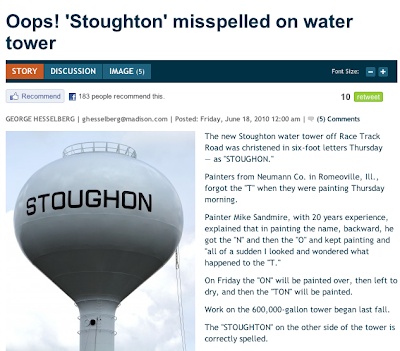
There’s a story at the Wisconsin State Journal about a mistake in nearby Stoughon Stoughton, Wisconsin. Entitled, Oops! ‘Stoughton’ misspelled on water tower, the title tells the tale.
The La Crosse Tribune has a wire photo and caption entitled, “Pet Waste Removal Worker Finds $58 in Dog Poop.” The story tells of Steve Wilson, an employee of DoodyCalls Pet Waste Removal, who found $58 in bills in a client’s dog’s poop. Wilson retrieved, cleaned, and return the money to the dog’s owner.
One reads that according to the “Association of Professional Animal Waste Specialists…Wilson is the first person in his profession to find and report money in dog poop.”
Other people may have done the same, of course, but if so, they would have done so while unaccredited, lacking membership in APAWS.
There’s been a controversy over remarks that Rand Paul, a Republican candidate for U.S. senate made, about the 1964 Civil Rights Act. While on an MSNBC program, Paul (the son of libertarian-leaning Republican Ron Paul) implied that he supported the right of private private businesses to decide whom to serve. (The 1964 Act prohibits the kind of discrimination Paul was discussing).
The next day, Paul announced that he was not advocating a repeal of any of the Civil Rights Act’s provisions, including those that ban private discrimination.
Paul was right to support all of the Act’s provisions. Although libertarians, as I am, favor as few government restrictions as possible, the federal 1964 Civil Rights Act was necessary to remove entrenched, discriminatory legal and social discrimination at the state and local level. Cathy Young, writing in Reason, takes a similar position:
As some strong champions of free markets, such as legal scholar Richard Epstein, have pointed out, racial segregation and discrimination by private businesses in the South was not simply the result of owners’ personal choices but of powerful societal pressure as well as coercion by state governments. Businesses that refused to discriminate were targeted for officially sanctioned or condoned harassment and intimidation.
Would “whites only” business practices have crumbled fast, as some libertarians believe, if the federal government had limited itself to dismantling the public foundations of segregation? Or was bigotry too pervasive, too deeply entrenched in minds and morals? The latter seems more likely. Moreover, for generations this private bigotry had been not only enabled but fostered by public policy, from slavery onward. Writing in The New Republic, John McWhorter, an insightful, iconoclastic black commentator, defends Paul’s and Stossel’s right to express their unorthodox views but also asserts that “the social rejection of racism was driven in large part by the head start, authority, finality, and even the drama of the legal banning of segregation.”
I am sure Epstein and McWhorter are right, and that the 1964 Act was necessary to overcome entrenched, enabled, immoral discrimination. To argue for limited government is to argue against the kind of locally-sanctioned bigotry that millions of Americans faced. Some laws are necessary to overcome far worse ones. The 1964 Civil Rights Act was necessary to overcome entrenched, active bigotry.
It’s simply unrealistic to argue against the Act, although there were a few men who were truly opposed to discrimination who did so at the time. (Young acknowledges this, too.)
Threats to liberty sometimes come not from a distant federal government, but for states and local governments that disregard fundamental principles of liberty, and act contrary to a centuries-long tradition of expanding freedom and consequent prosperity.
I’ve supported reform of Wisconsin’s laws so that chronically ill people can take regulated medical marijuana lawfully. I think reform in Wisconsin is long overdue, and that although reform did not pass in our recent legislative session, it one day will. When that happens, Wisconsin will join many other states that allow medically prescribed marijuana.
As for drug use more generally, I would not counsel anyone to take any drug (or even many herbs) without a doctor’s lawful prescription or recommendation. I’ve never found a so-called drug culture anything but wasteful and destructive.
Sadly, it’s not the only thing that’s destructive — our wasteful and futile enforcement efforts against minor drug offenses have been a huge mistake for society. Increasingly, Americans are coming to see that arresting people for marijuana offenses, for example, costs more than it gains. We should be focusing on treatment.
It was after all, as early as 1996 that the now late William F. Buckley and the editors of the National Review came out against the contemporary drug war. They were hardly radicals, or fanatics, or lunatics — they simply saw that the cost did not justify the results. See, National Review, February 1996.
Just recently, conservative and former Alaska Governor Palin, in a conversation with libertarian Ron Paul, rejected arrests for minor marijuana offenses. That’s not because Palin’s a liberal or radical — it’s because she sees the futility in the such prosecutions. In this regard, she’s following a proud line of conservatives who’d like to see real results rather than airy headlines.
After years of outrageously expensive and wasteful efforts to arrest and prosecute minor drug offenses, more and more Americans are turning away from committing people and money to these efforts.
In any newspaper that allows comments, one can see that some of the deepest scorn for bold headlines proclaiming success after a relatively minor drug arrest comes from obviously conservative readers who know that the resources committed to these efforts are wasteful and ineffectual. It’s harder and harder for officials to trumpet supposed victories without receiving ridicule from ordinary readers.
Here’s what Palin had to say:
If we’re talking about pot, I’m not for the legalization of pot. I think that would just encourage our young people to think that it was OK to go ahead and use it…However I think we need to prioritize our law enforcement efforts. If somebody’s gonna to smoke a joint into their house and not do anybody any harm, then perhaps there are other things our cops should be looking at to engage in and try to clean up some of the other problems we have in society…and not concentrate on such a, relatively speaking, minimal problem we have in the country.”
She’s right, and she also represents the direction of the country on these matters, across the political spectrum.
Here’s a clip from the interview in which she offered these remarks:
I’ve written about the urban chicken movement . It’s goal is to persuade communities to allow residents to keep a hen or tow for fresh eggs.
Many communities, ironically including rural communities like Whitewater, there are prohibitions on backyard hens in residential neighborhoods. Ordinances like this are more social than rational: I think it’s mostly small-town regulators concluding that chickens are a bad mark against a community.
(That’s silly, as it’s upscale communities that embrace urban chickens. It’s just one more way in which small-town bureaucrats can’t figure out which way the wind is blowing.)
Rationally, urban hens are likely to be less troublesome than many kinds of dogs that are permitted now.
There’s good news nationally for the urban chicken campaign.
Although nearby Janesville, Wisconsin recently voted against allowing urban chickens, successful and trendy Knoxville, Tennessee looks likely to approve urban chickens:
Knoxville City Council on Tuesday night approved an ordinance to legalize the keeping of backyard chickens within city limits.
The ordinance was sponsored by Councilman Chris Woodhull and approved on a unanimous voice vote. Second reading will be heard in four weeks rather than two weeks to give “stakeholders” a chance to meet to consider improving the ordinance.
Currently, the practice is illegal under the city code.
Stephen Smith, a nonpracticing veterinarian, said backyard hens will “decrease the (city’s) environmental footprint.”
Chad Hellwinckel, with the Knoxville Urban Hen Coalition, said backyard hens are a healthy source of eggs and strengthen community ties
The ordinance was approved on first reading on a unanimous, voice vote. Loud opposition in stodgy places only holds those communities back; trendy Knoxville will benefit from final approval and subsequent enactment of the ordinance. When opponents in nearby cities cluck about how troublesome a hen or two would be, it’s not that they understand more about the impact of hens, it’s that they understand less about a socially positive trend.
Whitewater, Wisconsin’s town squires should ask themselves this question: why do so many Wisconsinites see Whitewater as less trendy than a smaller places like Cambridge or Stoughton, Wisconsin? (I’d bet that many see smaller Cambridge and Stoughton as more trendy.) After call, of those three, it’s only Whitewater that has a college campus, with the positive energy and opportunities that provides. Yet, we lag other cities in a positive image.
It’s because a few hundred here — a declining, enervated group of town squires — try to regulate just about everything they can. They’ve kept the town stodgy and backward, reactionary and dull. Most people in town aren’t like that; most who run Whitewater and still dominate its scene are.
Fortunately, this group is in permanent decline, and in a generation they’ll be finished as a controlling force, as they’ll then lack the numbers to dominate a more educated, multicultural community.
Perhaps, then, Whitewater will have urban chickens, too.
Whitewater’s forecast calls for a sunny day with a high of eighty-five degrees.
On this date in Wisconsin history, Marquette and Joliet reached the Mississippi River in 1673. The Wisconsin Historical Society recounts their achievement:
1673 – Marquette & Joliet Reach the Mississippi
“Here we are, then, on this so renowned river, all of whose peculiar features I have endeavored to note carefully.” It’s important to recall that Marquette and Joliet did not discover the Mississippi: Indians had been using it for 10,000 years, Spanish conquistador Hernan De Soto had crossed it in 1541, and fur traders Groseilliers and Radisson may have reached it in the 1650s. But Marquette and Joliet left the first detailed reports and proved that the Mississippi flowed into the Gulf of Mexico, which opened the heart of the continent to French traders, missionaries, and soldiers. View a map of Marquette & Joliet’s route. Read Marquette’s journal on our Historic Diaries pages.
In the La Crosse Tribune, there’s a story about a police dog who found a parole violator after only two hours’ time on the job.
After the unfortunate injuries from a police dog in Edgerton, Wisconsin, it’s reassuring to see that the combination of a good dog and a competent handler will produce good results.