By JOHN ADAMS | January 30, 2010 - 9:49 pm - Posted in Uncategorized

On January 21st,  the United States Supreme Court handed down its decision in Citizens United, following oral argument in March, and re-argument in September.   The decision is controversial (sometimes unfairly through misunderstanding), but is a welcome recognition of First Amendment principles.

I have mentioned the case at least once before,  after the original oral argument, in a post entitled,”From Cato: Citizens United (Hillary: the Movie) v. Federal Election Commission.”  I’ll offer some remarks on the decision in this post, and will consider local matters — apart from the federal statute under review in Citizens United (§203 of the Bipartisan Campaign Reform Act of 2002, 2 U. S. C. §441b) — in another post.

The full text of the decision, including the opinion, concurring and dissenting opinions, is available online.  Three quick remarks: 1. I have read all these opinions.  2.  They’re lengthy — sadly, modern court opinions often amount to scores of pages, making them daunting and less commonly read than they should be.  3.  The syllabus at the front of the opinion is not itself an opinion; it’s just there as a summary from the Reporter of Decisions for readers’ convenience, and has no other purpose or effect.

What was the issue before the court?

In early 2008, Citizens United released a film entitled Hillary: The Movie. It’s was 90-minute documentary about  (then) Senator Clinton, at the time a candidate for the 2008 Democratic 2008 presidential nomination. The documentary expressly mentioned Senator Clinton, and offered interviews with pundits who were mostly critical of Senator Clinton. The film was released in theaters and on DVD, and Citizens United sought to bring it to video on demand.

Citizens United sought to distribute their documentary via video on demand within 30 days of the 2008 primary elections. Yet, CU was concerned that their film, and advertising about it, would be banned by a provisions of the Bipartisan Campaign Reform Act’s ban on independent, but corporately funded, expenditures. They sought declaratory and injunctive relief against the Federal Elections Commission, to prevent the FEC from seeking criminal and civil penalties for showing their documentary.

What’s the decision of the case?  Here it is –

The judgment of the District Court is reversed with respect to the constitutionality of 2 U. S. C. §441b’s restrictions on corporate independent expenditures. The judgment is affirmed with respect to BCRA’s disclaimer and disclosure requirements. The case is remanded for further proceedings consistent with this opinion.

Why decide this way?

Some members of the public might consider Hillary [the movie that Citizens United made] to be insightful and instructive; some might find it to be neither high art nor a fair discussion on how to set the Nation’s course; still others simply might suspend judgment on these points but decide to think more about issues and candidates. Those choices and assessments, however, are not for the Government to make. “The First Amendment underwrites the freedom to experiment and to create in the realm of thought and speech. Citizens must be free to use new forms, and new forums, for the expression of ideas. The civic discourse belongs to the people, and the Government may not prescribe the means used to conduct it.”

A few remarks –

  • Constitutional Provisions and Statutory Regulations. The question here is whether a constitutional provision protects a film-maker’s speech rights comprehensively, or whether a federal law may prevent the exercise of a constitutional right.  It is, as the opinion of the court notes, a settled matter of our law — of liberty itself — that

political speech must prevail against laws that would suppress it, whether by design or inadvertence. Laws that burden political speech are “subject to strict scrutiny,” which requires the Government to prove that the restriction “furthers a compelling interest and is narrowly tailored to achieve that interest.”

Note: the decision in Citizens United permits a continuing federal requirement on the disclosure of expenditures toward political speech; the decision, however, recognizes the right of citizens to political speech, not to be infringed during a campaign.

  • People Shouldn’t Lose Their Speech Rights Because They Band Together to be Heard.   One should note that Citizens United wasn’t simply an ‘organization,’ etc.: it was a group of real people, wanting to express themselves.  (In the scheme of things, it was far smaller than many politically active unions or corporations, for example.  The majority opinion notes that “Citizens United is a nonprofit corporation an annual budget of about $12 million. Most of its funds are from donations by individuals; but, in addition, it accepts a small portion of its funds from for-profit corporations.)

Ilya Somin, in a post entitled, “Corporate Rights and Property Rights are Human Rights: Why it’s a Mistake to Conflate a Right with the Means Used to Exercise it,” observes that

In my last post, I explained why it’s a mistake to deny free speech rights to people organized as corporations on the grounds that corporations aren’t “real people.” It’s true, of course, that a corporation is not a person. But the people who own and operate it are. “Corporate speech” is really just speech by people using the corporate form.

The mistake here is one we see in other contexts. Critics often denigrate rights by conflating them with the means used to exercise them. For example, a standard rhetorical attack on property rights is the claim that property rights aren’t really “human rights.” Property has no rights, it is said. Its true of course that property as such is not entitled to any rights. However, property rights actually belong to the people who own the property, not the physical objects themselves.

  • Party Affiliations.  I understand, but do not share, a partisan reaction to this decision.  I am neither a Republican nor a Democrat.  There’s consternation among many on the left about this decision, but I think that concern will soon pass. The left will find that this decision will permit the exercise of political speech in support of their views just as much as of those on the right.
  • Justice Stevens on Foreign Donations.  The decision in Citizens United did not overturn a ban on foreign donations:  “We need not reach the question whether the Government has a compelling interest in preventing foreign individuals or associations from influencing our Nation’s political process.” The decision left 2 U.S.C. section 441e, banning contributions and expenditures from foreign nationals, was untouched.
  • President Obama, Justice Alito. There’s so much fuss over what the president  said about the court, and how one of the justices responded, during the state of the union address.   I don’t think it matters much.  The president can say what he wants, and I don’t care if someone in the room mouths something in reply.  Concerns about decorum and what’s proper, about this matter, seem overwrought to me.  Presidents didn’t always deliver the state of the union in person, and justices haven’t always attended the speech when it’s been delivered before Congress.

I believe that the decision was a good one; campaign finance laws, of so many kinds, should not abrogate citizens’ political speech rights. The First Amendment is more than a policy proposal; it’s a recognition of fundamental and natural human rights.

Is there a local angle in all this?  Yes.  I don’t mean the federal statutes involved in the Citizens United case, but otherwise, in enforcement of election & campaign regulations, and equal treatment of incumbents and dissenters.

Sadly, beautiful Whitewater, Wisconsin (city and town) have become a disgusting, dank swamp of favoritism for incumbents, political conflicts of interest, supported by a lapdog and conflict-riddled newspaper, and sometimes aided by laughable, erroneous legal opinions of scarcely third-rate quality.  Seldom has any town in America been more ill-served and represented by its self-professed public servants, visionary bureaucrats, and community treasures.

No law in our fine state, no law of our beautiful republic, has made any good man in our city better; neither has either state or federal law kept any man in the city from the lies, exaggerations, errors, arrogance, and vanity to which he was otherwise lamentably inclined.

We cannot regulate away this foul pack of mediocrities and their sycophants.  They are here, and conduct themselves wrongly and stupidly, despite all the legislative efforts from Madison and Washington. What they don’t like, they ignore or distort in ways that would be shameful even to an ordinary child.

The answer to this sad affliction upon us is not restriction and regulation, but speech.

I am practical in all this; change will come slowly.  I know very well that change will not come from those shameful and selfish few who feast on the city now.  ’Bad’ does not get better, but only worse. They will not improve, except in a better quality of lies and excuses, so much as they are able.   Yet even the best lie is still easily refuted and exposed, to be held to account and contempt.

That’s the benefit of speech — outside a small collection of smug, selfish back-patters who truly promote only themselves, others see the truth, and embrace the American tradition of open, honest government over the emptiness of mediocre and mendacious management.   Exercise of those speech rights is so very American, and part of the happy and invigorating tradition that is the very stuff of our extraordinary country’s greatness.

Comments Off

An official’s weak arguments don’t become better or more convincing on repetition. On the contrary, stubborn repetition only reveals additional errors and mistakes, offering more opportunities for a robust critique.

Last week, I wrote about the selection of CESA 2, a taxpayer-funded agency, as the anchor tenant for Whitewater’s upcoming Innovation Center, a taxpayer-funded and debt-financed building in a planned tech park. See, On the Innovation Center’s Anchor Tenant. On Tuesday, Whitewater’s Tech Park Board issued a press release touting the selection of the agency as anchor tenant.

In my original post, I offered four arguments against the suitability of CESA 2 as an anchor tenant for the Innovation Center. The Tech Park Board’s press release both strengthens the argument against that selection of anchor tenant, and reveals how flimsy is the case in favor.

First, a summary of my initial, four arguments against a schools agency as an anchor tenant in a tech park:

  • What’s an Innovation Center and Tech
    Park?
  • America has excelled at this sort of private,
    entrepreneurial initiative time and again. For it, we are the envy of the world. It distorts and stretches the meaning of both innovation and technology to apply it to any organization, anywhere, at any time.

  • CESA 2 is not a Reasonable Choice for a
    Tech Park Anchor Tenant
  • CESA is, I am sure, a fine organization. It’s just not a technology concern, and it never will be, by any reasonable definition. It’s not even a private organization — CESA itself discloses that “[t]he leading source of CESA funds, in all cases, was revenue from member school districts which totaled $68.1 million, or 63% of all monies received. Revenue from federal ($16.7 million, 15% of the total) and state governments [sic] ($14 million, 13%) were the other major sources of funds.” CESA isn’t a technology concern — not one bit. It’s a state-mandated agency, feeding from tax dollars, that will fill up space in a technology park built on tax dollars and public debt

  • Carts Before Horses
  • Having departed from a commitment to following private demand, and thus addressing true community
    needs, the City of Whitewater embarks on a presumptuous project of public debt to accommodate a public agency anchor tenant.

  • Press coverage has been unquestioning and fawning
    See, CESA 2 tenant for Tech Park. The story presents unquestioningly city manager Brunner’s opinions on the topics therein.

There’s now a press release, issued January 26th, from the Whitewater University Technology Park Board that touts the CESA 2 as an anchor tenant. See, CESA 2 to lease space in Whitewater University Technology Park.

I’ll consider the contentions contained from the release, and reply to them. The release’s text is in italics, my replies are in a regular font:

The Whitewater University Technology Park continues to take shape
as CESA 2, the state’s largest Cooperative Educational Service Agency….The agency offers extensive training for more than 70
school districts in southern Wisconsin …. Brunner said. CESA 2 serves more than 135,000 students and 7,200 teachers in 74 school districts in the seven counties of Dane, Green, Jefferson, Kenosha,
Racine, Rock and Walworth. The agency provides professional development opportunities for teachers and helps school districts with its regular and special education programs. Last year, nearly 3,000 students went through the agency’s various driver education
programs.

The size of the tenant across many counties will not benefit Whitewater — services in other counties, or — wait for it — the number of students in driver education programs! — offer no gain for Whitewater.

We have a McDonald’s in Whitewater, but no one would be foolish enough to claim that the billions of hamburgers that chain sells nationally benefit Whitewater’s local economy. McDonald’s employs countless thousands, but no one would say that these are jobs for Whitewater.

Touting the size of a taxpayer-funded agency across distant counties doesn’t demonstrate a local benefit. It certainly doesn’t justify millions in federal spending a municipal public debt.

“CESA 2 is a great match for the Whitewater Innovation Center,”
said University of Wisconsin-Whitewater Chancellor Richard Telfer. “CESA 2′s mission of providing education and training support services for the area districts is a natural fit with the work already being done on campus in the University of Wisconsin-Whitewater’s College of Education. We look forward to partnering with CESA 2 and the many school districts it serves.”

Well, I am sure the university gains from a bond (public debt) issue on the city’s tab. I can see why Chancellor Telfer would like an educational tenant for the park. This tenant doesn’t match, however, the Tech Park’s own Mission Statement attributes.

Either Chancellor Telfer hasn’t read, doesn’t remember, or otherwise ignores the attributes of the board’s own mission statement, a board of which he is president.

Here’s what they are:

Attributes

  • The park will establish an innovation center which offers space, facilities, expertise and services to
    technology-based entrepreneurs and businesses.
  • Scientific and technological advancement will be promoted through the development of green and sustainable facilities.
  • The Whitewater University Technology Park is established to enhance the area’s quality of life, provide higher property values through improved building standards, and to strive for living wages and sustainable economic development.

Emphasis in red added.

(See, Mission Statement, three attributes.)

This anchor tenant is neither a technology-based business nor an
entrepreneur. It’s not a business, at all — it’s a publicly-funded agency.

[Gary] Albrecht [CESA 2 administrator] said 30 employees will work in the Innovation Center space.

Thirty? That’s 30, a whole number between 29 and 31. I am sure that the CESA 2 administrator, whose agency is renting the space, would know the correct number of employees who will need taxpayer-funded accommodations.

How very odd, though, that only a week ago, Whitewater city manager Brunner gave an interview with the Daily Union, and declared that CESA 2 would have “50 full- and part-time employees to work at the Innovation Center.”

See, CESA 2 tenant for Tech Park.

Brunner’s number is two-thirds higher than the figure that the very administrator of the anchor tenant cites in the Tech Park’s own press release.

Let’s assume that Brunner really meant fifty full-time employee equivalents, and the figure can be reconciled. I’m not sure that’s what the city manager meant, but let’s be charitable. If that’s true, then the earlier declaration of 50 is confusing, and exaggerates the effective number of employees, with a bigger-sounding, but erroneous, number. The earlier interview claim is grand; the actual number is considerably more modest.

Perhaps Brunner keeps a bottle of Miracle-Gro in his desk. In his Daily Union interview from last week, cited above, Brunner contends that the Innovation Center will host daily teacher and administrator training sessions that typically have between 20 and 100 attendees. In the Tech Park Board’s press release, there’s the claim that “upwards of 100 people per day visiting the facility.”

It only sounds impressive until one considers how vague the claim truly is. What does it mean that upwards of 100 people will daily be visiting the facility? To what do these visits amount, and how upward is upwards of 100? Are they the same as the 20 to 100 attendees Brunner cited a week ago, or would that bigger number include anyone — delivery people, lost motorists, vagrants, etc.?

The cost of the facility has been going upward, too, from its initial proposal. That cost, though, will finally settle on a definite amount to taxpayers in federal and local debt. The benefit remains vague and those numbers remain less credible than ever before.

In a more recent interview about the Tuesday press release, one finds that Brunner implicitly acknowledges that CESA 2 is not a traditional business candidate for a tech park.

Laughably, he tries to evade the selection of an unsuitable anchor tenant by contending that CESA 2 really is a support ‘business’:

City Manager Kevin Brunner said CESA 2 might not be a small startup business – a typical tenant of a business incubator – but it offers support to other business and could help attract small businesses to the park.

“We recognize the need for support businesses,” he said. “CESA 2 has the potential to offer support, and we’re already seeing interest from other education-related business in being a part of this.”

CESA 2 is not, itself a support business at all, as it’s not a private business. Using the word ‘business’ does not make the choice any more reasonable, as they designation is itself unreasonable.

(I am sure CESA 2 is a fine and needed taxpayer-funded agency — I don’t doubt they do good work. They’re just not a business. Here’s what they do — CESA 2 is a state-created agency “to assist districts in providing quality educational opportunities for students….[to] help school districts share staff, services and purchasing, and provide a link between local districts and the state.”

More about CESA is available at the following link:
http://www.cesa2.k12.wi.us/about/)

Selection of this anchor tenant is a poor decision, poorly defended.

Comments Off
By JOHN ADAMS | - 6:30 am - Posted in Daily Bread

Good morning,

Today’s forecast for Whitewater calls for a mostly sunny day, with a high of eleven degrees.

A smattering of stories available this morning:

  • Unemployment is up in Walworth County, yet again: Walworth County’s unemployment rate hits 9 percent.
  • Walworth County Today has a brief item about a diversity mural at Whitewater’s Lincoln School: “Students, teachers, parents and staff dedicated the mural, Celebrating Diversity and Community recently at Whitewater’s Lincoln Elementary School. Artist Reynaldo Hernandez helped dedicate the mural, which he created with the help of art teacher Jean Buckingham and the more than 300 students who attend Lincoln Elementary School.”
  • State Senator Judy Robson has decided not to run for re-election.
  • Meanwhile, Democratic Assembly Speaker Mike Sheridan of Janesville declared that he does not intend to resign his position.
  • The Whitewater Register, a weekly newspaper available in town, was free yesterday.  I’d make a joke, but it’s bad form to speak ill of the dead.

On this date in 1936, the Baseball Hall of Fame selected its first members: Ty Cobb, Babe Ruth, Honus Wagner, Christy Matthewson and Walter Johnson.

Today is also the anniversary of the publication, in 1845, of Poe’s The Raven.

….But the raven still beguiling all my sad soul into smiling,
Straight I wheeled a cushioned seat in front of bird, and bust and door;

Then upon the velvet sinking, I betook myself to linking
Fancy unto fancy, thinking what this ominous bird of yore —
What this grim, ungainly, ghastly, gaunt, and ominous bird of yore

Meant in croaking “Nevermore.”

Comments Off
By JOHN ADAMS | January 28, 2010 - 10:39 am - Posted in Libertarians

Sounds impossible, right?

Not really – Tad DeHaven, budget analyst at the Cato Institute, has a handy table showing how similar George W. Bush and Barack Obama really are.

See, Bush’s Third Term.

Take a look – you may be surprised at what you discover.

Comments Off
By JOHN ADAMS | - 6:00 am - Posted in Daily Bread

Good morning,

It’s a chilly forecast for Whitewater, with a predicted high of ten degrees, and blustery skies.

There’s a story over at the tech blog Ars Technica about Pope Benedict XVI, entitled, “Pope: Priests Should Blog, Tweet the Gospel Too.” Naturally, the blogging to which he refers doesn’t concern politics, but rather faith, as the story explains –

The Pope’s speech was posted in advance of the World Day of Communications set to take place in May, and it’s clear that this year, the Pope’s message is all about being active online. He emphasized that it’s not enough to merely be present on the Web—”Priests are thus challenged to proclaim the Gospel by employing the latest generation of audiovisual resources (images, videos, animated features, blogs, websites) which, alongside traditional means, can open up broad new vistas for dialogue, evangelization and catechesis.”

Priests should also make sure they’re getting on board early, becoming familiar with these tools while still in seminary. The Pope noted that the Internet isn’t just an artifact of the past in digital form, but rather a present and engaging medium.

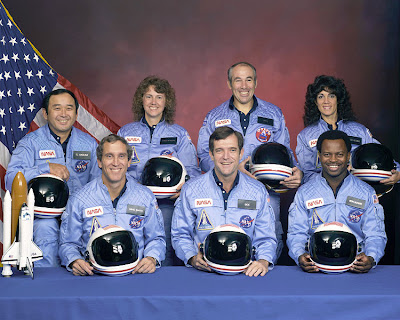
Today’s also a sad day in American history — on this day in 1986, the space shuttle challenger exploded shortly after takeoff, killing all on board:

Cape Canaveral, Fla. Jan. 28 — The space shuttle Challenger exploded in a ball of fire shortly after it left the launching pad today, and all seven astronauts on board were lost.

The worst accident in the history of the American space program, it was witnessed by thousands of spectators who watched in wonder, then horror, as the ship blew apart high in the air.

Flaming debris rained down on the Atlantic Ocean for an hour after the explosion, which occurred just after 11:39 A. M. It kept rescue teams from reaching the area where the craft would have fallen into the sea, about 18 miles offshore.

It seemed impossible that anyone could have lived through the terrific explosion 10 miles in the sky, and officials said this afternoon that there was no evidence to indicate that the five men and two women aboard had survived.

We recovered from that disaster, and another than followed, and we will recover from these listless years of uncertainty and official indifference to exploration. There are good ideas and private ambition, true innovations, and only the beginning of what’s possible, that will assure a future of space travel and exploration.

Comments Off
By JOHN ADAMS | January 27, 2010 - 11:19 am - Posted in City, Press

Over at the Volokh Conspiracy, a group blog of law professors and academics, there’s a post about the unfortunate conduct of James O’Keefe, an activist.

In a post entitled, “One Sting Too Many,” Jonathon Adler writes about allegations against O’Keefe:

It’s one thing to pretend to be a pimp when interviewing ACORN employees. It’s quite another to pretend to be a telephone repairman to gain access to a U.S. Senate office and its telephone system. Apparently noted ACORN-sting film maker James O’Keefe and some compatriots did not see the difference, and are now facing federal charges and the possibility of significant jail time. Politico reports. here.

See, One Sting Too Many.

It’s odd about all this, because the best opportunities for reform – and the only acceptable ones – are lawful avenues of inquiry.

Wisconsin and America offer citizens rights of lawful inquiry seldom exercised in Whitewater. Our Open Meetings Law (WOML, Wis. Stat. ss. 19.81-19.98) and Public Records Law (WPRL Wis. Stat. ss. 19.31-19.39) provide fair and clear rights of information and access.

We have no need for misguided pranks and supposedly daring conduct.

There are problems receiving full and complete compliance under our laws, but there is recourse through the Wisconsin Attorney General’s Office, and through supportive press inquiries. It’s not hard, either, to demonstrate officials’ third-rate efforts at obstruction and evasion. Hiding one thing typically reveals others.

Tenacity is required, but only lawful tenacity is necessary, permissible, and worthy of respect.

Comments Off

Like millions of others, I’ll be watching the president’s state of the union address. I’ll also be following the libertarian Cato Institute’s live-blogging of the event.

Cato Experts Live-Blogging Obama’s State of the Union Address.

Comments Off
By JOHN ADAMS | - 6:00 am - Posted in Daily Bread

Good morning,

The forecast calls for a partly sunny day today, with a high of twenty-two degrees.

Over at the Janesville Gazette, there’s a story about a settlement in an case involving charges against Darien Village board members for violations of Wisconsin’s Open Meetings Law, “Darien board settles in open meetings case.” (Wisconsin Open Meetings Law, Wis. Stat. § 19.81-19.98.)  

There likely aren’t enough cases like this in Wisconsin, as I’d guess violations are sadly common, and committed with near-impunity.

Helpful information on the Open Meetings Law is available from the Wisconsin Freedom of Information Council and the Wisconsin Attorney General’s  Office.

It’s a happy anniversary for exploration, discovery, and science: on this day in 1888, the national Geographic Society was founded.  Wired recounts the anniversary:

1888: Bound together by an enthusiasm for geography and travel, a small cadre of distinguished businessmen, explorers, scientists and scholars officially incorporates the National Geographic Society in Washington, D.C.

What began 122 years ago as a small, elite society for “the increase and diffusion of geographic knowledge” is now one of the world’s largest nonprofit scientific and educational institutions. Today its mission has a broader theme: “to inspire people to care about the planet.”

….The society’s publication, National Geographic magazine, began printing just 10 months after that founding meeting. It was initially a drab-looking scholarly journal sent to 165 charter members. Now its hallmark photography and more mainstream writing reach the hands of more than 40 million people per month….

From 1899 to 1910, membership grew from 1,400 to 74,000, and in the following 10 years advanced to to 713,000, and then continued to skyrocket. As a result, the society has become one of the largest and most inclusive in the world.

The explosive growth in membership is largely attributed to Grosvenor’s shift in the editorial direction of the magazine at the turn of the 20th century. Inspired by travelogues such as Charles Darwin’s Voyage of the Beagle and Richard Henry Dana Jr.’s Two Years Before the Mast, he made the magazine more accessible by including first-person narratives and the use of more straightforward, simple prose.

Grosvenor’s other game-changing decision was to feature photography prominently in the magazine. Surprisingly, National Geographic’s hallmark photojournalism began as a desperate attempt to fill 11 pages of the January 1905 issue before it went to press.

There is no tyranny so absolute as a printer’s deadline, but I simply did not have a good manuscript available. A large and rather bulky envelope lay on my desk. Still brooding about the unfilled pages, I opened the package listlessly … then stared with mounting excitement at the enclosures that tumbled out. Before me lay some 50 beautiful photographs of the mysterious city of Lhasa in Tibet.

Grosvenor considered the images so extraordinary that he used them despite the belief that they might cost him his job. But membership response was so positive that it became the genesis of the magazine’s popular appeal.

Comments Off

I have no idea of the likelihood of a double-dip recession, and even Martin Feldstein, a respected economist, won’t lay odds on a second recession.

Still, if the likelihood of another recession grows, the prospect of nothing beyond minimal growth, at best, grows, too.

No better time to reduce public spending, taxes, and regulations.

See, Double dip recession risk significant, Martin Feldstein warns.

Comments Off
By JOHN ADAMS | - 12:55 pm - Posted in City

I sometimes receive questions from faraway places, from readers for whom rural America is the stuff of movies and books, but not direct experience. Someone once asked me how many cows there were in Whitewater. The question’s funny to anyone who lives in the City of Whitewater, Wisconsin, but not to someone who knows that Wisconsin is a major dairy state. The calculation would run like this:

Dairy State + Rural Town = Cows All Over the Place.

That’s not what life here’s like, and I decided to offer out-of-town readers a tour, of sorts. One early morning in December, I decided to take a driving tour of Whitewater, with a voice recorder to store my remarks, and a camera to take a few pictures.

For a trip around town like this, I thought I’d take on a co-pilot. There’s no better company for an expedition than a faithful canine.

My dog agreed, setting only one condition for the trip — that he could have a pseudonym of his own. He thought about it for a moment, mulled different choices, and settled on Dog X. So it would be — Dog X and I would travel around Whitewater by car, looking for cows. It was our brief, around-town homage to Travels with Charley.

I recorded my observations, and have transcribed and reproduced them, in italics, below. I have not printed everything that I recorded, just a few remarks as Dog X and I searched for cows. Interspersed are some photos I took along the way.

….It’s about 9:26, Dog X and I are in the car, we’re going to let the car warm up a bit, and then we’re going to take a trip around Whitewater. We’ll see what we can see, we’ll get some food, and look
for cows around town….This is just a ride through town this morning….Our first stop will be Whitewater’s Municipal Building, the Locus of All Evil in the Modern World. Not as bad as Elkhorn, though.

That’s our county seat, and there we have the closest thing to a modern day Palace of Pandemonium….

I need to get some money from a cash machine, so I’m going to stop, in this case, at the crappiest bank in town. Unfortunately, that would be my bank. I think it’s actually listed that way in the Yellow Pages….

There aren’t a lot of people in town this morning, and it’s below freezing outside. We’ll grab some food before we start….Dog X and I are early-risers, but that’s pretty typical around this community. People get up early, and eat [dinner] early. The only people who don’t get up early are usually bureaucrats….

In Wisconsin, a lot of cash machines are called Tyme machines. I think the person who thought of that became governor, senator, something big, no doubt….

There’s a guy on a bicycle, riding past, but not likely for exercise. It’s awfully cold, but he’s riding for transportation, I think. We tease about other countries where people need to rely on bikes, but we have a lot of poor in Whitewater, and it may the only way for them to get around….

[stop for cash, back to car, off to municipal building]

I stopped at a local coffee shop, not far from a lake in town (Cravath Lake) and the Locus of Evil in the Municipality our Municipal Building. (Note: See how I’ve tempered my words from my narration, ‘locus of all evil’ — to ‘locus of evil in the municipality?’ It shows how delicate I can be.)

I stopped in the coffee shop, purchased a medium latte and a raspberry croissant. The total was only five dollars — far less than one might pay in Chicago or New York. There was local photographers’ work for sale on the walls of the shop, and I promised to l remind myself to stop back for something I liked.

The barista was pleasant and friendly; very typical of most shops in Whitewater. There’s a private charm to our town that political mistakes and excuses cannot obscure.

When I went back to my car, I gave Dog X a biscuit from my coat pocket.

….I’m going to go into the Cravath Lakefront Park now, and get a
picture of the area of the lakefront, and a train depot that’s nearby.

Here’s what they look like:

Lovely, aren’t they? No cows, though.

I’ll take a picture of the municipal building….There’s no one around, and that’s disappointing, really. I’d love to meet a municipal leader like the city manager or the chief of police today….It’s probably not a good idea that they’d be working at this hour, though. I’ll stick with the less-is-more view of governance. We don’t need more schemes in Whitewater, we need fewer.

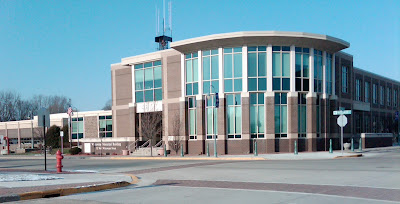
I’ll stop and take a picture of this drab, dull, impersonal building. No charm, no style, it could be a junior high somewhere….

Here it is, an ugly building with a silly name (it should be ‘City Hall’):

[back to car]

The street that the municipal building is on is called Whitewater Street, and driving down it, there’s a lumber yard at the end of the street. There’s a holiday tool sale in progress. We’re coming up on Whitewater and Janesville, and I’ll turn left and head down to a notorious intersection….this is probably the closest thing that we have to a real traffic problem. There’s no way that anyone else from anywhere else would think of it that way, but it’s a problem to us.

There’s also a crossing by the campus, where students keep getting hit by cars, and I don’t think that anyone’s found a way to make that safe, either.

I’m driving down through an old part of town, past Whiton Street.

It’s very common here for people to take fallen leaves, bag them, and place them along the side of the house for insulation, around the foundation. It’s something one may not see in other parts of the
country, but it’s common here.

I can see a sign from an out-of-town realtor. I remember a time when pretty much all the realtors were local, but that’s not true anymore. There’s out-of-town competition now. There’s a farmer on the left, and he puts produce out in a cart for people to purchase.

You can pass some of these homes, and it’s December, and they still have pumpkins out, even though it’s way past Halloween. Anyone with a pumpkin out now needs to buy himself a calendar, because it’ll be Christmas soon. I’m surprised there isn’t a city ordinance making this a seasonal violation. That’s absurd, of course, but we regulate
colors of signs, and sizes of signs, and lots of other aesthetics. Next up, pumpkins…

I’m going to turn left now, into our high school parking lot. Even though we’re a small town, we have a big high school. It’s a nice building. It has hundreds of students, all in a very modern building.

Behind the high school is an aquatic center, that was originally local, became part of a nearby hospital’s properties, and is local again. It’s doing much better now under local management. It’s an indoor pool, with water park, and a fitness center….

One of the things that’s true about a lot of small communities is that the school district will have a bigger budget than the municipality. That’s true of us…this district covers more than one town, and has a bigger budget than the City of Whitewater. It may be about a third
again as big, I think….I’ll take a picture of the school….”

Here’s our high school:

It’s the Home of the Whippets, the school mascot. Not the cow, thankfully — the Whippet.

…There are some homes near the high school, but no cows.

There are houses with barn stars. A barn star’s a traditional decoration on the outside of someone’s home. Someone once asked me what a barn star on a home meant. Most barn stars don’t mean much at all. If someone has a barn star that’s dark or teal or copper, that’s
not a problem. If you find someone with a bright red barn star, that’s a real problem. Those homeowners are probably communists….that’s the signal they use to each other, to rise up against representative government and the free market, I think….There’s probably a city task force that’s working on the problem….

I’m going to head over to an elementary school in town, Lincoln School, Home of the Leopards. I’m not sure when they took that mascot, but it’s a good choice. A lot of people in town have American flags out, on the side of their homes, or long poles. It’s not a national holiday, but there’s a lot of simple, proud patriotism in a town like ours. I’m on Prince Street, and I’ll stop here in front of Lincoln School.

Here’s Lincoln School, Home of the Leopards:

[I get back in the car, and Dog X sees another dog, outside in a yard near the school.]

There’s a dog outside, and he’s looking at us from his yard. It’s cold outside, but animals here are used to cold weather. Even a small dog like this one seems happy to be outside. Maybe dogs fear the cold in other places, but not here….

There’s a pumpkin in the middle of the street, for goodness’ sake….with a squirrel eating from it….That’s what happens when people leave pumpkins around.

Nearby is our college campus, and I’ll take a picture….There’s a crossing nearby that’s been a problem for pedestrians. I’ll take a picture of our campus’s alumni center.

Here’s the University of Wisconsin-Whitewater Alumni Center:

….Leopards, Whippets, Warhawks…no cows. Not one. Students
are probably getting ready for exams, and it’s quiet around here….I’ll drive to the west side of town, where we have some strip malls, a Wal-Mart, hardware store, and movie theater…We have a Walgreen’s, a bank, McDonald’s, a vacant storefront, vacant for a long time, that sued to be a Dairy Queen….

We have a few cash stores in town, and I’m not sure that’s a good sign. Some retail businesses will not locate to a strip mall with a cash store….if a merchant’s concerned about his brand’s image, he’s likely to stay away from a location with a cash store….

There’s a supermarket and a Wal-Mart on my right….and the famous Hawk Bowl Bowling Alley….there’s a Culver’s just beyond….

We have a Chrysler dealer, and that must be a challenging situation, since Fiat has a poor reputation in Europe….I have no idea what will happen to Chrysler, and Fiat probably doesn’t either.

There’s a movie theater and a Taco Bell at the edge of the west side of town…Every time I see Taco Bell, I think of Demolition Man, where all restaurants in the future are Taco Bells. I’m not sure why we
haven’t capitalized on that, with a slogan like….Whitewater: Fast Food of the Future….

[I drive back past the McDonald's again, to the east part of town, near Milwaukee Street.]

….I’m passing the Birge Fountain, a water fountain in town, and a nursing home, through our downtown. There’s a Masonic Lodge in town, with the several blocks of our downtown. There’s a Whitewater Register sign, a sign for our local newspaper’s office. There’s a travel service, art studio, bars….a dry cleaner’s with taxidermy animals in the front window….post office….more bars….a Mexican restaurant that once had a mariachi band….and I’ll head over to the
east side….

….A Citgo, a Firestone, a liquor store, a beer store….there’s no place for a cow….

That’s not all of our town, surely, but there’s no room for a cow in any of this. There’s more cow artwork in big cities than we have cows in our town. And yet, we do have an ordinance against livestock in town:

Livestock ordinances:

9.06.010 Livestock.

No person shall raise, store or keep livestock within the city on land which is less than two acres in size. “Livestock” includes, but is not limited to, sheep, goats, horses, cattle, or pigs. Livestock does not include dogs or cats.
(Ord. 970 1, 1981).

9.06.020 Zoning for livestock.

No person shall raise, store or keep livestock on any land within the city unless the raising, storing or keeping of livestock is either a permitted use or a conditional use under the zoning classification of such land.
(Ord. 1581, 2005).

As you can guess, there’s no need for it. People don’t decide for or against livestock merely because the law prohibits it. There’s no mad rush to purchase and raise cows in Whitewater, because it’s impractical to do so. People will decide rationally based on available conditions, and the few that choose foolishly will soon correct for their mistakes, or cause slight inconvenience to an entire town.

The ordinance, with it’s conditional use, is more likely to be applied in odd ways, with animals of greater harm permitted, and ones of less difficulty omitted or exempted. A dwarf goat’s probably less risk to others than bees. A few dogs might be a greater problem than a few chickens. The livestock provisions are unnecessary, and exceptions are a recipe for favoritism.

No herds of cows in Whitewater? No, sorry to say. I’d like to see a few walking around now and again. I think we’d do better with more cows, chickens, etc., and fewer regulations.

Comments Off
By JOHN ADAMS | - 6:30 am - Posted in Daily Bread

Good morning,

The forecast for Whitewater calls for flurries and a high temperature of about nineteen.

Our school district will hold a public listening session this afternoon, on charter schools. Here’s the announcement in full:

Dear Members of the Whitewater Community:

As we continue exploring building a 21st century learning community, we are ready to look more closely at each of the variety of options that were addressed in our panel discussion on December 16. Included in that discussion were charter schools, curriculum foci in the areas of science, technology, engineering and math (STEM), world languages, entrepreneurship, and post secondary educational opportunities. We will specifically be looking at charter schools at our next listening session as this option is the most time sensitive due to application deadlines.

We have invited back the two statewide experts, Mr. Barry Golden from the Wisconsin Department of Public Instruction and Mr. John Gee from the Wisconsin Charter Schools Association, to continue to share specifics related to charter schools.

Please consider attending on Tuesday, January 26 from 4:00-6:00 at the University of Wisconsin Whitewater University Center (UC) upstairs ballroom. Free parking is available in Lot 7.

We look forward to having you continue this exploration with us.

Sincerely,

Suzanne M. Zentner, Ph.D.   Mary Whitrock
District Administrator Curriculum/Staff Development Coordinator

Comments Off
By JOHN ADAMS | January 25, 2010 - 1:27 pm - Posted in City

The Community Development Authority meets this afternoon, at the municipal building, beginning at 4:30 PM.

The agenda for that meeting, and a list of upcoming meetings, is available online.

See, CDA agenda.

If there are groups in the city that deserve more scrutiny, the CDA, along with the Police and Fire Commission, would be at the top of any reasonable person’s list.

A small town should be a more open place, but the tendency to staff board after board with the same people, either dependable or compliant depending on one’s view, leaves a small town with less openness than many big cities.

And yet, in time, this too shall change.

Comments Off
By JOHN ADAMS | - 11:06 am - Posted in Inbox Reader Mail

Here a sampling of some questions and comments from recent email messages, to which I have responded privately, but will summarize and answer here.

For those faraway who once asked me how many cows are in Whitewater

I’m tardy in answering that question, as you have reminded me. In fact, I took a cow-searching drive through Whitewater in December, and recorded remarks along the way for subsequent transcription and posting.

There’s a regulatory angle in it all, too.

I promise to put it up tomorrow.

Why have I posted about televised meetings, and why do I now have a film reel/video icon on the right side of my website?

Because televised meetings are a great benefit to the city, offering the most accurate account of what actually happens at one of our public meetings.

Unfortunately, our public access cable team cannot be everywhere at once. Fortunately, they don’t have to be: Wisconsin law allows ordinary citizens to record public meetings, and requires accommodation of ordinary citizen recording.

In 2010, beginning in a few months, I wouldn’t wonder, we will see the exercise of these rights in Whitewater. Just as important, our small town will see the defense of these rights at law.

Legal justifications for decisions in this town are often thin and flimsy. An American town deserves better, and we will only get something better if someone exercises his rights, and defends that exercise at law. One always prefers an easier route, but it is better to prepare for a harder one.

The days of poorly publicized meetings, with little more than a few vague lines as minutes, will end for this town. Some of our public meetings have never seen the light of a movie lens, so to speak. For everything I have ever written, there’s a dozen times as much to be done.

In all of it, there’s the great adventure of being an American citizen.

I’ll post much more about this as the time gets closer.

Why no Facebook page?

Facebook seems like too much to me; I like having my own website, set up the way I like, and a second Facebook page would be too fancy for FREE WHITEWATER.

This website does have a Twitter account, and I like the simple, succinct format of Twitter. I learn a lot from others’ tweets, and enjoy following them.

Here’s a question that just came in today, to which I quickly replied: I was wondering what is your opinion of the recent Supreme Court decision regarding campaign funding?

Here was my brief reply:

I think it’s a great victory for free speech. I will post on it this week, and I will write about how local – not federal – enforcement of campaign finance laws is often biased and used to penalize dissenters, to the benefit of incumbents.

The fewer restrictions on speech, the better.

Will catblogging be back, why did it go away, have I stopped liking cats, etc.?

I like cats a great deal. I won’t say I love them, because if I did, I know one particular reader who would quickly ask, “Well, if you love them, why don’t you marry one?”

It may seem surprising, but for some people, a line like that still seems new. There are a lot of surprises in correspondence; I enjoy the unexpected range of opinion very much.

I enjoy reading what others write more than writing, myself — much appreciated, and many thanks.

Comments Off
By JOHN ADAMS | - 6:30 am - Posted in Daily Bread

Good morning,

It’s likely to be a snowy day today, with little or no accumulation, and a high of about 32 degrees.

There’s no school today.

But there is dancing, probably, somewhere in the city: unplanned, unscheduled, unsupervised, and unregulated.

One could not say the same, on January 25th, 1932 in nearby Janesville, as the Wisconsin Historical Society recalls:

1932 – Janesville Prohibits Sunday Dancing

On this date the Janesville council deadlocked, 3-3, on an ordinance that would have permitted public dancing on Sundays. [Source: Janesville Gazette]

Here’s a video, from 2006, of dancers having fun at a jitterbug camp:

Link: http://www.youtube.com/watch?v=Ht5d8zSYbYA

They’re having a great time. The sky hasn’t fallen. On the contrary — we’re better for it.

Comments Off
By JOHN ADAMS | January 23, 2010 - 6:00 am - Posted in Libertarians

Blogger and law professor Ilya Somin has a post up called ‘The Libertarian Vote,’ in which he describes recent findings on the number of libertarians in America:

David Kirby and David Boaz have published a new Cato Institute study estimating the size of the “libertarian vote.” They conclude that about 14% of American voters are libertarian in the sense of broadly opposing government regulation in both the economic and social realms. As a libertarian think tank, Cato obviously has a strong interest interest in coming up with a high estimate of the number of libertarian voters. However, Boaz and Kirby rely on polling questions from the National Election Study, a widely respected comprehensive survey of American political opinion developed by primarily liberal political scientists. They also note that other research by Gallup and Zogby comes up with higher estimates for the number of libertarian voters (20 to 25 percent). Other recent surveys show that the vast majority of Americans prefer smaller government with fewer services to larger government with more services (58 to 38 percent), and that trust in government is generally low.

Somin offers much more in the post, including whether actual membership in the LP is a good idea (he says no) and whether the Tea Party movement offers libertarians promise (he says it’s a good start).

Comments Off

There are still significant economic challenges ahead for Wisconsin, as unemployment in the state increased to 8.3% in December.

No better time for lower taxes and fewer regulations than during a time of rising unemployment.

See, December unemployment rate for Wisconsin continues upward trend — Walworth County Today.

Comments Off
By JOHN ADAMS | - 11:29 am - Posted in Free Market

Not long ago, I wrote that it would be a good idea to turn human space exploration from NASA’s responsibility to the private sector.

Imagine how happy I was to see a blog post from Dallas entitled, NASA Believes in the Free Market.

The headline promised auspicious news – another efficiency from free exchange – the adoption of an idea that libertarians have long supported. We believe in exploration, and that human space exploration and travel will develop most robustly with private incentives.

I was disappointed when I read the post: NASA is trying to sell some of its aging space shuttles. That’s hardly the the privatization of space exploration; it’s more like government as flea market and yard sale.

Optimist that I am, I had hoped the headline meant more; optimist that I yet remain, I believe even this step is a step in the right direction.

Comments Off

David Boaz, executive vice president of the libertarian Cato Institute, offers thoughtful remarks on where the Obama Administration has gone wrong, and what the president might do about it.

By pressing such a big-government program, Obama has energized a small-government element in the electorate that had been demoralized and pushed aside by a big-government Republican president. Right now, that movement looks likely to turn a lot of Democrats out of office this fall….

Some people point out that Ronald Reagan had low approval ratings after a year. But his policies then produced a strong recovery, and there’s no reason to expect that imposing more burdens on a struggling economy will have good results.

Obama has several models to choose from: He could reverse his tax-spend-and-regulate policies and hope for the same economic and political results that Reagan achieved. He could, like Bill Clinton, recognize the political obstacles to his sweeping ambitions and learn to work with Republicans on modest reforms. He may well end up like Lyndon Johnson, with an ambitious domestic agenda eventually bogged down by endless war. But I don’t think his wished-for FDR model – a transformative agenda that is both popular and long-lasting – is in the cards.

See, NPR.org – For This Libertarian, Obama’s First Year Looks Grim

Yes, despite my platform from my imaginary campaign for Congress, I’m willing to quote from NPR. It’s not that NPR is terrible, it’s that it shouldn’t be government-funded.

Until then, any port in a storm!

Comments Off
By JOHN ADAMS | - 6:30 am - Posted in Daily Bread

Good morning,

Today’s Whitewater forecast calls for a cloudy day, with a high of thirty-three degrees.

There’s no school today, leaving the community to face free-range juveniles throughout the city. We’ll muddle through, I’m sure.

On this day in 1950, according to Wired, a true innovator is acquitted: “Jan. 22, 1950: Jury Acquits Tucker of Fraud.”

Along with seven business associates, Preston Tucker — founder and namesake of the Tucker Car Corporation and the creator of the ultramodern Tucker ’48 sedan — is found not guilty of 25 counts of mail fraud, five counts of violating SEC rules and a single count of conspiracy to defraud.

The company, however, would not survive the bad press and production delays that the trial imposed. The name “Tucker” would become synonymous with a failed business dream….

Tucker, an automotive enthusiast and charismatic entrepreneur, had promised the public something pretty radical: a new car that was to be a total departure from prewar designs. The sedan would have a rear engine, a laminate windshield, side-impact protection and a trademark center headlight that turned with the front wheels — a feature that became a trademark of the Tucker’s appearance….

The SEC raided the Tucker plant on May 28, 1948, forcing Tucker to cease production and lay off 1,600 employees. The trial began October 4, with the prosecution trying to prove that Tucker never meant to build a car and that the sole intent of Tucker Car Corporation was to defraud investors.

Tucker’s defense attorneys argued that the Tucker was ready for mass production and that the company would have never built a plant and hired employees if it had only been a fraud. A former Tucker dealer, while testifying for the prosecution, inadvertently won favor for Tucker when he said his own ’48 sedan was the “finest car I have ever driven.” Attorneys even parked eight Tucker ‘48s in front of the courthouse and offered jurors the opportunity to take a ride.

After 28 hours of deliberation, the jury returned a verdict of not guilty on all charges. The unflappable Tucker famously told the press that “even Henry Ford failed the first time out.” Sadly, though Tucker would attempt to build another sports car with investors from Brazil, he died of lung cancer in 1956. Today, fewer than 50 complete Tuckers still exist, most of them in private collections.

Conspiracy theories surrounding the investigation abound, many of which added to the drama of the mostly historically accurate Tucker biopic, Tucker: The Man and His Dream. While a David-versus-Goliath story always makes a good movie, many people today think the Tucker Car Corporation always intended to build a car, and that the Big Three automakers — fearing competition from an upstart competitor — were behind the SEC’s investigation of Tucker.

Here’s the trailer from Tucker: The Man and His Dream:

Link: http://www.youtube.com/watch?v=mL-AFSAIln0

Comments Off
By JOHN ADAMS | January 21, 2010 - 2:30 pm - Posted in City, Planning, Press

Whitewater City Manager Kevin Brunner recently touted an A2 rating from Moody’s Investor Services. It’s what he didn’t say that’s most telling.

In his January 15th Weekly Report, Whitewater City Manager Kevin Brunner announced an affirmation from Moody’s Investor Services of the city’s A2 bond rating. The city’s rating is assigned to the sale of million dollars in bonds, of two different types. The bonds are public debt, that the city must repay with interest. Brunner included the Moody’s announcement, with his own preface, in his weekly report.  Here are my remarks, with the full announcement from Brunner appearing at the bottom of this post, for reference.

Moody’s rating of ‘A’ is actually a common rating — over half of municipalities rated have received it over a thirty-year period.

The A2 rating that Whitewater received (as re-affirmation) isn’t exceptional — it’s common. Moody’s rates municipal bond investments on a broad category scale as follows: Aaa, Aa, A, Baa, Ba, and so on. Within a category, such as ‘A,’ there’s additional differentiation between A1, A2, etc.

In the thirty-year period between 1970 and 2000, of the municipal bond investments Moody’s rated, over 54% were rated as ‘A.’ That’s right — over half. It’s hardly an exceptional rating — ‘A’ is the most common rating as a broad category across an entire generation of Moody’s ratings. See, Moody’s US Municipal Bond Rating Scale.

Here’s Moody’s own distribution chart, reproduced as Fair Use commentary:

Whitewater’s in the middle, with a rating like most others.  It’s certainly not exemplary.

Not only that, but Whitewater’s investments received an A2 rating, less than some others (that is, A1) within the most common category of ratings. We’re in the middle of the middle, so to speak — no better than typical.

That’s how Whitewater rated, but the Whitewater city manager’s announcement tells nothing of the the commonplace nature of the rating. On the contrary, one would think that the city had won some sort of prestigious honor.

Even a steak sauce does better:


There’s a habit in Whitewater to insist that pig’s ears are silk purses. No bother trying to make one from the other – here insistence alone is enough.

Moody’s — receives compensation for any solicited rating — only unsolicited ratings require no payment to Moody’s.

There’s much that has been written about the benefits and risks of solicited and unsolicited sets of ratings. Of this one can say with certainty that where the rating is solicited, the firm has received compensation for its services, but gains access to records it requests. Where the rating is unsolicited, the firm rates without financial interest, but bases the rating only on public information.

A solicited, and supposedly objective analysis in these issues comes for a price; the success of an issue may depend on the rating. Everybody involved in these transactions knows as much.

The bond rating depends most on the city’s ability to repay the bond issue with interest. Analyses of the actual conditions of residents are secondary to the ability of the city to tax to repay the debt with interest.

In this regard, Brunner’s like a man who buys a pricey suit and assumes that the purchase proves he’s in good health.  There is, of course, more room to tax – after all, it was Brunner who recently proposed an increase in the tax levy, in the middle of a deep recession, until Common Council saw better than to heap burdens on the city’s residents.  Residents would have been worse off if he had his way.

Moody’s analysis shows how much Whitewater depends on the university, rather than city-sponsored projects, for its stability and survival.

Even a casual glance at the Moody’s report — and Brunner must have done as much — reveals that Moody’s fundamentally bases its rating on the obvious truth that

city’s economy is dominated by the University of Wisconsin-Whitewater campus. While the associated property is tax-exempt and consequently unavailable as a taxable resource, Moody’s believes that the stability and employment opportunities that it affords local residents are significant positive credit factors. The university is by far the largest employer with over 1,000 employees and enrollment has hit a record level of approximately 11,000 students. The school continues to expand and, as evidence, has recently opened a new business school and residence halls this fall. In 2008 the value of the city’s building permits swelled due to a $30 million university construction project.

These aren’t accomplishments of city government — the campus props up the town.  I’ve argued as much for years.  The City of Whitewater may thank the State of Wisconsin for whatever opportunity we have.  These are not accomplishments of the city’s politicians and bureaucrats.

The rating’s analysis shows that we lag Wisconsin and America.

Both Madison and Milwaukee — even Milwaukee, with all her troubles – have higher ratings.   Whitewater’s median family income trails Wisconsin, and unemployment is over the state average.  No mention of child poverty, by the way — a figure that would not be affected by the presence of students (the presence of which Moody’s uses as an excuse to explain Whitewater’s below-average income statistics.)

Our rate of child poverty is astonishingly high — about one in four children.  A taxpayer funded tech park that relies on a taxpayer-funded agency as an anchor tenant will do nothing for them.

The rating ignores alternatives to borrowing.

Understandably, Moody’s merely reviews if the city can pay back a multi-million obligation, even if it has to tax more to do so.  I am sure that there is more to take from common residents — even the Sheriff of Nottingham could find an additional farthing or two from some ordinary person in Sherwood Forest.

There’s no analysis of whether this is the right plan and course for Whitewater.  The alternatives to the plan of a few middling bureaucrats’ vain ambitions to gobble as much stimulus money as possible, with additional debt heaped on the city as a result, are beyond Moody’s scope.

About Whitewater’s “successful use of tax increment districts (TIDs), including five additional TIDs established in 2007…”

Did someone write Moody’s analysis on April 1st?  It’s not even a suitable fool’s day joke.  If all the tax incremental districts were so successful, why would city manager Brunner bother to write, in his preface to his proposed 2010 budget, that “I also want the Finance Director to evaluate possible city debt savings through restructuring/refinancing. This will be especially critical in the next few months if the distressed TID legislation is approved by the State Legislature as expected and we will be look at how TID #4 could be extended beyond its current life.”

Moody’s analyst, you might want to call 911: Whitewater TID 4 may need a defibrillator, a distressed TID bill, something…

The local press coverage of the bond rating.

One can see an unquestioning view of public officials over at a local newspaper.   (Too funny, especially, is Brunner going on about how it would be unrealistic to expect the rating to be higher. Well, he’s right about at least one thing.)

Ultimately, crowing over a commonplace rating, and ignoring the very words that show Whitewater lags behind, serves not Whitewater, but advances only one bureaucrat’s overweening vanity.

From the city manager’s Weekly Report:

City Receives A2 Bond Rating for Upcoming Borrowing for Technology Park Development

Earlier this week, Moody’s Investor Services issued the following report on the city’s finances and continued to assign an A2 rating to the city bond issues that are scheduled for sale next Tuesday. Given the current economy and municipal financial difficulties, maintaining existing bond ratings can be difficult with a number of downgrades and only a very few upgrades occurring. Reading the report is very interesting and provides a good objective review of our community and its financial condition.

NEW YORK, January 13, 2010 –

Moody’s Investors Service has assigned an A2 rating to the City of Whitewater’s (WI) $3.3 million Taxable General Obligation Community Development Bonds, which will be offered as Build America Bonds, and $2.1 million General Obligation Refunding Bonds. Concurrently, Moody’s has affirmed the A2 rating on the city’s outstanding general obligation debt affecting $14.1 million. Both the taxable and tax-exempt bonds are secured by the city’s general obligation unlimited tax pledge. The community development bonds will finance infrastructure improvements within the city’s technology park (tax increment financing district four). The tax-exempt bonds will refinance three state loans and two privately placed loans for a net present value savings. The A2 rating reflects the city’s sound financial position, stable local economy significantly anchored by a state university, and manageable debt profile.

LOCAL ECONOMY DOMINATED BY STATE UNIVERSITY EXPECTED TO REMAIN STABLE

Whitewater is favorably located 45 miles southeast of Madison (general obligation rated Aaa/stable outlook) and 55 miles southwest of Milwaukee (rated Aa2/negative outlook). The city’s economy is dominated by the University of Wisconsin-Whitewater campus. While the associated property is tax-exempt and consequently unavailable as a taxable resource, Moody’s believes that the stability and employment opportunities that it affords local residents are significant positive credit factors. The university is by far the largest employer with over 1,000 employees and enrollment has hit a record level of approximately 11,000 students. The school continues to expand and, as evidence, has recently opened a new business school and residence halls this fall. In 2008 the value of the city’s building permits swelled due to a $30 million university construction project.

The city’s tax base is moderately-sized at $639 million, though this excludes the university campus, and growth over the last five years has been somewhat measured, averaging 5.1% increases annually. The city has encouraged diversity and growth through the successful use of tax increment districts (TIDs), including five additional TIDs established in 2007. Wealth indices are skewed downward given the presence of the large student population which accounts for 78% of the population. While the per capita income figures reflect the impact of the substantial student population (65.7% of the state average), the median family income is much stronger at 91.1% of the state average. Walworth County’s (general obligation rated Aa2) unemployment rate of 7.8% in October 2009 was slightly higher that than of the state and nation.

SOUND FINANCIAL POSITION SUPPORTED BY CONSERVATIVE MANAGEMENT

Moody’s expects the city to maintain a sound financial position due to prudent management evidenced by relatively healthy reserves. Over the last five years, the city has maintained essentially balanced operations with the exceptions of fiscal 2004 and 2008. In fiscal 2004, the city drew down its reserves by $584,000 due to a one time expenditure of $623,770 to retire the city’s unfunded pension liability. In fiscals 2005, 2006 and 2007 the city’s General Fund balance remained stable at $2.5 million, equal to 29.5% of fiscal 2007revenues. The city realized a deficit of $197,000 in fiscal 2008 due to higher than expected expenditures related to snow and ice removal early in the year and flood clean-up over the summer. While the city did receive about $100,000in Federal Emergency Management Agency (FEMA) reimbursement, the funds did not cover the entire out-of-pocket amount spent by the city. Officials report that fiscal 2009 year-end results will likely reflect a slight deficit of up to$68,000, though a portion of this is expected to be offset by unspent contingency funds. The city had budgeted the use of about $68,500 in reserves in fiscal 2009 to meet operational costs. Notably, the city did not implement any staff reductions or furloughs. In fiscal 2010 the city’s state shared revenue is expected to decline by $68,000, the city reduced its General Fund levy, and $75,000 of General Fund reserves were applied to the budget. Favorably, over $90,000 was budgeted as a contingency expenditure (equal to 1% of the budget) and, due to unused taxing margin year after year, the city can roll forward about $360,000. Although the city applies a modest amount of reserves to the budget each year, management expects to adhere to its General Fund balance policy of maintaining a minimum of 20% of the subsequent year’s budget.

In addition to property taxes, which account for 26.8% of the city’s fiscal 2008 operational revenue, the city receives a portion of its operational revenue from state shared utility revenue. Since the property valuation of aco-generation facility, constructed and operated by LS Power (senior secured rated Baa3/stable outlook), is not included in the city’s tax base, the utility pays tax on gross receipts to the state and the state subsequently makes annual payments to the city based on the valuation of the utility’s assets. Payments of $750,000 began in 1997 and will continue in lesser amounts going forward. Payments are tied to the depreciated value of the facility and therefore will decline slightly through 2012 and remain stable thereafter. The city has chosen to use these funds to pay debt service and cash finance capital projects, in order to preserve structural fiscal balance between recurring revenues and recurring expenditures.

MANAGEABLE DEBT POSITION GIVEN SIGNIFICANT SUPPORT FROM NON-DEBT SERVICE LEVY SOURCES

Moody’s expects the city’s above average debt burden will remain manageable given significant support from non-debt service levy sources and rapid principal amortization of 100% in ten years. The city’s direct debt burden is elevated at 3.1% of full valuation as is its overall debt burden of 4.4%. The city’s general obligation debt service is heavily supported by the revenues from the LS Power co-generation facility and increment from the city’s TIDs which together cover over 80% of the city’s debt service. Management plans to issue a series of refinancing bonds later this year for savings but has no capital borrowing plans until 2011 or 2012.

KEY STATISTICS

2008 Population estimate: 14,291 (6.4% increase since 2000)

2009 Full value: $639 million

Estimated full value per capita: $44,717

Direct Debt: 3.1%

Overlapping Debt: 4.4%

Fiscal 2008 General Fund Balance: $2.3 million (26.6% of revenues)

Walworth County’s unemployment rate (10/09): 7.8%

2000 Per capita income as a % of state: 65.7% (64.7% of US)

2000 Median family income as a % of state: 91.1% (96.3% of US)

Post-sale GOULT debt outstanding: $19.6 million

The principal methodology used in rating the current issue was Moody’s General Obligation Bonds Issued by U.S. Local Governments, published in October 2009 and available on www.moodys.com in the Rating Methodologies sub-directory under the Research & Ratings tab. Other methodologies and factors that may have been considered in the process of rating this issuer can also be found in the Rating Methodologies sub-directory on Moody’s website. The last rating action was on July 28, 2009 when the A2 GOULT rating for the city was affirmed.

Comments Off