FREE WHITEWATER

Monthly Archives: September 2007

The Whitewater Register’s Bleak Future

The contemporary Whitewater Register is inheritor of a proud legacy in Whitewater. The Register has squandered that legacy, and has a bleak future. The paper is a weekly, multi-section newspaper serving a town of fourteen thousand. The paper has several, mostly self-inflicted challenges, from which it is unlikely to recover.

1. Incurious! The worst problem with the Register is that it does not offer a curious, inquisitive, investigative outlook. There’s nothing investigative in the paper, ever. It’s a dull, plodding paper for lack of curiosity. There’s no reason to rush out and buy it, unless you think someone put your picture in it. (See my post entitled, “Carrying Water for Larry Meyer.”)

2. Poorly Written. It’s pedestrian prose, front to back. The few attempts the paper makes to make copy lively with quotations are callow, and preachy. (See, my post entitled, “The Whitewater Register: Overview.”)

3. Limited Local Coverage. Many of the stories are so general they could appear in just about any Wisconsin paper. That’s probably by design, so that the Southern Lakes newspaper chain can spread the same manure on as many fields as possible.

4. Stale Stories. The Register has the challenge of many weeklies — the story’s old by the time an issue hits the news stands (if they bother to carry a local, interesting story at all). The solution would be to publish investigative stories, but that would require (1) hiring someone talented, and (2) supporting that inquisitive reporter.

5. Competitive Pressures from Better Papers. The Daily Union, Janesville Gazette (both dailies) and The Week are (1) better written, (2) with a more objective, inquisitive nature, and (3) increasingly popular in Whitewater. Points (1) and (2) explain point (3). As the Daily Union extends more column inches to coverage of Whitewater, the Register has even less to distinguish itself.

6. Dismal Circulation Figures vs. Competitive Dailies. (I’ll use circulation figures that newspapers have reported in public documents to the State of Wisconsin, Newspaper Certification Rates, Statewide Bureau of Procurement Contract No. 15-99955-601. The figures are for paid circulation.)

Register (weekly): 1,569 paid circulation (that’s Paltry, with a capital “P”)

Daily Union (daily): 7,767 paid circulation

Janesville Gazette (daily): 22,340 paid circulation

7. Dismal Circulation Figures vs. Weeklies.

Of the listings in the State of Wisconsin document, the Register falls in the roughly the bottom quarter of newsweeklies by circulation. Approximately three out of four newsweeklies listed have higher circulation than the Register.

Let’s compare the Register with other newspapers in the Southern Lakes chain. When one looks at the percentage of a town’s population constituting paid subscribers, the figures are even more dismal:

Register: 1,569 paid circulation — population 14,262 — penetration 11%

Twin Lakes Report: 1,051 paid circulation — population 5,522 — penetration 19%

Waterford Post: 1,875 paid circulation — population 6,519 — penetration 28%

Burlington Standard Press: 3,648 paid circulation — population 10,524 — penetration 34%

Delavan Enterprise: 3,275 paid circulation — population 8,401 — penetration 39%

East Troy News: 1,627 paid circulation — population 3,911 — penetration 41%

Elkhorn Independent: 2,443 paid circulation — population 9,080 — penetration 26%

Palmyra Enterprise: 782 paid circulation — population 1,753 — penetration 44%

8. Dismal Circulation Figures vs. the Whitewater Banner. That’s right — the online Whitewater Banner, at www.whitewaterbanner.com — has a stronger weekly circulation than the Register. (The Banner’s not a site for acknowledged commentary – it’s more liked an electronic bulletin board, and so is closer to the current focus of the Register than a site of independent commentary like FREE WHITEWATER.)

About 500 people or so visit the Banner daily, according to its stats package. (It’s IPStat, with a link at the very bottom of the Banner’s page – just keep scrolling until you see a purple square, and click.) Not all of the Banner’s visitors are repeats, and IPStat’s not perfect, but it’s reasonable to conclude that in seven days, the Banner probably has about as many or more unique readers than the paid circulation of the Register.

The Banner can (1) update continuously, (2) has lots of truly local stories, (3) color photographs, and (4) it’s more accessible than a newspaper to anyone who learns of its web address (no need to go out to a store to buy it – just type and click twenty-four/seven). I have mixed feelings about aspects of the Banner; I have no doubt about its many advantages for community notices over the Register.

9. No Web Presence! The Southern Lakes chain, of which the Register is probably the weakest link — seems to have no web presence at all. It did at one time, and it may again. Will it be able to overcome the Banner? Hard to say – neither the Daily Union, Gazette, nor The Week have as many Whitewater community notices as the Banner. (Those newspapers’ online editions don’t compete on community notices – they’re a more complete example of true news reporting.) The Register inadequately reports compared with its print rivals; it inadequately publishes community events compared to the Banner; it offers no local commentary quite like FREE WHITEWATER.

10. Unable to Respond to a Solid Critique. I have, of course, criticized the Register in more than one post. I challenge an employee of that newspaper to defend the Register on the points of criticism in my posts entitled, Carrying Water for Larry Meyer, Whitewater Register’s Fawning Story on Police Day, and The Whitewater Register: Overview. If Carrie Dampier, or anyone else from the Register or Southern Lakes Newspapers, cares to refute those critiques, well, have at it. I can be reached at adams@freewhitewater.com. I will publish their defense, and reply thereafter. (Candidly, I think that someone is more likely to produce convincing evidence of Bigfoot than convincing evidence that the Register is a good newspaper.)

I have no doubt that the Register, under “editor” Carrie Dampier, will continue to offer only poorly written copy, ignore basic rules of journalism, and write as though it were the public relations agent for this town’s enervated, stagnating clique. I also have no doubt that the Register‘s bias doesn’t matter. The Register’s a dying paper with a paltry circulation. It’s already half way to being a weekly, commercial shopping advertiser, for goodness’ sake. Too funny: the town clique’s most reliable media lapdog is the city’s least influential news outlet.

The Register‘s bias in favored of an atrophied town faction only appeals to the already-committed, so to speak. If the Register is the best that the dissipated town elite can do, then they have no better future than the fish wrap that defends them.

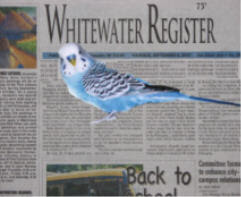
That brings me to the introduction of new symbols to represent the fish wrap-ready, birdcage-lining Whitewater Register. Over at the FREEWHITEWATER Design Labs™ Creative Art Department, there’s been a secret, round-the-clock effort to symbolize the Whitewater Register. Here are two graphic designs from that effort. Feel free to write to me at adams@freewhitewater.com, and let me know which one you prefer.

Enjoy:

Fish Wrap Register

Whitewater Register: The Parakeet’s Choice
Persistence Good and Bad.

Someone asked me recently if I wondered if some members of the town faction would abandon their weakest contentions and arguments in light of public criticism. My reply was that they would not, and I would be surprised if they did. My surprise was met with her surprise: why would they persist, and why would I write if I doubted that they would change? I’ll explain in this post, as I did to her in my recent conversation.

A group, confident in their own sense of entitlement, accustomed to speaking without contradiction, and unaccustomed to explaining their views thoroughly, will not yield to criticism. Their sense of entitlement will, to them, justify their reticence, but in any event if they’re not in the habit of argument, they’ll not easily acquire the practice. Old, bloated, self-important dogs learn no new tricks.

Most of them will persist in their views as long as they can express any views at all.

So why write? Most people write because they believe that what they write is right. There are many people in town who share the views of this website, but they’ve not previously read posts like what I write, since the town faction’s group-think discourages criticism. That group’s one reliable media outlet, the Register, prints little local news, and of that small amount, it prints nothing not agreeable to a lemming’s view of the world. The surest sign that someone’s filled with a sense of entitlement is when he questions whether someone else has a right to criticize. It’s doubly telling – of course you have a right to criticize, and if the best reply someone can make is that you should not criticize, then you know that he has no meaningful, substantive argument to make.

It’s enough to write what you believe. Consider carefully, write forcefully, reflect on replies thoroughly, and defend fundamentals courageously. That’s all there is. All these rest is just an over-analysis. Perhaps, along the way, you’ll bolster those who share your views, and encourage those otherwise uncommitted to the issue to consider the merits of it all.

Beautiful Whitewater: Stone Stable Celebration September 23rd

There will be a celebration of the Stone Stable restoration on Sunday, September 23rd. Here’s the announcement from the committee spearheading this effort:

Please join us at the Stone Stable on Sunday afternoon – September 23rd 2 – 5 p.m. FREE Horse & Wagon Rides at the Stone Stable Site – Bring your family ! Food Booth – Artifacts Exhibit – Time Capsule display – Farmers Market – Fun for all

I’ve written before about the Stone Stable restoration, as part of my Beautiful Whitewater feature. I wrote about the restoration effort in an earlier post by asking, “If someone told you that an old stone stable had been torn down, and some of your fellow residents had organized to rebuild, stone by stone, the stable on a new location, what would you think? I heard of this project months ago, and when I first heard of it, I was surprised; it’s a bold idea toward a traditional end.”

The restoration is proceeding impressively — the photo shows how much work goes into a restoration effort —

It’s fitting that the restored Stone Stable will be prominently located, and near to the train depot’s historical museum. Best wishes to all who have made this effort so successful.

Carrying Water for Larry Meyer

Few people are surprised anymore when they hear about accounts of press bias in newspaper and television reports. Readers are often, and rightly, skeptical of what they read and hear; is there a selective, distorted reporting of a story? There are still serious journalists in America, but seemingly fewer than in the past. Fewer in Whitewater, certainly: Carrie Dampier’s headline story on Star Packaging in the September 6th Whitewater Register reads like bias of a third-rate, homegrown variety. In a story entitled, “Former Star Packaging Employees Charged with Identity Theft,” Dampier reveals herself to be less than a middling reporter, let alone a supposed ‘editor.’ It’s a sad joke of a news story, so egregious in its omissions that it reads as though were written as a parody of egregious bias.

(For a quick recap of Dampier’s previous bias, see my post critiquing her saccharine coverage of May’s Police Day, that the Register entitled — get this, objective journalists everywhere — “What Would We Ever Do Without Them?”)

What junior-league mistakes does Dampier make in the article on Star Packaging? I’ll list them for you:

1. Inadequate Sourcing. She seems to use only one source for the headline story: the criminal complaint against a Mexican defendant in the case. That’s right — it’s the lead story for the paper, and all it merits from Dampier is a clip job from the criminal complaint in the case, augmented perhaps by a scan of the court docket. That would be a laughable effort for a real reporter, let alone a supposed ‘editor’ of the paper. Dampier never indicates if she tried to call defense counsel for a statement on the case. (If she did, and received no reply, she should state so; there’s enough space to add a line to that effect.) Instead, nothing. It’s just a one-sided, quickly cribbed effort to report what the prosecution wants you to know. No one — no one — is quoted in the ‘headline’ story.

2. Omissions About the Nature of the ‘Identity Theft’ Charge. No one reading this story — without other background the story fails to provide — would know the use of identity theft charges for the Star Packaging raid is an unusual, controversial application of Wisconsin’s identity theft statutes. It is, and other real newspapers outside Whitewater have published stories by real reporters (and editors) who explained to readers that it’s an unusual application of the statute. The Week has done excellent, solid reporting on the issue. (In my post entitled, The Identity Theft Excuse, I cited some of that reporting on how odd identity theft charges are in this case, and also linked to websites of responsible police departments, describing how they investigate real cases of identity theft against consumers.) If Dampier read anything other than the Whitewater Register, she might have noticed the better reporting of other local papers on the use of identity theft charges. If she’s not looking at what other reporters are writing about these stories that she covers –as an editor! — then she’s in the wrong line of work.

3. Omissions about the Impact of the Raid. There’s nothing about how controversial the raid has been, what it did to many hard-working families, and how it destroyed an employer in Whitewater. Nothing. When the Register ran a story on the one-year anniversary protest of the raid, it ran the story on the back page of the news section. When the Register wants to run a poorly sourced story flacking the prosecution’s’ criminal complaint in connection with the raid, it’s a front-page, headline story.

4. Omissions about Larry Meyer. Here’s where Dampier writes like she’s been living in a cave (one that’s far from Whitewater). She cites from the criminal complaint about Larry Meyer’s role in the Star Packaging Raid — controversial, disgraced, defendant-in-a-federal-civil-suit Meyer — as though he were an unbiased, respected figure. Dampier omits critical information about Meyer, but I’ll do her work for her, and give you the information that she hides from the pages of her newspaper:

Expert Witness: Investigator Led Crusade Against Businessman.” (Meyer — named defendant in a federal civil suit.)

Former Assistant District Attorney Krueger signed an affidavit that Meyer destroyed evidence in the investigation of Cvicker’s business. (Krueger subsequently left for a position with the Attorney General in Madison.)

My own posts on Meyer tell you what Dampier hides:

Burying the Story: Update on Larry Meyer.

Jim Coan and Larry Meyer’s Shameful Legacy.

The Identity Theft Excuse.

Dampier’s thin, lazy headline story omits more than it tells, and has the effect of carrying water for Meyer, in a vain attempt to rehabilitate him, and his disgraceful role in the Star Packaging Raid. If Dampier took any classes in journalism, she should sue for a tuition reimbursement: the story is a hack’s job if ever there were one. Only readers who are ignorant, or already converted to a whitewash of Meyer and the police role in Star Packaging will enjoy the Register‘s latest, shabby headline story.

(In an upcoming post later this week, I’ll show how the Register is a failing paper, and how it’s no longer an effective media outlet for flacking one-sided stories for its friends.)

Inbox: Reader Mail

I received the following email this week, in reply to my post entitled, “Observing Living Conditions,” from a concerned, involved citizen. First the email in black, and my replies in blue.

Dear Mr. Adams,

I just wanted to e-mail you to thank you for your opinions on this issue of student housing in Whitewater. It is reassuring to hear that there are community members out there that really understand the complexities of this issue. I will be the first to admit that there are some students living among us that are horrible to their neighbors, and they should be punished to the fullest extent of the law. It is just a shame that the other 90% of the student population who are good members of the community are branded with the same reputation, no matter what they try to contribute….

Adams: My pleasure. The cramped, narrow-minded resentment of students and the university is one of the great follies of our town. It’s undeniably true — to all but the most obtuse — that we should be one community, not two (and certainly not two at war with each other). Whitewater would shrivel without the university. An angry resentment of the campus is self-injurious.

There can be great charm in university life, and it should be free from the badgering of the city and a few residents who cajole others into that way of thinking and acting. I remember, as though it were yesterday, the joy I had when I first walked through the campus of my university, from one end to the other, awed by the many buildings around me. It was an honor for me when my family would visit, and we would walk about the campus together. That’s part of America — it’s a place of unrivaled colleges and universities, of knowledge theoretical and practical.

Those who attend college now are entitled to liberty, privacy, and respect no less than I was in my time.

Best regards,

Adams

The Uses of Politeness

America, and Americans, are generally a rough-hewn lot. We have a few dignified ceremonies — among them presidential inaugurations or funerals — but otherwise not many elaborate, refined, polite events. We are, thankfully, unburdened with the fancy pageantry of Britain. Britain, though, was no match for Louis XIV, whose court was the very model of elaborate, intricate politeness. The Sun King was no doubt polite and refined, but what of France? A second-rate economic power to Britain, France was torn by strife less than eighty years after his passing. All the while, America was growing, shaking off colonial bonds, and thereafter on the way to reaching from one side of the continent to another.

Politeness helped Louis XIV and his guests, but was useless for the progress, welfare, and success of his stagnant nation. Politeness (as so many have observed) was just a means of social restriction, and a way to stifle criticism.

That’s not an American trait: we were a nation born of vigorous writers, pamphleteers, and robust debate. Now, these centuries later were are a nation of newspapers, radio, television, and — here’s my favorite — bloggers. There may be a few people in this town’s stagnant, atrophied, cloistered clique who find this website upsetting, and, well, impolite.

That’s too bad — because when you turn away from serious inquiry and robust debate, you turn your back on the American tradition you have inherited.

In the end, the town clique only use the idea of ‘politeness’ or ‘optimism’ as ways to deflect legitimate criticism, and as a mask for its inability to offer principled, sensible, honest defenses of its often selfish, short-sighted actions.

Copy and Copyright

Most newspapers and blogs, including FREE WHITEWATER, will copyright their content. The City of Whitewater, also, asserts a copyright in its contents. (Actually, the city’s website disclaimer makes clear that not all rights are reserved. In any event, fair use principles would apply.)

Unlike other websites, and the local newspaper, you can be assured that I write all of my own copy. If it’s not my writing, it’s either obvious (like cartoons) or attributed properly (like letters I’ve received). My words go from pen and paper to keyboard and screen; I never publish unattributed copy from someone else as though it were merely a neutral statement. Words that amount to press releases should be attributed as such. Sometimes that’s obvious, sometimes it’s not. When the Register — and I’ll have much more about this next week — writes a story, it’s a parody of true journalism. I read what they write, and I’m left with the impression that half the supposed ‘news stories’ read more like single-side advertisements or virtual press releases.

The idea that because city officials, police, or prosecutors say something it’s public and objective — and need not be attributed because it’s supposedly fact is ignorant, naive, childish, and stupid (yes, all four!). True journalism and news reporting requires, at least, some minimal interest in investigation. If what a newspaper writes sounds as though it were dictated from one side of the issue, then the minimal demands of real reporting have not been met.

I write all of my copy, and no one else tells me what to say, or directs my writing to conform to a clique’s opinions, or suggests that I conform to commercial advertisers’ views. Perhaps, without any advertising campaign, that’s why FREE WHITEWATER had another great month in August, even better than July. Traffic growth to FREE WHITEWATER has been solely through word of mouth. Dedicated readers know, as I wrote in description of this site, that “JOHN ADAMS represents no party, faction, or clique within our city. ADAMS represents, instead, a fair politics, and a free, open culture.”

Thanks for a great August.

Friday Cartoon Feature

Here’s the Friday-morning cartoon feature from FREE WHITEWATER.

This week’s clip is a Krazy Kat and Ignatz Mouse cartoon. Both characters use a rough-and-tumble street slang.

In this cartoon from 1916, At the Circus, Krazy and Ignatz visit — predictably — a circus, and Krazy learns that women should not be underestimated.

Enjoy.

more >>

Open Letter: Race & Ethnicity?

Update — 9/18/2007 — I see that the City of Whitewater has updated its demographics information, with a link entitled, “VIEW WHITEWATER’S DEMOGRAPHICS” to a U.S. Census document on Whitewater in 2000. It’s a predictable response: post to a U.S. government document, with the implication that nothing in a federal document could be unsuitable.

It’s all context, isn’t it? Sometimes one doesn’t trumpet, or display, all possible facts about a place. One would imagine that would be obvious to an administration that emphasizes ‘enlightenment,’ or the ‘success force,’ or similar vapid quotations about politeness and supposed insight. Yet all these banal, pop-psychology phrases come in place of a serious reliance on the canonical political documents of this republic.

It’s predicable — but none too clever — that an administration that’s been silent (especially when it matters) on absurd candidacies and over-reaching authority would link to a third-party document. If I had bet on the matter, I would have staked on this likely response.

There is one great advantage, to me, of the city’s choice of demographics document — its data will be the starting point for a series on economics and poverty that I’ll begin later this week. Thanks, city officials, for making the beginning of that series that much easier.

Update — 9/11/07 — the City of Whitewater has now removed the link entitled Demographics from its website.

I love this small city, and I am convinced that it’s a place worth reforming.

Faithful readers well know that, near the time this website first started, I published a post in May about a now-defunct Community Development Authority webpage that listed our city’s demographics as “White, Non-minority 95%.” Here is the image of that page. Here’s what I wrote about that odd reference to race on that webpage:

1. Why would the Community Development Authority describe our workforce as “white, non-minority” when the law itself forbids hiring based on racial preference?

2. Who are “non-minorities?” Would Jews, or Mormons, for example, be considered minorities?

3. If the goal were diversity in hiring, why not directly mention by group those who are “non-white, minority” rather than emphasize whites, and leave others out by express exclusion?

4. Who actually wrote this description of our workforce?

5. From the point of view of the free market, why would race matter? Education, or experience in previous jobs, of course. But race?

I can find no similar statistics (’white, non-minority’) listed for neighboring Fort Atkinson’s website, and that’s unsurprising: the Whitewater Community Development description of our workforce speaks for itself, and its authors, and none too well.

In reply, CDA director Mary Nimm wrote to me that she had “no explanation for the content on the site today as it was
created / written by those before me. Since coming to the CDA in November of last year, I have been working with our IT department to gain control of the site for updates and redesign. You can expect numerous changes to be made over the next few months.”

Fair enough; patience is justified.

Now, months later, there’s a section entitled “About Whitewater — Demographics” on the City of Whitewater’s website. Here’s part of what it says, as of this posting:

RACE AND ETHNICITY
White 12,395
Black or African American 315
American Indian and Alaska native 36
Asian 197
Native Hawaiian and other Pacific islander 2
Some other race 333
Two or more races 159
Hispanic or Latino 873

There’s more:

PER CAPITA INCOME BY RACE OR ETHNICITY
Per capita income 13,965
White 14,214
Black or African American 11,046
Native American 11,514
Asian 13,244
Native Hawaiian and Pacific islander 620
Some other race 10,429
Two or more races 9,455
Hispanic or Latino 8,699

I have links listed below to seven other Wisconsin municipal websites, and not one of them – not one of them – has demographics like these, with an enumeration of race and ethnicity listed. Feel free to visit these other municipal websites of our neighbors and see if you find anything like what we have described here. You won’t.

City of Fort Atkinson
City of Jefferson
City of Elkhorn
City of Janesville
City of Milwaukeee
City of Madison
City of La Crosse

This peculiar catalog of race and ethnicity on our City of Whitewater website is contrary to the fundamental political traditions of the United States and the State of Wisconsin. As for America, Lincoln was right when he said that, ultimately, it was the Declaration of Independence’s recognition that all were created equal that underlay our constitutional tradition.

The State of Wisconsin, in our own state constitution, proudly and correctly declares that

ARTICLE I, SECTION 1. All people are born equally free and independent, and have certain inherent rights; among these are life, liberty and the pursuit of happiness; to secure these rights, governments are instituted, deriving their just powers from the consent of the governed.

Those are beautiful, noble, and virtuous words, and our legal foundation.

The City of Whitewater website should be more than a shabby genealogist’s newsletter, or a scattering of census information; it should represent the fundamental traditions of equality under the law without regard to race and ethnicity. Why, then, the odd interest in enumerating ethnic groups on the Demographics page? Is there no one who’s not aware of what this reasonably suggests about us? Is there no one who didn’t have a second thought about whether this information mattered? (Our neighboring cities knew better. Why can’t we do better?)

We declare to the world that we have so many Norwegians, so many Germans, etc. If a Norwegian or two moves away, and Italians arrive, what difference could it make? None that should matter to this city.

Imagine yourself at a party. It’s a refined affair, of the sort that the fancy love to attend. The hostess turns to you, to introduce you to her other guests. She looks out across the spacious room, dressed elegantly as she is, and extends her hand in the direction of the assembled gathering. She announces for you, and all to hear, “Well, I have three Germans over there, a Czech near the fireplace, and some Italians on the veranda. My white guests earn the most, but I do have a few racial minorities in the kitchen. They make less than the others, though, but what is one to do?”

That’s worse than an impolite, insulting introduction; it’s a fundamental misunderstanding of how one should think about one’s guests. Why would we treat our fellow residents with that same sort of disgraceful introduction?

This is no matter of mere website design; this is a matter of core content, and what that content means. It’s a matter of leadership, accountability, and proper oversight.

I have no idea which person – as a leader in this town — is responsible for the passage entitled Demographics. I have no idea if a political leader — and this is a political leader’s job – bothered to review and approve this content for the City of Whitewater’s website. I do know that where I live in Whitewater – and in every other part of this lovely city – we deserve a better introduction for visitors than one that trumpets an un-American, exclusionary enumeration by ‘Race and Ethnicity.’ more >>

Common Council Meeting for September 4, 2007

Here’s my commentary on the Common Council meeting for September 4th. It was quite an evening.

Drive-Through. The lively topic Tuesday was Council’s review of a Planning Commission endorsement (4-2) of a drive-through window for liquor sales at the Westsider. (I posted previously on the Planning Commission meeting where this recommendation was issued.) After a presentation from the Westsider’s owner, Council members and citizens discussed the drive-through.

What a wacky experience to watch one Council member badger others, fail to answer questions courteously, interrupt others frequently, and display a narrow, rigid demeanor almost all evening. That posture never plays well in person or on television, and it’s a quick ticket to political self-marginalization. (Although, quite candidly, I’m beginning to think that’s a destination already familiar to him.)

The best exchange of the evening was when that same Council member tried to distinguish between alcohol sales at Sentry (of which he apparently approves) and Wal-Mart (of which he likely does not). He was asked the clever, insightful question, “What’s different between Sentry and Wal-Mart” for sales procedures? His reply was to say that the question was a “loaded” one. What’s that reply supposed to mean? I’ll tell you what it means: it means someone asked you a perceptive question, and you didn’t have any clear, rational, convincing answer. It’s only loaded because you couldn’t provide a worthy reply.

Two things became clear: (1) someone didn’t approve much of alcohol sales in general (including questioning the prior approval of Wal-Mart’s license), and (2) the problem, gosh darn it, is all these bad, bad college students. It’s part of the false view that they’re wrecking the town. It’s like watching someone’s belligerent, when-I-was-a-kid-we-ate-bugs-for-supper uncle prattle on about how no one understands anymore. It conveys the impression of someone who might, at any moment, start complaining about how the town’s infested with shiftless, no-good punk kids.

One of the arguments against the drive-through was the Council member’s contention that he had talked to many people, and no one supported the idea. Too funny. Here’s someone who seems oblivious to the concept of selection or situation bias. It’s predictable that everyone says that to him. Selected acquaintances often either agree with one’s views on a subject, or know enough to pretend that they do.

This sort of approach has no broad-based appeal, and would not succeed city-wide. The best one will get out of this angry, frustrated delivery is to be on the losing side of a 6-1 vote in favor, which is what happened regarding the vote on a drive-though for the Westsider. The approval was a good decision, supporting sensible restrictions as proposed from a respected, established owner.

Banners in Town. Ms. Kienbaum suggested that businesses be allowed to display banners, to promote their merchandise, etc., and that the display of banners be impartially enforced. It’s a sensible, free-market friendly approach.

Oh, but there are aesthetic objections, and so one Council member insisted that the thirty-day limit on banners be enforced, lest the city be awash in signs and banners. That’s signs and banners, as opposed to vacant store fronts. By the way, why is thirty days’ time acceptable, but not thirty-one? It’s because one has to draw the line somewhere. Fair enough; let’s draw it where merchants have more opportunities to attract customers. If customers disapprove of banners, they’ll ignore them, or complain to merchants directly about them, and the incentive to display banners will disappear, and merchants will no longer buy them.

Why is this sort of petty restriction the government’s business? Perhaps, it’s because society would not accept the restriction, so someone badgers a municipal body to restrict private activity through municipal ordinances to enforce a narrow vision on others. Instead of a spontaneous order and a robust society, you have a hectoring, regulating, nanny state.

Apparently, some business people have used sandwich boards instead of banners, to get their message across. That, also, was too much for someone, who urged citizens to call the city and report supposed sandwich-board violators. Quick message to those involved: if you’re complaining about sandwich boards to the city, you have too much time on your hands, and should stop talking, and find something constructive to do.

(Ms. Kienbaum was definitely the saving grace of the evening. Do you wonder if she goes home at night and asks herself, “What’s wrong with some of these people?” No, I’m sure she doesn’t; it just wouldn’t be polite. That wouldn’t be her question; it would be my question.)

Nominations Committee. The key insight here was from Planning Board member Kristine Zaballos, who noted that when citizens have to interview in public for a public board, it’s a stressful experience. I see her point, but I wonder if there’s a way in which this prepares people who have a public role for potentially robust criticism? (Criticism that, as readers know – I support.) I’m not sure, though, that public interviewing is necessary, or the only way to assure that citizens selected for a public role are inured to public criticism. In any event, Mrs. Zaballos’s remarks conveyed the clear impression of having thought carefully about the nominations process.

A quick question for all concerned. By the time a citizen (not Mrs. Zaballos) is on four boards, is that person still an amateur in a public role? Aren’t you almost semi-pro by that point? (I’m teasing — be on as many as you feel, and others feel, you can productively manage.)

What We Know. What do we know, at the end of the night? That someone doesn’t like alcohol sales, doesn’t seem much to like the university, and doesn’t like banners from businesses because they just spoil the look of the town.

Where do these ideas and attitudes lead? They’re a combination of an alcohol-restricting Carrie Nation, a university-battling Ahab, a prying Mrs. Kravitz, all joined with the mortar of no-commercial-advertising restrictiveness.

That direction would place Whitewater right in the vicinity of the mess we’re in now, I think.

Observing Living Conditions

Here’s the first numbered topic from a weekly city report:

1. Targeted Housing and Property Maintenance Code Enforcement Program to Begin Next Week

The City will begin a targeted housing and property maintenance enforcement program next week that will focus on the neighborhoods throughout the City but with particular emphasis on those surrounding the UW-Whitewater campus. With many student renters now living in these neighborhoods, the City Neighborhood Services Department will be
focusing on enforcing a variety of local housing code issues including building repairs, proper refuse toter storage and removal, lawn parking, debris and littering, outside house furniture and lawn/weed maintenance. In addition, the City will be observing living conditions to ascertain if the local requirement that no more than three unrelated persons per household may live in the city’s single-family residential zoning districts is being met.

Over the next month, Neighborhood Services Officers along with the Police Department Community Service Officers will be enforcing existing city ordinances. These officers will be working seven days a week and will be also distributing information to both landlords and renters on what city ordinances may pertain to them. As such, this
targeted program is intended to be not only enforcement but also educational in its focus.

As readers know, I support the rights of property owners to be free and protected from vandalism and damage to their property. It’s heartbreaking to hear homeowners describe how their homes have been damaged in retaliation for their efforts to report violations of municipal ordinances. (Ordinary homeowners describing their infuriating experiences were — by far — the most powerful part of a recent Common Council discussion of code enforcement.)

Not all means, unfortunately, are appropriate to an end. Consider, for example, two parts of the city’s enforcement plan. First, the stated intention that “…the City will be observing living conditions to ascertain if the local requirement that no more than three unrelated persons per household may live in the city’s single-family residential zoning districts is being met.”

Are you kidding? No, apparently not. These words were written, so far as I can tell, in earnestness.

I would support the discharge of duties in response to citizen complaints or concerns. Our small town has decided to go farther. We’ll actually be using municipal workers — on the city’s initiative — for “observing living conditions” to figure out how many unrelated persons might be in a household. This is more than an overly-intrusive, bad idea: it’s really rather odd and strange. “Honey, what did you do today at taxpayer’s expense? Well, dear, I was staking out rental housing to make sure that no more than three unrelated persons were living there.” A well-adjusted person wouldn’t want to do something like that, even for part of a day. A sensible and prudent person wouldn’t set it down as part of a city initiative.

There’s a real need for better enforcement, but this plan will only make the enforcement effort too controversial, and creepy, to be effective. Rather than a measured, incremental effort to make modest gains, opponents of enforcement will rightly observe that the plan for municipal observations will be (1) a likely waste of time for not observing anything conclusive, or (2) overly prying and intrusive in order to observe something conclusive. ‘Overly prying and intrusive’ is not the business of the city. There’s no cause for this city to begin affirmative action hiring for voyeurs, peeping toms, or the otherwise excessively curious.

As I wrote last week, our town would have shriveled and died long ago without the university. We’ve embarked on a municipal initiative to build better relations with the university, for our common benefit. Now, were risking unnecessary tension and community alienation with students of that same university. I’m not opposed to commercial fishing, but if Ahab told me that the Pequod would have to steer a course, around the whole world, in search of a white whale, I’d have reason to doubt the voyage. Call me Ishmael. There’s far, there’s too far, and then there’s excessive, creepy far.

It’s a foolish over-reaching of municipal authority. It fits, however, the thinking of a town clique brimming with a sense of entitlement, and a conviction that if they want to do something, their chosen means are legitimate. Considerations of humility, modesty, reserve, and limited government are quickly forgotten when it’s what they want; limitations only apply when they might, themselves, be the targets of enforcement.

Which brings us to the unfortunate use of the word ‘targeted’ enforcement. At the last Common Council meeting, one of the council members took great umbrage at the suggestion that he intended to imply that excessive numbers of renters in a residence might be a student problem. Of course he meant students. That’s what this discussion is about, and its disingenuous to pretend otherwise. The latest report doesn’t pretend; the report notes a “particular emphasis on those [areas] surrounding the UW-Whitewater campus.” Near the UW Whitewater campus: where students live. Thanks for clearing that up; I wasn’t quite sure before. I’ve also had trouble determining if the sun rises in the east, if bears actually relieve themselves in the woods, and if the Holy Father is a Roman Catholic. Perhaps you might drop me a line at adams@freewhitewater.com and set me straight on those points when you get a chance.

When the city is finished hunting students, take a moment to re-think the use of the term ‘targeted’ enforcement. The wrap on Whitewater (even more than other places) is that this city’s clique uses public enforcement authority unfairly, and enforces against others, but never among its own numbers. For example, municipal violations — no matter how obvious — seldom seem enforced against city workers, their friends, or relatives. By contrast, those not well-connected, or disliked for personal reasons, seem to experience a disproportionately high number of enforcement actions. There has been more than enough ‘targeting’ in this town, thank you very much. more >>