
I have no idea why the minutes of the Police and Fire Commission make almost no mention of our Fire Department.
So little is addressed in that regard, that the best practice would be to assume that it is merely a Police Commission.
I have no idea why the minutes of the Police and Fire Commission make almost no mention of our Fire Department.
So little is addressed in that regard, that the best practice would be to assume that it is merely a Police Commission.
One measures the strength and honesty of an organization not merely by what it asserts, but by its willingness to allow others to test its assertions, so that it might be open to better practices. It is in this way that the lack of an authentic, accountable citizen complaint process illustrates so much of what it wrong with the Whitewater Police Department’s organizational culture. Our present citizen complaints process is hollow.
The U.S. Justice Department, in its 2001 paper entitled, Principles for Promoting Police Integrity, set up good and effective standards for local departments to use when handling citizen complaints. That makes sense: a good department should have nothing to hide, and should always seek a fair hearing for the citizens it is sworn to protect. One who trumpets his integrity and nobility should not hide from a fair, open examination of it.
Here are the basic guidelines for an authentic citizen complaint process from the Justice Department paper:
1. Perception of Fairness. “Agencies should provide a readily accessible process in which community and agency members can have confidence that complaints against agency actions and procedures will be given prompt and fair attention.”
2. Complaint Forms. Civilians should be allowed to file complaints in-person, by mail, by telephone, by facsimile transmission, or, where possible, by e-mail. A complaint form should be offered, but completion of the form should not be required to initiate a complaint. Individuals should be able to obtain and file complaint forms at places other than law enforcement agencies.
3. Officers and other employees should be prohibited from refusing to accept complaints, or attempting to dissuade a civilian from filing a complaint. Civilians should not be required to meet with or speak with a supervisory officer as a requirement for filing a complaint.
4. Complaints should be accepted from all individuals, including those who request anonymity. Complaints should be accepted from third parties to ensure that witnesses of abuse or misconduct can file complaints as well as victims of such misconduct.
5. Knowledgeable Investigator. Misconduct investigations of serious misconduct allegations, including allegations of excessive force, false arrest, improper search or seizure, or discriminatory law enforcement, should be conducted by an entity that has special responsibility for conducting misconduct investigations.
These sensible practices are far removed from the our practices for citizens in Whitewater.
There are three ways to make a citizen complaint in Whitewater, and all are far from a reasonable standard.
Email. Although the City of Whitewater website does not have a link to a citizen complain process, or any mention of one, there are a few email addresses that one could use. That’s not a process; it’s the absence of a process. A concerned citizen could write to a PFC member, or — amazingly — to a generic email box that goes to the police department.
No one who is truly concerned would take that approach. There’s not even a promise or assurance of how the email would be handled, who at the police department would address the email, or whether one or more PFC members might have a format to address citizen concerns.
When you link to a general email box, without a description of your rights and protections, here’s what it means:
The local organization is daring you to take a chance, knowing that ordinary people who believe that they have been injured will be too intimidated to speak up.
Serious professions like law and medicine have real and authentic processes for handling complaints. An email box without guarantees spelled out in writing is a sham, in which fragile or inexperienced people would be rightly intimidated. We’re like the proverbial southern town from the 1960s, in which the sheriff contends that everyone’s happy, because he has yet to hear of a single resident black or white resident speak up critically about his authority.
Here’s a snapshot of the main webpage page of the PFC:
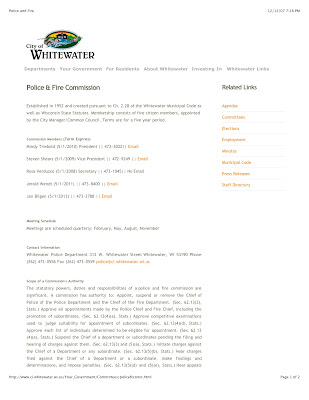
The second way that once could complain is to attend a PFC meeting. That’s likely even more intimidating than a generic email box with no clear explanation of rights, timelines, etc.
In fact, in the last three years, the minutes of the PFC reveal that only one citizen, a business owner, appears to have offered citizen comments.
I am sure that Chief Coan would say that proves there are no other concerns. That’s nonsense: he presides over a process that is unfamiliar and intimidating to ordinary people, and then announces that their silence is proof of his excellence. (That’s why television in a city that expects complaints about police conduct at a public meeting is a terrible idea. There’s no initial confidentiality in that sort of avenue.)
It should be obvious that complaints about police conduct are more serious, and more intimidating to those who believe that they have been injured, than ordinary comments at a public meeting. It’s more than a concern about signs, banners, and code violations, after all.
Finally, I suppose, someone could walk into the Municipal Building during the day ,and try to file a complaint. A city with a real outreach program would tell people how to file a compliant, and what their rights are. We have nothing like that here — other cities in Wisconsin do, but not ours.
Even after the height of community anxiety after the Star Packaging raid, the Whitewater Police Department — weeks afterward, was able to contend that there were no complaints about its conduct. Of course not — those who were aggrieved had no reason to trust that — absent any normal mechanism for complaining — their voices would be hear, or that they would be treated fairly.
You may say whatever you want (I advocate free speech, after all). Do not expect, however, that the the sparse web page of the PFC will convince a person of normal understanding and intelligence that he or she can feel comfortable filing a complaint. Do not expect that the absurd idea of expecting people to walk into a PFC meeting, and complaining there, will work. We do not have few complaints because people are happy; we have few complaints because it’s to hard for people to speak up with sound assurance. Someone who speaks English as a second language would have even less reason to feel comfortable or trust our practices.
It was President Reagan who often advised to “trust, but verify.” What then of a system that cannot be verified, that has no real citizen complaints process worth its salt? Coan presides over a system in which citizen complaints are difficult, and in which he can contend that the absence of complaints proves the nobility, integrity, etc., of his force.
It is system in which a reasonable person will not have confidence.
This week’s coming attractions include —
• Police and Fire Commission Series, continued
• Common Council Meeting for December 18th, 2007
• Inbox: Reader Mail — Housing Monopolies and Subsidies
• Choice in Education (holdover from last week)
• Christmas Tales: How the Grinch Stole Christmas Break by John Adams
• Friday Cartoon Feature
This is the fifth post in my series on the Whitewater Police and Fire Commission. The first post was an introduction to the series, and the second post cited the authority of our PFC under Wisconsin law. The third post suggested reasonable standards for Whitewater’s PFC. The fourth post discussed meeting minutes.
Let’s consider PFC performance by a few reasonable standards, standards that almost anyone should readily accept. (I will consider the citizen complaint process separately.)
The commission should fulfill its legislative mandate. Meetings are not a gift to the community; they are a requirement of the law for the welfare of the community. If other reasonable standards are not being met, then the legal protections that a real and robust PFC offers are not realized. It’s not as though someone failed to score a run at a community softball tournament; it’s far more than that.
Of all the meetings with minutes available, most last for less than one-hour, despite listing several serious topics for each meeting. Consider these brief encounters with oversight:
2/2/05 — 7:05 PM start to 7:38 PM adjournment.
5/14/05 — 7:03 PM start to 7:33 PM adjournment.
8/24/05 — meeting listed on city website without minutes — it was actually cancelled (as the minutes of the 11/16/05 meeting reveal)
11/16/05 — 7:00 PM start to 7:45 adjournment.
2/13/06 — meeting listed on city website without minutes – it was actually cancelled (as is clear from the subsequent 5/10/06 minutes, that refer to the prior meeting as 11/16/05).
5/10/06 — 7:00 PM start to 7:46 PM adjournment.
7/11/06 — 7:00 PM start to 8:35 PM adjournment. Finally a meeting over one hour! Yet, this meeting had a closed session portion to interview an applicant. Much of the time was interviewing, not a public meeting.
8/23/06 — 7:00 start to 9:05 PM adjournment. Only PFC meeting in the last three years’ time that resembles other ordinary civic board meetings in length.
8/30/06 — 6:30 start to 6:45 adjournment. The meeting went into closed session from 6:37 to 6:42, after which Chief Coan was reappointed, after having only recently resigned, taken a job elsewhere, and then returned to Whitewater. That’s right — reappointing a chief who left and then returned with a matter of weeks took the Whitewater PFC only five minutes to decide. A discussion of his sudden desire to return should have taken more than five minutes — a mere one minute per PFC member.
That’s not deliberation; it’s a rushed, embarrassing exercise in abdication of serious debate. How did the PFC measure the time it took to deliberate Coan’s reappointment? I don’t know, but an egg timer would have worked.
I could continue this way, but the point’s clear enough — historically, these meetings are so brief they’re a mere formality, not a practical matter of oversight.
The commission’s meetings should begin at a fixed, regular, and published time, so that citizens can reliably attend. Our PFC does not meet at on a consistent, regular basis. Look at the dates during which the City of Whitewater website says that the PFC has met; there’s nothing regular and predicable about these times.
2/2/05, 5/5/05, 8/24/05, 11/16/05, 2/13/06, 5/10/06, 7/11/06, 8/23/06, 8/30/06, 11/01/06, 2/7/07 (cancelled), 3/21/07, 5/23/07, 9/05/07.
Some of these are regular meetings, some are special meetings, but there’s no easy pattern for a citizen to follow. Other City of Whitewater meetings — including commission and board meetings — are held on a predictable schedule. The schedule of PFC meetings is a guessing game by comparison.
The commission should produce useful and thorough minutes of its meetings.
Most of the minutes from the PFC are now on the web — feel free to review them for yourselves. They completely lack the character of minutes, in which topics raised are listed, and the content of the discussion, and who raised different points, is listed. Instead, the so-called minutes look like mere agenda items. As I’ll contend tomorrow, televising these meetings without a genuine and reliable citizen complaint process would be the worst possible step. The best step is to have genuine minutes that are more than line items saying “Discussion of…” or “Update on…” with nothing more than the mere topic itself. What was said? Who said it? What were the reasons for a given position? Those are useful minutes.
The nature and role of the commission should be listed in the same places as all other community information. Here, the PFC looks like most other City of Whitewater boards and committees; its entry on the city website is about the same as, for example, the fountain committee or the tree commission.
Perhaps, just perhaps, some commissions and boards should receive more prominent notice. I’d suggest the PFC as one of them.
Information about the commission should be clear and easy to understand. I think that the PFC falls short in this regard. The municipal website lists that the PFC schedules meetings quarterly; it would be better if it held meetings quarterly. There’s also no explanation of a citizen complaints process. (I will post on that separately, tomorrow.)
Information about the commission should be available in the principal languages spoken in the
community. Months ago, I suggested that some translation tool be available to make the city website more accessible. My suggested automatic translation tool might not have been the best for the city, but some of these pages should be translated, even if manually. The last census indicates that about 6% of the community is Spanish speaking; the actual percentage is likely higher. If the City of Whitewater and Whitewater Police Department is truly interested in outreach, then some pages translated into Spanish would be a good start.
Coming Tuesday: Integrity and a true citizen complaints process in our town.
Bugs goes tropical in Wackiki Wabbit. Enjoy
Weeks ago, when I first thought about this series, I visited the City of Whitewater website for the minutes of the PFC meetings. By its own standards, there should have been four meetings each year (and at least that many as a matter of good policy, apart from the law). When I checked the city webpage at that time, I saw that there were quite a few minutes missing. I wrote to a representative of the city, and asked for copies of minutes that were missing. Here’s what I wrote:
I hope that your week went well, and that the week ahead is equally good. My name is John Adams, and I am the author and publisher of FREE WHITEWATER, an independent, local website offering commentary on Whitewater, Wisconsin. My site is published at www.freewhitewater.com.
I am writing to see if you could please provide electronic copies to me of the minutes from Police and Fire Commission meetings for those sessions that are missing from the City of Whitewater website.
At the website for the Police and Fire commission minutes, http://www.ci.whitewater.wi.us/Your_Government/Minutes/
policefcminutes.html, several meetings are listed without an accompanying document. I am writing to see if you could send me copies of the minutes for those sessions.The dates listed on the website without attached minutes are 8/24/05, 2/03/06, 2/07/07, and 5/23/07.
One other question, if I may: Has there been no other meeting since May in 2007?
Electronic copies would be more fine; I do not need any particular certification.
Please reply to me, at your convenience, at adams@freewhitewater.com .
Best regards,
John Adams
I received a helpful reply from someone who was neither part of the PFC nor the police department. It’s telling that there were gaps in the dates with available minutes on the city website, dating back years, but no one from the PFC, including its secretary from that time, filled those gaps. The missing minutes represented a gap of about one-third of the statutorily-mandated number of meetings from 2005-2007. Some missing minutes were not posted until I wrote to the city, and someone not on the PFC had to collect the information that she could.
Here is a snapshot of the City of Whitewater website page, after I wrote to the city, and after other minutes were added, listing meeting dates, and availability of minutes for those meetings:
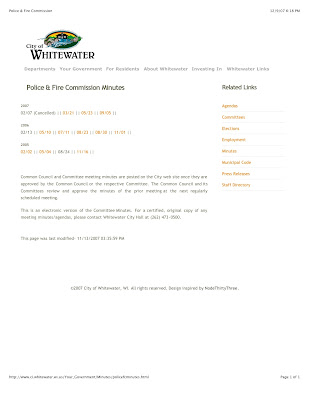
First, I well know that the copies on the web are not certified copies. It doesn’t matter: citizens should be able to see minutes of a public commission, on the web, without waiting years. It’s not as though city website doesn’t have other documents posted promptly. The minutes of the PFC are more important, I am quite sure, than any number of other papers, videos, and charts that are posted quickly. It should matter more than it has mattered, in any city.
Second, I have been in professional and civic meetings for my entire professional life — decades — and these are among the paltriest minutes that I have ever seen. Did no PFC member care to write thoroughly and carefully? Most of the minutes, as I’ll show, gloss over vital topics. The problem with most organizations is that minutes are too lengthy, too copious. It’s the opposite with these minutes — they offer too little.
They are revealing, nonetheless. I’ll offer more on that in my next posts. The PFC series will continue Monday, with an assessment of how well our town has been meeting the reasonable standards for a police commission and a citizen complaints process.
This is the third post in my series on the Whitewater Police and Fire Commission. The first post was an introduction to the series, and the second post cited the authority of our PFC under Wisconsin law. In this post, I will suggest reasonable standards for Whitewater’s PFC.
Every reasonable person can agree on a few clear principles for public meetings of legally-required boards and commissions:
1. The commission should fulfill its legislative mandate.
2. The commission’s meetings should begin at a fixed, regular, and published time, so that citizens can reliably attend.
3. The commission should produce useful and thorough minutes of its meetings.
4. The commission should offer citizens reasonable and fair opportunities to present grievances concerning the organization of
which the commission has oversight. A complaint process must be (1) easy to understand, (2) easy to use, (3) offer safeguards against fear of reprisal.
5. The nature and role of the commission should be listed in the same places as all other community information.
6. Information about the commission should be clear and easy to understand.
7. Information about the commission should be available in the principal languages spoken in the community.
These standards should apply no less to our PFC than to any other body. In fact, they should apply with greater care, as the police department over which the PFC exercises authority may lawfully investigate and use force against their fellow citizens.
Of these seven reasonable suggestions, our Commission meets only two — and fails to meet, or meets only partially, the other five.
Some of the most important roles of the PFC involve reasonable standards for handling citizen complaints. The Department of Justice offers sensible suggestions for managing citizens complaints fairly. In a paper entitled, “Principles for Promoting Police Integrity” the U.S. Department of Justice sets forth good police practices. In a section of that paper entitled, “Complaints and Misconduct Investigations,” the Department of Justice offers five guidelines for good practices for handling citizen complaints.
1. Perception of Fairness. “Agencies should provide a readily accessible process in which community and agency members can have confidence that complaints against agency actions and procedures will be given prompt and fair attention.”
2. Complaint Forms. Civilians should be allowed to file complaints in-person, by mail, by telephone, by facsimile transmission, or, where possible, by e-mail. A complaint form should be offered, but completion of the form should not be required to initiate a complaint. Individuals should be able to obtain and file complaint forms at places other than law enforcement agencies.
3. Officers and other employees should be prohibited from refusing to accept complaints, or attempting to dissuade a civilian from filing a complaint. Civilians should not be required to meet with or speak with a supervisory officer as a requirement for filing a complaint.
4. Complaints should be accepted from all individuals, including those who request anonymity. Complaints should be accepted from third parties to ensure that witnesses of abuse or misconduct can file complaints as well as victims of such misconduct.
5. Knowledgeable Investigator. Misconduct investigations of serious misconduct allegations, including allegations of excessive force, false arrest, improper search or seizure, or discriminatory law enforcement, should be conducted by an entity that has special responsibility for conducting misconduct investigations.
We fall short in each and every one of these standards for handling citizen complaints. In my next posts, I will show how, over the last three years, our community has not fulfilled basic standards for PFC meetings and has failed to establish a fair, reasonable, conventional complaint process.
This is the second post in my series on the Whitewater Police and Fire Commission. The first part was an introduction to the series. In this post, I will outline the powers of our Police and Fire Commission (PFC) under Wisconsin law.
The PFC is a legally-authorized and required commission under our law. It both has authority, and under Wisconsin law, it must be established and exercise that authority. There is nothing voluntary about a PFC — it’s neither a civic group nor an ‘optional’ organization. This makes sense: wherever and whenever a community needs and authorizes a police department to be armed and use force for the protection of others, prudence requires that some impartial, judicious group outside the department be empowered to exercise oversight of those who may use force. The authority is too great, the task too important, to be left merely to those within a police department. In Wisconsin, that authority rides with a PFC.
The basic provisions for a PFC are found at Chapter 62.13, et seq.., of Wisconsin Statutes.
What does the law tells us about the authority of a PCF? Wisconsin’s statues set forth basic provisions:
Number of Members. “Each city shall have a board of police and fire commissioners consisting of 5 citizens, 3 of whom shall constitute a quorum.” 62.13(1).
Different Political Parties. “No appointment shall be made which will result in more than 3 members of the board belonging to the same political party.” 62.13(1).
PRC Must Keep Records. “The board shall keep a record of its proceedings.” 62.13(1).
Board Shall Appoint, May Remove Police and Fire Chiefs. “The board shall appoint the chief of police and the chief of the fire department, who shall hold their offices during good behavior, subject to suspension or removal by the board for cause.” 62.13(3).
Board Shall Approve a Department’s Subordinates. “The chiefs shall appoint subordinates subject to approval by the board.” 62.13(4)(a)
Board Shall Establish List of Hiring Standards. 62.13(4)(a)
Commission May Suspend a Subordinate. 62.13(5)(a)
Entire Commission, or a Commission Member, May File Charges Against a Subordinate. 62.13(5)(b)
PFC meetings, unless otherwise involving specific and definite business, must by our law be open to the public. It’s not a private body, either by nature or practice. The assurance of citizen oversight is necessary.
It’s no small responsibility to be part of the commission. In many ways, it is an unenviable task: our community wants and needs protection (as do all communities), but suggestions or criticism of current practices may be met with scorn, derision, or accusations of ‘unsupportive’ behavior.
Readers know that I am a critic of the Whitewater Police Department, and its chief, Jim Coan. In this series, I will consider our Police Commission, and its role — by law and practice — in overseeing the Whitewater Police Department.
My views on the city are those of a libertarian, and libertarian thinking informs my opinions on economics, politics, and education.
Who are Libertarians? We are a fundamental part of the American political tradition, from the earliest days of settlement on this continent. Although we have never claimed an exclusive role in American history, we have always played a prominent part (in fact, long before the term ‘libertarian’ was coined). From Paine and Jefferson, to Thoreau, Friedman, Goldwater and Reagan, we have always been committed to the American dream. If someone tells you that libertarians aren’t committed to America, you can tell him or her that that’s a mistaken view. We are committed to the American promise of “individual liberty, free markets, and peace” (in the apt words of a fine libertarian organization). The libertarian tradition is part of the American tradition.
Who am I? I am the publisher and author of a website about life in Whitewater, Wisconsin. I believe that aspects of life in our city have strayed from the American tradition of liberty, and that a few people here disregard individual rights, free markets, and seek to inhibit a free and vibrant culture. I am a critic from principle: my writing follows the tradition of commentary in which the views matter more than the man.
Nonetheless, I have described myself plainly: I am a resident, citizen, and homeowner in Whitewater, Wisconsin. I am a common man, the son and grandson of two extraordinary men. My father and paternal grandfather were intelligent, serious, and strong advocates for free markets and personal liberty. They loved and defended this beautiful country. The were well-read and well-traveled; they made lasting friends abroad who shared their love of liberty.
By any standard, I have led a charmed life. I am the descendent of a proud tradition, the son and grandson of great men, received the education of my choice and hopes, have traveled widely, and have married well. I have a beautiful family, lovely home, and interesting work.
I have all that I have ever wanted. I write polemically, but I live peacefully. In the thinking of some here, I should surely be a champion of the present scene.
I love our small city, and it is natural that other people also love it. Sometimes, the defenders of a broken institution will defend it by accusing its critics of being strangers, or of personal bias. Neither is true in my case. Sometimes, people worry that by criticizing local officials, they will fail their community.
No one fails Whitewater who embraces America.
What is good and true in America — a Declaration, a Constitution, a Bill of Rights — ennobles Whitewater. We are far more than a small town; we are a small town made great when true to this free republic. No one will disappoint Whitewater, or America, by holding fast to the great people and principles of our democratic tradition.
This post is part two of my coverage of the December 10th Planning Commission meeting. I posted Part 1 earlier.
Residential Space on the First Floor of a Downtown Building. A prior Planning Commission session debated, and the Commission rejected, two residential units for the first floor of the old Hallmark store building on Main Street. At the December 10th meeting, the architect and owner of the building presented a proposal for one first floor apartment. The location is now vacant.
Statement of the Evening. Commission member Harriet Kaluva (term expires 5/1/2009), when asked her preference between a vacant building and a first floor apartment in the back of that building, answered candidly: “…I would prefer having an empty building until a developer comes along that would meet the requirements of the retail aspect or the retail mandate of Downtown Whitewater.”
Not everyone shares that view, of course. It’s forthright, and it is the risk that planning runs — a world where the plan supersedes ordinary needs. There’s ideology and then there’s blind ideology. (I am usually unconvinced of slippery slope arguments, and the notion that because we do something, we’ll do anything.) My point is not that blind ideology is inevitable, but that it should be avoided.
One way to avoid imposing a plan or ideology over human industry and creativity is to adopt policies that maximize the opportunities for free, creative action. A commitment to emptiness is, itself, empty. It’s easy to say ‘planning guidelines or nothing.’ Fear of being inconsistent devolves into unwillingness or inability to exercise judgment about reasonable distinctions and differences. If never really means never, ever, then the opportunity for reasoned debate is eliminated.
On Citizen Comments — a few residents spoke for or against the plan. I will address the most interesting remarks.
Bill Bowen. Longtime readers know that Bowen and I have corresponded previously. Bowen asked the question, “What are people thinking….Why would people sign statements of support for this [first floor residential space]?” He offered the suggestion that soon we’ll be flooded with demand for student housing, and that demand will swamp the downtown.
Why? It’s a slippery slope argument — approve this, and then a deluge will follow. As I noted above, one would hope for a municipal commission that could make distinctions. If it’s all approval, or all rejection, all the way down, why have a planning body at all?
One might venture that some property owners supported this proposal because a lingering vacancy is undesirable.
Tami Brodnicki. The director (or is it executive director?) of Downtown Whitewater seemed as persuasive and congenial as when I last saw her at a meeting. Brodnicki read a statement contending that neither pedestrian malls nor sports arenas are of benefit to a downtown revitalization program.
Good to know. I have one question, though: Did Brodnicki pick up the wrong statement? Perhaps the one from which she read was for a city that might actually, someday, have a sports arena in its downtown. Whitewater (population 14,000) is not likely to be that city.
Property Owner/Applicant. Frustrated, angry, and hostile — here was a woman who nearly pulled defeat from the jaws of victory. As she went on, and on, was the architect for the plan thinking, “Oh well, there goes another project down the drain?”
She remarked that the property should not be called the Hallmark building, but instead by her family’s surname. I am sure that she’s proud of her family, but if they did not make a sufficient public impression previously, it’s a bit late to insist on the point while before the commission as an applicant. I’ll call it the Hallmark building, because that’s how everyone in town knows it.
The Planning Commission approved the application, with several conditions, for first floor residential space on a close 4-3 vote.
Two items stood out for me from the December 10th meeting: (1) a discussion of a sign for a downtown restaurant, and (2) a request of an owner to rent a first floor apartment in the back of the old Hallmark store location.
I’ve mentioned before that while one’s opinions should not change from forum to forum, one’s manner and presentation should fit the forum. I write polemically (that’s perhaps an understatement), but what’s possible on the page way not be effective in person. Anger plays poorly in person, and on television. Sometimes I’ll use an italic font to emphasize a word in print, but I might not emphasize the word when speaking. Different forum, different manner: same point.
At the same time, the world’s a messy place, and sometimes people will get angry, make faces, etc. That may be, by turns, ridiculous or frustrating. There is something satisfying and reassuring about a person who stays calm while those nearby lose their cool.
Restaurant Sign. A local restaurant in our downtown wanted a sign for its window. The plans for the sign were in black-and-white, and did not specify colors. Planning Commission member Rick Gilpatrick asked this question, “Wouldn’t the city have interest in having a record of what the colors are?”
It’s a rational question, and one typical of planning meetings in all sort of places. It’s certainly a conventional request and a conventional outlook.
It doesn’t have to be this way, though. What if we lived in a society where a restaurant owner could display a sign without filing a colored drawing with the city? If a shopkeeper decided one day that teal would be more suitable on the sign than navy, must a municipality know (and approve)? My question is not about conventional practice — it’s about the possible, about what could be.
I do not believe that this level of planning and municipal oversight is necessary for a town to function, let alone function well. This isn’t planning to compete, it’s not even reasonable planning for aesthetics (an often dubious concept, to my mind), it’s just planning. If the restaurant owner said that she thought orange and gold would make a good sign, what would one say? Orange, but not — absolutely not — tangerine orange?
I know full well planning commissions often ask questions about color, etc. My question is why it’s necessary of the city to inquire. Refraining from inquiry wouldn’t mean disaster; it would be an improvement. It’s not planning for order, but planning merely necessary to permit a spontaneous order, that we should favor. The true advantage of more spontaneity is not a calculated efficiency or cost savings; it’s liberty and the creative, unpredictable, amazing possibilities that liberty affords us. At the end of the day, I am convinced that a less-structured, less-inquisitive municipality is a better one, for moral and prudential reasons. It’s not that the current system is all bad; it’s that a less inquisitive system would be better.
I believe in a community where ordinary judgments about beauty are left to individual homeowners and businesses. Neither my neighbor nor my community’s elected representatives should, for example, restrain or restrict my ability to paint a house or sign a given color. (That hasn’t happened to me, by the way; my point is general.) I favor a world with the freedom to choose the shade I want, without filing a document, or asking permission of a committee. Left on their own, people will typically choose wisely, and its patronizing to think otherwise. If they don’t, then I’ll not trouble myself about the result. Most choices will be as good, or better, than managed choices. That these choices will have been made without intrusion or oversight makes them even better.
We should be strong enough to accept the free aesthetic choices of others.
Last week’s posts included discussion of Dr. Roy Nosek’s views on student housing, the campus before exams, the contradiction of public officials supporting confidentiality in municipal litigation, the last Planning Commission meeting, and the last Common Council meeting.
This week’s coming attractions include —
• Planning/Architectural Review Board Meeting for December 10th
• Beautiful Whitewater: Video
• Choice in Education
• Common Council meeting for December 11th
• A Police Commission Series
• Friday Cartoon Feature more >>
I’ll make two quick comments on the Common Council meeting for December 4th, 2007.
First, there’s a serious point to be made about how tax incremental financing is less advantageous and riskier than appears. That’s not apparent until years after a district is established. Tax incremental financing — old or new — should be a last-ditch effort.
Second, get your tape measures out — the Baymont Inn’s sign might be too big! Too funny. As against, for example, the golden arches of McDonald’s? What’s nearby? A gas station, a bowling alley, a Wal-Mart, a hardware store, and an auto dealership. The Baymont’s blue sign is as suitable as what surrounds it. It’s just silly quibbling to waste time on the matter.
I’ll catch up on my coverage of the Planning Commission with a post on its November 26th meeting. One topic stood out: should the Planning Commission meet once or twice a month? Under the rules of the Planning Commission, the chairman can make that decision, but he sensibly allowed it to be a board decision. (How often one meets is something that all members should have a chance to discuss.)
I have advocated previously that less is more, and that meeting once a month would be a good idea.
Common Council president and voting member of the Planning Commission Marilyn Kienbaum favored keeping a twice-monthly meeting schedule, as (1) it would provide more opportunities for developers to meet the Commission, (2) more opportunities would allow a greater number of approvals, (3) Attorney Mitchell Simon — who handles fair amount of real estate work, and whose opinion she respects — supports the current, twice monthly-schedule, and (4) hinted that Whitewater might not need a city planner if the Planning Commission met only once monthly.
(Ordinarily, one might expect that I would be inclined to the view that we could do without a city planner. When someone says that the city might not need a planner, it’s almost like date music to a libertarian. I do not think that it was meant as a serious suggestion, however. In any event, it’s not the main question, but rather a possible, and only possible, consequence of deciding the main question. The main question is about how often to meet.)
The idea of meeting once-monthly is the more reasonable position. Kristine Zaballos noted, among other points, that (1) other communities’ commissions meet monthly, and (2) meeting monthly would provide an incentive for businesses and developers to submit complete, informative proposals (lest they have to wait another month). Presumably, it’s also an incentive for the planner city planner to gather all needed information for the commission (lest he be accused of inefficiency).
There is no competitive disadvantage where our commission would meet with the same frequency as others’ commissions. I do not believe that meeting more frequently has given us an advantage; in fact, it seems that meeting more frequently has led to less respect for the submissions process, the tendency to carry items from meeting to meeting, and more discussion of small matters. Part of Mrs. Zaballos’s point was that a change in process (meeting monthly) would lead to a change in behavior (more thorough submissions and less small-talk). She’s likely right. It’s reason enough to move to a monthly schedule. (Significantly, it does not depend on mere promises of better submissions and better review; the incentive is in avoiding a month’s delay.)
The decision at the November 26th meeting was 5 – 2 in favor of meeting monthly.