FREE WHITEWATER

Monthly Archives: September 2008

Four Minutes, Forty Seconds Against a Misguided Bailout

Over at the Wall Street Journal, Barry Ritholtz, the blogger who publishes the economics blog entitled, “The Big Picture,” talks about the risks of a government bailout of large, failing financial firms. 


This has been an odd election year, with unexpected winners and losers along the way.  We’ve still six weeks’ worth of possible surprises ahead. 
 
It is a sad end to the current Administration that it leaves its nation and party downcast and frustrated.   George W. Bush has done more to squander the positive accomplishments of Goldwater and Reagan than any Republican of our time.  Only Nixon equals Bush in fiscal failure, interference with individual liberties, and political disarray.  Bush leaves his party with no one who can confidently reject government meddling.  He has assured his fellow citizens only diminished opportunities in a society where government is more important than ever before. 

Daily Bread: September 24, 2008

Good morning, Whitewater

The Whitewater Tree Commission will meet at 4:00 p.m. today.

The National Weather Service forecasts a temperature of 80 degrees with a slight chance of thunderstorms. The Farmers’ Almanac predicts “fair and cold weather.”

Yesterday’s better prediction: NWS.

In Wisconsin history on this date, in 1857, the Wisconsin Historical Society entry indicates either a slow day in our history, or a great event in Badger State cuisine: today marks the anniversary of the First Sheboygan County Cheese Award. Here are the details that make this a memorable date:

On this date N.C. Harmon of Lyman was awarded the first premium prize for cheese made in Sheboygan County. The award was given at the Sheboygan Agricultural Society fair held in Sheboygan Falls. The next year saw John J. Smith procure the first cheese vat in Sheboygan County. He manufactured cheese on a cooperative plan, collecting curd from his neighbors. Both are early events in the long and important history of cheesemaking in Sheboygan

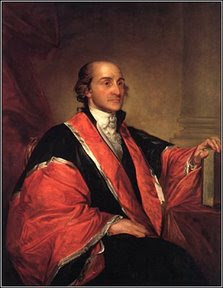
On this date in American history, in 1789, President Washington signed the Judiciary Act of 1789, establishing the United States Supreme Court. John Jay of New York served as our first chief justice, later leaving the court to become governor of New York. (Jay is depicted below either in the judicial robes of the era, or his bedspread.)


Microsoft Uses Apple

Last week, I posted on a failing Microsoft ad campaign, and Microsoft’s abandonment of Jerry Seinfeld as a pitchman. Microsoft decided to respond directly to Apple’s “I’m a Mac, I’m a PC” campaign with an “I’m a PC” reply ad.

Ready?

When Microsoft created their reply ad, they used Apple hardware and Adobe software to create it.

Microsoft employees may later have tried to conceal evidence that they used Apple and Adobe products.

Too funny, but predictable – Apple makes better products, and so does Adobe.

No one is surprised when ordinary people who work in a business sometimes behave in a self-interested and dishonest way. Yet, when people no different assume public office, they ask and expect that others will see them as selfless public servants, above possible reproach.

We also have reason to doubt a Microsoft-only reliance in our schools when Microsoft forgoes a Microsoft-only approach in the marketplace.

See
Apple Insider at http://www.appleinsider.com/articles/08/09/19/
microsofts_im_a_pc_campaign_created_with_macs.html

for more on the story.

Daily Bread: September 23, 2008

Good morning, Whitewater

There are no public municipal meetings scheduled for the City of Whitewater.

The National Weather Service patchy fog in the early morning, and then sunny with a high temperature of 80 degrees. The Farmers’ Almanac predicts “pleasant initially, then showers spread east into Ohio.”

Yesterday’s better prediction: NWS.

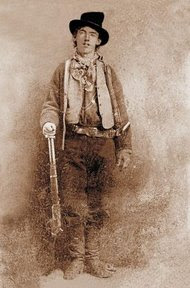
On this date in American history, in 1875, Billy the Kid was arrested for the first time, for stealing a basket of laundry. His life of crime ended — along with his life, itself — six years later, when Sheriff Pat Garrett fatally shot him on July 14, 1881.

Our Election Laws

America is an extraordinary place, but there’s much sadness in the fact. We are extraordinary in part because we are a free people, yet that condition is one that should be universal. It’s not — much of the world lives and dies under selfish, oppressive dictatorship.

Our freedoms depend on the respect and deference to the rights of the individual, and the utter dependence of government as an instrumentality of a free people. On the power of citizens as voters to elect their representatives for discrete times and duties rests our security from pernicious authority.

The right to vote is not a gift or entitlement to government; it is a bulwark against oppressive government, and a reminder that all legitimate authority derives from the consent of the governed.

America has had more than one recent election controversy. The close partisan divide between her two major parties — and the spoils that a victorious party comes to control — make additional controversies likely.

Locally, there are three things that are essential to our political integrity.

First, we must offer all those who can lawfully vote a place and convenient opportunity to do so. We were right to establish a second polling place in town; cities have several or dozens of polling places.

Second, we must treat each and every citizen who may lawfully vote in the same manner, making special allowance for those who are disabled. The are no categories of ‘senior’ and ‘junior’ voters: there are merely those who are eligible to vote.

I know, and you know, too, that sometimes older residents look upon younger voters as lesser voters. There is no such category at law, and the social prejudice that sees this distinction is both legally wrong and laughable. A legitimate voter is a legitimate voter is a legitimate voter. There is no reason to respect a social prejudice that stands in the way of lawful rights. Self-appointed town fathers and aging matrons have no authority to trump the law because of their cramped, narrow view of the world.

I would as soon ask a drunk his opinion of sobriety as our town fathers their opinion of propriety.

Third, I believe that we should enforce respectfully and politely the full measure of our election laws on registration and voting.

(There is a recent effort of Wisconsin Attorney General J.B. Van Hollen to require election officials to conform to 2006 federal elections requirements. See, for example, Van Hollen Files Lawsuit On Voter Identity. His lawsuit stems from a state board’s decision not to check voter registration between Jan. 1, 2006 and Aug. 6, 2008 as required by the Help America Vote Act of 2006. Democrats charge Van Hollen’s action is politically motivated; they have filed an open records request to learn more about the motivation of his actions. I will set aside the merits of Van Hollen’s effort, and speak generally.)

There is far too much concern about election laws in America, and the best course is to comply fairly, politely, and closely. If our existing federal laws should prove too burdensome, a future Congress may repeal or amend them. Until that time, cities and counties should not be in the position to pick and choose.

We, in Whitewater, should comply with all applicable federal laws, as we should with state law. We should not, and must not, disregard either federal or state law for local considerations. Other communities may take a different course, but our best course is full compliance with state and federal law.

Daily Bread: September 22, 2008

Good morning, Whitewater

There is one public meeting scheduled for today: a Community Development Board of Directors meeting scheduled for 4:30 p.m.

At 7 p.m., there will be a meeting of our district’s school board.

Quick note: Posts on the settlement of a civil right suit against the city are yet a few days away.

The National Weather Service forecasts dense fog in the early morning, and then sunny with a high of 79 degrees. The Farmers’ Almanac predicts “pleasant initially, then showers spread east into Ohio.” ‘Then’ refers, I think, to the end of their multi-day series, on September 23rd.

Last week’s better prediction: Basically even. Sometimes a general prediction like pleasant weather is right even if there is more specific information that’s right, too. There’s a difference in measurement between 10 and 10.00, but at a high level, both describe a number between 9 and 11.

In Wisconsin history on this date, in 1788, the Wisconsin Historical Society reports that J. Dubuque was allowed to mine in Wisconsin. He didn’t get his permission from the American government, but from a more local authority:

On this day in 1788, Julien Dubuque, a French trapper from Quebec, was granted permission by a council of Sauk and Fox Indians of the area to work the lead mines. Using the Sauk and Fox as a labor force, Dubuque found the Upper Mississippi Valley to be rich in lead, which was used in the production of firearms. Dubuque had the most success in what is now the area of Dubuque, Iowa.

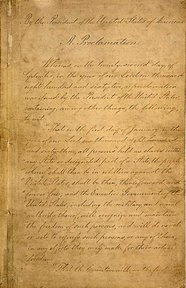
On this date in American history, in 1862, President Lincoln issued the Emancipation Proclamation. The History Channel has a video with information on this and other events that took place on this date:

http://link.history.com/services/link/bcpid1184539009/
bclid1214007432/bctid1213938785

The Common Council Meeting for September 16, 2008

Whitewater, Wisconsin’s latest Common Council meeting was held this last Tuesday, September 16, 2008.

Whitewater recently experienced a traffic fatality along its principal roadway through town. There was an extended discussion of which changes to traffic signals might be prudent. It might seem like an easy decision, but risk-reduction of this kind is seldom easy. There are no sure decisions, and that was evident in the discussion.

Later in the meeting, there was a discussion of a proposed amendment to a current city ordinance about the screening of dumpsters. That discussion drifted into an extended discussion, and that’s about all one needs to know about the state of affairs in our small city.

There was a past Council session when Council members tried to find ways to work together more congenially. I remarked at the time, in a post entitled, “The October 16th Common Council Meeting,” that

I have never heard or seen a session like this for politicians. I’m sure Whitewater’s not the first city to try this; I’ve just never heard of it elsewhere. I wish the effort well, and the first council meeting after the on boarding seems to have gone well. There is a difference with modern business or professional life, though. In a business or professional setting, typically the team leader will be able to hold others accountable for not living up to the standards set at the session. For a legislative body, elected representatives have — rather than a single hiring-and-firing manager — different constituencies and legislative districts. Over time, they may decide that it matters more to them to please their districts and constituents than it matters to maintain the common standards of the on-boarding session.

We’ll see.

In a political environment, harmony may prove illusive, as it did during the dumpster discussion. Perhaps recurring on-boarding sessions would have been more prudent, but I doubt it.

That a dumpster debate produces discord suggests little progress has been made in the last year, and that, from one from one set of Council leaders to another, the more things change, the more they stay the same.

Planning Commission Meeting for September 15, 2008

Whitewater, Wisconsin’s monthly Planning Commission meeting took place on Monday, September 15th.

Part of the meeting — the principal part, I think — involved a discussion of re-zoning a neighborhood near our local college campus. Much of the neighborhood has evolved from single family homes into multi-unit student apartments, and our community faced the question: Should the neighborhood be re-zoned to reflect the change in use, and permit additional transformation without regulatory interference?

I thought that the meeting went very well, especially considering how angry some residents and their political champions are about any transition of any neighborhood at any time to student housing in our college town.

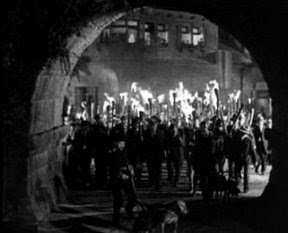
One often expects to see an angry mob, furious at an economy that they cannot control, but that government must, just must, control for them.

Something like this —

Some are so worked up that they’re convinced natural change to a neighborhood is pestilence and plague.

It’s all ‘death’ of a neighborhood now.

It cannot be dead if people still live there. It’s still a neighborhood; it’s just not what some might have wanted, but that others — residents just as much — do want.

So when students move in, it becomes a dead neighborhood, a desert, or (to use a term from Judge Dredd) the curséd earth. I’ve remarked before that some speak of students as though they were rats, and at the time I though that no stronger manner of description would be available. I was wrong; opponents of student housing anywhere off campus had depths yet to plumb.

Something like this —


The initial re-zoning proposal from a consulting firm that our city retains was amended before the evening was over; the proposal as the evening began called for the preservation of a small pocket of single family homes in the proposed multi-unit area.

I understand why: the residents once asked for it. Later, seeing that it might limit their re-sale options, they came to oppose a limited single-family pocket at the meeting. They had the same problem as that of Sen. Kerry on another matter: they were for it before they were against it.

Part of good planning for the consultant would have been to see that a single-family pocket was a bad idea, no matter how much some might have initially wanted it. Part of leadership would have been for this city administration to say that although residents once asked for it, it was a bad idea, both for them and the neighborhood.

The re-zoning (including an amendment that removed the single-family pocket from the proposed multi-unit rezoning) passed on a vote of 7-0.

Where was the city administration in all this?

Hedging and equivocating.

Even the city manager’s endorsement of this re-zoning proposal was tepid and pandering. It was tepid because he never declared for the proposal in a simple, straightforward way. He might just declare: I support this change, or I oppose it.

Most people understand that his hesitant manner indicates support, but it’s hardly inspiring.

What’s pandering though, both intellectually and practically, is the suggestion that if the Tratt Street neighborhood becomes higher density, then as matter of balance other neighborhoods should be enforced to lower density.

Practically, this administration will be unlikely to enforce zoning requirements elsewhere in the city effectively. It’s just an attempt to placate a few angry people. This administration has had little appreciable success anywhere in the city with enforcement — it’s been an over and under-enforcement problem. (See, Whitewater Common Council Meeting for 9/2: Student Housing (Part 1).)

Intellectually, even if it’s true that the housing imbalance between single family and multi-dwelling units is the biggest problem in the city, the administration cannot redress that imbalance appreciably through zoning restrictions elsewhere in the city.

Only additional single-family homes, perhaps on the periphery of the city, will appreciably shift the proportional balance (one that is now in favor of apartments).

We have a black market in rental units because a few politicians and their angry supporters will not allow a free, open market to permit more apartment options. I have argued in favor of those options. (See, Student Housing in Whitewater: Our Mistaken and Repetitive Approach.)

Some want to illustrate how markets are dishonest, but the real dishonesty is pretending that we haven’t limited selfishly the opportunities for an entire community.

Let someone build modern multi-unit apartment buildings and these ‘transition’ and ‘conversion’ fears will go away. Otherwise, consign yourself to a perpetual enforcement war against student apartments in every neighborhood of the city, without end.

The Planning Commission made the right choice Monday night, but this matter is unresolved.

Assessing A City Manager’s Views on Leadership

In this single post, I will offer remarks in reply to the published or publicly recorded views on leadership of the city manager from Whitewater, Wisconsin. I am a blogger from Whitewater, but the Whitewater manager’s views are likely common to career public officials in your town, too. If anything, they’re likely familiar to you, differing only in the delivery of the man or woman who speaks them where you live.

I have reproduced the remarks from yesterday in black; my comments will appear below in blue.

On the Authority of the City Manager in Whitewater, Wisconsin [From the City of Whitewater, Wisconsin’s Website, http://www.ci.whitewater.wi.us/Departments/citymanager.html]:

The City Manager plans and directs the administration of the City to ensure that efficient municipal services are provided and are in line with Common Council objectives.

Administration department functions include: Liaison to the Common Council advising them on all significant matters and presenting all items which require Council action or approval. Directs, develops and implements appropriate budgeting, including capital improvements and administrative planning and control procedures. Provides communications and public relations to the news media and people in the community through various communications media. Coordinates with other governmental agencies and represents the interests of the City in metropolitan, state, county, school district, and national activities as delegated by the City Council. Responsible for effective recommendations in areas of policies, planning, administering community services, community development, public safety, administrative services, financial planning, and human resources. Works closely with each department to plan and coordinate activities to ensure effective service to the public and efficient conduct of all municipal affair.

The City Manager oversees: City Clerk, Neighborhood Services Administrator, Finance Director, Park & Recreation Director, Public Works Director, The Community Development Authority, Police and Fire Commission, Library Board, and respectively oversees: Community Development Authority Director, Fire Chief, Police Chief, and the Library Director.

Adams: The list is expansive, but the responsibilities are meant to be restrained: “plans and directs the administration of the City to ensure that efficient municipal services are provided and are in line with Common Council objectives.” Providing efficient municipal services is hardly objectionable, or as our own city manager might say, is ‘fairly innocuous.’

The real question is not whether a manager assures efficient services, but what scope of services he believes his or her city needs.

On Encouraging Economic Growth [From the Northwestern of Oshkosh, June 3, 2008]:

“How to [sic] you spur private investment? You use public monies as incentives,” Brunner said. “We’ve got a (downtown) façade program … in the first two years of our façade-grant program I think we’ve given out over $200,000, but it’s an incentive that is leveraged then by the private investment.”

Adams: Why should government set the incentives for community economic development? This is a much bigger debate, but it’s telling that a long-term public employee sees nothing out-of-the ordinary about thinking that government sets the economic goals and pace of the community. It’s so obvious to career officials — I see what we should do, and if I spend some public money, then I’ll be able to produce that result. If I spend it, they will come.

Two other points to make, here. First, one sees how easily the benign idea of efficient municipal services becomes guiding the economy of an entire city. It all depends on what services a local official describes as services within the scope of the city’s authority.

The bureaucrat seldom adopts the true minimum — he defines minimum ever upward.

Second, one will quickly hear that this is the will of the community, and that all of this is what the community wants. Officials often over-state their community mandate, always to the advantage of their own schemes and plans. They then rely on the community’s indifference to their own supposed importance as proof of community support.

No one thinks that General Motors speaks for America, although it has millions of shares outstanding. City officials often insist that they speak for their entire communities, though they may have been elected only by a few hundred votes, and by a margin of only a dozen or less.

It’s not that they lack the lawful authority to speak; it’s that they lack the mandate they claim.

To insulate themselves from criticism, they contend that they’re mere public servants doing the will of the people, defending children, the elderly, small pets, etc.

These same officials will see self-interest in their critics, but somehow see themselves wholly free from the darker aspects of human nature they identify in others.

What power is it that suspends human nature and self-interest in them, but preserves it in their critics? If career bureaucrats truly have such a power, imagine how powerful they would be: no cartoon superhero would be greater. They are, in a way, half-way there already: it’s a cartoonish notion to think they have this level of self-command.

They are as we are; no more or less.

On A Flexible Leadership Style [From the Northwestern of Oshkosh, June 3, 2008]:

Brunner said he is open to being either a leader or a follower of the council.

“Here in Whitewater we don’t have a mayor. I’m the ‘mayor.’ I’m CEO and they expect me to be front and center as a mayor would be … If that’s what they want me to do, I’ll do that,” he said. “I prefer more to be on the sidelines, helping the council realize its goals, as opposed to being in the front leading the charge to be honest with you, but I think they’re both effective.”

Adams: There should be no sideline role for the man who oversees nearly a dozen departments and departmental leaders. Lead or follow, stand or hide, declare boldly or equivocate: these are the choices a man or woman freely makes when accepting a voluntary post.

Waiting to follow the loudest voice in the room, holding back or vacillating as the town fathers swing from one view to another, will not do — say what you mean, simply and plainly. Declare.

All that experience and training and education must erase at least a little timidity and hesitation, now and then.

On Community Pride [From the Northwestern of Oshkosh, June 3, 2008]:

As for community pride, Brunner said he thinks it’s important for the city manager to instill it.

“I think that the council and the manager have to be the chief cheerleaders for the community,” he said. “Because if you’re not excited about what’s happening in the community and where it’s going, how can you expect everyone else to be?”

Adams: A city might seek efficient management of municipal services, but look were it leads: The Chief Cheerlearder. Here ones sees the real view — a dangerous one — of an over-reaching, arrogant public servant. Shut up and cheer.

Consider this merely from a legislative perspective. The idea of legislators of the community as chief cheerleaders leaves no room for principled dissent, even from those lawfully elected. If the citizens of a legislative district elect a representative who disagrees with the legislative majority, must he remain silent, or acquiesce?

Of course not: nothing is farther from America’s lawful tradition of free, independent speech, and is farther from a legislator’s authority to speak as he wishes.

I note also the simple-minded and arrogant notion that care for the community must involve cheering for its current direction. No legislator, and no citizen, need feel that the only legitimate words are positive words. How many in American history have argued against a course, a view, as mature men and women who loved their county? I need not name them; anyone moderately knowledgeable of our history knows that many of our greatest leaders held, at one time, dissenting views.

Fewer pom poms, and more history books, would do our administration — and yours, wherever you live — well.

On Why There are City Managers [From the Northwestern of Oshkosh, June 3, 2008]:

Brunner said in the end he just wants to do what’s best.

“You’re trying to build a better community,” he said. “That’s the bottom line. That’s why I exist.”

Adams: Well, here we are, at the embarrassing truth of things — its’ not efficient municipal services after all, but an appointed public official’s role to create a better community. There is no more arrogant, self-aggrandizing role than the official who believes that his goal is to create a better community.

Government does not exist to build a better community — it exists to provide minimal services while the community freely grows and spontaneously organizes itself. We neither need nor should want a presumptuous career bureaucrat to build a better community for us.

When an official, in my town or yours, wakes each morning with the notion that he exists to build a better community, he’ll have trouble understanding America’s tradition of limited, restrained government. If one thinks that building a better community is one’s role, then what is unjustified in attainment of that better community?

There are governors, senators, and presidents who are more restrained in their presumed scope of responsibility. There are priests, pastors, and rabbis who are less presumptuous of their roles.

On Fostering Economic Development in Janesville [From a public recording of station WCLO of a 7/14/08 citizens’ panel interview of managerial candidates]:

We are very fortunate in this particular state to have a tremendous work ethic, we are very fortunate to have a tremendous, our intellectual capital is pretty outstanding and that obviously comes from our educational systems in this state whether it be, you know, at the local level or the outstanding university system that we have. So I think in a knowledge based economy that we are in today, we need to first really work on the collaborative approaches that we can do with our educational institutions….

The name of the game in today’s economy is continuous learning, and we have to provide our workforce the opportunities, accessible ready resources, for continuous learning. So I think that’s part of it. I’m going to throw out an idea to the Council this afternoon, but maybe creating a Janesville University where you bring the resources of all these great universities that we have nearby maybe right into the community…

Adams: We need not create more public schools or universities or programs. Wisconsin does not lack for schools and books. Having spent so much to offer education to so many, we need not pretend that additional public resources will heal the pain of a struggling working-class community.

I am a great advocate of learning, but it need not be public as against private. In any case, a government offering of re-training is only useful upon a private offering of employment. It’s a middle-class notion that schooling can accomplish just about anything; neither the lower nor upper class is so unrealistic.

People who are legitimately concerned about their immediate future have little comfort in a university education, or even most re-training; they are programs that work their benefits not immediately but over a lifetime.

I am not a strong advocate of education for a career, although others may choose differently; I am an advocate of education as its own enriching, civilizing, personal experience.

On Collaboration & Pronouns [From a public recording of station WCLO of a 7/14/08 citizens’ panel interview of managerial candidates]:

….If I use the term I, I don’t like to use the pronoun ‘I,’ I don’t use that very often, but if I say ‘I’ I am obviously trying to impress you all in what I’ve done, but everything I’ve done is in collaboration, in cooperation, with a lot of good people….”

Adams: Sometimes one has to be prepared to accept personal responsibility for oversight that is placed solely in one’s hands, as the oversight of nearly a dozen departments and their leaders requires. False humility need not apply; if a manager oversees a dozen, then he or she oversees that dozen.

If one really oversees those departments, what has one done when they’ve gone astray? more >>

A Technological Answer to a Municipal Problem: Dog Poop DNA Scanning

There are millions of pet dogs in America, and those millions leave millions of calling cards on lawns, sidewalks, and curbsides each day.  While dog owners should clean up after their pets, dog waste is just another excuse for government to complain, cajole, and hector residents to do what they should. 
 
Since there are few stupid ideas that some wasteful official won’t consider, how about blowing investing city tax revenue on a technological spending program investment in our community to detect and punish those who won’t clean up after their dogs?
 
Modern civilization now has the technology to match the DNA from dog waste with a recorded DNA swab sample of canine saliva.  Forget about encouraging neighborhood services officers and busybody neighbors to spy on their fellow residents – it would all be a matter of a DNA match, if only someone would only boldly commit our community along this path.
 
Below appears an inspiring video that tells the fantastic tale, and points us toward a brave, new era of poop-free living.
 
Whitewater bureaucrats – can’t you see it?  Here’s our dream town, just a swab sample away. 
 
Besides, if it will work with dogs, then it will work with … Oh, I’ll let you offer that ordinance…          


Here is a page link in the event the Reuters video loads slowly:

http://www.reuters.com/news/video?videoId=90923&feedType=VideoRSS&feedName=
OddlyEnough&rpc=23&videoChannel=4&sp=true
more >>

A City Manager’s View of Leadership, Part 2

Here is Part 2 of A City Manager’s View of Leadership. Part 1 appears in the preceding post.

On Fostering Economic Development in Janesville [From a public recording of station WCLO of a 7/14/08 citizens’ panel interview of managerial candidates]:
 
We are very fortunate in this particular state to have a tremendous work ethic, we are very fortunate to have a tremendous, our intellectual capital is pretty outstanding and that obviously comes from our educational systems in this state whether it be, you know, at the local level or the outstanding university system that we have.  So I think in a knowledge based economy that we are in today, we need to first really work on the collaborative approaches that we can do with our educational institutions….
 
The name of the game in today’s economy is continuous learning, and we have to provide our workforce the opportunities, accessible ready resources, for continuous learning. So I think that’s part of it.  I’m going to throw out an idea to the Council this afternoon, but maybe creating a Janesville University where you bring the resources of all these great universities that we have nearby maybe right into the community…


On Collaboration & Pronouns [From a public recording of station WCLO of a 7/14/08 citizens’ panel interview of managerial candidates]:
 
….If I use the term I, I don’t like to use the pronoun ‘I,’ I don’t use that very often, but if I say ‘I’ I am obviously trying to impress you all in what I’ve done, but everything I’ve done is in collaboration, in cooperation, with a lot of good people….”  
 
 
On Exceptional City Services and President Kennedy’s Inaugural Address [From a public recording of station WCLO of a 7/14/08 citizens’ panel interview of managerial candidates]:
 
Well, first of all, I think there’s got to be a connection between what the city employees are doing and the larger goal.  Let me explain that by telling you a story.  I believe in management by metaphor, so I tell a lot of stories because people relate to stories real well.
 
I always sit down with new employees in the city, I really appreciate and understand the importance of that, and I tell them I might be the city manager but what you do is just as important as what I do. None of us are as important as all of us. 
 
And I tell them a quick story, and I’m going to tell you this quick story.  President John F. Kennedy, 1961, Inaugural Address, what did he say?  He said we’re going to put a man on the moon, we didn’t have any female astronauts so I apologize for that … [appreciative laughter]… but we’re going to put a man on the moon by the end of the decade….
 
A couple of years later, President Kennedy was going through one of the NASA buildings, and he saw this older man, and he was waxing the floor, the vestibule of the floor, and you could tell that he had great pride in what he was doing.  Okay?   And President Kennedy came up to this little old man and said, “Boy, thank you for taking care of this building, your doing a wonderful job.”  He said [the older man], “Mr. President, I am helping to put a man on the moon.” 
 
That’s what we have to do…

 
  Choosing One’s Words Carefully [From the City Manager’s Weekly Report, 3/7/08, inspiration quotation at the end document]:
 
“Be careful; think about the effect of what you say. Your words should be
constructive and bring people together, not pull them apart.” -Miriam Makeba

 
I think this is a good selection of our city manager’s views, and you may find that your own officials have a similar outlook.  These are probably the views of many careerist bureaucrats and appointed officials across America.  There’s nothing unusual or unique about any of these remarks. 
 
I will post commentary on these views at this same time tomorrow.  I will offer, as you can guess, a different perspective – one more rooted in the private and individual than the public and communal. 

There is no hurry: our city manager isn’t going anywhere.

Neither am I.

In the meantime, I will post our latest Planning Commission Meeting and latest Common Council meetings, and offer a recap of recent Libertarian Party foolishness politics. 
 
After I post on these manager’s remarks, I will offer a few posts tomorrow on the Constitutional lawsuit against the City of Whitewater in the Meyer case. 

A City Manager’s View of Leadership, Part 1

I live in Whitewater, Wisconsin — a small town of 14, 296 in southeastern Wisconsin. You may live far away, in a larger city, but your form of city government may yet be similar to ours — an elected city council and its appointed city manager. Our government talks much about excellence and professionalism and vision and leadership, as yours likely does, too.

What does that mean?

In our own case, I will illustrate principally from two published interviews (and less so from a few other public sources) what that means for the City Manager of Whitewater, Wisconsin, Kevin Brunner. I have no personal connection to our appointed manager, and neither like nor dislike for him. Only his public comments about his position, and public actions in his role, mean anything to me.

You may find that his views are much like those of officials where you live.

I will draw principally on public remarks that our city manager gave to a paper from Oshkosh, Wisconsin while interviewing for a job in that city, and from a recorded interview he gave to a citizens’ interview panel from Janesville, Wisconsin while interviewing for a position in Janesville.

There is no better way to illustrate how an official thinks about his role and accomplishments than when he describes himself, in the best light as he sees it, for a new position.

I will set out his published views in this post, and my remarks on those views in a subsequent post.

On the Authority of the City Manager in Whitewater, Wisconsin [From the City of Whitewater, Wisconsin’s Website, http://www.ci.whitewater.wi.us/Departments/citymanager.html]:

The City Manager plans and directs the administration of the City to ensure that efficient municipal services are provided and are in line with Common Council objectives.

Administration department functions include: Liaison to the Common Council advising them on all significant matters and presenting all items which require Council action or approval. Directs, develops and implements appropriate budgeting, including capital improvements and administrative planning and control procedures. Provides communications and public relations to the news media and people in the community through various communications media. Coordinates with other governmental agencies and represents the interests of the City in metropolitan, state, county, school district, and national activities as delegated by the City Council. Responsible for effective recommendations in areas of policies, planning, administering community services, community development, public safety, administrative services, financial planning, and human resources. Works closely with each department to plan and coordinate activities to ensure effective service to the public and efficient conduct of all municipal affair.

The City Manager oversees: City Clerk, Neighborhood Services Administrator, Finance Director, Park & Recreation Director, Public Works Director, The Community Development Authority, Police and Fire Commission, Library Board, and respectively oversees: Community Development Authority Director, Fire Chief, Police Chief, and the Library Director.

On Encouraging Economic Growth [From the Northwestern of Oshkosh, June 3, 2008]:

“How to [sic] you spur private investment? You use public monies as incentives,” Brunner said. “We’ve got a (downtown) façade program … in the first two years of our façade-grant program I think we’ve given out over $200,000, but it’s an incentive that is leveraged then by the private investment.”

On A Flexible Leadership Style [From the Northwestern of Oshkosh, June 3, 2008]:

Brunner said he is open to being either a leader or a follower of the council.

“Here in Whitewater we don’t have a mayor. I’m the ‘mayor.’ I’m CEO and they expect me to be front and center as a mayor would be … If that’s what they want me to do, I’ll do that,” he said. “I prefer more to be on the sidelines, helping the council realize its goals, as opposed to being in the front leading the charge to be honest with you, but I think they’re both effective.”

On Community Pride [From the Northwestern of Oshkosh, June 3, 2008]:

As for community pride, Brunner said he thinks it’s important for the city manager to instill it.

“I think that the council and the manager have to be the chief cheerleaders for the community,” he said. “Because if you’re not excited about what’s happening in the community and where it’s going, how can you expect everyone else to be?”

On Why There are City Managers [From the Northwestern of Oshkosh, June 3, 2008]:

Brunner said in the end he just wants to do what’s best.

“You’re trying to build a better community,” he said. “That’s the bottom line. That’s why I exist.”

Daily Bread: September 19, 2008

Good morning, Whitewater

There are no public meetings scheduled for the city today. You stay private, Whitewater! (Hat tip to the fine screenwriters of Anchorman.)

The National Weather Service forecasts sunny weather, with temperature of 79 degrees. The Farmers’ Almanac predicts that pleasant conditions will continue.

Yesterday’s better prediction: Even. An FA forecast of pleasant weather coincides with the NWS predictions over the last few days.

In our schools, it’s activity night at the Middle School at 7 p.m.

In Wisconsin history on this date, in 1832, according to the Wisconsin Historical Society, the conclusion of the Black Hawk war led the Fox and Sauk to cede land near modern-day Iowa:

On this date Sauk and Fox Indians signed the treaty ending the Black Hawk War. The treaty demanded that the Sauk cede some six million acres of land that ran the length of the eastern boundary of modern-day Iowa. The Sauk and Fox were given until June 1, 1833 to leave the area and never return to the surrendered lands. Some sources place the date as September 21.

Wired reports that on this date in 1982, Scott Fahlman became the creator of the emoticon:

At precisely 11:44 a.m., Scott Fahlman posts the following electronic message to a computer-science department bulletin board at Carnegie Mellon University:

19-Sep-82 11:44 Scott E Fahlman : -)
From: Scott E Fahlman

I propose that the following character sequence for joke markers:
: -)

Read it sideways. Actually, it is probably more economical to mark things that are NOT jokes, given current trends. For this, use:
: -(

With that post, Fahlman became the acknowledged originator of the ASCII-based emoticon. From those two simple emoticons (a portmanteau combining the words emotion and icon) have sprung dozens of others that are the joy, or bane, of e-mail, text-message and instant-message correspondence the world over….

Fahlman’s original post was lost for a couple of decades and believed gone for good, until it was retrieved from an old backup tape, thus cementing his claim of priority.

: -)

Register Watch™ for the September 11, 2008 Issue of the Paper

In this post, I’ll review the September 11th issue of the Whitewater Register, the low-quality, poorly-written news weekly in my town of 14,296.   
 
I read these stories so you don’t have to – doubt not my love for excellence as I wade though page after page of … something other than excellence. 
 
Front page.  Last week’s sad story on the need for traffic safety grew sadder still with the news that Michael Chaloupka, a twenty-three year old graduate of the University, died from injuries received after being stuck by a car in the city. 
 
Everything else on the front page is mundane, and so far less sad and disturbing, by comparison.  Taste of Whitewater was a fine event, marred not even by the rain (the story ran before the Friday & Saturday event). 
 
There’s one other front page story that might have been much shorter – the renewal of the city manager’s contract.  There’s nothing about the published terms of the contact that seems unusual or different from that of thousands of career city bureaucrats in cities across America.         
 
The entire story might have been reduced to a single sentence: City manager receives salary ‘a’ for term ‘b’ with possible penalties for early voluntary departure of ‘c.’ 
 
Had the story been a single sentence, we might have been spared an inapt reference to financial penalties in the contract.  Dampier speculates that “[p]erhaps it was because of Brunner’s wandering eye that the Council put in some financial penalties…” 
 
It’s a poor choice of phrase, inapplicable in this contractual matter.  Looking at other employment opportunities doesn’t mean someone has a wandering eye.  Hundreds must have read that sentence and thought … Hmm, no, that’s the right expression.  There’s a predictability about these poor word choices in the Register
 
Penalty clauses are common in many employment contracts.
 
What’s more interesting, to me, is what the city manager thinks about his role and responsibilities.  Terms are less interesting than what someone believes about his role.  In this respect, I am much more interested in what someone recently described, I think, as the “leadership and vision of Kevin.”       
 
(That’s Kevin Brunner, not Kevin Bacon, Kevin Costner, or Kevin Kline.) 
 
That interest in a public official’s leadership and vision will lead me to post tomorrow on the city manager’s outlook, from public statements and interviews.  His views are probably not much different from the outlook of others, in similar jobs, all over the country.
 
Inside.  There’s a section inside the paper called ‘School,’ but it only suggests how little school news there is in the paper.  I am still working on a school series, and I will have it done, I am confident, before the next summer Olympics, in London, in 2012.
 
There are some prominent ads in the paper this week, including a full page ad for an event in Waterford, and two half-page ads for concerns in Lake Geneva
 
How much value the Waterford ad will be in the Whitewater Register I cannot say, but then it’s telling that there are not more Whitewater ads in the Whitewater Register