FREE WHITEWATER

Monthly Archives: August 2010

How Is Smoking Pot Like Beating an Old Lady? – Reason Magazine

It’s like beating an old lady in the way it’s prosecuted and the sentences handed down for possession.

The Associated Press reports that “[Udonis] Haslem was charged with possessing more than 20 grams of marijuana, a third-degree felony which could bring maximum punishments of a $5,000 fine and a five-year prison sentence.” Twenty grams is less than three-quarters of an ounce….

Even without evidence of intent to distribute, possessing a small quantity of marijuana in Florida can get you the same sentence as grand theft, burglary, and battery of a police officer or an old lady.

Aside from medicinal use cannabis (where it’s lawful), I wouldn’t encourage marijuana or tobacco smoking. And yet, these sentences are so disproportionately severe compared to sentences for violent crimes that they’re an affront to justice.

Via How Is Smoking Pot Like Beating an Old Lady? – Hit & Run : Reason Magazine.

Which Government Programs are Real and Which are Fake?

Over at Reason’s Rough Cut group blog, there’s a posted video entitled, “Which Government Projects are Real and Which are Fake?”


“Joke-telling robots, expensive walking tunnels, BlackBerries for smokers, and training American prostitutes to drink responsibly. What do these things have in common? They’re all questionable government spending projects in a time when our economy is struggling and people can’t get jobs….or, maybe we just made them up.

Put yourself to the test. See if you can outwit the Rebel Economist before she stumps you. So what is it: REAL or FAKE?”

Here’s the video:


Link:
http://www.youtube.com/watch?v=9Gp0JuBp8xA.

The gentlemen who concocted these spending programs have lost all sense of what’s legitimate. Ideas like these would only make sense to someone without any sense of how ordinary people live. more >>

The Whitewater, Wisconsin City Manager’s Unpersuasive Lament

I read, each week, the Weekly Report from Whitewater’s City Manager, Kevin Brunner. The August 13th issue has clippings that Brunner chose to include from news stories and columns published elsewhere. Brunner included one from New York Times columnist Paul Krugman. Here’s the clipping Brunner included:

Krugman States Anti-Government Movement Hurting “Basic Government Functions.”
Paul Krugman writes in his column for the New York Times (8/8, A9), “We’re told that we have no choice, that basic government functions – essential services that have been provided for generations – are no longer affordable. And it’s true that state and local governments, hit hard by the recession, are cash-strapped. But they wouldn’t be quite as cash-strapped if their politicians were willing to consider at least some tax increases.” Krugman argues that “the antigovernment campaign has always been phrased in terms of opposition to waste and fraud…But those were myths, of course; there was never remotely as much waste and fraud as the right claimed. And now that the campaign has reached fruition, we’re seeing what was actually in the firing line: services that everyone except the very rich need, services that government must provide or nobody will, like lighted streets, drivable roads and decent schooling for the public as a whole.”

Although Krugman’s a noted, respected economist, but he’s a poor columnist. Worse than a poor columnist, though, is any appointed city bureaucrat who re-prints a column like this — the content is partly false, partly distorted, and the bureaucrat’s use of it is self-pitying and tone deaf.

First, Krugman’s column, one I presume Brunner actually read, talks about how America is unpaving roads because of a bad economy. That’s misleading, as Jack Shafer notes, in a column at the Washington Posts’s Slate entitled, What Krugman, Maddow, and the press corps don’t understand about gravel roads. Only a minuscule number of roads are returning to unpaved gravel, and in many cases that’s because they’ve been replaced by newer, paved roads. Furthermore, as Shafer observes, America’s been on a road-paving frenzy for decades. We don’t lack for paved roads.

Second, Brunner uses the headline — perhaps one that someone else originally vote — “Krugman States Anti-Government Movement Hurting “Basic Government Functions.” ” There’s really no significant anti-government movement in America — there’s a limited government movement, a limited and responsible government movement. All sensible people, of whom one includes libertarians, believe in the truly basic government functions of public safety for police and fire, for example. There are questions about policy for police and fire departments, but no one questions that American communities need both services. It’s just hyperbole and grandstanding to contend otherwise.

It’s a false dichotomy to contend that there are two sides to this debate: anti-government or pro-basic functions. That’s just silly. The question is what size for basic functions, not whether there will be basic functions. I can see how a columnist might exaggerate the debate, but what of Brunner? How can he contend that there are anti-government forces fighting basic services, when he’s been paid for a long career, at public expense?

His role is not nearly as fundamental as police or fire protection, and yet he’s enjoyed an long career as a city manager on the public tab.


Third, Brunner’s leadership is hardly a model of efficiency, sound management, or good governance. Whitewater has a tax incremental financing debacle, budget problems, high poverty, open storefronts, and problems of basic enforcement & the administration of justice, all of which I have written about before. If one is to look for someone who would stand athwart a supposed challenge to government, itself, perhaps it should be someone less connected with the many problems we now face.

Having committed so many resources to big-ticket project after big-ticket project, all the while wheedling for his own assistant to the city manager, in times of hardship for front-line employees and residents, Brunner’s just not a credible defender of good and sound fiscal policy.

There’s a serious examination due of Whitewater’s tax policy under Brunner’s administration, as well as our tax incremental financing debacle, his administration’s city budget policy, a full assessment of the Innovation Center, and beyond all that, issues of equitable enforcement of regulations, and administration of justice. Much of this will require a careful, line-by-line assessment (as of Brunner’s new Fiscal Analysis for the City of Whitewater).

It’s a task well worth undertaking in the months ahead — to see where we truly are, and how to walk the difficult terrain ahead. There are reasonable solutions and reform proposals to consider along the way. I am convinced that, no matter how challenging these times for Whitewater or America, a set of reforms can produce a fairer, more prosperous city. Not how things have been, but by change, to create new and lasting opportunities.

Daily Bread for Whitewater, Wisconsin: 8-17-10

Good morning,

Whitewater’s forecast for today calls for a mostly cloudy day, with a high temperature of seventy-seven degrees.

The City of Whitewater’s Common Council meets tonight, at 6:30 p.m. The agenda is available online.

The Wisconsin Historical Society recalls a historic moment, from 1936, that’s still evocative today:

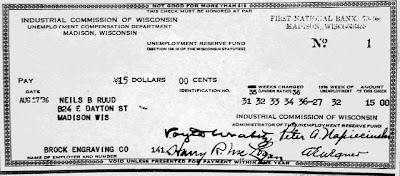
1936 – Wisconsin Issues First Unemployment Check

On this date the state of Wisconsin issued the first Unemployment Compensation Check in the United States for the amount of $15. The recipient was Neils N. Ruud who then sold it to Paul Raushenbush for $25 for its historical value. The check is now at the Wisconsin Historical Society. Wisconsin was the first state to establish an Unemployment Compensation program. [Source: Wisconsin Department of Workforce Development]

There’s something very American the re-sale of this check. Here’s a copy of it:


Whitewater Innovation Center’s Second Tenant: As Unsuitable as the First

I am one of the few people who bothers to read the Weekly Report of Whitewater, Wisconsin’s City Manager, Kevin Brunner. Read it I do, and in the August 13th edition, one sees this announcement about a second tenant for the under-construction Innovation Center:

Construction on Schedule for Whitewater Innovation Center; Another Tenant to Lease Space in Center
See Pictures.

Construction of the Whitewater Innovation Center, the first building in the Whitewater University Technology Park, is right on schedule with an anticipated completion date of January 1, 2011. All of the structural steel has been erected and interior walls are currently being installed. The exterior walls will be constructed soon with a projected early October total enclosure of the building planned.

Also, a second tenant in the building has been announced. The Jefferson Eastern Dane Interactive Network (JEDI), a distance learning/virtual classroom consortium that serves nine southern Wisconsin school districts will lease an 800 square foot module on the Innovation Center’s second floor. JEDI’s five employees, including JEDI Director Dr. Leslie Steinhaus, will be moving to the Center next February from their current offices in Milton.

This announcement is nearly beyond parody.

The second tenant for the center is, like the first, a publicly-funded educational tenant now located in Milton, Wisconsin. In fact, this “second tenant” now shares space in the same building as CESA 2, the Cooperative Educational Service Agency, the selected anchor tenant for the Center. That’s right — the larger school agency is moving, and so the tiny school agency — now located in the same building at 448 E. High Street, Milton, WI 53563 — is moving too.

They not only have a public source of funding in common, and the same address, they also have the same phone number (608-758-6232)!

Actually, the connection is closer still, as the JEDI Network’s own history page reveals:

JEDI is leased by the Wisconsin Department of Adminstration [sic] on behalf of the participating school districts and MATC. The DOA issued a competitive Request for Proposal (RFP) from a consortia of the region’s telephone and cable television providers. The basic technical requirements were defined and cost estimates prepared based upon the required features, engineering studies, and vendor consultation.CESA #2, as management agents for JEDI, made application to the Wisconsin State Trust Fund Loan program in order to obtain the necessary funding for the project.

Emphasis added. Here’s a link to a website screenshot.

This is hardly a second and independent tenant, by any reasonable definition. Calling this a true second tenant is laughable. There’s a shady, dodgy aspect to these descriptions that conceals the real and distorted nature of this project.

I have no doubt that CESA 2 does good work, but here’s their own description, from the CESA 2 webpage, to which I’ve linked:

….[CESA 2] help[s] school districts share staff, services and purchasing, and provide a link between local districts and the state. All services provided are determined by participating member school districts. Special education for disabled students is the service CESAs most commonly provide schools….

Here’s the JEDI description, from its website:

The Jefferson-Eastern Dane Interactive (JEDI) is a distance education network of the following school districts: Cambridge, Deerfield, Fort Atkinson, Jefferson, Lake Mills, Marshall, Palmyra, Parkview, Whitewater as well as
MATC and UW Whitewater

These are not private tech businesses, or new startups — they are publicly-funded entities moving to a new, multi-million dollar building, itself the result of taxpayer dollars and taxpayer debt (through bonds).

Brunner is well-past shameless in describing this as an “Innovation” Center and “Tech” Park. It’s closer to a public-sector employees’ remodeling effort. But it says much about how tone-deaf Brunner is, that he cannot see the ridiculousness of his own announcements.

(Funnier still is Brunner’s implication that mentioning Dr. Leslie Steinhaus — former administrator of our public school district — is somehow a positive contribution to his announcement. For more on Steinhaus, whose entire school district tenure was as an extended exercise in mediocrity — see, Dr. Steinhaus vs. Student: Student Wins!)

And yet, for it all, we surely have not heard the last embarrassment concerning this wasteful, shameless project.

Cato@Liberty – Paul Krugman on Carter and Reagan: Wrong Again

Over at Cato.org, Alan Reynolds shows how Paul Krugman’s turned out to be a sloppy, careless columnist. In assessing the tax policies of the 1970s and 80s, Krugman cherry picks his figures, and even gets the starting date of a recession wrong – by about a year. Krugman’s blog makes mistakes like this ever more frequently (recently about Paul Ryan’s Roadmap for America).

He’s a world-class economist who’s a mediocre columnist, mostly phoning his columns in. He calls his column “The Conscience of a Liberal,” but there are myriad liberal columnists and bloggers who write better, more accurate posts than Krugman.

See, Paul Krugman on Carter and Reagan: Wrong Again.

A Referendum for Whitewater, Wisconsin’s Schools

There’s a story at GazetteXtra.com about a November referendum for the Whitewater Unified School District. See, Whitewater schools seeking referendum.

I haven’t written much about our schools lately. There’s been talk about a referendum for months, but no commitment in the press until now. The Gazette reports that “the school board is expected to approve a resolution for a referendum that asks voters to allow the district to exceed state revenue caps by $620,000 each year for five years, from 2011-12 to 2015-16. The referendum will be on the ballot Tuesday, Nov. 2.”

(The district received voters’ approval in 2006 to exceed revenue caps by that same amount; this referendum would extend spending beyond the caps for another five years. There’s also a second possible referendum, about a bond issue.)
I’m not about to make a prediction on the chances for the referendum; this is a year of political volatility and uncertainty. I don’t know what voters will conclude.

One can say two things, however. The WUSD may need this money “desperately,” as District Administrator Dr. Suzanne Zentner contends. Nonetheless, the case for (or against) the referendum should (and will) rest on more than an adverb. It will require a detailed assessment of where the money goes now, and what would happen without it. What, precisely depends on the six-hundred thousand; what, precisely, would be lost without it? Would only one set of items be lost, or are alternative cuts possible?

These are fair questions, and they’re ones that proponents of the referendum — administrators, teachers, and politicians — should be prepared and happy to answer. I emphasize politicians, because, after all, members of the school board should be able to offer a detailed view on the referendum.

There’s a second thing one can, and should say: it’s unconvincing to suggest that the referendum carries no additional tax impact, since it’s a continuation of an existing tax burden. The WUSD’s Director of Business Services, Jim Strasburg, makes that contention:

Strasburg said the referendum – because it is a continuation of an original referendum and its related tax burden – carries no additional tax impact for district residents. “That money is already in the levy,” he said.

There may be a justification for the referendum’s passage; this is not it.

Director Strasburg is wrong in his analysis. The extension of an existing tax burden, set to expire, is an additional burden, and so has an additional (tax) impact. For that matter, the imposition of a tax or cost is a burden at each time and occasion it’s imposed. It’s impossible for it to be otherwise. All resources are allocated, all costs borne, in conditions of scarcity where one use precludes other possible uses.

This is no reason to support the extension of tax or spending proposals — that something has been a burden and obligation in the past does not justify continuing it. The presumption in a community should always be against taking privately earned money from those who earned it. It may be a rebuttable presumption, but it should be a presumption nonetheless. To suggest otherwise it to declare that current tax and spending policy is unalterable, except by way of increase.

My point isn’t that the referendum can’t be justified; it’s that nothing said so far does justify it, clearly and convincingly. It’s fair to wait, and see what officials and politicians say in greater detail.

On Whitewater’s “Innovation” Center, August 2010

There’s a story at the Janesville Gazette‘s website that offers a chance to consider yet again Whitewater’s Innovation Center. It’s a welcome opportunity. For the Gazette‘s story, see UW-Whitewater is a serious player in economic development.

First, an observation about the Innovation Center and Tech Park:

This is an eleven million dollar publicly-funded project, using federal tax dollars and bonds (in this case, public debt). The anchor tenant for the project isn’t a tech concern, or even a private concern: it’s CESA 2, the Cooperative Educational Service Agency.

CESA 2 is publicly-funded, and here’s what it does, from its own description:

For over 100 years, school districts in Wisconsin counties were serviced by county superintendents. As school district reorganization developed and school districts became larger, the role of the county superintendent changed substantially. The 1963 Legislature and various school organizations studied the pattern of Wisconsin school organization and concluded that the county superintendency should be replaced with Cooperative Educational Service Agencies.

The function of the Cooperative Educational Service Agencies is clearly defined in Section 116.01 of the State Statutes.

The organization of school districts in Wisconsin is such that the legislature recognizes the need for a service unit between the school district and the State Superintendent. The Cooperative Educational Service Agencies may provide leadership and coordination of services for school districts, including such programs as curriculum development assistance; school district management development; coordination of vocational education; and exceptional education, research, special student classes, human growth and development, data collection processing and dissemination, and in-service programs.

This anchor tenant is neither a tech concern, a business incubator, nor even a private business of any kind. I’m sure they do good work; it’s just not the right kind of work for a tech park.

These millions will help to transfer a taxpayer-funded entity now using conventional accommodations in Milton, Wisconsin to fancy digs in Whitewater, Wisconsin. (I know they’re fancy digs, because pictures of it, and descriptions of it, trumpet how amazing the building is, with — wait for it — a large lobby and reception area.)

Along the way, from the announcement of this project, I’ve posted on it.

Two more points are worth noting about the project.

First, the City of Whitewater has moved Heaven and earth to make this project happen, and in times when a focus might have been on local problems, there’s been a “let’s put on a show” push for all of this. The efforts, expenditures, and imprimatur of the City of Whitewater are conveying a dubious benefit the university. Yet, however misplaced, they are the City of Whitewater’s efforts.

It’s both ridiculous and funny to see for all his work, Whitewater City Manager Kevin Brunner doesn’t even show up in the story. It’s all UW-Whitewater and Chancellor Telfer now.

I’ve thought that Brunner might be pushing all this as a line item on his resume, but now I’m not sure if that would even be possible — perhaps he needs to ask Telfer for permission to mention the project.

One can be sure that this project is a huge effort for a small town with serious problems — problems that this wasteful “Innovation Center” will not solve.

(The speculation about what the Innovation Center will actually produce is simply nebulous, with ideas that it might help produce video games, or have something to do with Google, or be a business incubator. As for an incubator of private businesses, one could simply ask those in the building to look at the publicly-funded anchor tenant, and then do the opposite. As for video games — something once ludicrously suggested at a public meeting — one would hope that for all the money involved, we get something on the order of another Halo. Sadly, it’s looking more and more like the best we could hope is Raving Rabbids, if that.)

Second, it’s telling that UW-Whitewater seems to treat this as one project. The recent $5.9 million federal taxpayer grant is lumped with the Innovation Center’s funding, the Innovation Center being the recipient of a separate taxpayer grant and separate bond (debt) issue. These are not one project, but two. Yet, they’re lumped together as one.

One supposes that it’s all meant to show how they’re complementary to each other, the millions for the Innovation Center and the millions for the job-training program. And yet, the tighter the link to a university program, the more questions it raises about the City of Whitewater’s entry, obligations, and ongoing involvement in the Innovation Center project.

That’s a topic for another day.

Daily Bread for Whitewater, Wisconsin: 8-16-10

Good morning,

Whitewater’s forecast calls for a sunny day with a high temperature of eighty-one degrees.

The Wisconsin Historical Society recalls that on this day in 1900, Wisconsin saw an auto race in Racine:

On this date the city of Racine hosted its first automobile race. The competitors were A. J. Horlick in a Locomobile and Robert W. Hindley in a Winton. The race started at 11 a.m. in front of the Grand Union Tea Co. store on Main St. The course was over the 14 unpaved miles to Western Union Junction (Sturtevant) and back. About a mile outside town Mr. Hindley overtook a stalled Mr. Horlick who up to that point had been ahead. Horlick was able to continue the race, but it was Hindley who was declared the winner. [Source: Racine History Timeline]

More information about the manufacturers of the competing automobile companies is available online. The Winton Motor Carriage Company continued production until 1924, and the Locomobile Company of America produced cars until 1929.

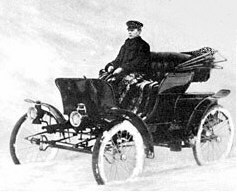
I don’t know which models raced in Racine in 1900, but here’s an 1899 Winton Stanhope:


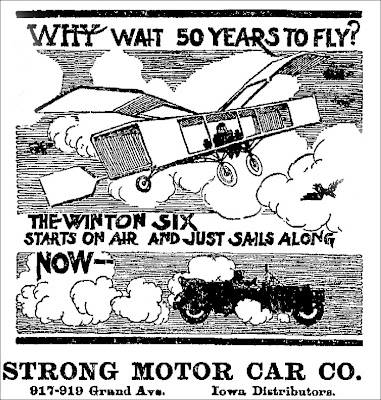
The Winton Motor Carriage Company had, in 1910, advertising for its cars that was optimistic even to this day: