
Adele tries to make a James Bond theme as memorable as they once were for an earlier generation.
Monthly Archives: October 2012
Daily Bread
Daily Bread for 10.15.12
by JOHN ADAMS •
Good morning.
Monday in Whitewater will be sunny, with a high of fifty-six.
In an astonishing feat over Roswell, New Mexico, Felix Baumgartner accomplished his long-standing goal of the highest (128,000 feet) and fastest (supersonic!) successful free-fall in history. Baumgarther. For those who watched it live, either on television or the Web, it was a captivating, nerve-wracking, genuinely amazing sight. HEre are highlights of Felix’s jump:
Luke Dittrich, who spent time with Felix’s team in 2010, writes about why this matters:
Fifty television channels covered the jump live, seven-million people watched it stream online, and @redbullstratos has 235,000 followers and counting. But beyond the dazzle, beyond the slickness and the spectacle, is Felix’s achievement really that important?
It is. He’s demonstrated that human beings can safely fall further, and faster, than was previously known to be possible. This has real applications in the development of the emergency systems that will be essential for the advancement of manned spaceflight. For humans to finally reach further afield, for us to break our current forty-year-long holding pattern, we’ll need to make giant leaps in both rocket and safety technology. Dr. Jonathan Clark, one of the members of the team that made Felix’s feat possible, lost his wife, the astronaut Laurel Clark, when the space shuttle Columbia broke up at an altitude very close to the altitude from which Felix jumped. The lessons learned on Sunday might help us avoid similar catastrophes in the future.
Beyond that, there’s something refreshing about the idea that millions of people spent at least a few minutes marveling at the old-fashioned exploits of a brave man in a spacesuit. The current doldrums of our national space program have nothing to do with a lack of interest on the part of the public. We’re still fascinated. We still yearn to go up, higher and higher.
Truly admirable.
Recent Tweets, 10.7 to 10.13
by JOHN ADAMS •
http://storify.com/DailyAdams/recent-tweets-10-7-to-10-13-14
Cartoons & Comics
Sunday Morning Cartoon: Mickey Mouse in 1929’s Haunted House
by JOHN ADAMS •
Daily Bread
Daily Bread for 10.14.12
by JOHN ADAMS •
Good morning.
Sunday brings a day of heavy rain to Whitewater, with a high of sixty-three falling into the upper forties by the late afternoon.
On this day in 1947, Chuck Yeager broke the sound barrier:
For years, many aviators believed that man was not meant to fly faster than the speed of sound, theorizing that transonic drag rise would tear any aircraft apart. All that changed on October 14, 1947, when Yeager flew the X-1 over Rogers Dry Lake in Southern California. The X-1 was lifted to an altitude of 25,000 feet by a B-29 aircraft and then released through the bomb bay, rocketing to 40,000 feet and exceeding 662 miles per hour (the sound barrier at that altitude). The rocket plane, nicknamed “Glamorous Glennis,” was designed with thin, unswept wings and a streamlined fuselage modeled after a .50-caliber bullet.
Because of the secrecy of the project, Bell and Yeager’s achievement was not announced until June 1948. Yeager continued to serve as a test pilot, and in 1953 he flew 1,650 miles per hour in an X-1A rocket plane. He retired from the U.S. Air Force in 1975 with the rank of brigadier general.
On this day in Wisconsin History, in 1912, Theodore Roosevelt was shot in Milwaukee:
….Roosevelt was in Wisconsin stumping as the presidential candidate of the new, independent Progressive Party, which had split from the Republican Party earlier that year. Roosevelt already had served two terms as chief executive (1901-1909), but was seeking the office again as the champion of progressive reform. Unbeknownst to Roosevelt, a New York bartender named John Schrank had been stalking him for three weeks through eight states. As Roosevelt left Milwaukee’s Hotel Gilpatrick for a speaking engagement at the Milwaukee Auditorium and stood waving to the gathered crowd, Schrank fired a .38-caliber revolver that he had hidden in his coat.
Roosevelt was hit in the right side of the chest and the bullet lodged in his chest wall. Seeing the blood on his shirt, vest, and coat, his aides pleaded with him to seek medical help, but Roosevelt trivialized the wound and insisted on keeping his commitment. His life was probably saved by the speech, since the contents of his coat pocket — his metal spectacle case and the thick, folded manuscript of his talk — had absorbed much of the force of the bullet. Throughout the evening he made light of the wound, declaring at one point, “It takes more than one bullet to kill a Bull Moose,” but the candidate spend the next week in the hospital and carried the bullet inside him the rest of his life.
Schrank, the would-be assassin, was examined by psychiatrists, who recommended that he be committed to an asylum. A judge concurred and Schrank spent the remainder of his life incarcerated, first at the Northern Hospital for the Insane in Oshkosh, then at Central State Hospital for the criminally insane at the state prison at Waupun. The glass Roosevelt drank from on stage that night was acquired by the Wisconsin Historical Museum. You can read more about the assassination attempt on their Museum Object of Week pages.
Daily Bread
Daily Bread for 10.13.12
by JOHN ADAMS •
Good morning.
Saturday brings showers and thundershowers to Whitewater, with a high of sixty-five, and between three-quarters to one inch of rainfall.
On this day in 1943, Italy abandoned the Axis, and declared war on Nazi Germany, in a succinct declaration: “In the face of repeated and intensified acts of war committed against Italians by the armed forces of Germany, from 1500 hours Greenwich time on the thirteenth day of October Italy considers herself in a state of war with Germany.”
Ever wonder what happens when one cracks an egg underwater? Wonder no more:
From Google’s daily puzzle, a question about Russian politics: “Immediately following his abdication in 1917, the last czar of Russia sought exile for his family and himself. Who was the ruler of the country that denied the czar’s request?” more >>
Presidential race 2012
The Biden-Ryan Vice Presidential Debate
by JOHN ADAMS •
For those who didn’t get a chance to see the vice-presidential debate live, here’s the entire debate on YouTube.
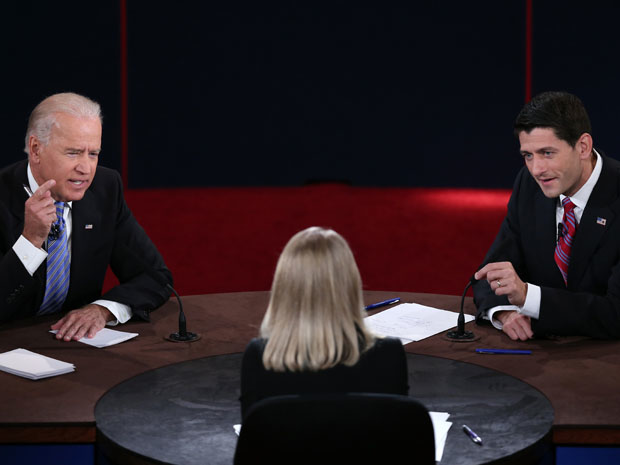
Two candidates and one moderator, all around a simple table:
Posted also at Daily Adams.
City
The Old Guard Can’t See the Trees for the Forest
by JOHN ADAMS •
One often hears that a person, seeing only parts but not the whole, cannot see the forest for the trees. With Whitewater’s old guard, something like the opposite is true: they can’t see the trees for their (odd) view of the forest.
There’s a reason for this: beyond the many thousands of capable and productive residents of Whitewater, there are a few hundred striving social climbers whose bottomless need for recognition impels them to look only to the biggest institutions of the city for approval.
One will often hear them say, for example, that Whitewater is simply the sum of its university, school district, and city government.
All three are important, but the old guard only sees these three institutions in a narrow way: as the leaders at the top of each, with whom they can ingratiate themselves and advance their own social status. That each of these institution exists only as the sum of hundreds of people – individuals all – matters less to them than the supposed prestige derived from being among their leaders’ social circle.
It’s a new man’s idea of being involved, by consorting only with people of influence, community leaders, or dignitaries (their occasional term, not mine).
They’ve almost no feel for the many hundreds or thousands who are part of these organizations, let alone still more who are residents of the city engaged in daily productive work unconnected with our schools, campus, or city government.
It’s as though someone believed that he could understand the zoology of the African savannah simply by studying a few adult, male lions.
There are some very smart leaders within each of these institutions who don’t share the old guard’s view, but there’s no one in the old guard who doesn’t seek to ingratiate himself or herself with anyone of prominence in one of these organizations.
I’ve sometimes been asked why I don’t commonly use the term ‘townies’ rather than ‘town squires,’ ‘town fathers,’ or ‘old guard.’ It’s because the first term, ‘townies,’ is nothing like the others. The thousands of average people born in the city (a ‘townie,’ I suppose) are far more capable than the few hundred I’m thinking of as ‘town squires,’ town fathers,’ or ‘old guard.’ They’re not the same groups – one is large and productive, the other is smaller, less capable, and industrious mostly in mutual admiration and social climbing.
Our small group of town squires talks almost exclusively among its own numbers (having no feel or taste for ordinary residents), and so typically misunderstands the greater community. That’s why they seem so tone-deaf, so reactionary, to anyone beyond that few hundred. They don’t see this, though, because they principally communicate among their own, and are the victims of a sad, severe selection bias. They often bolster their own most ridiculous views.
They’ve been this way for so long, they can’t even imagine other points of view.
It’s autumn in the city, but also a different, inescapable autumn for the old guard. They’re not yet finished in this town, but they’ve no demographic future, either.
A more cosmopolitan outlook, whether of the right or left, will replace their imperceptive view.
Cats
Friday Catblogging: Siamese Cats from Cats 101
by JOHN ADAMS •
Poll
Friday Poll: Which Debate Format Do You Prefer: Standing at Lectern or Seated at Table?
by JOHN ADAMS •
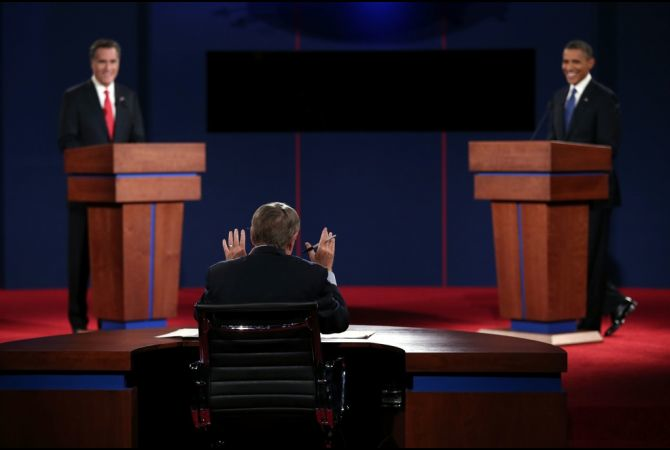
We’ve had two debates this fall, in the presidential race, of different formats: a presidential race debate with the candidates standing at a lecterns, and a vice-presidential debate last night with the candidates seated at a table. This difference in the style of the presidential and vice-presidential debates has been followed since 2000.
Correction, 5:29 PM: the vice presidential candidates in 2008 stood while debating, but in 2000 and 2004 were seated at a table.
Which format, if either, do you prefer?
I like the candidates seated at a table – it’s less formal, but I think it also makes for a more interesting discussion and clash of views.
What do you think?
Daily Bread
Daily Bread for 10.12.12
by JOHN ADAMS •
Good morning.
Whitewater’s week ends with a sunny day and a high of fifty-one.
On this day in 1492, Columbus reached the New World:
On August 3, 1492, Columbus set sail from Palos, Spain, with three small ships, the Santa Maria, the Pinta, and the Nina. On October 12, the expedition reached land, probably Watling Island in the Bahamas. Later that month, Columbus sighted Cuba, which he thought was mainland China, and in December the expedition landed on Hispaniola, which Columbus thought might be Japan. He established a small colony there with 39 of his men. The explorer returned to Spain with gold, spices, and “Indian” captives in March 1493 and was received with the highest honors by the Spanish court. He was the first European to explore the Americas since the Vikings set up colonies in Greenland and Newfoundland in the 10th century.
On this day in 1782, Wisconsin’s Territorial Governor Henry Dodge was born:
On this date Territorial Governor Henry Dodge was born in Vincennes, Indiana. The son of Israel Dodge and Nancy Hunter, Henry Dodge was the first Territorial Governor of Wisconsin. Prior to this position, he served as Marshall and Brigadier General of the Missouri Territory, Chief Justice of the Iowa County (Wisconsin) Court. During the Black Hawk War of 1832 he led the Wisconsin militia who ultimately brought the conflict to its tragic end. He served as Territorial Governor from July 3, 1836 to October 5, 1841 and again from May 13, 1845 to June 7, 1848. He also served as U.S. Territorial Senator from 1841 to 1846. When Wisconsin was admitted to the Union as a State, dodge was elected as a Democrat to the United States Senate; he was reelected in 1851 and served from June 8, 1848, to March 3, 1857. He was also twice nominated for President and once for Vice President, all of which he declined. Henry Dodge died on June 19, 1867 in Burlington, Iowa.
From the GoComic’s TrivQuiz for 10.12.12, here’s a question about actors playing comic book characters: “Which character from the comics pages was played onscreen by (A) Buster Crabbe and Sam J. Jones, (B) Johnnie Weismuller, Ron Ely, and Casper Van Dien, and (C) Christopher Reeve and Dean Cain?”
Nature
The October Sky: Blazing Venus, Andromeda, and Orionid Meteors
by JOHN ADAMS •
Human Nature, Law
The True Measure of Institutional Greatness
by JOHN ADAMS •
Most communities – even small ones — have a few larger institutions, and Whitewater is no exception.
The measure of those institutions is not how they protect their leaders’ reputations, but how they support and nurture the many individuals, separate and distinct, of which they are formed. This is true even when those individuals meet with misfortune.
Corrupt or selfish institutions will cast aside a few, supposedly for a greater community good. Every institution confronts this temptation, and deficient ones succumb to it: Do the financial and reputational needs of leaders, expressed manipulatively as a concern for all, justify the sacrifice of a few ordinary individuals?
Most church scandals, and workplace or educational cases of abuse, begin with this impulse. It’s a kind of utilitarianism – an act utilitarianism – that attempts to justify whatever is done in the name of an imagined aggregate community benefit. Act utilitarians have no normative rules: anything can go into the hopper, so long as there’s a claimed net gain.
That’s immoral, of course: there’s a reason that we wouldn’t sacrifice people to make it rain even if those sacrifices would work.
It’s the individual, not the institutional, that matters.
The late William Safire, a truly great man, felt the legitimate subjects of criticism were those in authority, those who held elected & appointed office or positions in the press. He often said that one should be most critical at the height of an official’s power, which he expressed as criticizing officials ‘when they were up.’ It would never have occurred to him to malign an ordinary person for an imagined social gain.
He would never have accepted an act utilitarian’s calculus.
And yet – and yet — every community has a few people who are, at bottom, act utilitarians.