
FREE WHITEWATER

Monthly Archives: May 2013

Daily Bread for 5.5.13

Beautiful Sunday weather is ahead for Whitewater. We’ll have partly sunny skies, a high of seventy-two, and light winds at five to ten miles per hour.

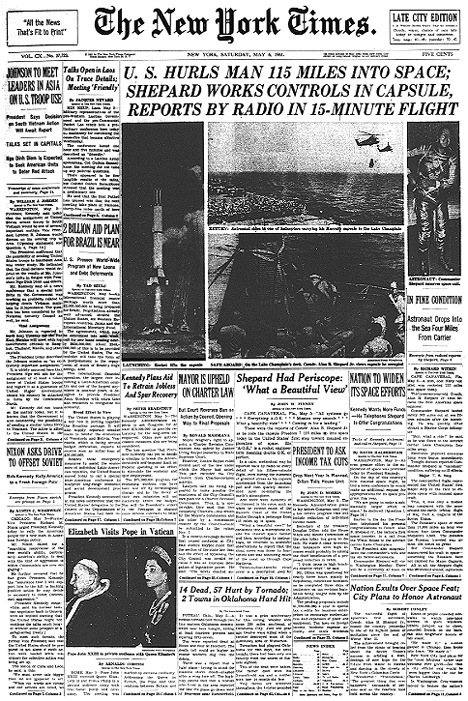
On this day in 1961, “astronaut Alan B. Shepard Jr. became America’s first space traveler as he made a 15-minute suborbital flight in a capsule launched from Cape Canaveral, Fla.”

20130505-082853.jpg

Shepard wasn’t the first man in space, but Americans yet had reason to be proud of his accomplishment.

On 5.5.1862, Wisconsin soldiers fought in Virginia:

1862 – (Civil War) Battle of Williamsburg, Virginia

The Battle of Williamsburg was a key engagement in the Peninsular Campaign that began on March 17, 1862. The 5th Wisconsin Infantry and Company G of the 1st U.S. Sharpshooters participated in this battle. Outnumbered Confederate forces held off the Union advance long enough for the bulk of the Confederate army to continue its withdrawal toward the capital at Richmond.

Google’s daily question isn’t just about art, but an art collector: “In 1861, Louis-Napoléon Bonaparte bought 11,835 artworks for the Louvre, including 641 paintings from what Italian art collector?”

Daily Bread for 5.4.13

Good morning.

A Saturday of isolated, afternoon thunderstorms and a high of sixty-nine awaits. Whitewater will enjoy 14h 13m of sunlight, 15h 16m of daylight, with a waning crescent moon.

On this day in 1927, Academy of Motion Picture Arts and Sciences was founded. At the Academy’s website, among so many other offerings, there’s an interesting interview with special effects designer Douglas Trumball, on the Science of Movies. Trumbull talks about creating believable effects through the use of miniatures, his film “Silent Running,” and plans for future filmmaking.

On this day in 1864, Wisconsin soldiers take part in the Wilderness Campaign:

1864 – (Civil War) Wilderness Campaign opens in Virginia
Union forces crossed the Rapidan River in Virginia and prepared to fight at the Wilderness the next day. The resulting series of battles between May 5 and June 12, 1864, is called the Wilderness Campaign, or Grant’s Overland Campaign.

The 2nd, 5th, 6th, 7th, 19th, 36th and 38th Wisconsin Infantry regiments and the 4th Wisconsin Light Artillery participated in this series of bloody battles. The initial Battle of the Wilderness on May 5-7, 1864, produced nearly 30,000 casualties without giving either side a clear victory.

Google poses a question about French design: “Of what type of architecture is the Paris Cathedral that in 1970 was the site of Charles de Gaulle’s funeral?”

Friday Poll: Is Hockey Too Violent?

Yesterday, in the NHL playoffs, Eric Gryba hit Lars Eller, leaving him bleeding on the ice:

Montreal Canadiens center Lars Eller was taken off the ice on a stretcher after being leveled by a hit from Ottawa Senators defenceman Eric Gryba on Thursday night.

With 6:37 remaining in the second period of Game 1 of the first round Eastern Conference playoff series between the Canadiens and Senators, Eller was looking back to receive a pass from teammate Raphael Diaz when Gryba delivered a high, hard hit. Eller dropped to the ice near the Canadiens’ blue line and lay motionless as blood pooled beneath his face. According to NHL.com, Canadiens medical personnel prevented Eller from getting up. He was taken off the ice on a stretcher. Gryba was hit with a major penalty for interference and a game misconduct.

The story’s graphic, of couse, as is video of the incident:

So, is hockey too violent? I’ll say no – both fans and officials react against Gryba’s conduct – he’s both booed from the crowd and penalized for the hit. There’s a fan and official rejection of Eric Gryba that speaks well of the sport.

What do you think?


Daily Bread for 5.3.13

Good morning.

It will be a rainy day with a high of fifty-one for Whitewater.

It’s Machiavelli’s birthday:

On this day in 1469, the Italian philosopher and writer Niccolo Machiavelli is born. A lifelong patriot and diehard proponent of a unified Italy, Machiavelli became one of the fathers of modern political theory….

Machiavelli’s political life took a downward turn after 1512, when he fell out of favor with the powerful Medici family. He was accused of conspiracy, imprisoned, tortured and temporarily exiled. It was an attempt to regain a political post and the Medici family’s good favor that Machiavelli penned The Prince, which was to become his most well-known work.

Though released in book form posthumously in 1532, The Prince was first published as a pamphlet in 1513. In it, Machiavelli outlined his vision of an ideal leader: an amoral, calculating tyrant for whom the end justifies the means. The Prince not only failed to win the Medici family’s favor, it also alienated him from the Florentine people. Machiavelli was never truly welcomed back into politics, and when the Florentine Republic was reestablished in 1527, Machiavelli was an object of great suspicion. He died later that year, embittered and shut out from the Florentine society to which he had devoted his life.

Though Machiavelli has long been associated with the practice of diabolical expediency in the realm of politics that was made famous in The Prince, his actual views were not so extreme. In fact, in such longer and more detailed writings asDiscourses on the First Ten Books of Livy (1517) and History of Florence (1525), he shows himself to be a more principled political moralist. Still, even today, the term “Machiavellian” is used to describe an action undertaken for gain without regard for right or wrong.

In Wisconsin history, Golda Meier is born on this date in 1898:

1898 – Golda Meir Born
On this date, Golda Meir (nee Mabovitch) was born in Kiev, Russia. Economic hardship forced her family to emigrate to the United States in 1906, where they settled in Milwaukee. She graduated from the Milwaukee Normal School (now University of Wisconsin-Milwaukee) and joined the Poalei Zion, the Milwaukee Labor Zionist Party, in 1915.

In 1921, she emigrated to Palestine with her husband, Morris Myerson, where they worked for the establishment of the State of Israel. Meir served as Israel’s Minister of Labor and National Insurance from 1949 through 1956 and as the Foreign Minister until January of 1966. When Israeli Prime Minister Levi Eshkol died suddenly in 1969, Meir assumed the post, becoming the world’s third female Prime Minister. She died in Jerusalem on December 8, 1978. [Source: Picturing Golda Meier]

Google-a-Day asks about a treaty: “What treaty was responsible for the creation of the intergovernmental organization that would eventually be replaced by the UN?”

Kinds of Chocolates

Reader Karl Marx mentioned a liking for chocolate, and cartoonist Mark Anderson has a cartoon with the some of the many flavors of that treat. (He’s inexplicably omitted sweet and contented.)

6609

Daily Bread for 5.2.13

Good morning.

Thursday in Whitewater will be a bit cooler, and a bit wetter (perhaps), than yesterday: a high of fifty-nine and a one-third chance for showers.

The Landmarks Commission meets at this evening at 6 PM.

On this day in 1941, a breakfast offering is born: “General Mills began shipping a new cereal called “Cheerioats” to six test markets. (The cereal was later renamed ‘Cheerios.’)” Cheerios billed itself as the world’s first “ready-to-eat oat cereal.”

20130502-063449.jpg

Google-a-Day poses a question about pop culture: “Which playwright’s work inspired the 2011 film directed by the actor who played Count Laszio de Almásy in 1996?”

Restaurant Review: The Black Sheep

20130501-115313.jpg

I wrote two weeks ago that I’d review two restaurants in succession, and Chef Tyler Sailsbery’s Black Sheep, at 210 W. Whitewater Street along Cravath Lake, is the promised second of those two reviews.

And yet, it’s odd to write about Whitewater’s Black Sheep as the second of a series – it’s a fine establishment on its own. There never has been (and never will be) a perfect restaurant, but the Black Sheep is a strong addition to area dining.

The restaurant offers a New American cuisine, with with an emphasis on fresh, local ingredients. There’s a nationwide trend toward upscale restaurants of this type, and part of Chef Sailsbery’s accomplishment is embracing this trend for Whitewater.

Alice Waters, the author of the Art of Simple Food, derived from experiences at her Berkeley restaurant on Shattuck Avenue, would find much she’d appreciate at the Black Sheep. She calls her own recipes the ammunition of a delicious revolution, but it’s more informative to say that it’s a new, lighter, more organically-sourced American cuisine.

There’s an entire publishing industry for – and a bit against – Waters’s ideas, but I’ll declare my allegiance, and say that I’ve enjoyed many of her recipes.

For a smaller restaurant, the Black Sheep has a comprehensive menu. Although that might signal problems elsewhere, I found every dish I tried to be well-prepared; Sailsbery’s menu exhibits overall strength.

Lunch affords choices of about five salads, three soups, a few appetizers, and about ten principal choices. Patrons will find real enjoyment in the mushroom bisque, properly light and subtle. There’s none like it in the city, and that’s too bad: this is a bisque as it should be. It’s more than a shame that so many offerings in restaurants are heavy, thick, almost leaden.

The Black Sheep avoids this — successful New American cooking rests on dishes that are light, relatively simple, and never overpowering. One should taste the combination of ingredients, rather than only one over others.

Those having lunch will enjoy the salmon cakes, with chipotle aioli and sautéed spinach.

The dinner menu presents ten principal dishes, about four more of pasta, and two weekly specials (beef short ribs or lamb shank during my visits).

On one visit I chose the lamb ravioli, and the suggested pairing with Bell’s Two Hearted Ale was sound.

You know, that the suggested pairings include a Merlot (Velvet Devil Merlot) is an encouraging sign. Merlot’s taken quite the hit, in film and popular opinion thereafter, and Sailsbery’s suggestion shows a thoughtful assessment rather than an acceptance of a passing bias.

One enters the Black Sheep on Whitewater Street, to find two principal rooms: an entranceway with small dining room and full bar to the left, and a second dining room to the right. They’re not independent spaces: it’s simply the configuration of the building, one that formerly housed a meat market. The division of the space works very well, with the bar separate from the larger dining area.

One quick note – this is fine, but not formal, dining. I rather like that, but the atmosphere is more casual than some might expect. Seating includes couch and cushions along one row of tables, and to my mind that’s all to the good.

There are – in any place – a few gaps. On one visit I noticed that the menus had seen one to many presentations, and I’d switch the tablecloths for something just a bit more textured that wouldn’t need pressing.

One hears so much about what it means to aspire, to be aspirational. It does mean something, but nothing matters more for a restaurant than what patrons truly experience – the table is set only for them, and only their impressions truly matter.

The Black Sheep aspires to offer fine dining for Whitewater, but the strength of Sailsbery’s offering is not simply an aspiration, but rather an accomplishment.

Easily recommended – equally suitable for an enjoyable evening with one’s spouse, friends, or colleagues.

LOCATION: 210 W. Whitewater Street, Whitewater, WI 53190 (262) 458-4751.

OPEN: Mon to Sat, 11 AM – 10 PM — there’s much to be said for simple, regular hours like these, that patrons will easily remember.

PRICES: Main dish and a glass of wine for about $20-25.

RESERVATIONS: Accepted.

DRINKS: Good election of Whites and Reds. Wollersheim’s Prairie Fumé will not disappoint.

SOUND: Moderate, but one can hear one’s companions easily.

SERVICE: Relaxed, attentive, conversational, and friendly. I found a light, welcome playfulness in the waiters and waitresses I met during my visits.

VISITS: Three (one lunch, two dinners).

RATING: Recommended — 3.75 of 4.

20130501-121823.jpg20130501-121823.jpg20130501-121823.jpg20130501-115411.jpg

RATING SCALE: From one to four stars, representing the full experience of food, atmosphere, service, and pricing.

INDEPENDENCE: This review is delivered without financial or other connection to the establishment or its owner. The dining experience was that of an ordinary patron, without notice to the staff or requests for special consideration.

Daily Bread for 5.1.13

Good morning.

A new month begins with mostly sunny skies, a high of 81, and southwest winds at 5 to 10 mph. We’ll have 14h 6m of sunlight, 15h 8m of daylight, and a waning gibbous moon. There will be two minutes more light tomorrow.

Tonight at 5:30 and again at 6:30, in Hyland Hall Room 3101, there will be training sessions for business people on a Digital Mapping Project: the sessions will present tips on marketing a business in an environment of digital communication. For more information, see Wednesday, May 1st: The Digital Whitewater Mapping Project.


The Empire State Building from Paul Sellen on Vimeo.

It’s the anniversary of the Empire State Building’s dedication ceremony:

On this day in 1931, President Herbert Hoover officially dedicates New York City’s Empire State Building, pressing a button from the White House that turns on the building’s lights. Hoover’s gesture, of course, was symbolic; while the president remained in Washington, D.C., someone else flicked the switches in New York.

The idea for the Empire State Building is said to have been born of a competition between Walter Chrysler of the Chrysler Corporation and John Jakob Raskob of General Motors, to see who could erect the taller building. Chrysler had already begun work on the famous Chrysler Building, the gleaming 1,046-foot skyscraper in midtown Manhattan. Not to be bested, Raskob assembled a group of well-known investors, including former New York Governor Alfred E. Smith. The group chose the architecture firm Shreve, Lamb and Harmon Associates to design the building. The Art-Deco plans, said to have been based in large part on the look of a pencil, were also builder-friendly: The entire building went up in just over a year, under budget (at $40 million) and well ahead of schedule. During certain periods of building, the frame grew an astonishing four-and-a-half stories a week.

At the time of its completion, the Empire State Building, at 102 stories and 1,250 feet high (1,454 feet to the top of the lightning rod), was the world’s tallest skyscraper. The Depression-era construction employed as many as 3,400 workers on any single day, most of whom received an excellent pay rate, especially given the economic conditions of the time. The new building imbued New York City with a deep sense of pride, desperately needed in the depths of the Great Depression, when many city residents were unemployed and prospects looked bleak. The grip of the Depression on New York’s economy was still evident a year later, however, when only 25 percent of the Empire State’s offices had been rented….

Google has a question about a mountain in Europe: “What mountain in Switzerland includes three types of glacial erosion, and resembles an ancient Egyptian structure with four specific sides?”