
Gail Albert Halaban – Paris Views from Boaz Halaban on Vimeo.
Insults:
How they think of their customers: Walmart's "fat girl" Halloween costume section causes uproar http://t.co/s3WZgOljMM
— John Adams (@DailyAdams) October 27, 2014
Gail Albert Halaban – Paris Views from Boaz Halaban on Vimeo.
Insults:
How they think of their customers: Walmart's "fat girl" Halloween costume section causes uproar http://t.co/s3WZgOljMM
— John Adams (@DailyAdams) October 27, 2014
Good morning, Whitewater.
Tuesday in Whitewater will be partly cloudy with a high of fifty-four.
Common Council meets tonight at 6:30 PM.
It’s Jonas Salk‘s birthday, and Google commemorates that day with a doodle:

On this day in 1919, the House of Representatives passes the Volstead Act:
While the Eighteenth Amendment to the United States Constitution prohibited the production, sale, and transport of “intoxicating liquors”, it did not define “intoxicating liquors” or provide penalties. It granted both the federal government and the states the power to enforce the ban by “appropriate legislation.” A bill to do so was introduced in Congress in 1919. Later this act was repealed by the Twenty-first amendment.
The bill was vetoed by President Woodrow Wilson, largely on technical grounds because it also covered wartime prohibition, but his veto was overridden by the House on the same day, October 28, 1919, and by the Senate one day later.[9] The three distinct purposes of the Act were:
to prohibit intoxicating beverages,
to regulate the manufacture, sale, or transport of intoxicating liquor (but not consumption), and
to ensure an ample supply of alcohol and promote its use in scientific research and in the development of fuel, dye and other lawful industries and practices, such as religious rituals.[10] It provided further that “no person shall manufacture, sell, barter, transport, import, export, deliver, or furnish any intoxicating liquor except as authorized by this act.” It did not specifically prohibit the use of intoxicating liquors. The act defined intoxicating liquor as any beverage containing more than 0.5% alcohol by volume and superseded all existing prohibition laws in effect in states that had such legislation.
On this day in 1892, a fire leaves thousands homeless:
1892 – Disastrous Fire in Milwaukee’s Third Ward
On this date an exploding oil barrel started a small fire in Milwaukee. It spread rapidly and by morning four people had died, 440 buildings were destroyed, and more than 1,900 people in the Irish neighborhood were left homeless. It was the most disastrous fire in Milwaukee’s history.[Source: Historic Third Ward]
Google-a-Day asks a sports question:
What year was the term that refers to the four-year period between Olympic Games first used?
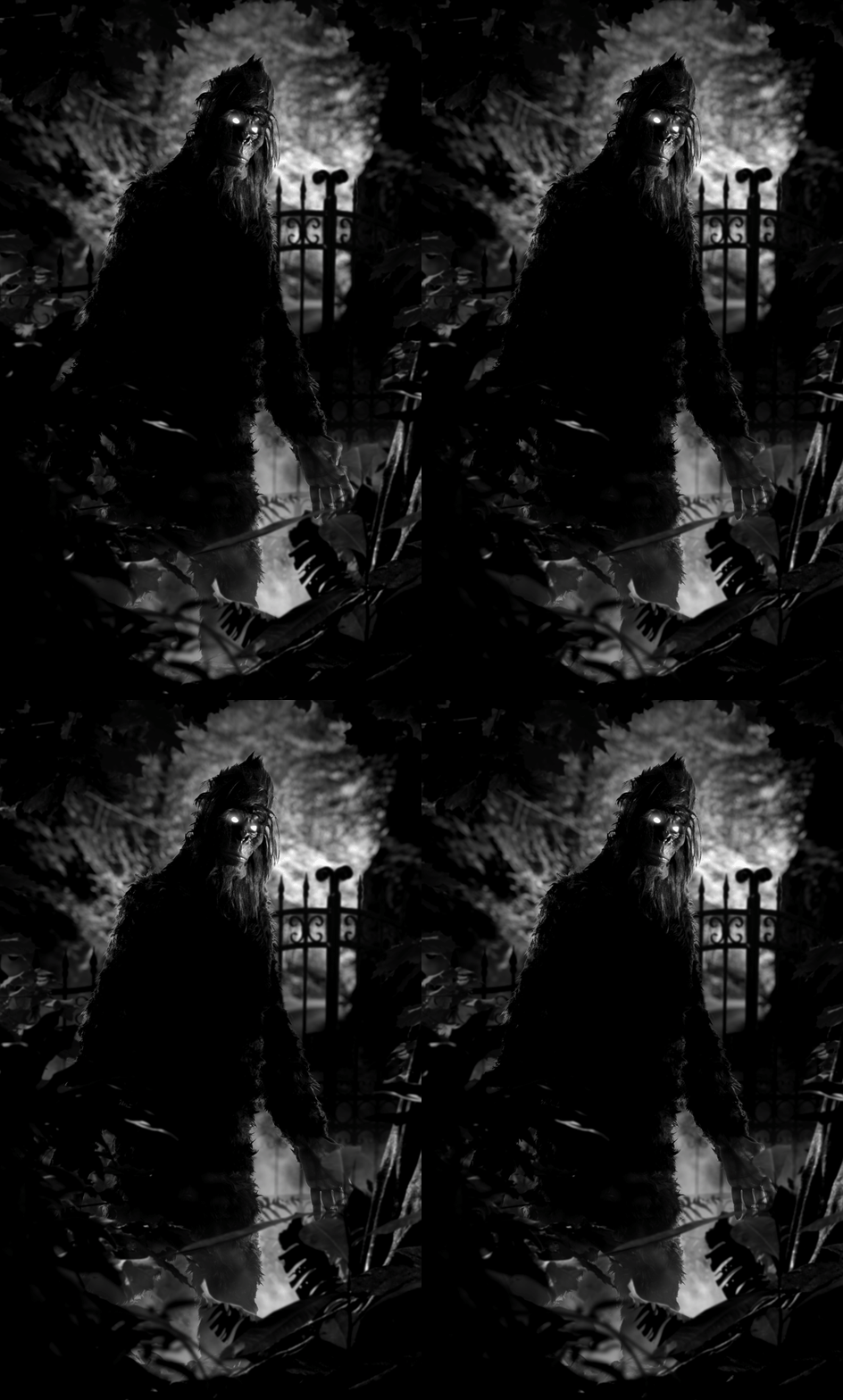
For today’s Halloween animation, let’s go with Bigfoot:
In debating, clash is neither a hostile encounter nor an English punk group.
Anyone who was ever a high-school or college debater knows that debaters define clash between two sides as adversaries’ discussion of the same claims or topics, simply from opposing points of view.
That means clash is a good thing: both sides are talking about tax legislation from 1987, for example, but with conflicting views about whether the legislation was beneficial.
If one person’s talking about tax legislation from 1987, but the other side is talking about foreign policy from that year, there may be no clash at all – the sides aren’t even debating a common topic. It’s all about 1987, but that’s so broad a subject there’s no clash, no point of dispute worth hearing.
Debate judges want to hear clash.
In political debates, it’s desirable, too: candidates who differ should engage each other on those differences.
Now go one step farther, and think about elections: it’s usually not enough simply to turn out one’s base – there will be some undecided voters and even opposing voters a candidate might win over.
The key to success may depend on going where those undecided and opposing voters are, and trying to persuade some of them.
If one finds those voters, one might have to brook a bit of clash – of a congenial discussion with a resident where there’s a difference over a topic.
Most campaigns need to go where there might be some clash in the discussion, and then handle that clash with sangfroid.
That’s why speaking to sympathetic gatherings of a few may be less valuable than speaking to large gatherings of the skeptical or opposed.
Wisconsin’s not been a state where residents have had much taste for clash as debating defines it. Today, there’s probably less clash, and more reliance on a sympathetic audience, than ever before.
That’s too bad: clash in debate sharpens, elevates, and so improves, our public life.
We’ve eight days until this gubernatorial election, and it’s been quite the battle.
However happy or sad you’ve been with ’14, here’s one thing you likely won’t notice in ’18: newspapers’ political endorsements.
That’s because print newspapers either won’t be around by ’18, they won’t be making endorsements by ’18, or their few remaining readers won’t be looking at those papers for more than inserts and sports coverage.
Of the two big papers in the state, the Journal Sentinel no longer endorses, but the State Journal still does.
After the ’12 recall election, the JS abandoned endorsements, disingenuously contending that they thought endorsements were less helpful than simply writing about particularly policies. They may be less helpful, but that’s not why the paper abandoned them, as just about anyone connected with the paper will admit in conversation: reader ire at unpopular endorsements is too hard for a financially fragile enterprise to bear.
(Now that Journal Communications will be a newspaper-only group, and their broadcast television and radio stations will go with Scripps, they’ll be even more vulnerable. The papers proudly announced that on the day they are split off they will be leaving debt-free. Their first day of independence will be the only day that newspaper group is ever again debt-free. )
The State Journal still makes endorsements, but one can guess that each and every endorsement weights on Lee’s finance team.
Only a few years ago, either paper would have made endorsements freely, whether popular or unpopular with readers, and still have been confident of ongoing readership. If there’s any paper in America that sanguine today (except perhaps the Wall Street Journal), then I’m not familiar with it.
Closer to home, local dailies face the same problem, but they probably have even less chance of survival as dailies than does the JS. (What they do about endorsements won’t change their fate: a man falling from a thousand-foot cliff wouldn’t appreciably worsen his prospects by smoking a cigarette on the way down.)
Have 2014 newspaper endorsements been irritating for you? Cheer up: you’ll have one less thing about which to worry the next time around.
Good morning, Whitewater.
Our week in town begins with partly sunny skies and a high of seventy-four. There’s an even chance of rain later in the day.
Posts this week will include commentary on the schools referendum (two on politics for Tuesday, the curriculum apart from the referendum on Wednesday), videos for Halloween, and on Friday FREE WHITEWATER’s annual Scariest Things in Whitewater. (This year will be the eight annual edition of that post).
It’s Theodore Roosevelt’s birthday:
Theodore “T.R.” Roosevelt, Jr. … [a] (October 27, 1858 – January 6, 1919) was an American politician, author, naturalist, soldier, explorer, and historian who served as the 26th President of the United States.[3] He was a leader of the Republican Party (GOP) and founder of the Progressive Party insurgency of 1912. He is known for his exuberant personality, range of interests and achievements, and his leadership of the Progressive Movement, as well as his “cowboy” persona and robust masculinity.[4] Born into a wealthy family in New York City, Roosevelt was a sickly child who suffered from asthma. To overcome his physical weakness, he embraced a strenuous life. He was home-schooled and became an eager student of nature. He attended Harvard College where he studied biology, boxed, and developed an interest in naval affairs. He quickly entered politics, determined to become a member of the ruling class. In 1881 he was elected to the New York State Assembly, where he became a leader of the reform faction of the GOP. His book The Naval War of 1812 (1882) established him as a learned historian and writer.
On this day in 1864, a solider from Waukesha sinks a confederate ship:
On this date William Cushing led an expedition to sink the Confederate ram, the Albermarle, which had imposed a blockade near Plymouth, North Carolina and had been sinking Union ships. Cushing’s plan was extremely dangerous and only he and one other soldier escaped drowning or capture. Cushing pulled very close to the Confederate ironclad and exploded a torpedo under it while under heavy fire. Cushing’s crew abandonded ship as it began to sink. The Albemarle also sunk. Cushing received a “letter of thanks” from Congress and was promoted to Lieutenant Commander. He died in 1874 due to ill health and is buried in the Naval Cemetery at Annapolis, Maryland. [Source: Badger Saints and Sinners by Fred L. Holmes, p.274-285]
Google-a-Day asks a sports trivia question:
What is the name of the twin of the wife of the Super Bowl XXXVI MVP?
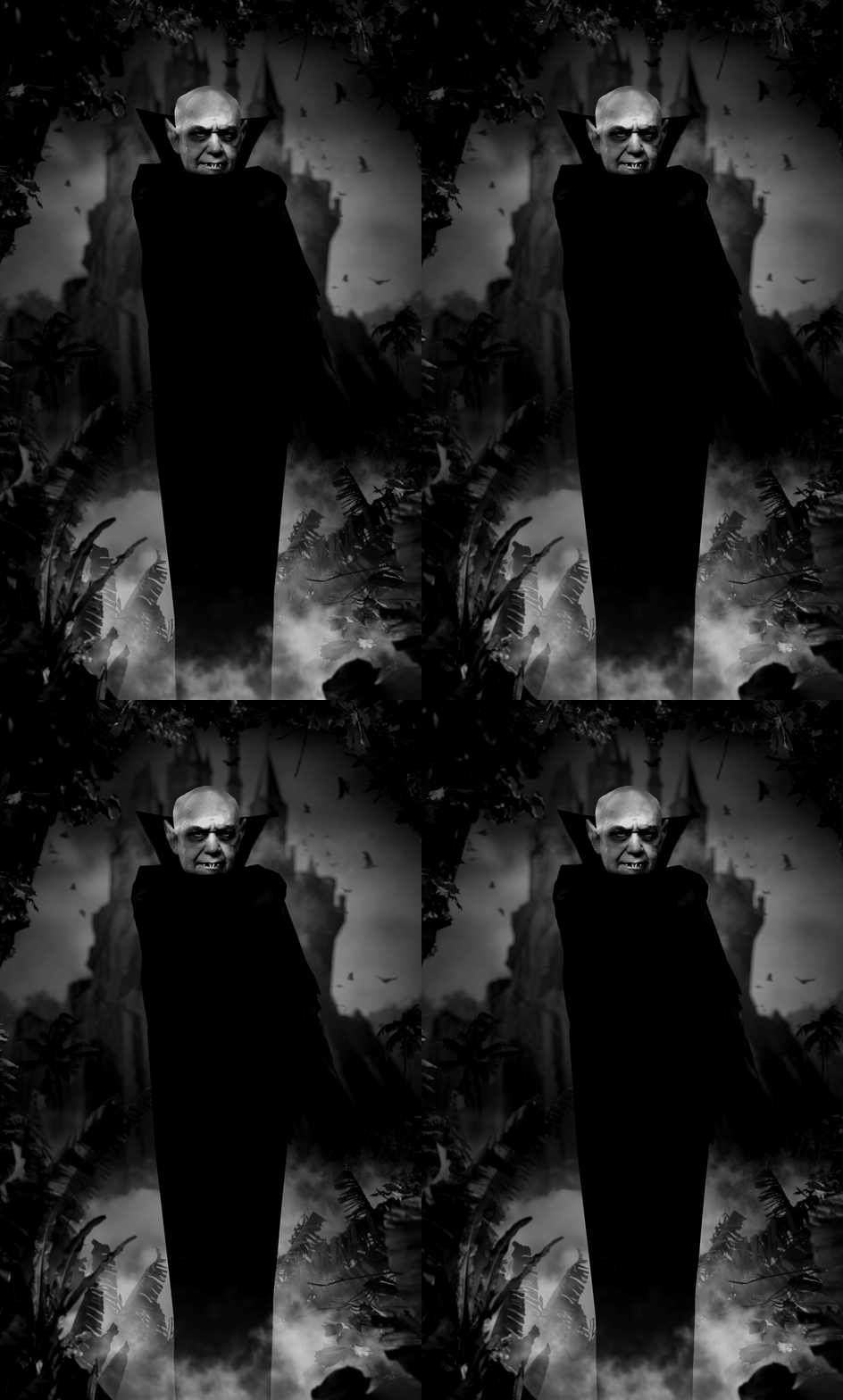
How ’bout a 3D animation, from the Emmy-winning artists and directors at The Saline Project, to start our Halloween week? For today, a vampire:
Animator vs. Animation from Alan Becker on Vimeo.
Good morning, Whitewater.
We’ve a beautiful Sunday ahead, with sunny skies and a high of sixty-two. Sunrise today is 7:22 AM and sunset 5:56 PM. The moon is a waxing crescent with eight-percent of its visible disk illuminated.
Friday’s FW poll asked if a woman who became stuck in a former boyfriend’s chimney tried to climb down from true love or nuttiness. Over seventy-seven percent of respondents said Genoveva Nunez-Figueroa’s actions were evidence of nuttiness.
On this day in 1881, a there’s a gunfight at the O.K. Corral:
The Gunfight at the O.K. Corral was a 30-second gunfight between outlaw Cowboys and lawmen that is generally regarded as the most famous gunfight in the history of the American Wild West. The gunfight took place at about 3:00 p.m. on Wednesday, October 26, 1881, in Tombstone, Arizona Territory. It was the result of a long-simmering feud between Cowboys Billy Claiborne, Ike and Billy Clanton, and Tom and Frank McLaury, and opposing lawmen: town Marshal Virgil Earp, Assistant Town Marshal Morgan Earp, and temporary deputy marshals Wyatt Earp and Doc Holliday. Ike Clanton and Billy Claiborne ran from the fight unharmed, but Billy Clanton and both McLaury brothers were killed. Virgil, Morgan, and Doc Holliday were wounded, but Wyatt Earp was unharmed. The fight has come to represent a period in American Old West when the frontier was virtually an open range for outlaws, largely unopposed by law enforcement who were spread thin over vast territories, leaving some areas unprotected.
The gunfight was not well known to the American public until 1931, when author Stuart Lake published a largely fictionalized biography, Wyatt Earp: Frontier Marshal, two years after Earp’s death.[1] Published during the Great Depression, the book captured American imaginations. It was also the basis for the 1946 film, My Darling Clementine, by director John Ford.[1] After the film Gunfight at the O.K. Corral was released in 1957, the shootout became known by that name. Since then, the conflict has been portrayed with varying degrees of accuracy in numerous Western films and books.
On this day in 1818, Wisconsin gets her first counties:
1818 – First Counties in Wisconsin Declared
On this date Lewis Cass, governor of the Michigan Territory, declared the first counties in Wisconsin. The counties included Michilimackinac (all areas drained by Lake Superior tributaries), Brown, and Crawford counties, which were separated through Portage. Michilimackinac County is now part of the state of Michigan. Governor Cass later became the Secretary of War under President Andrew Jackson, as well as the Minister to France and a Michigan Senator. Cass, a Democrat, also ran for president in 1848, but lost to Whig Zachary Taylor due to factions within the Democratic Party and the formation of the Free Soil Party. [Source: Historic Elmwood Cemetery and Foundation]
Americans aren’t the only ones who like pumpkins this time of year.
Teddy Bear the Porcupine happily devours a small pumpkin:
Good morning, Whitewater.
Saturday in Whitewater will be lovely, with sunny skies and a high of sixty-five.
Even the most extraordinary records are susceptible of being surpassed. Not long ago, Felix Baumgartner amazed the world with a high-altitude skydive. Now, an executive from Google has broken Baumgartner’s record.
Here’s video of Alan Eustace’s jump:
See, for more information, Parachutist’s Record Fall: Over 25 Miles in 15 Minutes Alan Eustace Jumps From Stratosphere, Breaking Felix Baumgartner’s World Record.
On this day in 1909, a brewery explosion claims a life:
1909 – Explosion at Pabst Brewing Company
On this date a major boiler house explosion devastated three stories at Pabst Brewing Company early in the morning. The damage was estimated at about $250,000, one worker was killed and another was injured. Pabst Brewing Company filed a claim with its insurer, the Hartford Steam Boiler Inspection and Insurance Company, to recover damages from the explosion. [Source: Hartford Steam Boiler Inspection and Insurance Company]
In California, Genoveva Nunez-Figueroa became stuck in the chimney of a former boyfriend’s house, all part of a failed attempt to become reacquainted with him:
The county Fire Department’s urban search and rescue team was called to the scene. Photos posted on Twitter by the department showed firefighters on the roof of the house as they worked to reach the woman, who was conscious during the rescue.
The flue was lubricated with dish soap before she was lifted out of the chimney, placed in a Stokes basket and hoisted from the roof by a ladder truck, according to VCFD Capt. Mike Lindbery.
There’s some good in all this, however. The former boyfriend offered sage advice for all humanity:
The home’s resident, who did not wish to be identified, said he had met Nunez-Figueroa online and they had gone on about six dates.
He cautioned other people about allowing acquaintances into their homes.
“Before you have somebody come in your house really check them out … really give it some time before you let somebody in, because they might want to stay,” he told KTLA.
See, Woman Arrested After Becoming Trapped in Chimney at Thousand Oaks Home @ KTLA.
Good morning, Whitewater.
Friday will be mild and increasingly sunny, with a high of sixty-five.
On this day in 1945, the United Nations comes into force:
On April 25, 1945, the United Nations Conference on International Organization convened in San Francisco with 50 nations represented. Three months later, during which time Germany had surrendered, the final Charter of the United Nations was unanimously adopted and signed by the delegates. The Charter called for the U.N. to maintain international peace and security, promote social progress and better standards of life, strengthen international law, and promote the expansion of human rights.
On October 24, 1945, the U.N. Charter came into force upon its ratification by the five permanent members of the Security Council and a majority of other signatories. The first U.N. General Assembly, with 51 nations represented, opened in London on January 10, 1946. On October 24, 1949, exactly four years after the United Nations Charter went into effect, the cornerstone was laid for the present United Nations headquarters, located in New York City. Since 1945, the Nobel Peace Prize has been awarded five times to the United Nations and its organizations and five times to individual U.N. officials.
On this day in 1933, Janesville has a visitor:
1933 – Amelia Earhart Visits Janesville
On this date Amelia Earhart spoke to the Janesville Woman’s History Club as part of the group’s 57th anniversary celebration. Four years later, Earhart disappeared as she attempted to fly across the Pacific Ocean. [Source: Janesville Gazette 10/24/1933, p.2]
Google-a-Day asks about art:
In what kind of building will you find the 15 x 29 ft. mural created for the husband of Beatrice d’Este?