FREE WHITEWATER

Monthly Archives: October 2014

The Campus-City Gap

All these years, so much talk about closer ties, and there’s still a chasm between city and university.  

So much so, that for many residents in the city to learn about university-related crime, they’d have to look for an out-of-city station or publication.

See, from Saturday @ 2:58 PM, Student reportedly called name, kicked, punched: UW-Whitewater says attackers used sexually derogatory term before attack.

My point isn’t that UW-Whitewater did not alert its students about the now-reported incident – they have a campus-notification system. 

My point is that hyper-local news sources are few, and no less ideological (often selectively so) than are self-acknowledged commentators. 

I’d guess it’s made worse by a university leadership that so evidently yearns for Old Whitewater’s acceptance. 

It’s only when the city and university – both – have a culture that encourages more than striving to be one of a few hundred in middling magpies that there will be improvement in city-university conditions.

That’s at least one, and perhaps two, chancellors from now. 

Daily Bread for 10.6.14

Good morning, Whitewater.

The beginning of our week will be mostly sunny with a high of fifty-eight. Sunrise today is 6:58 AM and sunset 6:28 PM. The moon is in a waxing gibbous phase with ninety-six percent of its visible disk illuminated.

Friday’s FW poll asked respondents whether they thought a dog (Sammy, a boxer) should be allowed on the sofa. Almost seventy-four percent of respondents said yes, she should; around twenty-six percent of respondents said she shouldn’t.

Every day, countless people use computers to draw, and many of those drawings use curved shapes. How do computers really make those curves? Peter Nowell explains how:

Cubic Bezier Curves – Under the Hood from Peter Nowell on Vimeo.

On this day in 1866, America experiences her first train robbery:

Famous train robbers include Bill Miner, Jesse James, and Butch Cassidy. Jesse James is mistakenly thought to have completed the first successful train robbery in the American West when on July 21, 1873 the James-Younger Gang took US $3,000 from a Rock Island Railroad train after derailing it southwest of the town of Adair, Iowa.[1] However, the first peacetime train robbery in the United States actually occurred on October 6, 1866, when robbers boarded the Ohio & Mississippi train shortly after it left Seymour, Indiana. They broke into one safe and tipped the other off the train before jumping off. The Pinkerton National Detective Agency later traced the crime to the Reno Gang. There was one earlier train robbery in May 1865, but because it was committed by armed guerrillas and occurred shortly after the end of the Civil War, it is not considered to be the first peacetime train robbery in the United States. Some sources say that the May 1865 robbery took place at a water siding while the train was stopped taking on water.

On this day in 1917, Wisconsin’s Fighting Bob speaks up for free speech:

1917 – Robert La Follette Supports Free Speech in Wartime
On this date Senator Robert La Follette gave what may have been the most famous speech of his Senate career when he responded to charges of treason with a three hour defense of free speech in wartime. La Follette had voted against a declaration of war as well as several initiatives seen as essential to the war effort by those that supported U.S. involvement in the first World War. His resistance was met with a petition to the Committee on Privileges and Elections that called for La Follette’s expulsion from the Senate. The charges were investigated, but La Follette was cleared of any wrong doing by the committee on January 16, 1919. [Source: United States Senate]

Google-a-Day asks a question about pop culture:

The 2011 Emmy Award winner for “Outstanding Lead Actor in a Comedy Series,” starred opposite “The Big Easy” actress in the 2011 revival of what Broadway play?

Daily Bread for 10.5.14

Good morning, Whitewater.

Sunday in town will be fair with a high of fifty-six. Sunrise today is 6:57 AM and sunset is 6:29 PM. The moon is in a waxing gibbous phase with eighty-nine percent of its visible disk illuminated.

A camera crew in Iceland recorded the volcanic eruption of the Bardabunga Volcano using a small Phantom 2 quadcopter. The first video below shows their work, and the second video explains how much effort it took to get close to the volcano and make a recording:

On this day in 1813, future president William Henry Harrison defeats a combined British and Indian force at the Battle of the Thames:

Shortly after daybreak on October 5, after ordering his troops to abandon their half-cooked breakfast and retreat a further two miles, Procter formed the British regulars in line of battle with a single 6-pounder cannon. He planned to trap Harrison on the banks of the Thames, driving the Americans off the road with cannon fire. However, he had taken no steps towards fortifying the position (e.g. by creating abatis or throwing up earthworks), so the ground presented no obstacle to the American mounted troops, while scattered trees masked the British fire. Tecumseh’s warriors took up positions in a black ash swamp on the British right to flank the Americans. Tecumseh rode along the British line, shaking hands with each officer, before joining his warriors.[12]

General Harrison surveyed the battlefield and ordered James Johnson (brother of Richard Mentor Johnson) to make a frontal attack against the British regulars with his mounted Kentucky riflemen. Despite the Indians’ flanking fire, Johnson broke through, the British cannon having failed to fire. The exhausted, dispirited and half-starved British troops fired one ragged fusillade before giving way. Immediately Procter and about 250 of his men fled from the field. The rest surrendered.

Tecumseh and his followers remained and carried on fighting. Richard Johnson charged into the Indian position at the head of about 20 horsemen to draw attention away from the main American force, but Tecumseh and his warriors answered with a volley of musket fire that stopped the cavalry charge. Fifteen of Johnson’s men were killed or wounded, and Johnson himself was hit five times. Johnson’s main force became bogged down in the swamp mud. Tecumseh is believed to have been killed during this fighting. The main force finally made its way through the swamp, and James Johnson’s troops were freed from their attack on the British. With the American reinforcements converging and news of Tecumseh’s death spreading quickly, Indian resistance soon dissolved.

Colonel Johnson may have been the one who shot Tecumseh, though the evidence is unclear. William Whitley, a Revolutionary War veteran, is also credited with killing Tecumseh. Whitley, of Crab Orchard, Kentucky, volunteered for the raid on Tecumseh’s camp, and was killed during the attack. Before the attack, he had requested that General Harrison have his scalp removed if he died and send it to his wife.

After the battle, American mounted troops moved on and burned Moraviantown (marked today by the Fairfield Museum on Longwoods Road), a settlement of pacifist Christian Munsee of the Moravian Church, who had not participated in the fighting. Because the enlistments of the militia component of Harrison’s army were about to expire, the Americans retired to Detroit.

Daily Bread for 10.4.14

Good morning, Whitewater.

We’ll have about a one-third chance of showers, on a Saturday with a high of forty-six.

Saturday Night Live has a suggestion for the NFL on player introductions. One can think of it as a version of truth-in-advertising:

On this day in 1957, the Soviets launch Sputnik 1 into orbit:

The Sputnik rocket was launched on 4 October 1957 at 19:28:34 UTC (5 October at the launch site[1]) from Site No.1 at NIIP-5.[53] Telemetry indicated the side boosters separated 116 seconds into the flight and the core-stage engine shut down 295.4 seconds into the flight.[51] At shut down, the 7.5 tonne core stage with PS-1 attached had attained an altitude of 223 km (139 mi) above sea level, a velocity of 7,780 m/s (25,500 ft/s) and velocity vector inclination to the local horizon of 0 degrees 24 minutes. This resulted in an initial orbit of 223 kilometres (139 mi) by 950 kilometres (590 mi), with an apogee approximately 500 kilometres (310 mi) lower than intended, and an inclination of 65.1 degrees and a period of 96.2 minutes.[51]

19.9 seconds after after engine cut-off, PS-1 separated from the second stage[1] and the satellite’s transmitter was activated. These signals were detected at the IP-1 station by Junior Engineer-Lieutenant V.G. Borisov, where reception of Sputnik’s “beep-beep-beep” tones confirmed the satellite’s successful deployment. Reception lasted for two minutes, until PS-1 fell below the horizon.[28][54] The Tral telemetry system on the R-7 core stage continued to transmit and was detected on its second orbit.[1]

The designers, engineers and technicians who developed the rocket and satellite watched the launch from the range.[55] After the launch they drove to the mobile radio station to listen for signals from the satellite.[55] They waited about 90 minutes to ensure that the satellite had made one orbit and was transmitting, before Korolyov called Soviet premier Nikita Khrushchev.[56] On the first orbit the Telegraph Agency of the Soviet Union (TASS) transmitted: “As result of great, intense work of scientific institutes and design bureaus the first artificial Earth satellite has been built”.[57] The R-7 core stage, with a mass of 7.5 tonnes and a length of 26 meters, also reached Earth orbit and was visible from the ground at night as a first magnitude object following the satellite. Deployable reflective panels were placed on the booster in order to increase its visibility for tracking.[56] The satellite itself, a small, highly polished sphere, was barely visible at sixth magnitude, and thus more difficult to follow optically. A third object, the payload fairing, also achieved orbit.

The core stage of the R-7 remained in orbit for two months until 2 December 1957, while Sputnik 1 orbited until 4 January 1958, having completed 1,440 orbits of the Earth.[1]

Daily Bread for 10.3.14

Good morning, Whitewater.

We’ll have morning showers with a high of fifty-five.

On this day in 1990, after decades of division and Communist oppression, East Germany is reunified with the West:

The Volkskammer, the Parliament of East Germany, passed a resolution on 23 August 1990 seeking the accession (Beitritt) of the German Democratic Republic to the Federal Republic of Germany as allowed by article 23 of the West German Basic Law, effective 3 October 1990.[7][8] In the wake of that resolution, the “German reunification treaty”,[9][10][11] commonly known in German as “Einigungsvertrag” (Unification Treaty) or “Wiedervereinigungsvertrag” (Reunification Treaty), that had been negotiated between the two German states since 2 July 1990, was signed on 31 August 1990. This Treaty, officially titled Vertrag zwischen der Bundesrepublik Deutschland und der Deutschen Demokratischen Republik über die Herstellung der Einheit Deutschlands (Treaty between the Federal Republic of Germany and the German Democratic Republic on the Establishment of German Unity), was approved by large majorities in the legislative chambers of both countries on 20 September 1990[12] (442–47 in the West German Bundestag and 299–80 in the East German Volkskammer). The amendments to the Federal Republic’s Basic Law that were foreseen in the Unification Treaty or necessary for its implementation were adopted by the Federal Statute of 23 September 1990. Under article 45 of the Treaty,[13] it entered into force in international Law on 29 September 1990, upon the exchange of notices regarding the completion of the respective internal constitutional requirements for the adoption of the treaty in both East Germany and West Germany.

With that last step, and in accordance with article 1 of the Treaty, Germany was officially reunited at 00:00 CET on 3 October 1990. East Germany joined the Federal Republic as the five Länder (states) of Brandenburg, Mecklenburg-Vorpommern, Saxony, Saxony-Anhalt and Thuringia. These states had been the five original states of East Germany, but had been abolished in 1952 in favour of a centralised system. As part of the 18 May treaty, the five East German states had been reconstituted on 23 August. At the same time, East and West Berlin reunited into one city, which became a city-state along the lines of the existing city-states of Bremen and Hamburg. In an emotional ceremony, at the stroke of midnight on 3 October 1990, the black-red-gold flag of West Germany—now the flag of a reunited Germany—was raised above the Brandenburg Gate marking the moment of German reunification.

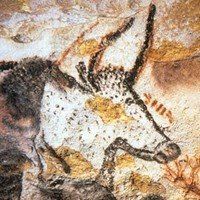
Google-a-Day asks about art:

8a4

Many of the cave paintings at Lascaux show the animals with heads in profile, but with horns facing forward. This is an example of what convention of representation?

The Dean’s Drug-War Equality Argument

I’m sorry I didn’t get to this sooner, but one of UW-Whitewater Dean of Students Mary Beth Mackin’s remarks about drug busts on campus deserves a reply.  She’s offered an argument for equality of treatment on and off campus.  Her argument implies that she either misunderstands the underlying justification for equality arguments, or that she supports the Drug War no matter how Draconian in Whitewater, inner cities, or anywhere in America. 

Her remarks came during an interview with Gilman Halsted of Wisconsin Public Radio.  (See, UW Campuses Use Undercover Student Informants In Drug Busts: Students Caught Dealing Drugs Are Offered Option Of Wearing Wire In Exchange For Reduced Charges.)

In that interview with WPR, Dean Mackin offers the contention that because non-college students might be subjected to drug charges (even for small amounts of narcotics), it’s fair that college students should be, too:

She said that when students break drug laws on campus, they shouldn’t be treated differently just because they’re students.

“I think the important thing is this is not an anomaly to a college campus,” Mackin said. “It’s the same thing that happens to 19-year-old who has not come to college, who’s working somewhere out in society.”

There’s her equality argument.  On campus, off campus, wherever: the same drug policies equally enforced.

Dean Mackin, however, can only make this equality argument ethically if she believes that the Drug War is a positive one for society. 

That’s because the extension of equality depends on the conviction that what one extends is, in itself, positive.  One can virtuously seek an extension of a good thing; the extension of suffering or harsh treatment to greater numbers in the name of equality is no virtue. 

So extending the right to vote, freedom of speech and assembly, or marriage makes sense when one sees those as fundamental expressions of one’s humanity.  Equality in these cases is an extension of positive goods. 

By contrast, no one contends that equality of treatment would have justified the extension of Jim Crow laws, for example, from parts of America to the whole country. The unfairness of the laws trumps an argument from equality that they should have been extended to all fifty states.

To believe morally in the equal reach of the Drug War requires the belief that the Drug War is a social good. 

Ms. Mackin may believe that, of course. 

If she does, then she might tell those from the inner city, not just in Whitewater, that she’s committed to the equality of severe penalties and incarceration everywhere: Milwaukee, Chicago, Whitewater, wherever.

Dean Mackin might ask those many inner city residents, if she has the time, if they feel better about their treatment under the law now that she’s advocating equality of conditions on her rural campus. 

I’d guess she’d not be met with a positive or thankful response.

Daily Bread for 10.2.14

Good morning, Whitewater.

We’ll have a probability of thunderstorms today, with a high temperature of seventy-four.

Whitewater’s Landmarks Commission meets tonight at 6 PM.

Wilson attends a 1918 parade. Via Wikipedia.

On this day in 1919, Pres. Wilson suffers a stroke while in office:

The immediate cause of Wilson’s incapacity in September 1919 was the physical strain of the public speaking tour he undertook in support of ratification of Treaty of Versailles. In Pueblo, Colorado, on September 25, 1919, he collapsed and never fully recovered.[247]

On October 2, 1919, he suffered a serious stroke, leaving him paralyzed on his left side, and with only partial vision in the right eye.[248] He was confined to bed for weeks and sequestered from everyone except his wife and physician, Dr. Cary Grayson.[249] For some months he used a wheelchair and later he required use of a cane. His wife and aide Joe Tumulty were said to have helped a journalist, Louis Seibold, present a false account of an interview with the President.[250]

He was insulated by his wife, who selected matters for his attention and delegated others to his cabinet. Wilson temporarily resumed a perfunctory attendance at cabinet meetings.[251] By February 1920, the President’s true condition was public. Many expressed qualms about Wilson’s fitness for the presidency at a time when the League fight was reaching a climax, and domestic issues such as strikes, unemployment, inflation and the threat of Communism were ablaze. No one, including his wife, his physician or personal assistant were willing to take upon themselves responsibility for the certification, required by the Constitution, of his “inability to discharge the powers and duties of the said office”.[252] This complex case became a motivation for passage of the 25th Amendment.[253]

Google-a-Day poses a question about music:

Unlike most oratorios, the one written by Handel in 24 days does not have what kind of plotline?