FREE WHITEWATER

Monthly Archives: October 2015

Daily Bread for 10.2.15

Good morning, Whitewater.

Friday in town will be partly sunny with a high of sixty-one. Sunrise is 6:53 and sunset 6:34, for 11h 40m 07s of daytime. The moon is a waning gibbous with 74.9% of its visible disk illuminated.

On this day in 1959, the Twilight Zone debuts on CBS:

The series was produced by Cayuga Productions, Inc., a production company owned and named by Serling. It reflects his background in Central New York State and is named after Cayuga Lake, on which Ithaca College is located.

Aside from Serling, who wrote or adapted nearly two-thirds of the series’ total episodes, writers for The Twilight Zone included leading authors such as Charles Beaumont, Ray Bradbury, Earl Hamner, Jr., George Clayton Johnson, Richard Matheson, Reginald Rose, and Jerry Sohl. Many episodes also featured new adaptations of classic stories by such writers as Ambrose Bierce, Jerome Bixby, Damon Knight, John Collier, and Lewis Padgett.

Twilight Zone???’??s writers frequently used science fiction as a vehicle for social comment, as networks and sponsors who censored controversial material from live dramas were less concerned with seemingly innocuous fantasy and sci-fi stories. Frequent themes on The Twilight Zone included nuclear war, McCarthyism, and mass hysteria, subjects that were avoided on more serious primetime television. Episodes such as “He’s Alive” or “The Monsters Are Due on Maple Street” offered specific commentary on current events and social issues. Other stories, such as “The Masks“, “I Dream of Genie“, or “Mr. Denton on Doomsday” were allegories, parables, or fablesthat reflected the moral and philosophical choices of the characters.

Despite his esteem in the writing community, Serling found the series difficult to sell. Few critics felt that science fiction could transcend empty escapism and enter the realm of adult drama. In a September 22, 1959, interview with Serling, Mike Wallace asked a question illustrative of the times: “…[Y]ou’re going to be, obviously, working so hard on The Twilight Zone that, in essence, for the time being and for the foreseeable future, you’ve given up on writing anything important for television, right?” While Serling’s appearances on the show became one of its most distinctive features, with his clipped delivery still widely imitated today, he was reportedly nervous about it and had to be persuaded to appear on camera. Serling often steps into the middle of the action while the characters remain oblivious to him, but on one notable occasion, they are aware of his presence: In the episode “A World of His Own“, a writer (Keenan Wynn) with the power to alter his reality objects to Serling’s narration, and promptly erases Serling from the show.

In season two, due to budgetary constraints, the network decided – against Serling’s wishes – to cut costs by shooting some episodes on videotape rather than film. The requisite multicamera setup of the videotape format precluded location shooting, severely limiting the potential scope of the storylines, and the experiment was abandoned after just six episodes (“Twenty Two“, “Static“, “The Whole Truth“, “The Lateness of the Hour“, “The Night of the Meek“, and “Long Distance Call“).

The original series contains 156 episodes. Unlike seasons one through three, season four (1962–63) consists of one-hour episodes. Season five returned to the half-hour format.


On this day in 1861, the first train of the Wisconsin Central Railroad runs:

On this date the first train of the Wisconsin Central Railroad ran between Menasha and Waupaca. The railroad was important in the development of railroads in Wisconsin. [Source: History Just Ahead: A Guide to Wisconsin’s Historical Markers edited by Sarah Davis McBride, p.69]

Here’s the final puzzle in this week’s Puzzability series, Blended Wines:

This Week’s Game — September 28-October 2
Blended Wines
We have some lovely pairings this week. For each day, we’ve taken the name of a wine, added a letter, and scrambled all the letters to get a new word. The answer phrase, described by each day’s clue, is the wine followed by the longer word. The clue includes the lengths of the answer words in parentheses.
Example:
Person attending a party in honor of a dry red wine (8,9)
Answer:
Cabernet celebrant
What to Submit:
Submit the phrase, with the wine first (as “Cabernet celebrant” in the example), for your answer.
Friday, October 2
Tasty sauce for soaking meat made with an amber-colored fortified wine (7,8)


The December 2014 Presentation
(Part 1)

WGTB logo PNG 112x89 Post 36 in a series. When Green Turns Brown is an examination of a small town’s digester-energy project, in which Whitewater, Wisconsin would import other cities’ waste, claiming that the result would be both profitable and green.

In this post, I’ll consider the Donohue firm’s December 2014 public presentation to Whitewater on a wastewater upgrade. The full presentation is embedded immediately below. As the discussion is long, in this post I’ll consider the first 36 minutes from the discussion. (This is the initial portion during which Donohue and then City Manager Clapper describe the project. Thereafter, the discussion opens to public comments.)

Donohue Firm’s December 2014 Presentation to Whitewater from John Adams on Vimeo.
 

(Every question in this series has a unique number, assigned chronologically based on when it was asked. All the questions from When Green Turns Brown can be found in the Question Bin.  Today’s questions begin with No. 217.)

217. Donohue’s first technical memo mentions that a goal of Whitewater’s city officials is to sell water (“[t]he value of water was discussed in detail….The option of producing a sellable water product is of major interest to the city.”). Why no mention of that goal here?

218. Donohue’s presentation, by their account, addresses the ‘liquids train’ portion of the project (that is, not the biosolids processing at the plant). Can one have a liquids train project without a biosolids train? (It’s a rhetorical question.) More directly: does a particular liquids train method require a definite biosolids train method? If so, when and which methods are bound in this way?

219. Whitewater, as Donohue outlines it, has two options for phosphorus management: (1) Option One (immediate compliance with phosphorus reduction upon construction) or (2) Option Two, using the so-called “Clean Waters, Healthy Economy Act” without any capital costs. Donohue recommends Option Two.

The obvious question: how much phosphorus does Option Two remove, in absolute terms and relative to Option One? Since Option Two requires a payment in lieu of physical reductions, for Whitewater’s environment doesn’t Option Two’s solution really mean no practical, significant phosphorus reduction at all?

220. Why did Whitewater’s officials choose paying to allow continued levels of phosphorus discharge in the local environment rather than commit to actual, physical reductions in levels of phosphorus discharge?

221. When did City Manager Clapper first choose Option Two? (He presumably chose Option Two – payment in lieu of significant phosphorus reductions – by the time of this 12.16.14 presentation. If it were otherwise, Donohue would be advocating a key approach without the assent of Whitewater’s full-time staff.)

222. What record, if any, does City Manager Clapper have of the basis of his decision on or before 12.16.14 in favor of Option Two (payment in lieu of significant phosphorus reductions)?

Next: The December 2014 Presentation (Part 2).

WHEN GREEN TURNS BROWN: Mondays @ 10 AM, here on FREE WHITEWATER.

Daily Bread for 10.1.15

Good morning, Whitewater.

A new month begins with partly cloudy skies and a high of sixty. Sunrise is 6:52 and sunset 6:35, for 11h 42m 59s of daytime. The moon is a waning gibbous with 84% of its visible disk illuminated.

Whitewater’s Landmarks Commission meets this evening at 6:00 PM.

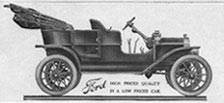
On this day in 1908, Henry Ford reveals a production model car that will transform American and global transportation:

On October 1, 1908, the first production Model T Ford is completed at the company’s Piquette Avenue plant in Detroit. Between 1908 and 1927, Ford would build some 15 million Model T cars. It was the longest production run of any automobile model in history until the Volkswagen Beetle surpassed it in 1972.

Before the Model T, cars were a luxury item: At the beginning of 1908, there were fewer than 200,000 on the road. Though the Model T was fairly expensive at first (the cheapest one initially cost $825, or about $18,000 in today’s dollars), it was built for ordinary people to drive every day. It had a 22-horsepower, four-cylinder engine and was made of a new kind of heat-treated steel, pioneered by French race car makers, that made it lighter (it weighed just 1,200 pounds) and stronger than its predecessors had been. It could go as fast as 40 miles per hour and could run on gasoline or hemp-based fuel. (When oil prices dropped in the early 20th century, making gasoline more affordable, Ford phased out the hemp option.) “No car under $2,000 offers more,” ads crowed, “and no car over $2,000 offers more except the trimmings.”

The design was revolutionary:

1908_Ford_Model_TThe Model T was designed by Childe Harold Wills, and Hungarian immigrants Joseph A. Galamb[17] and Eugene Farkas.[18] Henry Love, C. J. Smith, Gus Degner and Peter E. Martin were also part of the team.[19] Production of the Model T began in the third quarter of 1908.[20] Collectors today sometimes classify Model Ts by build years and refer to these as “model years“, thus labeling the first Model Ts as 1909 models. This is a retroactive classification scheme; the concept of model years as we conceive it today did not exist at the time. The nominal model designation was “Model T”, although design revisions did occur during the car’s two decades of production….

The Model T had a front-mounted 177-cubic-inch (2.9 L) inline four-cylinder engine, producing 20 hp (15 kW), for a top speed of 40–45 mph (64–72 km/h). According to Ford Motor Company, the Model T had fuel economy on the order of 13–21 mpg-US (16–25 mpg-imp; 18–11 L/100 km).[21] The engine was capable of running on gasoline, kerosene, or ethanol,[22][23] although the decreasing cost of gasoline and the later introduction of Prohibition made ethanol an impractical fuel for most users.

The ignition system used an unusual trembler coil system to drive the spark plugs, as used for stationary gas engines, rather than the expensive magnetos that were used on other cars. This ignition also made the Model T more flexible as to the quality or type of fuel it used. The need for a starting battery and also Ford’s use of an unusual AC alternator located inside the flywheel housing encouraged the adoption of electric lighting, rather than oil or acetylene lamps, but it also delayed the adoption of electric starting.

Here’s the Thursday game from Puzzability:

This Week’s Game — September 28-October 2
Blended Wines
We have some lovely pairings this week. For each day, we’ve taken the name of a wine, added a letter, and scrambled all the letters to get a new word. The answer phrase, described by each day’s clue, is the wine followed by the longer word. The clue includes the lengths of the answer words in parentheses.
Example:
Person attending a party in honor of a dry red wine (8,9)
Answer:
Cabernet celebrant
What to Submit:
Submit the phrase, with the wine first (as “Cabernet celebrant” in the example), for your answer.
Thursday, October 1
Measuring out helpings of a medium-bodied red wine (5 4,10)