
FREE WHITEWATER

Monthly Archives: October 2016

James Fallows on ‘Eleven Signs a City Will Succeed’ (Part 1)

Over at The Atlantic, and connected to that publication’s American Futures series, James Fallows writes about ‘Eleven Signs a City Will Succeed.’  Today, I’ll list Fallows’s eleven signs, and tomorrow, I’ll write about whether the list applies to Whitewater, and how Whitewater fares to the extent that the list is applicable.

(The list is sure to excite superficial policymakers, eager to claim credit for headlines that actual conditions belie.  Using a happy headline out of context has been the modus operandi of the Whitewater’s leading exaggerators for many years now. “We’re all those things: Mission Accomplished!”

Where many weak assessments end, the real discussion only begins.

Still, considering the list seriously, rather than superficially, will be useful to see where improvement may be made.  Fallows explains briefly in his essay what he means by each of these signs, and those explanations are useful to consideration our own situation.)

Here’s the list:

1. Divisive national politics seem a distant concern.

2. You can pick out the local patriots.

3. “Public-private partnerships” are real.

4.  People know the civic story.

5.  They have a downtown.

6.  They are near a research university.

7.  They have, and care about, a community college.

8.  They have unusual schools.

9.  They make themselves open.

10.  They have big plans.

11.  They have craft breweries.

See, in full, Eleven Signs a City Will Succeed @ The Atlantic.

Tomorrow : James Fallows on ‘Eleven Signs a City Will Succeed’ (Part 2)
Daily Bread for 10.11.16

Good morning, Whitewater.

Tuesday in town will see an even chance of showers this morning, a sunn afternoon, and a high of seventy-one. Sunrise is 7:05 AM and sunset 6:17 PM, for 11h 12m 15s of daytime. The moon is a waxing gibbous with 72.5% of its visible disk illuminated.

The Landmarks Commission Effigy Mounds Subcommittee will meet this morning at 9 AM.

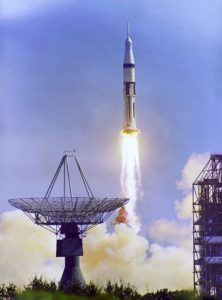
On this day in 1968, NASA launches the first Apollo mission with a crew:

800px-apollo_7_launch_-_gpn-2000-001171Apollo 7 was a 1968 human spaceflight mission carried out by the United States. It was the first mission in the United States’ Apollo program to carry a crew into space. It was also the first U.S. spaceflight to carry astronauts since the flight of Gemini XII in November 1966. The AS-204 mission, also known as “Apollo 1”, was intended to be the first manned flight of the Apollo program. It was scheduled to launch in February 1967, but a fire in the cabin during a January 1967 test killed the crew. Manned flights were then suspended for 21 months, while the cause of the accident was investigated and improvements made to the spacecraft and safety procedures, and unmanned test flights of theSaturn V rocket and Apollo Lunar Module were made. Apollo 7 fulfilled Apollo 1’s mission of testing the Apollo Command/Service Module (CSM) in low Earth orbit.

The Apollo 7 crew was commanded by Walter M. Schirra, with senior pilot / navigator Donn F. Eisele, and pilot / systems engineer R. Walter Cunningham. (Official crew titles were made consistent with those that would be used for the manned lunar landing missions: Eisele was Command Module Pilot and Cunningham was Lunar Module Pilot.) Their mission was Apollo’s ‘C’ mission, an 11-day Earth-orbital test flight to check out the redesigned Block II CSM with a crew on board. It was the first time a Saturn IB vehicle put a crew into space; Apollo 7 was the first three-person American space mission, and the first to include a live TV broadcast from an American spacecraft. It was launched on October 11, 1968, from what was then known as Cape Kennedy Air Force Station, Florida. Despite tension between the crew and ground controllers, the mission was a complete technical success, giving NASA the confidence to sendApollo 8 into orbit around the Moon two months later. The flight would prove to be the final space flight for all of its three crew members — and the only one for both Cunningham and Eisele — when it splashed down in the Atlantic Ocean on October 22, 1968. It was also the final manned launch from Cape Kennedy.

JigZone‘s daily puzzle for Tuesday is of a cow:

Twenty-Five Years On: School Board & City

Alternative title: Culture Advances While Beyond Politics Far Lags Behind.

Over at the Banner, there’s a new feature entitled, “A mini-look at local history – a new Banner Monday project!”  The 10.10.16 entry is about two public actions from twenty-five years ago.

I’m all for history (local or otherwise), but the entry is telling coming from a publisher who’s been in office, on either the School Board or Common Council, for most of the last quarter-century.  In fact, the entry shows how ineffectual Whitewater’s local political class has been for the last generation.  We’ve had significant cultural and demographic change, but government hasn’t kept up.

One reads that on October 10, 1991

[t]he Whitewater School Board is seeking volunteers from the community to serve on a task force charged by the board “to design and implement a student and staff training program to heighten awareness of, and skills responding to, racial, ethnic, and cultural diversity in Whitewater.”

Board members are particularly interested in having strong minority representation on the task force….

These were (and are) good & fair goals, but even a generation later, Whitewater’s political class is still having trouble finding, for example, Hispanic members of the community to take part on municipal political boards.

So much so, that in 2015, twenty-four years later, Whitewater’s City Manager Clapper requested and the city’s common council “authorized forming a community taskforce to investigate possible ways for the city’s Hispanic population to become more active in civic and governmental activities and municipal committees.”  See, Whitewater to seek Hispanic involvement, August 19, 2015.

Whitewater’s Hispanic community has grown considerably during this last generation, as have other groups such as students (of diverse ethnicity), but her political institutions have not kept pace.  Whitewater’s private life during these many years – the demographics and culture of our city – have grown in ways in which a small, insular political class has failed adapt.  (Among that small class, there are some who have even been all-too-evident revanchists.)

The responsibility of successfully encouraging residents to participate rests with the leadership class that governs – especially those who have been in government for decades – in this city. There are some leaders who commendably see this, but too many who’ve not kept pace.

Whitewater is overdue for a politics that matches her community. more >>

Film: Tuesday, 12:30 PM @ Seniors in the Park, Elvis & Nixon

This Tuesday, October 11th at 12:30 PM, there will be a showing of Elvis & Nixon @ Seniors in the Park, in the Starin community building.

Elvis & Nixon is “the untold true story behind the meeting between Elvis Presley, the King of Rock ‘n Roll, and President Richard Nixon, resulting in this revealing, yet humorous moment immortalized in the most requested photograph in the National Archives.”

The film stars Michael Shannon and Kevin Spacey, with a run time of one hour, twenty-six minutes, and carrying an R rating from the MPAA for language.

One can find more information about Elvis & Nixon at the Internet Movie Database.

Enjoy.

Daily Bread for 10.10.16

Good moring, Whitewater.

Whitewater’s work week will begin with sunny skies and a high of seventy-one. Sunrise is 7:03 AM and sunset 6:19 PM, for 11h 15m 05s of daytime. The moon is a waxing gibbous with 62.7% of its visible disk illuminated.

Whitewater’s Planning Commission meets tonight at 6:30 PM.

On this day in 1973, Vice President Agnew resigns:

On October 10, 1973, Spiro Agnew became the second Vice President to resign the office. Unlike John C. Calhoun, who resigned to take a seat in the Senate, Agnew resigned and then pleaded no contest to criminal charges of tax evasion,[31] part of a negotiated resolution to a scheme wherein he was accused of accepting more than $100,000 in bribes[32] during his tenure as governor of Maryland. Agnew was fined $10,000 and received three years’ probation.[33] The $10,000 fine covered only the taxes and interest due on what was “unreported income” from 1967. The plea bargain was later mocked by former Maryland Attorney General Stephen H. Sachs as “the greatest deal since the Lord spared Isaac on the mountaintop.”[34] Students of Professor John F. Banzhaf III from the George Washington University Law School, collectively known as Banzhaf’s Bandits, found four residents of the state of Maryland willing to put their names on a case that sought to have Agnew repay the state $268,482, the amount it was said he had taken in bribes. After two appeals by Agnew, he finally wrote a check for $268,482 that was turned over to Maryland State Treasurer William S. James in 1983.[35]

As a result of his no contest plea, the Maryland judiciary later disbarred Agnew, calling him “morally obtuse”.[36] As in most jurisdictions, Maryland lawyers are automatically disbarred after being convicted of a felony, and a no contest plea exposes the defendant to the same penalties as one would face with a guilty plea.[citation needed]

Agnew’s resignation triggered the first use of the 25th Amendment, specifically Section 2, as the vacancy prompted the appointment and confirmation of Gerald Ford, the House Minority Leader, as his successor. This remains one of only two instances in which the amendment has been employed to fill a vice-presidential vacancy. The second time was when Ford, after becoming President upon Nixon’s resignation, chose Nelson Rockefeller (originally Agnew’s mentor in the moderate wing of the Republican Party) to succeed him as Vice President. Had Agnew remained as Vice President when Nixon resigned just 10 months later, Agnew himself would have become the 38th President, instead of Ford.[30]

JigZone‘s daily puzzle for Monday is of a bridge:

UW-Whitewater’s Amy Edmonds Out as Athletic Director

UW-Whitewater’s current Athletic Director, Amy Edmonds, is reportedly out as head of UW-Whitewater’s athletic programs.  The report notes that she’s being demoted to associate athletic director (at a significant cut in salary).

There’s no certainty that she would, in fact, remain in a subordinate role following the apppointment of an interim director, let alone a permanent one.

See, http://royalpurplenews.com/19898/news/athletic-director-to-be-replaced/.

Edmonds was appointed interim director, and later permanent athletic director, during then-Chancellor Richard Telfer’s tenure. Edmonds and Telfer are now co-defendants in a federal defamation lawsuit from former wrestling Coach Timothy Fader. See, Former Coach Fader Files Federal Lawsuit Against UW-Whitewater Officials.

For more about Edmonds from FREE WHITEWATER, see, Coach Timothy Fader, Vindicated, Former Coach Fader Vindicated Five Times Over, Chancellor Telfer & UW-Whitewater Officials: Why Wait 147 Days?, and Questions on Assault Reporting, Formality, and Former UW-Whitewater Wrestling Coach Fader.

Daily Bread for 10.9.16

Good morning, Whitewater.

Sunday in town will be sunny with a high of forty-three.  Sunrise is 7:02 AM and sunset 6:20 PM, for 11h 17m 55s of daytime.  The moon is a waxing gibbous with 53.4% of its visible disk illuminated.

Friday’s FW poll asked whether readers thought that Norwegian Prime Minster Erna Solberg’s Pokemon Go playing during a parliamentary session was a dereliction of duty or an admirable commitment to catching ’em all.  A majority of respondents (68.42%) said it was a dereliction of duty.

On this day in 1635, Roger Williams is banished from Massachusetts, but be goes on to found Rhode Island:

Religious dissident Roger Williams is banished from the Massachusetts Bay Colony by the General Court of Massachusetts. Williams had spoken out against the right of civil authorities to punish religious dissension and to confiscate Indian land.

After leaving Massachusetts, Williams, with the assistance of the Narragansett tribe, established a settlement at the junction of two rivers near Narragansett Bay, located in present-day Rhode Island. He declared the settlement open to all those seeking freedom of conscience and the removal of the church from civil matters, and many dissatisfied Puritans came. Taking the success of the venture as a sign from God, Williams named the community “Providence.”

Among those who found a haven in the religious and political refuge of the Rhode Island Colony were Anne Hutchinson – like Williams, she had been exiled from Massachusetts for religious reasons – some of the first Jews to settle in North America, and the Quakers. In Providence, Roger Williams also founded the first Baptist church in America and edited the first dictionary of Native-American languages.

Daily Bread for 10.8.16

Good morning, Whitewater.

Saturday in town looks to be lovely, with sunny skies and a high of fifty-nine. Sunrise is 7:01 AM and sunset 6:22 PM, for 11h 20m 46s of daytime. The moon is a waxing crescent with 45.3% of its visible disk illuminated.

On this day in 1871, the Great Chicago Fire begins:

The Great Chicago Fire was a conflagration that burned from Sunday, October 8, to early Tuesday, October 10, 1871. The fire killed up to 300 people, destroyed roughly 3.3 square miles (9 km2) of Chicago, Illinois, and left more than 100,000 residents homeless.[1]

….The fire started at about 9:00 p.m. on October 8, in or around a small barn belonging to the O’Leary family that bordered the alley behind 137 DeKoven Street.[2] The shed next to the barn was the first building to be consumed by the fire, but city officials never determined the exact cause of the blaze.[3] There has, however, been much speculation over the years. The most popular tale blames Mrs. O’Leary’s cow, who allegedly knocked over a lantern; others state that a group of men were gambling inside the barn and knocked over a lantern. Still other speculation suggests that the blaze was related to other fires in the Midwest that day.

The fire’s spread was aided by the city’s use of wood as the predominant building material in a style called balloon frame; a drought before the fire; and strong southwest winds that carried flying embers toward the heart of the city. More than two thirds of the structures in Chicago at the time of the fire were made entirely of wood. Most houses and buildings were topped with highly flammable tar or shingle roofs. All the city’s sidewalks and many roads were made of wood.[4] Compounding this problem, Chicago had only received an inch (2.54 cm) of rain from July 4 to October 9 causing severe drought conditions.[5]

In 1871, the Chicago Fire Department had 185 firefighters with just 17 horse-drawn steam engines to protect the entire city.[6] The initial response by the fire department was quick, but due to an error by the watchman, Matthias Schaffer, the firefighters were sent to the wrong place, allowing the fire to grow unchecked.[6] An alarm sent from the area near the fire also failed to register at the courthouse where the fire watchmen were. Also, the firefighters were tired from having fought numerous small fires and one large fire in the week before.[7] These factors combined to turn a small barn fire into a conflagration.

On the same date, a fire in Wisconsin devastates Peshtigo:

1871 – Peshtigo Fire

On this date Peshtigo, Wisconsin was devastated by a fire which took 1,200 lives. The fire caused over $2 million in damages and destroyed 1.25 million acres of forest. This was the greatest human loss due to fire in the history of the United States. The Peshtigo Fire was overshadowed by the Great Chicago fire which occured on the same day, killing 250 people and lasting three days. While the Chicago fire is said to have started by a cow kicking over a lantern, it is uncertain how the Peshtigo fire began. [Source:Wisconsin Magazine of History]