FREE WHITEWATER

Monthly Archives: August 2017

What’s Left

It was Secretary Clinton who, during the campaign, controversially but memorably asserted that “[t]o just be grossly generalistic, you could put half of Trump’s supporters into what I call the ‘basket of deplorables,'” Hillary Clinton said at a New York fundraiser on Sept. 9. “The racist, sexist, homophobic, xenophobic, Islamaphobic, you name it. And unfortunately, there are people like that, and he has lifted them up.”

This August, conservative Jennifer Rubin considered Clinton’s assertion, in a post entitled About the ‘deplorables’…

….there is no non-deplorable rationale for continuing to defend this president, his rhetoric and his moral obtuseness. No one is asked to confess error in voting for him (although some self-scrutiny would be appreciated). Nevertheless, continuing to deny he is unfit for office and to make excuses for his verbiage makes one complicit in his racial divisiveness and his determination to provide aid and comfort to neo-Nazis and white nationalists.

Some delude themselves by thinking that Trump can show “greater moral clarity” (!) (as the Republican Jewish Coalition preposterously did) or that staying in the administration prevents damage to the country (as Gary Cohn, John F. Kelly and others apparently do) or that the 2016 voters’ verdict cannot be upset with no regard for subsequent events (as Republican lawmakers insist). Let’s be blunt, these are rationalizations for continued support for an unfit, racist president. It does in fact make one deplorable.

Indeed. What’s left of Trump’s support is deplorable, and those who continue to look away are enablers of the deplorable.

Trump is manifestly unfit & those who actively continue to support him are the defenders of unfitness. In another, meaningful way, the national, state, and local politicians who are  publicly silent in the face of Trump’s daily abuses manifest a profound unfitness all their own.

For them, it’s a wager, perhaps: that in time, the rest of us will forgive or forget.

No: the future will write the history of the present, and will record Trump, his remaining supporters, and those officeholders who stayed silent, each in his or her own way, as deplorable.

Daily Bread for 8.31.17

Good morning.

Month’s end in Whitewater will be partly cloudy with a high of seventy. Sunrise is 6:16 AM and sunset 7:29 PM, for 13h 10m 09s of daytime. The moon is a waxing gibbous with 70.6% of its visible disk illuminated. Today is the {tooltip}two hundred ninety-fifth day.{end-texte}Days since Trump’s election, with 11.9.16 as the first day.{end-tooltip}

Whitewater’s Landmarks Commission is scheduled to meet this afternoon at 4:30 PM.

On this day in 1987, Michael Jackson releases Bad, his seventh studio album. On this day in 1864, “1st, 12th, 16th, 17th, 21st, 24th, 25th and 32nd Wisconsin Infantry regiments along with the 5th and 10th Wisconsin Light Artillery batteries fight in the Battle of Jonesborough, Georgia.

Recommended for reading in full —

Anna Nemtsova, Betsy Woodruff, and Spencer Ackerman contend that Someone’s Lying About the Money for Trump Tower Moscow:

….Reports from earlier this week indicate [Felix] Sater, a convicted felon and former business associate of Trump, claimed in November 2015 he had lined up funding from VTB—a huge Russian bank, 60 percent of whose shares are owned by the Kremlin—for a Trump Organization construction project in Moscow.

If Sater’s claim is true, it could be a key link between Trump world and the Kremlin. But the bank at issue told The Daily Beast it isn’t. The Daily Beast cannot independently determine which side is telling the truth.

“VTB never held any negotiations about financing the Trump Tower in Moscow,” a bank representative told The Daily Beast in a statement. “We’d like to underline that not a single VTB group subsidiary had any dealings with Mr.Trump, his representatives or any companies affiliated with him”….

Dan Friedman reports on The Curious Link Between Trump’s Moscow Tower Deal and a Ukraine “Peace Plan”:

A pair of Trump associates, Michael Cohen and Felix Sater, appear to be gaining significance in the Trump-Russia investigation. News broke this week that during the presidential campaign the two sought a deal for the construction of a Trump Tower in Moscow. And, as reported earlier this year, the pair pushed a Kremlin-backed proposal for the US to lift sanctions on Russia—part of a proposed “peace deal” between Ukraine and Russia that Cohen and Sater brought to Trump’s then national security advisor Michael Flynn.

Congressional investigators are now interested in how the Moscow tower proposal and the so-called peace deal may connect. “That is a question members will be exploring, certainly,” says an official close to the Senate Intelligence Committee. One thread running through both deals is Russia’s desire for relief from US sanctions, which the Trump presidential campaign repeatedly signaled it was interested in accommodating. How that might shed further light on the deals is a “very interesting line of inquiry,” the official adds….

Philip Allen Lacovara explains How the pardon power could end Trump’s presidency:

Almost certainly, a presidential decision to preemptively pardon any of those caught up in Mueller’s investigation, whether former campaign chairman Paul Manafort, former national security adviser Michael Flynn or Donald Trump Jr., would be effective and would spare those pardoned from prosecution, at least on the federal level.

So Trump may be tempted to use this mechanism to extricate himself from what he calls derisively “the Russia thing.”

But issuing pardons to his own friends, associates and relatives could be a perilous path for Trump, creating additional exposure on two levels, criminal and political — both flowing from an important proposition that is often overlooked in the debate over presidential power. Our legal system provides mechanisms for probing the intent and motives behind the exercise of power. The president may have the power to grant effective pardons in the Russia investigation, but both Congress and the federal prosecutor are entitled to determine whether the exercise of that power violates constitutional and statutory norms….

Josh Dawsey reports that Mueller teams up with New York attorney general in Manafort probe:

Special counsel Robert Mueller’s team is working with New York Attorney General Eric Schneiderman on its investigation into Paul Manafort and his financial transactions, according to several people familiar with the matter.

The cooperation is the latest indication that the federal probe into President Donald Trump’s former campaign chairman is intensifying. It also could potentially provide Mueller with additional leverage to get Manafort to cooperate in the larger investigation into Trump’s campaign, as Trump does not have pardon power over state crimes.

The two teams have shared evidence and talked frequently in recent weeks about a potential case, these people said. One of the people familiar with progress on the case said both Mueller’s and Schneiderman’s teams have collected evidence on financial crimes, including potential money laundering….

Business Insider’s talking peanut butter:

For Your Consideration, Dr. Jonas Salk

local scene Each year, newcomers arrive in Whitewater to take positions of one kind or another. Two weeks ago, in Welcome to Whitewater, I posed this question to new residents: “If Whitewater were perfect – that is, complete and lacking nothing – would anyone have needed you?”

Beyond that question, with its interpretation and answer left to others, I’ll offer no personal checklist, no set of rules for “how people talk around here,” no indulgent reminiscences, no cautionary words or sly advice.

Instead, I’ll offer the example of a great man, who remained to the last an industrious and humble man. Dr. Jonas Salk introduced his polio vaccine in 1955, saving the lives and health of people around the world. He worked until his death in 1995, his last project an attempt to develop a vaccine for HIV, a goal that others are yet pursuing even today.

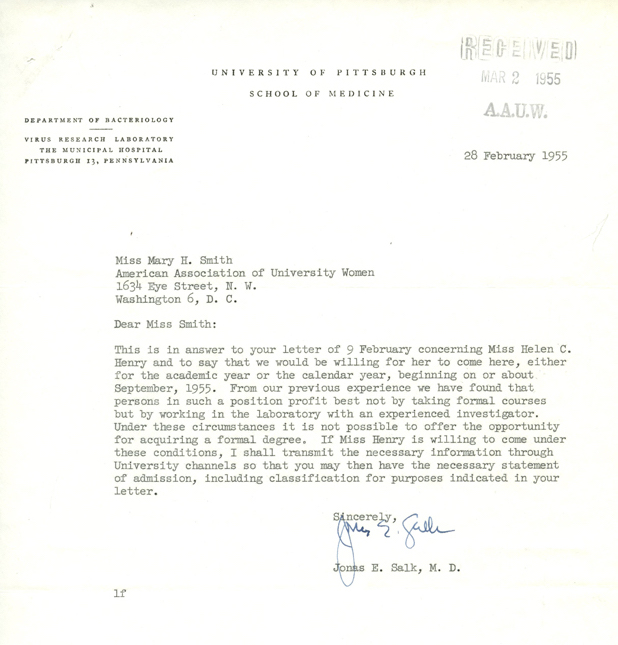
Around the same time as the Salk’s vaccine was introduced (and after trials that assured him it would work), Salk wrote a letter offering an internship in his laboratory. The letter is a model of simplicity and humility. Salk writes kindly and directly, making no reference to his own accomplishments either in the text or below his signature.

His work was its own reward, requiring not the slightest ornamentation.

For your consideration, Dr. Jonas Salk —

Daily Bread for 8.30.17

Good morning.

Midweek in Whitewater will be mostly sunny with a high of seventy-nine. Sunrise is 6:18 AM and sunset 7:31 PM, for 13h 12m 56s of daytime. The moon is a waxing gibbous with 61.6% of its visible disk illuminated. Today is the {tooltip}two hundred ninety-fourth day.{end-texte}Days since Trump’s election, with 11.9.16 as the first day.{end-tooltip}

On this day in 1945, MacArthur arrives in Japan, “and immediately decreed several laws. No Allied personnel were to assault Japanese people. No Allied personnel were to eat the scarce Japanese food. Flying the Hinomaru or “Rising Sun” flag was initially severely restricted (although individuals and prefectural offices could apply for permission to fly it). ” On this day in 1862, Wisconsin troops rest at the White House lawn: “The 2nd, 3rd, 5th, 6th and 7th Wisconsin Infantry regiments fought in the Second Battle of Bull Run. By the end of this third day, more than 18,000 soldiers had been killed or wounded and Union forces had been pushed back to Washington, D.C. When the Wisconsin regiments arrived in Washington, they rested on the White House lawn. According to historian Frank Klement, “President Lincoln came out with a pail of water in one hand and a dipper in the other. He moved among the men, offering water to the tired and thirsty. Some Wisconsin soldiers drank from the common dipper and thanked the President for his kindness.”

Recommended for reading in full — 

April Glaser reports that Russian bots posing as regular people are trying to sow discord on Twitter after Charlottesville:

….The Alliance for Securing Democracy, a project of the German Marshall Fund that tracks efforts to undermine democratic governments, monitors a collection of 600 Twitter accounts that are known to be linked to Russian influence, including openly pro-Russian users, accounts that take part in Russian disinformation campaigns, and automated bot accounts that parrot Russian messaging.

They found these accounts busy at work in the days after Charlottesville. “PhoenixRally,” “Antifa,” and “MAGA” were among the most common hashtags used by these accounts this week. One of the central themes shared by the Russian-linked accounts after Charlottesville was an accusation, propagated by both the Russian news agency Sputnik and American far-right media personality Alex Jones, that the left-leaning philanthropist George Soros had supported the counterprotesters.

One example of a likely bot was an account under the name Angee Dixson, opened on Aug. 8, the Tuesday before the Charlottesville rally started, as reported by ProPublica. Described in her Twitter bio as a conservative Christian, Angee sent about 90 tweets out a day, in which she vigorously defended President Trump’s response to the rally and shared pictures that allegedly showed violence on the part of counterprotesters in Charlottesville. The account has now been shut down….

The Digital Forensic Research Lab lists Twelve Ways to Spot a Bot (“Some tricks to identify fake Twitter accounts”):

“Bots” —automated social media accounts which pose as real people — have a huge presence on platforms such as Twitter. They number in the millions; individual networks can number half a million linked accounts.

These bots can seriously distort debate, especially when they work together. They can be used to make a phrase or hashtag trend, as @DFRLab has illustrated here; they can be used to amplify or attack a message or article; they can be used to harass other users.

At the same time, many bots and botnets are relatively easy to spot by eyeball, without access to specialized software or commercial analytical tools. This article sets out a dozen of the clues, which we have found most useful in exposing fake accounts….

(It’s worth keeping in mind that Putin uses both bots and actual people – trolls who are online all day – to spread anti-American lies and pro-Trump propaganda.)

Evan Perez reports that Special counsel subpoenas Manafort’s former attorney and spokesman:

Special Counsel Robert Mueller has issued subpoenas to a former lawyer for Paul Manafort and to Manafort’s current spokesman, an aggressive tactic that suggests an effort to add pressure on the former Trump campaign chairman.

The subpoenas seeking documents and testimony were sent to Melissa Laurenza, an attorney with the Akin Gump law firm who until recently represented Manafort, and to Jason Maloni, who is Manafort’s spokesman, according to people familiar with the matter.

Manafort is under investigation for possible tax and financial crimes, according to US officials briefed on the investigation. The allegations under investigation largely center on Manafort’s work for the former ruling party in Ukraine, which was ousted amid street protests over its pro-Russian policies….

Sean Illing interviews 10 legal experts on why Trump can’t pardon his way out of the Russia investigation [two of ten, below]:

Julie O’Sullivan, law professor, Georgetown University
If the President pardons anyone involved in the Russian investigation, it may prove to be one of the stupidest things he has yet done. If the president were to pardon Kushner or Manafort or Flynn, presumably that pardon would extend to the Russia investigation because that is what concerns Trump. If — and this is a big if — the president is shown to have pardoned them to avoid his own personal exposure in the Russia investigation, that in and of itself could constitute obstruction of justice.

Peter Shane, law professor, Ohio State University
Russiagate pardons would pose some strategic risks for Trump. No one pardoned could constitutionally withhold their testimony in either a criminal investigation or from Congress. And, unlike the pardon of Arpaio, which is a despicable blow to the rule of law, pardoning anyone who might have been a co-conspirator in misconduct involving Trump himself would much more plausibly be impeachable.

And in any event, there is no “ground to prepare.” Pardoning Manafort, Flynn, Kushner, or anyone surnamed Trump would unleash a firestorm of protest that the Arpaio pardon will not lessen in any way. In Marbury v. Madison, John Marshall said there were “political” acts for which the president “is accountable only to his country in his political character and to his own conscience.” While Trump’s “conscience” has yet to display itself, both Congress and the voters can hold him to account “in his political character.”

Allen Miller shows a monarch caterpillar going into a cocoon:

Trump’s the Failure We Always Knew He Would Be

local scene Writing in the Journal Sentinel, Craig Gilbert finds that Donald Trump has squandered chance to broaden base, increase popularity, polls show:

“He’s done nothing to expand his base and, if anything, he’s sort of where he was, or experiencing greater erosion,” says Lee Miringoff, who conducted polls this month for NBC/Marist in Wisconsin, Michigan and Pennsylvania that showed Trump with a job approval rating in the mid-30s….

But here are some findings from the NBC/Marist survey of 910 Wisconsin adults, taken Aug. 13-17:

Trump has a negative approval rating from blue-collar whites, a group that is widely perceived as his demographic base, represents about half the vote in Wisconsin and favored Trump by nearly 30 percentage points last fall over Democrat Hillary Clinton. Among whites without a college degree, 38% approve of Trump and 47% disapprove. Democrat Barack Obama is today significantly more popular with these blue-collar voters in Wisconsin than Trump is. Obama is viewed favorably by 52%, Trump by 36%.

Trump’s standing with college grads, women and younger voters — three groups he struggled with in the campaign — is catastrophic. Only 24% of college grads in Wisconsin approve of his performance. Only 29% of voters under 45 do. Only 25% of women do, while 63% disapprove. It’s pretty extraordinary to see presidential numbers that lopsided from groups that represent broad demographic categories. Women make up over half the electorate. If you’re at negative 38 percentage points with an entire gender (25% approval minus 63% disapproval), it’s hard to overcome.

A significant minority of conservatives and Republicans express doubts, fears or disapproval of Trump. This is a polarized age. Modern presidents can expect almost unanimous opposition from voters in the other party, so they depend on nearly unanimous support from voters in their own party. But in the NBC/Marist Wisconsin poll, 19% of Republicans disapprove of Trump, 24% view him negatively, 25% think America’s role on the world stage has been weakened by his decisions, 31% feel embarrassed by his conduct as president, and 37% think he’s done more to divide the party than unite it.

There’s a telling aspect to political life in a rural small town, even if the town (like Whitewater) went for Hillary Clinton. While there’s no significant political cost to criticizing liberals (calling them weak, snowflakes, social justice warriors) or defaming former Pres. Obama (doubting his own religious identification, absurdly insisting he’s not American), there is a huge fear of upsetting diehard Trump supporters.

All these lifelong, proud middle class GOP town notables – so sure and smug – become shaking kittens when a Trumpist walks into the room. Even before Trump, this trend was pronounced.

(Funny story from two years ago. At a public meeting, a slovenly, brash woman asked some candidates if, after “all the money had been spent on special needs students and minorities,” what they would do for “normal people.” Obvious point, in Whitewater or other small towns: only a tiny fraction of any public money allocated goes to either minority or special needs residents. If one listens to talk radio or Fox News all day, however, one might falsely believe that most public expenditures go toward buying McMansions for Obama supporters or Special Olympians.)

For it all, it’s clear that Trump’s base is smaller than he ceaselessly claims, and that even among white working class voters who are supposedly his core constituency, he’s unpopular.

Those who’ve decided that local politics is only possible if they refrain from alienating Trump’s deplorable base are both weak in the face of that band and unnecessarily worried over its size. As it is, Trump doesn’t have a majority, and doesn’t even have a majority from a working class demographic, behind him. This makes sense: a majority overall and majorities within different groups now see well that Trump is an autocratic, bigoted confidence man.

Even if Trump had all the world behind him, opposition would be worth and necessary. It’s useful to remind oneself, however, that Trump never had and never will have all the world behind him. He doesn’t even have the formidable base he claims he has.

Daily Bread for 8.29.17

Good morning.

Tuesday in Whitewater will be mostly cloudy with a high of seventy-four. Sunrise is 6:17 AM and sunset 7:33 PM, for 13h 15m 43s of daytime. The moon is a waxing gibbous with 52.2% of its visible disk illuminated. Today is the {tooltip}two hundred ninety-third day.{end-texte}Days since Trump’s election, with 11.9.16 as the first day.{end-tooltip}

John Locke is born on this day in 1632. On this day twelve years ago, Hurricane Katrina makes landfall in Louisiana.

Recommended for reading in full —

Ryan Goodman asks Did Trump Campaign Collude with Russia to Defeat Republican Opponents in GOP Primary?:

Russia’s election interference began well before the general election. It started during the GOP primaries and clearly in support of Donald Trump over his GOP opponents. Thanks to investigative reporting by the New York Times, we now know, at the very least, the Trump campaign was open to support from the Russian government by early June 2016 when senior campaign members met with Russians purporting to have information from the Kremlin that would harm Hillary Clinton’s presidential bid, discussed timing for implementing Russian support, and failed to report any of this to U.S. authorities. Many have raised the question whether the Trump campaign’s knowledge of Russian government support and these kinds of exchanges began before June 2016. Yet to truly understand the scope of Russian interference in the U.S. election, we must ask a more specific question: did the Trump campaign know about, accept, or work with the Russian government when the Kremlin interfered in the GOP primary?

The publicly available information on this matter should prompt Congress, Robert Mueller, news media, and others to pursue that question with utmost concern. Let’s take a closer look….

Rosalind S. Helderman, Carol D. Leonnig and Tom Hamburger report that a Top Trump Organization executive asked Putin aide for help on business deal:

A top executive from Donald Trump’s real estate company emailed Russian President Vladi­mir Putin’s personal spokesman during the U.S. presidential campaign last year to ask for help advancing a stalled Trump Tower development project in Moscow, according to documents submitted to Congress on Monday.

The request came in a mid-January 2016 email from Michael Cohen, one of Trump’s closest business advisers, who asked longtime Putin lieutenant Dmitry Peskov for assistance in reviving a deal that Cohen suggested was languishing.

“Over the past few months I have been working with a company based in Russia regarding the development of a Trump Tower-Moscow project in Moscow City,” Cohen wrote to Peskov, according to a person familiar with the email. “Without getting into lengthy specifics, the communication between our two sides has stalled….

Manu Raju reports on How a request about Russians made its way from West Virginia to Trump’s team:

Washington (CNN) A West Virginia man who was a former contractor in Iraq proposed setting up a meeting with Russians and the Trump campaign last year to discuss their “shared Christian values,” raising new questions for investigators to explore as part of their Russia inquiry.

Current and former US intelligence and law enforcement officials, as well as other intelligence experts, say that Russians sought to employ covert tactics to find entry points into the Trump campaign. And more broadly, experts say, Russian intelligence services have sought to court conservative organizations, including religious groups, to build alliances in the United States.

It’s unclear whether this attempted meeting amounted to such a tactic, or if it was simply an innocent request….

Jennifer Rubin concludes that Trump exemplifies abuse of power:

President Richard Nixon faced impeachment not for any crime but, under the first article of impeachment, because, “in violation of his constitutional oath faithfully to execute the office of President of the United States and, to the best of his ability, preserve, protect, and defend the Constitution of the United States, and in violation of his constitutional duty to take care that the laws be faithfully executed, has prevented, obstructed, and impeded the administration of justice.” It does not say — and it was not established — that he committed a crime. In essence, the House of Representatives concluded that impeachment and removal would be justified if Nixon used the instruments of power not for the country’s benefit but to save his own political skin (“using the powers of his high office, engaged personally and through his close subordinates and agents, in a course of conduct or plan designed to delay, impede, and obstruct the investigation” of the Watergate break-in).

As one charged with enforcement of the laws and the fair administration of justice, the president is not acting in the public interest when he uses his powers as a shield against inquiry. That seems particularly relevant as we begin to look at the case for impeachment against President Trump. Following on The Post’s blockbuster story that Trump was seeking a major deal with Russia at the time he was running for president, the New York Times reports:

A business associate of President Trump promised in 2015 to engineer a real estate deal with the aid of the president of Russia, Vladimir V. Putin, that he said would help Mr. Trump win the presidency.

The business associate, Felix Sater, wrote a series of emails to Mr. Trump’s lawyer, Michael Cohen, in which he boasted about his ties to Mr. Putin and predicted that building a Trump Tower in Moscow would be a political boon to Mr. Trump’s candidacy.

“Our boy can become president of the USA and we can engineer it,” Mr. Sater wrote in an email. “I will get all of Putins team to buy in on this, I will manage this process.”

As the Times notes, there is no evidence Sater “delivered” for Trump, but what we do get is a clear picture, in conjunction with previous disclosures, of gross conflicts of interest and abuse of power….

NASA has video of Saturn with stunning real images from Cassini:

Sec. of State Tillerson Distances America from Trump

I’m no fan of Rex Tillerson, an American Secretary of State who is a recipient — from dictator Vladimir Putin — of the Russian Order of Friendship,  but even Tillerson had the sense to disclaim the stain that Trump has spread over this country.

In the clip below, on Fox News, Tillerson makes clear that Trump speaks not for our people but only himself when he defends bigotry. That’s true, of course – we are a better people than Trump is a man. It’s not even close – he’s markedly below the ethical and moral standards of America’s just and worthy people.

(How long Tillerson, such as even he is, will last in this administration one can’t say.)

H/t to Kyle Griffin, a producer at MSNBC, who remarks that the clip is “Must-watch. Wallace asks Tillerson if Trump speaks for American values: “The President speaks for himself.” (Note Wallace’s reaction.)”

One City, Two Presentations of the Same Regulation

local scene Small towns are meant to be (or at least are depicted in Hollywood as) simple, unassuming places. That’s not always true, to be sure — the same information can be presented in more than one way. There’s a place for look and feel, for style and manner, for how a town presents itself to its own residents and the world beyond.

No better illustration of the difference between Old and New Whitewater (states of mind, not ages or individuals) is found than in how the City of Whitewater and the Banner, a politician-publisher’s website, present information on a regulation against temporary signs. (Quick note: here I’m addressing style of presentation, not the underlying merit or stated motivations for the regulation.)

Each image expands into a larger window when clicked

Here’s how the municipal government presented a sign regulation on its website:

Here’s how the longtime politician’s website presented the city’s sign regulation:

These aren’t, to be sure, the same message, and illustrate the way that presentation changes meaning. Style affects communication: go, Go, GO, GO, and GO convey different meanings.

Indeed, there’s a way in which the older style leaves in doubt the success of the city’s efforts to project a more modern, business-standard presentation.

Film: Tuesday, August 29th, 12:30 PM @ Seniors in the Park: The Founder

This Tuesday, August 29th at 12:30 PM, there will be a showing of The Founder @ Seniors in the Park, in the Starin community building.

The Founder (2016), is the story of Ray Kroc, “a salesman who turned two brothers’ innovative fast food eatery, McDonald’s, into the biggest restaurant business in the world with a combination of ambition, persistence and ruthlessness.”

John Lee Hancock directs the one hour, fifty-five-minute film, starring Michael Keaton, Nick Offerman, and John Carroll Lynch.  The film carries a PG-13 rating from the MPAA.

One can find more information about The Founder at the Internet Movie Database.

Enjoy.

Daily Bread for 8.28.17

Good morning.

Monday in Whitewater will see thunderstorms with a high of seventy-two. Sunrise is 6:16 AM and sunset 7:34 PM, for 13h 18m 29s of daytime. The moon is a waxing crescent with 42.5% of its visible disk illuminated. Today is the {tooltip}two hundred ninety-second day.{end-texte}Days since Trump’s election, with 11.9.16 as the first day.{end-tooltip}

Whitewater’s Urban Forestry Commission is scheduled to meet at 4:30 PM, and her Library Board at 6:30 PM.

On this day in 1963, at the Lincoln Memorial, Dr. King delivers his ‘I Have a Dream Speech.’

On this day in 1862, the Iron Brigade fights its fights its first battle: “The unit was composed of the 2nd Infantry, 6th Infantry, 7th Wisconsin Infantry, and the 19th Indiana Infantry, 24th Michigan Infantry, and Battery B of the 4th U.S. Light Artillery and was well known for its valor at such Civil War battles as Bull Run, Antietam and Gettysburg.”

Recommended for reading in full — 

Carol D. Leonnig, Tom Hamburger and Rosalind S. Helderman report that Trump’s business sought deal on a Trump Tower in Moscow while he ran for president:

While Donald Trump was running for president in late 2015 and early 2016, his company was pursuing a plan to develop a massive Trump Tower in Moscow, according to several people familiar with the proposal and new records reviewed by Trump Organization lawyers.

As part of the discussions, a Russian-born real estate developer urged Trump to come to Moscow to tout the proposal and suggested that he could get President Vladimir Putin to say “great things” about Trump, according to several people who have been briefed on his correspondence.

The developer, Felix Sater, predicted in a November 2015 email that he and Trump Organization leaders would soon be celebrating — both one of the biggest residential projects in real estate history and Donald Trump’s election as president, according to two of the people with knowledge of the exchange.

….the details of the deal, which have not previously been disclosed, provide evidence that Trump’s business was actively pursuing significant commercial interests in Russia at the same time he was campaigning to be president — and in a position to determine U.S.-Russia relations. The new details from the emails, which are scheduled to be turned over to congressional investigators soon, also point to the likelihood of additional contacts between Russia-connected individuals and Trump associates during his presidential bid….

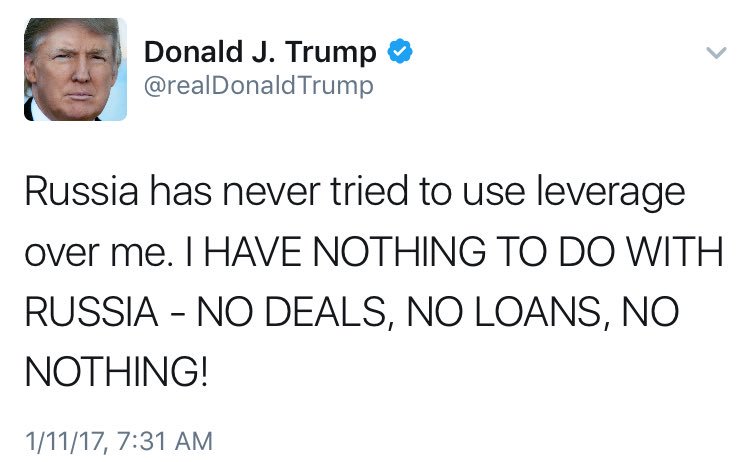
Meanwhile, here’s Trump in January 2017, lying on Twitter yet again:

Ahmed Baba offers The Ultimate Cheat Sheet To The Trump-Russia Investigation:

It was November 9th, 2016. The mood was joyous in the Kremlin as President Vladimir Putin, along with Russian officials, celebrated the election of Donald J. Trump as 45th President of the United States. Champagne was literally popped and toasts were made, as this foreign adversary celebrated American democracy.

Russian Governor, Viktor Nazarov

What we have here is an orchestrated effort by Russia, a hostile foreign power, to undermine American democracy and prop up Donald Trump. Russian President Vladimir Putin’s strategy involved complex espionage and coordinated propaganda campaigns designed to damage Hillary Clinton, chipping away at her support from both the far-left and far-right of the political spectrum.

Russia’s intentions have been widely debated. Some say they never truly expected Trump to win, and were merely trying to weaken Clinton politically, whom Putin has accused of sowing discord in his own nation after Clinton questioned the legitimacy of Russia’s 2011 parliamentary elections. Putin wanted Clinton to come into office beleaguered by congressional investigations and a divided United States [cheat sheet follows]….

Elizabeth Randol explains Why Government Can’t Be Allowed to Make You Pay for Free Speech:

Imagine if Dr. Martin Luther King, Jr., future Congressman John Lewis, and their compatriots in the civil rights movement had been stuck with the bill for Sheriff Bull Connor’s harassment, beatings, and arrests. Under a proposal before the Pennsylvania Senate, people who take to the streets to express their political views would face exactly that if they end up on the wrong side of the law.

On August 16, Senator Scott Martin (R-Lancaster) introduced a bill that could hold protesters liable for public safety costs associated with demonstrations.  The primary trigger for this proposed legislation was the protest of the  Dakota Access Pipeline, though it was introduced just four days after the white supremacist demonstrations in Charlottesville, Virginia.

Under Senate Bill 754[2], courts could hold individuals convicted of protest-related misdemeanors or felonies liable for all public safety costs associated with demonstrations. This is most certainly unconstitutional and would likely be struck down in federal court, but only after a costly legal fight….

David Haynes warns of The risk of believing in Foxconn:

Even under the best conditions, Wisconsin taxpayers won’t break even for 25 years, according to the nonpartisan Legislative Fiscal Bureau. But it might be a lot longer if more workers than expected drive up from Illinois or if Foxconn automates more work than expected and creates fewer jobs. In a globally competitive industry, Foxconn will automate extensively, which is why predictions of 13,000 jobs in a few years at the Wisconsin plant sound wildly optimistic. Points for [WEDC leader] Hogan for trying to mitigate that risk. The fact is we really don’t know where the break-even point is. The Fiscal Bureau notes that the way Gov. Scott Walker’s administration accounted for the capital tended to reduce the cost to taxpayers. Using a more typical accounting method “could push the break-even point for the project further into the future,” the Fiscal Bureau warns.

But there is a more basic question that has to be answered: Can Foxconn be trusted?

I’d love to believe the story that Foxconn Chairman Terry Gou is spinning. I’d love to imagine a sprawling, new industry emerging in southeastern Wisconsin, an operation that includes thousands of good-paying factory jobs making next-generation flat-panel LCD screens (Hogan says the median wage would be nearly $54,000). I’d love to see scores of smart technical people working at a cutting-edge research and development facility.

But then the dream bubble over my head bursts, and I remember Harrisburg, Pa.

And India and Brazil.

And Vietnam and Indonesia.

In all of those places, Foxconn talked big and failed to deliver. Walker has blamed the collapse of a factory deal in central Pennsylvania on a transition in state government. (A Democrat took office). But how to explain the others?….

Here’s a map shows every upcoming solar eclipse until 2040:

Mentoring

local scene I’ve long held that Whitewater’s Major Public Institutions Produce a Net Loss (And Why It Doesn’t Have to Be That Way). This contention is true for several reasons, all leading to this result: “Whitewater’s major public institutions – her city government, school district, and local university – produce this unexpected result: although members of the government are certainly also sharp and capable individually, they often produce collectively a product that’s beneath their individual abilities or that of other competitive Americans.”

Why is this so? I’d suggest that in the breadth of these institutions, across all members, mentoring is weak. In a well-ordered and competitive profession or institution, a mentorship between an experienced leader and a younger work is a long process, lasting somewhere between five and ten years. There’s always particular to learn procedurally, but it’s just as true that the application of substantive, field-specific knowledge (medicine, law, finance, engineering) to particular circumstances is a gradually-acquired skill.

Some might suggest that a gifted young professional should advance more quickly than this, that someone in this position shouldn’t need a mentor for so long. I’d answer with two points: (1) some mentorships can productively last for decades, as a valuable if in later years less-used resource, and (2) it’s the most gifted young professionals who will gain the most from a long mentorship under a talented older colleague.

Ordinary grapes don’t take long to become juice; fine grapes slowly develop into excellent wines.

Mentorships in these local institutions probably go poorly because (1) the mentors are themselves weak or bad examples, and (2) younger workers are impatient to assert abilities that are, in fact, not nearly so developed as they would be in a truly nurturing environment.

Whitewater’s public institutions have particular public departments or administrative branches in which there hasn’t been a competent, capable leader for decades (literally, a generation or more). Each and every one of the employees who has come up in conditions like that has been cheated from a proper coaching and proper maturation within his or her field.

It’s worth stating what I believe to be a cold truth (almost always applicable): if an early professional’s development (the first five to ten years) is poorly guided, his or her whole career thereafter risks being markedly less than it might have been under sound guidance. Often the younger worker won’t even be able to discern the difference between his or her mediocre development and a competitive professional’s training.

Even someone with many developmental gaps can be brought to a sound professionalism if one begins early enough, and has the chance to guide positively, nurturingly. A younger professional who doesn’t have that experience is harder to guide positively, and (if there’s any chance of success) the task often requires more correction and discipline than anyone might wish.

A community that does not provide good mentors will not develop good professionals. It will find itself stuck with those who don’t know what they don’t know.  Good mentors need to be those with both practical and substantive knowledge in the younger employee’s field. General guidance and how-tos are not enough: a doctor could show a young lawyer around town, but that ordinary information isn’t why anyone consults with a doctor or a lawyer. A solid mentor, by the way, should himself or herself be reading field-specific material (e.g., as a physician with new procedures, new medicines, new approaches, etc.) or considering practical techniques (e.g., as a designer with new construction techniques, equipment, materials, etc.) each day. If one’s not thinking each day about one’s field, one needs rethink one’s line of work.

Someone who has gone nine or ten years without good guidance (e.g., no mentor, a weak mentor), is troublesome both on his or her own and to others. It’s an imposition on private time and resources to expect that private citizens to tolerate those who have wasted their own years and done little or nothing to help younger colleagues, colleagues who by then are simply a burden or risk to others.

A small town like Whitewater only makes matters worse when leaders insist all is well, all the time. Positive coaching should be a private matter. When accentuating the positive becomes the public ethos, younger workers will place public relations over the substance of their fields. Looking good as a goal impresses only the vain or weak-minded.

The public ethos should rest on the claim that whatever one does can be improved and advanced, internally through proper mentoring and externally through the adoption of best practices wherever they may be found.

 

Daily Bread for 8.27.17

Good morning.

Whitewater will see thunderstorms today with a high of seventy-two. Sunrise is 6:15 AM and sunset 7:36 PM, for 13h 21m 14s of daytime. The moon is a waxing crescent with 32.4% of its visible disk illuminated. Today is the {tooltip}two hundred ninety-first day.{end-texte}Days since Trump’s election, with 11.9.16 as the first day.{end-tooltip}

On this day in 1883, the island volcano Krakatoa erupts, causing tidal waves in Indonesia’s Sunda Strait that would claim some 36,000 lives in Java and Sumatra. On this day in 1864, the 5th, 6th, 7th, 19th, 36th, 37th and 38th Wisconsin Infantry regiments remained entrenched around Petersburg, Virginia.

Recommended for reading in full —

David Frum observes that Trump Won’t Back Down:

….Trump has bolted himself back to his political base, defying all mainstream opinion. It’s not just a matter of appealing to nativist voters, although Donald Trump always is glad to do that. Many conservative voters who are not especially nativist will rally to the Arpaio pardon too. Conservatism has been leaking its ideological contents for a long time now, and the Trump experience has ejected whatever little remained. Yet conservative voters remain passionately attached to Donald Trump, at least as compared with anyone else in politics, as a recent poll from George Washington University demonstrates. Among Republicans in Republican districts, 53 percent complained their member of Congress was not doing enough to support President Trump; only 4 percent complained that the representative was doing “too much”….

If it weren’t for the atavistic hatreds—and of course the micro-targeted paybacks to favored lobbying constituencies—not much would remain in the Trump era of the party of Reagan and the Bushes. But the hatreds still rage hot and fierce, and having been powered into the presidency by them once, Donald Trump hopes he can do it again. After all, what other choice does he have? Not only because he has accomplished nothing better, but because it’s not in his nature even to imagine what that “better” could look like.

(Frum’s right, as Trump’s course is unsurprising. This is why it’s true, as it has been since the beginning of Trump’s rise, that our present conflict will end only when Trump meets his complete ruin.)

Adam Liptak explains Why Trump’s Pardon of Arpaio Follows Law, Yet Challenges It:

Noah Feldman, a law professor at Harvard, argued before the pardon was issued that such a move “would express presidential contempt for the Constitution.”
“Arpaio didn’t just violate a law passed by Congress,” Professor Feldman wrote on Bloomberg View. “His actions defied the Constitution itself, the bedrock of the entire system of government.” By saying Mr. Arpaio’s offense was forgivable, Professor Feldman added, Mr. Trump threatens “the very structure on which his right to pardon is based.”

It was the first act of outright defiance against the judiciary by a president who has not been shy about criticizing federal judges who ruled against his businesses and policies. But while the move may have been unusual, there is nothing in the text of the Constitution’s pardons clause to suggest that he exceeded his authority.

(Trump will abuse powers granted to him to undermine lawful authority – such as that of the judicial branch – that remains outside his grasp.)

Edel Rodriguez writes that As a boy, I fled despotism in Cuba. Now I’m fighting it here in America:

….At 19, I became an American citizen, one of the highlights of my life. Throughout high school, I had become a devoted student of U.S. history and cherished this country’s democratic system. I came to feel that this was truly my country.

Over the past year, though, I’ve sometimes strained to differentiate my adoptive country from the dictatorship I fled. Violence at political rallies, friends watching what they say (and noting who is in the room when they say it) and a leader who picks on society’s weakest — this has felt all too familiar. I began making art about what I saw, to bear witness. I wanted to hold up a mirror to the president’s daily abuses of the Constitution, test the rights given to me by that Constitution. I wanted to find out if this is really the land of the free, the home of the brave.

The work has been published on magazine covers worldwide and on street posters, and has appeared at numerous political rallies. I’ve been interviewed by television shows and been the subject of news articles. I would give all of that up for a return to normalcy. A return to the idea that the magic of America lies in the fact that it is a country of immigrants and will always be. I love going to Chinatown and not understanding a thing, eating new food in Koreatown, speaking Spanish with the guys in the taco truck and dancing to Arabic music with the Egyptian falafel cook on the street. One of the great things about America is having a genuine international experience without having to travel.

Immigrants have made America a shining example to the world, have renewed this country and will continue making it great.

Michael Cavna reports on The next Pokémon Go? Star Wars unveils a massive ‘Last Jedi’ augmented-reality game:

If it can work for Pokémon, then why not for the world of Obi-Wan?

An augmented-reality experience as real-world physical hunt is being rolled out next month by another global entertainment franchise, with the next Star Wars film, “The Last Jedi,” on the near horizon.

Last summer, as the AR scavenger hunt from Pikachu’s universe exploded — spurring a $7.5 billion market-value surge for maker Nintendo — The Washington Post’s Comic Riffs asked: “Now, what’s to keep the Comcasts and Apples and Amazons and Disneys of the world from making our naturally 3-D world the exciting new area of augmented exploration on a scale as massive as Pokémon Go?”

The short answer from Disney, one year later: Apparently nothing. Because the Mouse House is unveiling its promotional stunt of a free “treasure hunt” on a rather massive scale, the company announced early Thursday.

The campaign’s basics, by the numbers: As the first wave of “Last Jedi” merchandise lands Sept. 1 (a.k.a. “Force Friday II”), the “Find the Force” AR game — involving about 20,000 stores in 30 countries — will let participants hunt down 15 Star Wars characters, two are which are new. (Is that the Admiral Ackbar you’re looking for?)….

Today I Found Out describes the sad fate of the passenger pigeon in From Billions to Zero in 50 Years:

Daily Bread for 8.26.17

Good morning.

Saturday in Whitewater will be partly cloudy with a high of seventy-five. Sunrise is 6:14 AM and sunset 7:38 PM, for 13h 23m 58s of daytime. The moon is waxing crescent with 23.7% of its visible disk illuminated. Today is the {tooltip}two hundred ninetieth day.{end-texte}Days since Trump’s election, with 11.9.16 as the first day.{end-tooltip}

On this day in 1863, the 3rd Wisconsin Cavalry is among the Union forces that assault Confederate-held Perryville, Oklahoma.

Recommended for reading in full — 

Judd Legum relates The inside story of how TMZ quietly became America’s most potent pro-Trump media outlet:

Trump was the ideal vehicle for TMZ to break into political coverage. A reality TV host and a creature of celebrity culture pursues the most powerful position in the world?—?all while dishing out TMZ-friendly sound bites on a daily basis.

As Trump has risen, TMZ has quietly emerged as, arguably, the most important pro-Trump outlet in America. Fox News is the largest and best known, but its audience is older and already inclined to support Trump. Breitbart is the most aggressive and strident, but its connection to white nationalism limits its appeal. TMZ attracts a large and diverse audience?—?precisely the folks Trump needed to reach to stitch together a winning coalition.

Stories on TMZ not only gain a wide audience online but also appear on two nationally syndicated daily television shows (TMZ and TMZ Live) that, in most markets, are aired multiple times each day.

Jennifer Rubin asks Is the GOP a lost cause?:

….Consider the following: If Trump is still president in 2020 and still enjoys a strong majority of support among Republicans, what hope would there be for a devoted anti-Trump Republican? He or she would be running in a party convinced that there are “fine people” in league with neo-Nazis, that the press is the enemy of the people, that white working-class people are victims of foreigners, that Christianity is under attack, that Russia isn’t so bad after all, etc. It seems unlikely that a decent, rational person could win the nomination of a party gone (politically speaking) stark-raving mad….

It would seem that those Republicans contemplating a challenge to Trump –as Ohio Gov. John Kasich reportedly is — have to consider the possibility that the GOP is a lost cause. If they would be blocked from running as an independent under so-called “sore loser” rules, then it would make far more sense to run for president as an independent or leader of a new third party. Preparation for that possibility should start sooner rather than later.

Kristen Soltis Anderson contends that Data show that Trump’s real base is 24 percent of the electorate:

….The data – on issues and on Trump himself — keep pointing back to “one-in-four” as the true size of Trump’s base. It is around one in four who like the tweeting, like the insults, the things other people say are mean or unproductive behavior.

If Trump’s job approval erodes to down to this level, that would almost certainly spell electoral doom for Republicans. On the eve of the Pelosi wipe-out of GOP House control in 2006, former President George W. Bush had an approval rating that looked a lot like Trump’s does now, to say nothing of how bad things could get if they fall further.

But one-quarter of the 160 million registered voters in America is still 40 million people. That’s not enough to win re-election, but it’s enough to pack a lot of arenas donning red MAGA hats — and that may be good enough for Trump’s tastes.

Jane Coaston writes that ‘Virtue Signaling’ Isn’t the Problem. Not Believing One Another Is:

….The real problem, of course, isn’t the signaling part: Everyone is signaling all the time, whether it’s about social justice or their commitment to Second Amendment rights or their concerns about immigration law. Those who accuse others of virtue signaling seem angry about the supposed virtues themselves — angry that someone, anyone, appears to care about something they do not. Another Twitter user, defending Donald Trump after the infamous ‘‘Access Hollywood’’ tape, wrote: ‘‘Stop virtue signaling. It doesn’t work. Are you saying you never talked dirty in a [private] conversation?’’ The logic here is not that Trump or his actions were morally correct, but that no one else is, either, and anyone who claims otherwise is lying….

But of course many people do care, about all sorts of things that you or I might disagree with. People on low-lying islands in the Pacific care about climate change. Members of the armed forces care about military spending. Transgender people care about their ability to access public facilities, gay people care about whether they can adopt children and evangelical Christians care about their ability to live out their faith in the workplace. These people have families and friends, and next-door neighbors and dog walkers, who most likely care, too. This caring is not a crime; it is an argument, about what people should value in the first place. And accusations of ‘‘virtue signaling’’ are, more than anything, a way of walking out on that argument and dismissing it altogether — a quick and easy solution for those moments when engaging and listening, agreeing or disagreeing, seem too hard, too challenging, too personal, too dangerous.

(When Trumpists criticize others for virtue signaling, they’re running from the powerful argument that Trump is a living expression of vice.)

Great Big Story tells of The Dog Lifeguards of Italy: