Problems of small-town planning are not from lack of plans, they’re from lack of judgment and foresight. Even the smallest towns have plans, regulations, task forces, etc. Problems come from planners (both professionals and residents on committees) who lack the judgment to distinguish between big and small matters (and so waste time on the small). They may also lack foresight (and so cannot distinguish between likely and unlikely outcomes).
Attention to detail is only useful if one can sort details by immediate and future significance.
Saturday in Whitewater will be cloudy with a high of twenty-seven. Sunrise is 7:25 AM and sunset 4:33 PM, for 9h 07m 55s of daytime. The moon is a waning gibbous with 87.1% of its visible disk illuminated.
On this day in 1777, American forces under the command of Gen. Washington repulse a British attack at the Battle of the Assunpink Creek near Trenton, New Jersey.
On Election Day, General Paul M. Nakasone, the nation’s top cyberwarrior, reported that the battle against Russian interference in the presidential campaign had posted major successes and exposed the other side’s online weapons, tools and tradecraft.
“We’ve broadened our operations and feel very good where we’re at right now,” he told journalists.
Eight weeks later, General Nakasone and other American officials responsible for cybersecurity are now consumed by what they missed for at least nine months: a hacking, now believed to have affected upward of 250 federal agencies and businesses, that Russia aimed not at the election system but at the rest of the United States government and many large American corporations.
Three weeks after the intrusion came to light, American officials are still trying to understand whether what the Russians pulled off was simply an espionage operation inside the systems of the American bureaucracy or something more sinister, inserting “backdoor” access into government agencies, major corporations, the electric grid and laboratories developing and transporting new generations of nuclear weapons.
At a minimum it has set off alarms about the vulnerability of government and private sector networks in the United States to attack and raised questions about how and why the nation’s cyberdefenses failed so spectacularly.
An impressive cosmic huddle will greet sky-watchers around the globe as four worlds cluster in the southeast morning sky. Mercury, Jupiter, and Saturn will all appear in near-perfect alignment, while the nearby crescent moon will frame the trio of planets. Each planet will appear as a brilliant dot, with Mercury being the faintest and Jupiter the brightest—all easily visible to the naked eye.
Through binoculars, stargazers will be able to spot Jupiter’s four largest moons, while a small telescope will reveal Saturn’s rings. Because of Earth’s position relative to Mercury and the sun, only half of the innermost planet’s disk will appear illuminated to us. As a result, Mercury will look like a miniature version of the quarter moon through the telescope.
….
AUGUST 12 AND 13: PERSEID METEOR SHOWER PEAKS
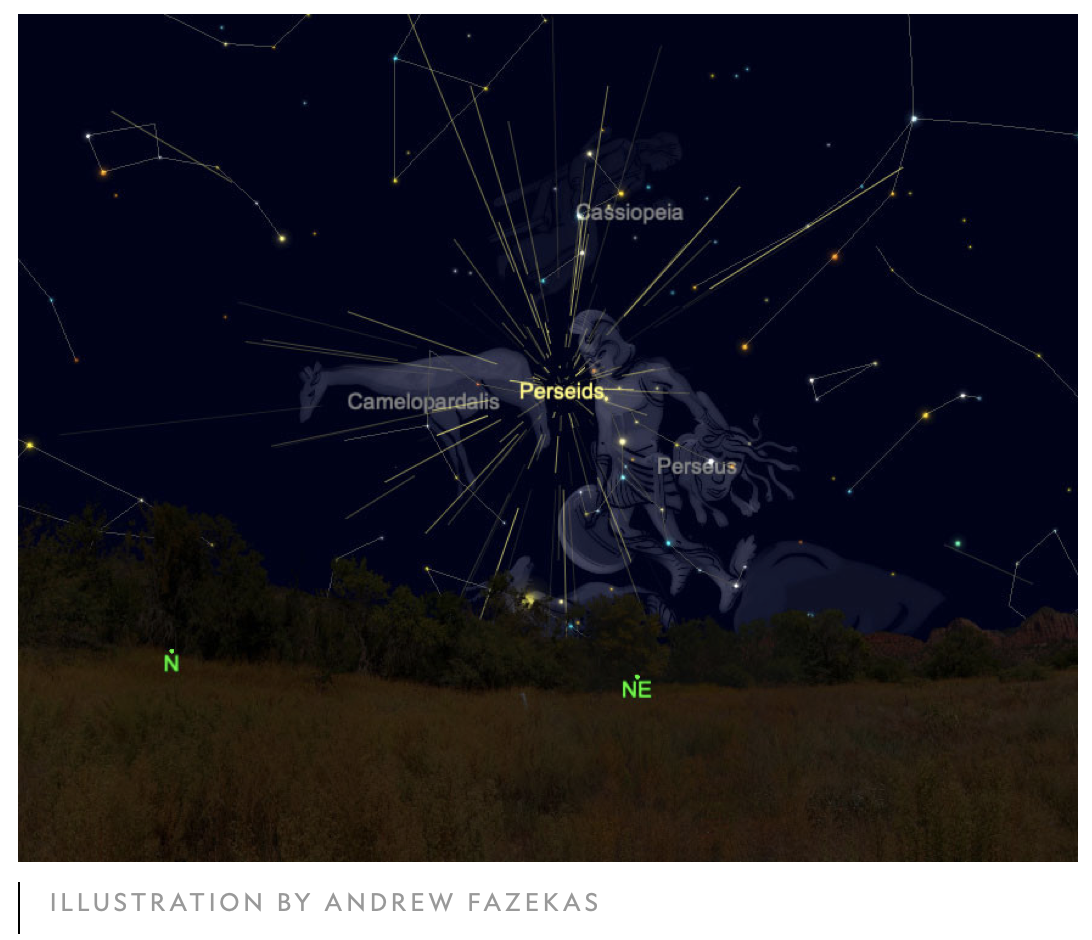
Every mid-August, Earth travels through a cloud of debris shed by the comet Swift–Tuttle, producing a flurry of shooting stars in the skies as small meteors burn up in the upper atmosphere. This is the Perseid meteor shower, and it can produce up to 60 shooting stars an hour in a typical year.
This year promises to be particularly good for the Perseids, since the shower’s peak will coincide with a dark, moonless sky. A thin crescent moon will set during the early evening, ushering in excellent viewing conditions later in the night. The Northern Hemisphere is favored since the meteors always appear to radiate from their namesake constellation Perseus, which lies close to the horizon this time of year for those in far southern latitudes.
To get the best view of this celestial fireworks show, scout out a viewing spot with as little light pollution as possible. Even from a suburban backyard or park, dozens of shooting stars should be visible each hour under clear skies.
People lie about the dumbest things. Here is Republican @ScottWalker (who has been caught lying before) posting a photo of his "great pizza tonight." Next to it is the uncropped version of the same pizza, in a photo he posted last year. pic.twitter.com/LvDkw0I5H7
For Whitewater – and other places – the pandemic hasn’t changed contemporary politics or culture, it has revealed plainly the character of contemporary politics and culture: divided, debilitated. Whitewater’s meaningful changes began years ago, with the Great Recession (2007-2009). For small towns like Whitewater, that recession never ended. It’s as if a man with poor circulation was improperly treated as he began to suffer strokes, first slight, then more pronounced. The wrong treatment would only assure that with each transient episode, the successive toll would become worse.
An easier path to recovery was years ago; it will be a rougher course now.
Catnip’s pungent odor comes from a chemical called nepetalactone. It helps the plant repel insects.
But this research takes us further into the evolution of nepetalactone using genetic analysis. According to study co-author Benjamin Lichman, a plant biologist at the University of York, his team discovered “a suite of unusual enzymes” were responsible for nepetalactone’s kitty arousing properties.
“These enzymes are not found in any related plant species and have evolved uniquely in catmint,” Lichman says.
Nepetalactone uses a double-whammy — literally — to stupefy cats. Lichman and his colleagues discovered that while other types of mint form chemicals using only one enzyme, nepetalactone instead activates one enzyme, which sets off a chain reaction to activate a second enzyme.
Friday in Whitewater will be cloudy, with some snow this evening, and a high of thirty-two. Sunrise is 7:25 AM and sunset 4:32 PM, for 9h 07m 00s of daytime. The moon is a waning gibbous with 93.8% of its visible disk illuminated.
How much damage did Donald Trump do around the world, can it be repaired, and did he accomplish anything of lasting significance? Assessing the international legacy of the 45th US president is not so much a conventional survey of achievement and failure. It’s more like tracking the rampages of a cantankerous rogue elephant that leaves a trail of random destruction and shattered shibboleths in its wake. Last week’s wild pardoning spree is a case in point.
First, the big picture. Trump’s confrontational manner, combined with his “America First” agenda, seriously undermined transatlantic relations and US global leadership. Joe Biden promises to set this right, but it will not be easy.
….
Trump encouraged authoritarian “strongman” leaders such as Turkey’s Recep Tayyip Erdogan and Egypt’s dictator Abdel Fatah al-Sisi, and hooligans such as Brazil’s Jair Bolsonaro. He coddled autocrats such as Saudi Arabia’s Mohammed bin Salman and Russia’s Putin. Worse, his lies eroded trust in democracy and the rule of law, at home and abroad. Yet even as, properly and electorally vanquished, he slowly departs, he continues to antagonise and divide – and to be lionised by the right.
Maybe it’s not that hard to see why. Trump’s personal brand of viciousness appealed to every worst human instinct, justified every vile prejudice, excused every mean and unkind thought. His is a blind ignorance that resonates with those who will not or cannot see. Falsehood is always easier than truth. For these reasons, Trump’s global legacy is Trumpism. It will live on – toxic, immoral, ubiquitous and ever-threatening.
Fourteen years ago, I decided to drive across the United States. This came after a childhood of cross-country rides in the back seat of my parents’ car, visiting my grandparents in Southern California. But in 2007, when I was a full-fledged grown-up, my grandmother worried about this trip well before my departure. My mother wanted to know where I would sleep. My sister said she couldn’t imagine driving all those miles by myself.
“Don’t you wish you had someone there to share it with?” she asked.
Reminding them about my four-legged travel buddy did nothing to quell their unease. “I’m not alone,” I said, time and again. “Darwin will be with me.”
Perhaps I carried an extra air of confidence when I reiterated that statement about my co-pilot and explained that this trip was wholly different from a solo adventure. I had just read John Steinbeck’s “Travels With Charley: In Search of America,” and it spoke to me. Loudly.
“I took one companion on my journey — an old French gentleman poodle known as Charley,” Steinbeck wrote. He described Charley as a born diplomat, expert sniffer and poor fighter. He was an early bird, a good watchdog and friend who “would rather travel about than anything he can imagine.” The pair set off on their journey in September 1960.
Darwin was also a good friend — a sassy, independent beagle, occasional growler and regular howler who loved road trips second only to eating. In 2007, we traveled 8,800 miles in 30 days.

 Problems of small-town planning are not from lack of plans, they’re from lack of judgment and foresight. Even the smallest towns have plans, regulations, task forces, etc. Problems come from planners (both professionals and residents on committees) who lack the judgment to distinguish between big and small matters (and so waste time on the small). They may also lack foresight (and so cannot distinguish between likely and unlikely outcomes).