FREE WHITEWATER

Author Archive for JOHN ADAMS

Officers and Rights

Someone wrote to me, and mentioned that in the comments section of the Janesville Gazette stories on FREE WHITEWATER, some of the most supportive comments on free, anonymous speech came from those who are apparently police officers. (See, City Officials Seek Blogger’s Identity and Blogger Keeps a Watchful Eye on Whitewater.)

I’m not surprised. Most officers are more likely to be better-versed in an understanding of law and rights than others.

I think that it should be clear — to a literate, rational person — that I have an affection and close family connection to policing. In my late-December 2007 post entitled, The Force We Need, I state plainly, that my concerns are of the leadership of our police department.

That’s why it’s unavailing when our force’s present chief falsely contends that I am somehow angry at the department. I am angry at no one; I am critical — for sound reasons of policy — at our current police administrator, and the lack of adequate citizen oversight.

As for our officers, I have always wished them well, and believed that they deserved and would benefit from a different direction. more >>

Daily Bread: April 21, 2008

Good Morning, Whitewater

I’ll lead off this morning with the birthday, in 1838, of conservationist John Muir. Muir was born in Scotland, but came to Wisconsin in 1849. Muir’s work on behalf of conservation and environmental concerns included the founding of the Sierra Club. About two years ago, I read his nature writings, collected in a Library of America volume. Muir’s Story of My Boyhood and Youth recounts, among other experiences, his time in Wisconsin.

There’s an excellent trail named in Muir’s honor in the southern unit of the Kettle Moraine State Forest. It says much about Muir’s greatness that it’s only one of the several trails and parks across America named in his honor.

There’s a Park Board meeting schedule for today at 5 p.m., but otherwise no public meetings scheduled in the city.

In our school district, there is a meeting at the high school of the Whitewater Parent Advisory group scheduled for five o’clock.

Last week, I mentioned that District Administrator Steinhaus submitted an application as a candidate, based on published accounts, for at least four positions in other communities. I don’t recall seeing any other Whitewater publication mention all four applications together, but I may have missed it. The number is significant because it suggests a desire to leave the community. If a candidate applies to one place, the application may mean no more than a special bond to another group; four applications suggests more strongly a desire to leave one’s present position. (I know that sometimes a candidate for superintendent submits applications to more than one district in an area.)

Here’s an update: the St. Cloud, Minnesota picked Steven Jordahl to be its next superintendent; the Prior Lake-Savage District selected Sue Ann Gruver; White Bear Lake selected Mike Lovett.

To my knowledge, the Holmen, Wisconsin District position remains open.

The National Weather Service predicts a high of 77 degrees for today; the year-in-advance Farmers’ Almanac predicts “blustery showers” for the Great Lakes. more >>

Planning and Weather Forecasting

I’ve included two weather forecasts with most Daily Bread posts: one from the National Weather Service, and one from the Farmers’ Almanac.

As I noted previously, there is a way to look at the two as a contrast between government and private sector planning. Reader Amy wrote me in early April, and asked me if the two weather reports had a deeper meaning. Here’s what I wrote on April 7th in reply:

Reader Amy writes with her theory about the use of a weather report on Daily Bread: Am I including a daily weather report (1) just as a weather report, (2) as a commentary on planning — from the National Weather Service, (3) or both? She says both.

That’s it — adding a weather report is both a simple daily bulletin and a libertarian’s take on how hard prediction of complex events — key to planning — really is. That’s why, of course, the Farmers’ Almanac prediction runs alongside the National Weather Service one. In one case, we have the finest models of forecasting in the world; in the second, the assessment of a small book that’s by turns interesting, quaint, or funny, but hardly scientific.

Superficially, the contrast appears to be one between a government agency (NWS) and a private forecaster (Almanac Publishing Company). That appearance is only part of the story — it only addresses the organization responsible for the two forecasts, not the method each uses.

Looking deeper, in this case I think that it’s the government agency that exhibits the flexibility and versatility most common in the private sector; the Farmers’ Almanac — although a private concern — adopts a method more typical of long-range government planning.

There are a few common characteristics to most government planning: (1) long-range forecasting, (2) comprehensive forecasting, (3) planning for others’ property, not one’s own, (4) a public nature of the planning that may encourage special interests to co-opt or distort the planning outcome, and (5) general inflexibility (based mainly on characteristics (1) and (2)).

These characteristics may not all apply in every case, but they appear often in government planning. The long-range and comprehensive nature of most government planning exhibits that audacity that most leads government planning astray — it’s too difficult, even for the very clever, to allocate resources as well through a planning process as through the suppleness of market incentives based on prices.

If that’s true, then it’s the Farmers’ Almanac — with its year-in-advance forecasting method, that more closely resembles government planning than an actual government agency. It’s the Farmers’ Almanac that has the boldness to predict something as complicated as the weather a year in advance.

Once they make the prediction, there’s no going back — the forecast is published, and will not be changed. Like most bad government planning, the Almanac seeks to plan far ahead (a year is a relatively long time for a weather forecast), about complicated events (climate on any given day), and is inflexible (once printed, there’s no going back).

The National Weather Service adjusts forecasts quickly and flexibility as conditions change, and even relies on information from ordinary people to adjust its forecasts. (The National Weather Service has an e-Spotter program, where people can use the Internet to report conditions as they happen.)

That’s why, in this case, I would expect that the flexibility and openness to new information would favor the National Weather Service as a forecaster over the Farmers’ Almanac. In this situation — a rare one, I think — it’s the government agency that has the advantage, as its method is more like a market-oriented one that than an actual, privately-owned publication.

Register Watch™ for the April 17, 2008 Issue

Blogging’s been around for a while, but it’s still new to some people. The unfamiliarity of it likely disturbs a few people in Whitewater. The best example of an overwrought media reaction to blogging can be found in the Register’s March 28th issue, in Register editor Carrie Dampier’s proffer defense of her newspaper. My reply to her defense can be found at my post entitled, “Register Watch™ for the March 28, 2008 Issue (Part 2)

No one should really be shocked by blogging — I’ve contended that blogging is just a modern form of the long American tradition of pamphleteering. See, for example, “Blogging: Once and Future American Tradition.”

Many blogs and websites comment on the media without causing any kind of embarrassing, ill-argued reply. There’s Times Watch, a blog that covers and critiques the New York Times; alternatively, one could read Fox Attacks, a website that critiques Fox News.

If there are blogs that critique sports figures, television stars, politicians, books, films, cars, and musicians, then no one should really be surprised that bloggers will take a look at how the press functions.

Our small town could use a vigorous press, as I believe that a vigorous press keeps government honest.

I’ll take a look at the April 17th issue of the Register and see how our local paper — 152 years old — is doing.

The front page offers up three stories — the dedication of the Cravath Lakefront Arch on Sunday, the new Common Council, and the continuing, multi-part series on the Police Department. (I have waited to comment on the police series, and after three stories in print I feel there’s enough to assess what’s the series. I will do so early next week.)

The most prominent of the stories, accompanied by a color photograph, is on the Cravath Lakefront Arch to be dedicated Sunday. The story describes the sections of the arch, its principal donors, and the date and time of the formal dedication ceremony (Sunday, April 20th at 2 p.m.)

There’s one odd bit to the story, though: the description of a design that commemorates “Whitewater’s rich past, present, and future.” I hope very much that our future is rich, but I know of no way to commemorate what has yet to happen.

Editor Dampier writes on the new member of the Common Council (Lynn Binnie), the Council election of a president (Patrick Singer), and which Council members will have places on various boards and committees. The story involves not a single quotation from anyone (1) reflecting on his or her election, (2) the possible direction of the Council, or (3) assignment to any board or committee.

That seems like the very least one should expect from a newspaper that proudly proclaims it’s Whitewater’s community paper. This is about as incurious as a story could be. Most reporters would like to ask a few questions, get reactions, etc. There’s none of that in this story from any of the elected officials. It’s just a dull recitation without any insight into how any of these politicians might feel about the year ahead.

(There is an accompanying photograph of Binnie taking his oath of office, printed in overly rich colors, and shot from an angle that captures one of the two people in the photograph only from the back.)

Ten — yes, ten — relatively brief stories inside the paper list no author: DWI Receives 2008 National Main Street Program Accreditation, Siren’s Warning, Stimulus Payment Help for Seniors, Public Information Meeting Scheduled for Highway 12 Project, Whitewater Chamber Welcomes New Members, Gateway Offers Forklift Training, EF Homestay Program Looking for Host Families, ‘Help is Here Express’ Bus Tour Comes to Whitewater, Fort Health Care Supports “List it, Don’t Risk It” Campaign, and Top 10 Problems with the American Diet.

Who wrote these pieces? I don’t know. Not one has a byline. Not one says “By Register Staff’, etc. Some of them read like barely re-worked press releases. They take up a lot of space, but they’re without any sort of inquisitive angle, etc.

One wonders if anyone at the Register has any curiosity at all. A local paper should be more than an attempt to fill space between out-of-town advertisements. (Most ads in the April 17th section of the Register are still for concerns located beyond Whitewater.) more >>

Friday Morning Cartoon

Today I offer a cartoon called “Chicken a la King.” It has a Mae West parody, and Mae works her magic in this 1936 cartoon.

It’s also an inside reference to a reader who sometimes sends single-panel parodies of this website to me. He sends them along as a “Hen House” series, in which a quintet of hens critique FREE WHITEWATER. It’s a good series, and I enjoy it. The hens are no fans of FREE WHITEWATER, but that doesn’t really matter to me.

I am sure I like the series more the way it is.

Here’s Chicken a la King — Enjoy.

more >>

Daily Bread: April 18, 2008

Good morning, Whitewater

I’ll run Register Watch™ tonight, and include references to other blogs that review or comment on specific publications.

There are no public meetings scheduled today in Whitewater. Private life goes on unimpeded. (There is the libertarian take of the day.)

The archway near Cravath Lake will be dedicated this weekend, at 2 o’clock on Sunday afternoon. The arch follows the nearby restoration of the Stone Stable as a change in the appearance of the area near Cravath. I have posted previously that I consider the Stone Stable the best Whitewater project of 2007.

In our school district, there are spring pictures at Washington School today, and a book fair at Lincoln.

On this date in 1818, Wisconsin-area land became part of the Michigan Territory. Becoming part of the Michigan territory is not as ominous as it sounds — it brought Wisconsin closer to eventual statehood (as a shift from Wisconsin’s prior status as part of the Northwest Territory).

The forecast is for rain today. I’ll summarize a contrast between forecasts from the National Weather Service and the Farmers’ Almanac this weekend. I’ll also contend that it’s really the private forecast that’s closer to a traditional government model than the National Weather Service’s forecasting method.

Bob Barr Update: Reason‘s David Weigel Reports

Over at Reason, Hit & Run, David Weigel writes, “Bob Barr Has a Posse. Maybe.” I agree, but most especially with the ‘maybe.’

Barr’s running under 30,000 dollars in website-collected contributions as of today. That’s hardly anything. (I assume that the figure represents website-only contributions; if it’s all contributions, he’s in far worse shape.)

Weigel also has an article — available online — from Reason Magazine about Barr, entitled, “Bob Barr and the Libertarians.”

Note: I do not yet have a preferred candidate for the presidential race.

The Work of Loving Kindness: Alzheimer’s Association Donates Books in Jefferson County

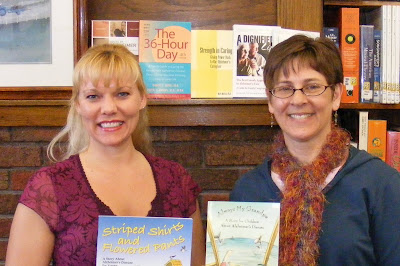
Charity, mercy, and loving kindness will always mean more than politics or policy. In Jefferson County, the Alzheimer’s Association donated books to help an understanding of the disease. Here is a photo from the donation, and the press release detailing the Association’s efforts immediately follows.

(Jennifer Sterling of the Alzheimer’s Association and Amy Lutzke, Reference Librarian, Dwight Foster Public Library in Fort Atkinson.)

Alzheimer’s Association Donates Books to Jefferson County Libraries Book Distributed During National Library Week

Milwaukee, WI – April 16, 2008 – The Alzheimer’s Association recently donated numerous adult and children’s books on Alzheimer’s disease to public libraries in Jefferson County. This effort, which occurred during National Library Week, was geared toward an ongoing public awareness initiative to provide education and support for the 50,000 people in Southeastern Wisconsin who are dealing with Alzheimer’s disease.

Specific books available at the public libraries in Jefferson County include “The 36-hour Day: A Family Guide to Caring for People with Alzheimer’s Disease, Other Dementias, and Memory Loss in Later Life”, and children’s books entitled “Striped Shirts and Flowered Pants: A Story About Alzheimer’s Disease for Young Children”, and “Always My Grandpa: A Story for Children About Alzheimer’s Disease”. Funding for the books was provided by a grant from the Southeastern Wisconsin Community Foundation. For information on services relating to Alzheimer’s disease or related dementia, contact Jennifer Sterling, Regional Services Coordinator, at 920-272-3900.

The Alzheimer’s Association is a national non-profit organization dedicated to eliminating Alzheimer’s disease through the advancement of research and to enhance care and support for individuals, their families, and caregivers. The Alzheimer’s Association of Southeastern Wisconsin provides information, education, and support to people with Alzheimer’s and related dementias, their families, and healthcare professionals throughout an 11-county region. For more information about Alzheimer’s disease and local services visit www.alz.org/sewi or call the toll-free, 24-hour Helpline at 800-272-3900.

– ### –

MEDIA CONTACT: Kristen Crump, Marketing Communications Manager
(414) 479-8800 ext. 206
kristen.crump@alz.org

Kristen L. Crump, Marketing Communications Manager
Alzheimer’s Association of Southeastern Wisconsin
6130 W. National Avenue
Milwaukee, WI 53214
414-479-8800 ext. 206
414-479-8819 fax
800-272-3900 toll free
www.alz.org/sewi

· Alzheimer’s is the seventh leading cause of death in the United States.
· Alzheimer’s is not normal aging, it is a progressive and fatal disease.
· By 2050, experts predict that there will be as many as 16 million Americas living with the disease
· One out of eight people age 65 and older have Alzheimer’s and nearly one out of every two over age 85
has it.

Source: Alzheimer’s Association, 2008.

Daily Bread: April 17, 2008

Good morning, Whitewater

A boiler explosion on campus yesterday resulted in minor injuries for a worker performing routine maintenance. It’s fortunate that there were no other injuries. The Gazette has a update on the accident.

It’s supposed to be rainy today, less like early summer, and more like Wisconsin in April. At least, that’s the forecast from the National Weather Service. In addition to the the forecast summary, the NWS publishes a webpage that details the forecaster’s underlying analysis. It’s called Area Forecast Discussion, and it’s interesting to read. Here’s the NWS explanation for providing a forecast discussion:

This National Weather Service product is intended to provide a well-reasoned discussion of the meteorological thinking which went into the preparation of the Zone Forecast Product. The forecaster will try to focus on the most particular challenges of the forecast. The text will be written in plain language or in proper contractions. At the end of the discussion, there will be a list of all advisories, non-convective watches, and non-convective warnings. The term non-convective refers to weather that is not caused by thunderstorms. An intermediate Area Forecast Discussion will be issued when either significant forecast updates are being made or if interesting weather is expected to occur.

Since the Farmers’ Almanac predicts pleasant weather, one forecaster is likely to be disappointed.

On this day in 1987 1897, Wisconsin native Thornton Wilder was born, in Madison. He won the Pulitzer Prize twice (first for the oft-performed Our Town), and taught in the 1930s at the University of Chicago.

In our schools today, there is a book fair at Lincoln School, and at fifth grade patents meeting at 6:30 p.m. at the Middle School. Like many others, I have fond memories of book fairs and book orders at school.

The St. Cloud Times (Minnesota) reports that Leslie Steinhaus is scheduled to be at a “St. Cloud School Superintendent Candidate Public Reception” today. I do not know how far along the process is, otherwise.

There are no public meetings scheduled for the City of Whitewater for Thursday. more >>

Common Council Meeting for April 15, 2008

The Common Council meeting began with a swearing in ceremony for three council members. Two were returning incumbents (Stewart and Taylor) and one was a new council member (Binnie).

Council President. The next action was an election for Council president. There were two nominees: Jim Stewart and Patrick Singer. Stewart is a retired employee of the university, and publisher of a local website, and Singer has served on both committees and other civic groups in the city. Singer was elected president of the council.

Afterward, there was a nomination for president pro tem: Max Taylor and Jim Stewart were the candidates for that office. Stewart was elected to that office, an office that is about a year old.

Whether it means a different direction for the city I cannot yet say. Sometimes a vote reflects a desire for a certain direction; other times it has no such meaning. It will be, at the very least, a different style of leadership.

That we need a different direction — a more tolerant, market-friendly city — I find beyond doubt. That it matters more to be right, than to look right, I am quite certain. There is more — far more — emphasis on marketing the city than in reforming its principal departments.

Committees. Representatives appointed to various committees: Alcohol Licensing (Singer, Taylor, Binnie); Cable TV (Singer); Community Development Authority (Stewart, Stauffer); Landmarks (Nosek); Library Board (Binnie): Parks and Recreation (Taylor); Planning and Architectural Review Commission (Kienbaum, and Taylor as alternate); Tree Commission (Nosek); Birge Fountain (Nosek).

Accreditation. Chief Coan talked about the onsite re-accreditation review of the Whitewater Police Department on April 23, 24, and 25. Citizens can call a local number, 262-473-1371, from 8 a.m. to 11 a.m. on April 25th to offer comments about the accreditation effort. I may post on accreditation next week.

Zoning. There was a brief discussion of reducing the length of time that it one must wait for a re-determination a zoning decision. It’s 18 months in Whitewater now. There was an administration proposal that a petitioner would have to wait only six months. That’s more reasonable.

Eighteen months is far too long anywhere, and certainly in a city that needs all the incentives it can offer to new businesses. Nearby towns have either no waiting periods or far shorter ones.

Dr. Nosek was concerned that a developer or petitioner might re-petition endlessly. It’s an unreasonable worry. Endless re-petitioning doesn’t happen in towns that have no waiting period, where petitioners have to pay the costs of a re-zoning petition.

Nearby towns offer a competitive advantage, and they have stuck with it. Anti-market views are often presented in abstract ways, even when confronted with evidence that a custom works well in other places. It’s a impulse to set aside practice (even if it happens successfully elsewhere) in favor of narrow reasoning.

When City Manager Brunner, with consultation of the City Attorney, says that six months seemed historically implied, he ignores successful, market-friendly practices elsewhere. Why would the city manager, relying on the city attorney, know more about successful practices than many people and leaders, in several neighboring communities? Why rely on the dead hand of past-practice more than the successes current in competitive, neighboring cities?

If we adopted a foolish regulation in the past, must we keep that regulation or a portion of it now as a sop to precedent?

A quick (in more ways than one), better approach: remove a time restriction on re-petitioning.

Note and Update 8:55 PM: A reader wrote to note, correctly, that I neglected to mention that the Council voted to recommend, to the Planning Commission, that the current waiting period be removed from the existing city requirement. Two quick replies:

(1) My point was that the original recommendation, from the administration, to the Council was for a continued waiting period (6 months), and my comments were in reply to that initial recommendation. The reader is right that there was more to the discussion than that — the administration recommendation was my concern, but the discussion extended beyond, and apart, from the administration recommendation. I have added this update to be clearer about the discussion.

(2) The recommendation to remove the current waiting period was not, listening to the discussion, the same as the full council’s endorsement of no waiting period. It’s clear at least one member might favor a waiting period, and others were waiting to see what the Planning Commission might craft. That’s not the same as a unanimous endorsement that there be no waiting period.

I support removal of the waiting period, unambiguously and without hesitation. There was nothing in the discussion to suggest that sending it to the Planning Commission means that everyone on the council shares the view that there should be no waiting period.

Daily Bread: April 16, 2008

Good morning, Whitewater

It’s predicted to be a beautiful day in Whitewater. The National Weather Service says sixty-nine degrees and breezy. Good enough. Farmers’ Almanac predicts a spell of pleasant weather. They’re either both wrong, or both right.

As we approach summer, each day has been about two or three minutes longer than the preceding one. Although the official time for sunset is a just past 7:30 p.m., civil twilight extends for about a half hour more. There’s ample light to live, work or play outside until past 8 o’clock. (There’s my libertarian outreach to a favorite smart growth planning slogan.)

Today in our history, the battleship USS Wisconsin was commissioned, in 1944. On Wisconsin!

At 7 p.m., there will be a meeting of the tree commission. That’s the only public meeting scheduled in the city today. There has been periodic concern about leaf collection in the city — focusing on how irritating it is to rake them up. There is also a small number that favors government regulation at every turn.

I am surprised these two groups have not joined forces. Whitewater could be the first city in Wisconsin that mandates a cactus-only policy. No leaves, and I’m not even sure if the needles ever fall off.

There’s a policy that will attract attention far and wide.

The Importance of Curiosity

FREE WHITEWATER is a website of independent commentary. It’s not a news site, but it does have something is common — as blogs do — with news sites. Curiosity is key to writing about life in town.

That’s why good reporters and newspapers always exhibit an interest in what lies beneath the initial statement or public announcement.

Here’s a great example — a new blog from a reporter, who’s writing about what it’s like covering the news. It’s called “It’s All about the Story,” and it’s about ‘the day to day grit’ of being a reporter. There’s much — much — to being a journalist, but as a non-journalist, I am very sure that curiosity and interest in one’s own profession must be vital to those skills.

News is more than a mere listing of events — it’s an insight into how news is crafted, reported, and presented to others. It’s All About the Story has the right perspective — it is all about the story.

Over at the GazetteXtra, there’s a whole section on reporters’ and editors’ blogs, so that those who care about reporting can share their insights, insights that underlie their reporting.

Elected — and appointed — officials will provide one take on an event, and often hope and expect that what they say will be taken at face value. In fact, it’s that they expect it to be so — based on who they are, and believe themselves to be — that’s so presumptuous.

In the end, their view on policy comes as close to do you know who I am? than even a parody would be able to do.

The best antidote for all this is an inquisitive outlook. A good reporter or newspaper will be a curious one, interested in the work of journalism itself.

Daily Bread: April 15, 2008

Good morning, Whitewater

It’s April 15th, tax day in Whitewater, and for three hundred million Americans. No one needed to be reminded, but it’s worth noting that we are a highly-taxed state. Wisconsin has been that way for years, and it has taken a toll on us. The sad (and sad because avoidable) details are available at the Leaving Wisconsin blog.

The National Weather Service predicts that it will be 62 and breezy. If that’s the same as the Farmers’ Almanac prediction of ‘squally’ (and I have my doubts) then the forecasters are in agreement.

In Wisconsin history today, in 1900, Spencer Tracy was born. Tracy was born in Milwaukee. My favorite Tracy film: Bad Day at Black Rock, from 1955. Tagline from the film, according to the Internet Movie Database — “Suddenly you realize murder is at your elbow! – and there’s no way out!”

There are no meetings scheduled in the School District, but there are any number of sporting events that should be unaffected if the weather holds as predicted.

There is a Common Council meeting tonight at 6:30 p.m., with the swearing in of new members, and the election of a new council president, etc.

The Brewers did not play yesterday — they play the Cardinals tonight. Milwaukee is currently half a game back (to St. Louis) in the National League Central, so it will be a key, early-season series.