FREE WHITEWATER

Author Archive for JOHN ADAMS

Daily Bread for 8.11.14

Good morning, Whitewater.

There’s a seventy-percent chance of afternoon thunderstorms today, with a high of eighty, in the Whippet City.

Whitewater Planning Commission meets at 6 PM tonight.

In Friday’s FW poll, on whether it would be advisable to pet a zoo lion, 81.82% of respondents would say No, but thanks for asking.

To start off the week, here’s Veritasium‘s presentation of 5 Fun Physics Phenomena:

On this day in 1965, the Watts Riots begin.

On 8.11.1919, a great team is born:

1919 – Green Bay Packers Founded

On this date the Green Bay Packers professional football team was founded during a meeting in the editorial rooms of Green Bay Press-Gazette. On this evening, a score or more of young athletes, called together by Curly Lambeau and George Calhoun, gathered in the editorial room on Cherry Street and organized a football team. [Source: Packers.com]

Google-a-Day asks a geography question:

What mountain in Switzerland includes three types of glacial erosion, and resembles an ancient Egyptian structure with four specific sides?

Daily Bread for 8.10.14

Good morning, Whitewater.

Sunday in the city will be partly sunny with a high of eighty. Sunrise is 5:56 AM and sunset is 8:04 PM. It’s a full moon today, at 1:10 p.m. Central Daylight Time.

NASA tests a saucer-shaped vehicle using a high-altitude balloon:

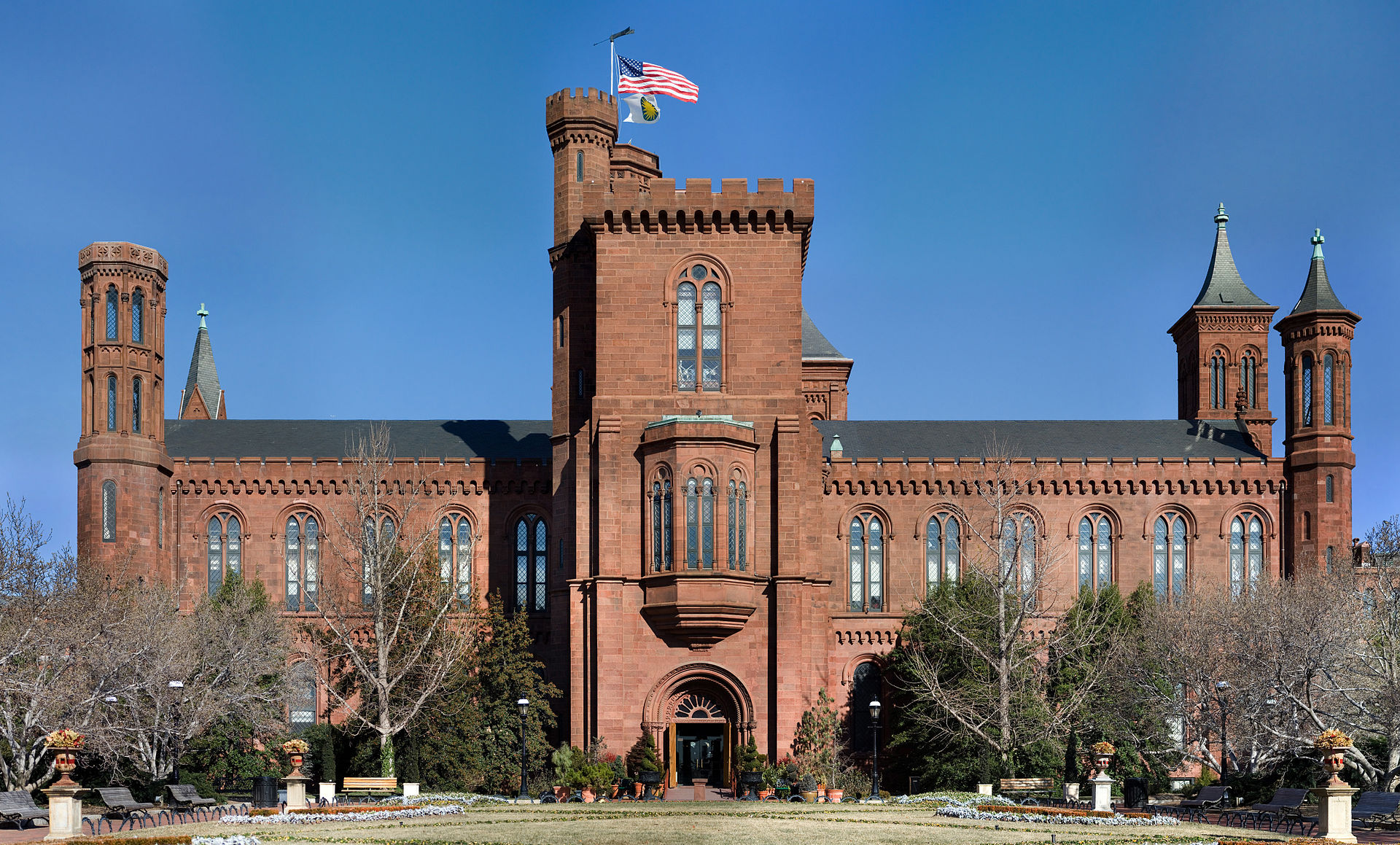
On this day in 1946, Pres. Polk signs a bill creating the Smithsonian Institution:

Smithsonian_Building_NR
The “Castle” (1847), the Institution’s first building and still its headquarters

The Smithsonian Institution ….  smith-soe-nee-?n), established in 1846 “for the increase and diffusion of knowledge,” is a group of museums and research centers administered by the United States government. Originally organized as the “United States National Museum,” that name ceased to exist as an administrative entity in 1967.[1] Termed “the nation’s attic”[2] for its eclectic holdings of 137 million items,[3] the Institution’s Washington, D.C. nucleus of nineteen museums, nine research centers, and zoo—many of them historical or architectural landmarks—is the largest such complex in the world. Additional facilities are located in Arizona, Maryland, New York City, Virginia, Panama and elsewhere, and 168 other museums are Smithsonian affiliates. The Institution’s thirty million annual visitors[4]are admitted without charge; funding comes from the Institution’s own endowment, private and corporate contributions, membership dues, government support, and retail, concession and licensing revenues.[3] Institution publications include Smithsonian and Air & Space magazines….

British scientist James Smithson (d. 1829) left most of his wealth to his nephew Henry James Hungerford; however, when Hungerford died childless in 1835,[5] the estate passed “to the United States of America, to found at Washington, under the name of the Smithsonian Institution, an Establishment for the increase & diffusion of knowledge among men.”, in accordance with Smithson’s will.[6] Congress officially accepted the legacy bequeathed to the nation, and pledged the faith of the United States to the charitable trust on July 1, 1836.[7] The American diplomat Richard Rush was dispatched to England by President Andrew Jackson to collect the bequest; Rush returned in August 1838 with 105 sacks containing 104,960 gold sovereigns (about $500,000 at the time).[8][9]

Once the money was in hand, eight years of Congressional haggling ensued over how to interpret Smithson’s rather vague mandate “for the increase and diffusion of knowledge.”[7][9] Unfortunately the money was invested by the US Treasury in bonds issued by the state of Arkansas which soon defaulted. After heated debate, Massachusetts Representative (and ex-President) John Quincy Adams persuaded Congress to restore the lost funds with interest[10] and, despite designs on the money for other purposes, convinced his colleagues to preserve it for an institution of science and learning.[11] Finally, on August 10, 1846, President James K. Polk signed the legislation that established the Smithsonian Institution as a trust instrumentality of the United States, to be administered by a Board of Regents and a Secretary of the Smithsonian.[7]

Daily Bread for 8.9.14

Good morning, Whitewater.

Saturday in town will be mostly sunny, with a high of around eighty, and east winds of five to ten mph.

On this day in 1974, Gerald Ford becomes president:

In accordance with his statement of resignation the previous evening, Richard M. Nixon officially ends his term as the 37th president of the United States at noon. Before departing with his family in a helicopter from the White House lawn, he smiled farewell and enigmatically raised his arms in a victory or peace salute. The helicopter door was then closed, and the Nixon family began their journey home to San Clemente, California. Richard Nixon was the first U.S. president to resign from office.

Minutes later, Vice President Gerald R. Ford was sworn in as the 38th president of the United States in the East Room of the White House. After taking the oath of office, President Ford spoke to the nation in a television address, declaring, “My fellow Americans, our long national nightmare is over.”

Ford, the first president who came to the office through appointment rather than election, had replaced Spiro Agnew as vice president only eight months before. In a political scandal independent of the Nixon administration’s wrongdoings in the Watergate affair, Agnew had been forced to resign in disgrace after he was charged with income tax evasion and political corruption. In September 1974, Ford pardoned Nixon for any crimes he may have committed while in office, explaining that he wanted to end the national divisions created by the Watergate scandal.

On this day in 1793, a pioneer is born:

1793 – Milwaukee Pioneer Solomon Juneau Born

On this date Laurent Salomon Juneau was born in Repentigny, Quebec, Canada. Known as the founder of Milwaukee, Juneau was a fur trader with John Jacob Astor’s American Fur Company. He built the first log house in Milwaukee in 1822 and followed with the first frame house in 1824. In October 1833 he formed a partnership with Morgan L. Martin to develop a village on the east side of the Milwaukee River. Juneau was elected commissioner of roads and director of the poor in September 1835. He was also appointed postmaster, a position he held until 1843. In 1837 he began publishing the Milwaukee Sentinel. He was elected first mayor of Milwaukee in 1846. Juneau died on November 14, 1856. [Source: Dictionary of Wisconsin Biography, p.198]

Friday Poll: Petting a Zoo Lion


Although some of the facts are disputed, there’s common acknowledgement that Renae Ferguson visited a small Michigan Zoo, entered a lion’s cage, and may have had part of her finger bitten off. Ferguson contends a zookeeper invited her into the cage to pet the lion; the zoo claims she entered against an employee’s warning.

(Note to zoo: that’s a sketchy defense. A plaintiff’s attorney will likely contend that the applicable standard of care requires a cage design that prevents visitors from entering, regardless of what a zoo’s employee might have said.)

In any event, assuming you were invited to pet a zoo lion, would you do it?

Daily Bread for 8.8.14

Good morning, Whitewater.

We’ll end our work week on a mostly sunny Friday with a high of eighty.

On this day in 1974, Nixon resigns, to be effective noon the next day.

Text of the full speech is available at the University of Virginia’s Miller Center website.

Six years earlier, on August 8, 1968, Wisconsin picked Nixon:

1968 – Wisconsin Delegates Nominate Nixon

On this date thirty Wisconsin delegates at the Republican National Convention in Miami cast their votes to nominate Richard Nixon as the Republican party presidential candidate. These thirty votes gave Nixon the majority over Nelson Rockefeller and Ronald Reagan and won for him the party nomination. Nixon selected Spiro Agnew to be his running mate. [Source: Back in Time]

Google-a-Day asks about an abolitionist:

What abolitionist rented a house from the husband of the woman for whom Grace Park in Akron, Ohio, is named?

No Official in America Reigns

Over at the Gazette, yet another editorial goes wrong. 

While trying to praise the work of retiring Rock County Administrator Craig Knutson, the Gazette headlines with Our Views: Rock County’s Craig Knutson deserves salute for solid reign (subscription req’d).  (The editorialist uses reign once again, in the body of the editorial.) 

The use of reign is most likely a superlative gone bad: in a rush to praise Knutson, that praise includes an imperious description of his tenure, as though he were a king.  It’s too much for too little. Even the most ardent supporters would shy from writing, respectively, of a Clinton reign or a Bush reign.  (If used at all, that description of tenure would be used only with sarcasm, as an insult.) 

It’s not, however, an accidental use in this editorial: it appears twice (title and body), and in any event it’s not as though a thousand monkeys at a thousand keyboards typed away until reign appeared twice.  (At least, one supposes that’s not how the Gazette produces its editorials.) 

I think it’s something more, really, than just a misused word ignorantly assumed to be one of praise.  It’s an obsequiousness to anyone in authority, something ones sees from the Gazette’s editorial board over and over. 

Insiders, influencers, self-professed development professionals, corporatist special interest groups, unctuous toads and shady hucksters: those are the people to whom the Gazette speaks, and from whom they wish to curry favor. 

It’s too funny that the editorial describes gasps and groans from Rock County board members when they learned of the administrator’s pending retirement, as though mentioning what a few politicians think settles a question more decisively than what many residents think.

As for Rock County, Jefferson County, Walworth County, or any of the other sixty-nine counties of Wisconsin — no one reigns, and it’s an insult (of intention or ignorance) to say otherwise.

Some Assets Can Only Be Sold Once

A person with an apple orchard can – and expects – to sell apples for more than one season.  In fact, his success almost certainly depends on more than one year’s crop. 

For media companies selling radio or television stations, or spinning print from broadcast assets, it’s a one-time transaction. 

When the broadcast properties are gone, they cannot be sold by the same company again (and probably can’t be repurchased, at least for the same or lower price). 

Perhaps the assets to be sold aren’t worth much, and are mostly a headache, anyway.

For broadcast-station sales, that’s not true; those sales are more like selling a kidney than an appendix, so to speak. 

Then again, media problems are not, principally, economic problems; they’re content problems. 

It’s by failing to see that content is paramount that media develop economic problems.  Asset sales, though, aren’t lasting solutions to those problems. 

Daily Bread for 8.7.14

Good morning, Whitewater.

Thursday will be mostly sunny with a high of seventy-nine. Sunrise today is 5:53 AM and sunset 8:08 PM. The moon is a waxing gibbous with eighty-six percent of its visible disk illuminated.

Whitewater’s Landmarks Commission meets tonight at 6 PM.

On this day in 1912, Theodore Roosevelt accepted the nomination of the Progressive (Bull Moose) Party. He fell well short of Wilson in the November election, but ahead of Taft:

Roosevelt ran a vigorous campaign, but the campaign was short of money, as the business interests which had supported Roosevelt in 1904 either backed the other candidates or stayed neutral. Roosevelt was also handicapped by the fact that he had already served nearly two full terms as President, and thus was challenging the unwritten “no third term” rule.

In the end Roosevelt fell far short of winning. He drew 4.1 million votes—27%, well behind Wilson’s 42% but ahead of Taft’s 23%. (6% went to SocialistEugene Debs). He received 88 electoral votes, compared to 435 for Wilson and 8 for Taft.[13]

This was nonetheless the best showing by any third party since the modern two-party system was established in 1864. Roosevelt was the only third-party candidate to outpoll a candidate of an established party.

Google-a-Day poses a science question:

The founder of the annual medical science awards that are often called “America’s Nobels” is also considered the founder of what field?

When Even Other Democrats Complain About a Democratic Candidate

Mike Sheridan’s running in the 15th District Senate primary against two other Democrats, as Sen. Cullen is retiring.  

It’s not common for others within one’s party to be so critical of a candidate against whom they’re not running, but former colleagues of Mr. Sheridan (when he was in the Assembly) have strong criticisms of his candidacy.

(Links below are subscription req’d, to the Gazette.)

First Jim Krueser, Kenosha County executive, Former Assembly Democratic leader:

Mike Sheridan, when you were elected to the Legislature, I served as leader of the Assembly Democratic Caucus. I enjoyed working with you and believed you had a bright future. When I retired from the Assembly, I was proud to turn the leadership reins over to you. Boy, do I regret supporting you as leader.

Among a series of poor choices, your having an inappropriate relationship with a lobbyist, who had a major issue before the Legislature, reflected a true lack of leadership.

Power changed you. You were one of the top leaders in Wisconsin. This didn’t mean you could hold your office hours on the golf course. Your service was selfish rather than selfless.

Ultimately, your constituents suffered the most from your poor choices. Their disappointment was reflected in your re-election loss in 2010.

But wait, there’s more…

Assembly Democrat Fred Kessler of Milwaukee spent $5,000 on an ad just to complain about his former colleague:

Rep. Fred Kessler, D-Milwaukee, said he paid about $5,000 to place the radio ad in the Janesville market, including on radio stations WCLO and WJVL….

Kessler said he had many issues with Sheridan.

Beyond the payday legislation, Kessler said he didn’t like Sheridan’s leadership on issues such as funding for voucher schools, placement of sexual offenders and redistricting.

“Mike was a terrible leader,” Kessler said, claiming that Sheridan several times did not follow through on the overwhelming wishes of his caucus.

I don’t agree with many of Kessler’s positions (including his opposition to anonymity), but it’s truly unusual for these two men to speak as boldly as they have about fellow Democrat Mike Sheridan. 

In Kessler’s case, he’d be happy with either of the other Democrats in the race – his opposition isn’t even wrapped around an endorsement. 

I’m curious to see how this primary ends – is this kind of intra-party opposition to Mr. Sheridan derived from a well-founded concern that he might win on August 12th, or is it merely a strongly-felt expression of disappointment with a former colleague?