

Anderson, Cartoons & Comics
Never Not
by JOHN ADAMS •
Good morning, Whitewater.
Wednesday in Whitewater will be sunny with a high of seventy-seven.
Farmer Daniel Klingenberg decided to play a cover of a Lorde song on his trombone for his cows. They liked it:
On this day in 1945, after years of a war that Japan began at Pearl Harbor, America dropped an atomic bomb on Hiroshima.
Google-a-Day asks a question about language and geography:
What is the largest surviving Latin American language reaching from Columbia to Chile?
Sharks, like many people, dislike surveillance cameras:
REMUS SharkCam: The hunter and the hunted from Woods Hole Oceanographic Inst. on Vimeo.
In 2013, a team from the Woods Hole Oceanographic Institution took a specially equipped REMUS “SharkCam” underwater vehicle to Guadalupe Island in Mexico to film great white sharks in the wild. They captured more than they bargained for.
Posted at FREE WHITEWATER and Daily Adams.
Over at the Gazette, there’s a letter to the editor that touts Mike Sheridan, candidate for the 15th Senate District, as skillful: Your Views: Mike Sheridan has skills, ability to serve state Senate district (subscription req’d).
I’ve written about Sheridan’s public career before; for those readers who are Democrats, and will vote in the primary, there are better choices.
For those touting Sheridan’s skills, there is at least something to be said for how important skills – in general – are.
Napoleon Dynamite explains:
Just what the Wisconsin Senate needs, no?
DANGER ISLAND from Ryan Gillis on Vimeo.
Good morning, Whitewater.
We’ll have a sunny day with a high of seventy-seven today.
Common Council meets tonight at 6:30 PM.
I’ve purchased a few things on eBay, but I’ve never sold anything there. For those who do, or would like to do so, here’s a video that describes a simple way to make one’s goods look sharp, with a basic photographic technique:
On this day in 1864, the United States Navy defeats a Confederate force at the Battle of Mobile Bay:

The Battle of Mobile Bay of August 5, 1864, was an engagement of the American Civil War in which a Federal fleet commanded by Rear Adm. David G. Farragut, assisted by a contingent of soldiers, attacked a smaller Confederate fleet led by Adm. Franklin Buchanan and three forts that guarded the entrance to Mobile Bay.
The battle was marked by Farragut’s seemingly rash but successful run through a minefield that had just claimed one of his ironclad monitors, enabling his fleet to get beyond the range of the shore-based guns. This was followed by a reduction of the Confederate fleet to a single vessel, ironclad CSS Tennessee. Tennessee did not then retire, but engaged the entire Northern fleet. The armor on Tennessee gave her an advantage that enabled her to inflict more injury than she received, but she could not overcome the imbalance in numbers.
She was eventually reduced to a motionless hulk, unable either to move or to reply to the guns of the Union fleet. Her captain then surrendered, ending the battle. With no Navy to support them, the three forts within days also surrendered. Complete control of the lower Mobile Bay thus passed to the Union forces.
Mobile had been the last important port on the Gulf of Mexico east of the Mississippi River remaining in Confederate possession, so its closure was the final step in completing the blockade in that region.
This Union victory, together with the capture of Atlanta, was extensively covered by Union newspapers and was a significant boost for Abraham Lincoln’s bid for re-election three months after the battle.
Google-a-Day asks a question about oil:
Who drilled the first European oil wells in 1864?
Posted at FREE WHITEWATER and Daily Adams.
There are more than three kinds of officials, but consider these three broad types:
1. The Mediocre. In almost all cases, people are more than intelligent enough to complete the tasks before them – it’s usually ignorance or laziness that inhibits successful work. These are the so-called public servants who mostly seem to be serving their own need for the limelight. They’re light on ideas but big on being seen.
They’re disparaging of study and reflection, even if the standard required should be no more than a conventional, high school education and follow-up reading. Even that’s too hard for them, often, and they’re likely to be heard complaining that they shouldn’t have to do better.
(There’s an irony about the views of this first group. Among their number are some who are quick to blame falsely those of other races or ethnicities for laziness, yet it is the members of this group who are, in fact, truly lazy.)
2. The Flacking. These officials are credentialed, and want to make sure you know it on each and every occasion they’re introduced.
In their work, they may show little evidence of the formal education they tout, but that’s not their purpose: they misuse their credentials to lend credibility to their mediocre compatriots who are too indolent to do good work.
Find ten Mediocrities, and you’ll find one overly-credentialed Flack who’s role is to lend credibility to the shoddy work of the ten. That the Flack does almost nothing substantive, himself, doesn’t matter – his job is to lend a patina of erudition to otherwise bottom-shelf work.
3. The Talented. From every walk of life, from every race and ethnicity, one finds people who are truly talented. They’re thorough, inquisitive, and dogged by turns.
Their success depends much less on formal study than it does on a lifelong commitment to diligence and informal study. If some of these talented officials should also be formally schooled, they’re the ones who have stayed informed of the literature of their fields long after graduation, throughout their careers.
It’s only the third group of these three that truly advances a community; the other two groups hold it back.
Posted at FREE WHITEWATER and Daily Adams.
Good morning, Whitewater.
We have a sixty percent chance of afternoon thunderstorms, with a daytime highs of eighty-one. Sunrise today is 5:49 AM and sunset is 8:12 PM. The moon is in a waxing gibbous phase with fifty-seven percent of its visible disk illuminated.
The Fire & Rescue Task Force is scheduled to meet tonight at 7 PM.
On this day in 1914, England declared war on Germany. The New York Times reported the news the next day:
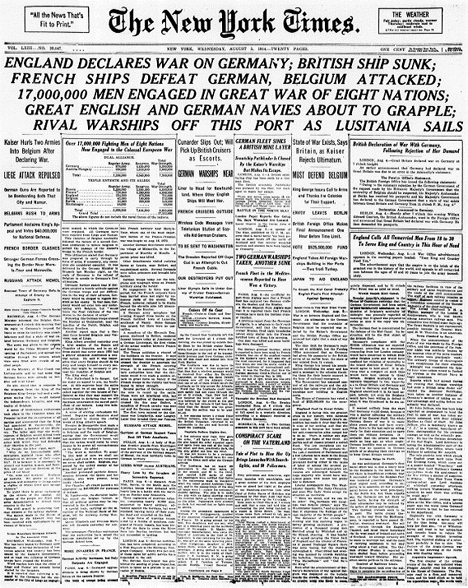
London, Wednesday, Aug. 5– War is on between England and Germany. An ultimatum to the German Government that the neutrality of Belgium must be respected was rejected by the Kaiser’s Government and the British Foreign Office announced last night that a state of war existed.
The time limit for Germany’s reply was set at midnight, but the Foreign Office announced that as Germany had given his passports to the British envoy at an earlier hour, the state of war existed from 11 o’clock.
King George has issued his proclamation mobilizing the army and has sent a message to the colonies thanking them for their hearty support in the hour of national emergency.
The Government has assumed control of all the railways and the Admirality has taken over all the foreign warships now building in English ports. The House of Commons has voted a fund of $525,000,000 for the emergency.
Google-a-Day begins the week with a football question:
What player’s status for the 2012 Super Bowl was questionable in January after he missed practice for the second day in a row due to an ankle injury?
They’ve started in Burbank, California, presumably because an opening front there will be met with little resistance from the many millions of people who’ve long stopped caring much about Californians.
Shrewd, very shrewd.
At FREE WHITEWATER, earlier this year, I predicted that coyotes would be the next local obsession to grip our small town (after boa constrictors and foxes).
Here they come —
Posted at FREE WHITEWATER and Daily Adams.
Good morning, Whitewater.
We will have a one-third chance of afternoon thunderstorms on a day with otherwise sunny skies and a high of eighty-three. Sunrise today is 5:48 AM and sunset is 8:13 PM. The moon is in its first quarter today.
For the FW Friday poll, about whether extraterrestrial beings or bratty German kids were likely responsible for crop circles in Bavaria, most respondents (59.09%) thought kids were responsible.
We often hear about the speed of light, but what about the speed of dark? Vsauce considers the supposed paradox that the speed of darkness is faster than the speed of light, and resolves that apparent (but erroneous) speculation:
On this day in 1958, the nuclear submarine USS Nautilus travels beneath the ice, across the North Pole:
In response to the nuclear ICBM threat posed by Sputnik, President Eisenhower ordered the US Navy to attempt a submarine transit of the North Pole to gain credibility for the soon-to-come SLBM weapons system.[11]
On 25 April 1958, Nautilus was underway again for the West Coast, now commanded by Commander William R. Anderson, USN. Stopping at San Diego, San Francisco, and Seattle, she began her history-making polar transit, operation “Sunshine”, as she departed the latter port on 9 June. On 19 June she entered the Chukchi Sea, but was turned back by deep drift ice in those shallow waters. On 28 June she arrived at Pearl Harbor to await better ice conditions. By 23 July her wait was over, and she set a course northward.
She submerged in the Barrow Sea Valley on 1 August and on 3 August, at 2315 (EDT) she became the first watercraft to reach the geographic North Pole.[12] The ability to navigate at extreme latitudes and without surfacing was enabled by the technology of the North American Aviation N6A-1 Inertial Navigation System, a naval modification of the N6A used in the Navaho cruise missile. (The N6A-1 had been installed on Nautilus and Skate after initial sea trials on the USS Compass Island in 1957.)[13]
From the North Pole, she continued on and after 96 hours and 1,590 nmi (2,940 km; 1,830 mi) under the ice, surfaced northeast of Greenland, having completed the first successful submerged voyage around the North Pole. The technical details of this mission were planned by scientists from the Naval Electronics Laboratory including Dr. Waldo Lyon who accompanied Nautilus as chief scientist and ice pilot.
Navigator’s report: Nautilus, 90°N, 19:15U, 3 August 1958, zero to North Pole.
Navigation beneath the arctic ice sheet was difficult. Above 85°N both magnetic compasses and normal gyrocompasses become inaccurate. A special gyrocompass built by Sperry Rand was installed shortly before the journey. There was a risk that the submarine would become disoriented beneath the ice and that the crew would have to play “longitude roulette”. Commander Anderson had considered using torpedoes to blow a hole in the ice if the submarine needed to surface.[citation needed]
The most difficult part of the journey was in the Bering Strait. The ice extended as much as 60 feet (18 m) below sea level. During the initial attempt to go through the Bering Strait, there was insufficient room between the ice and the sea bottom. During the second, successful attempt to pass through the Bering passage, the submarine passed through a known channel close to Alaska (this was not the first choice as the submarine wanted to avoid detection).
Good morning, Whitewater.
For the Main Street Festival today, Whitewater will have a mostly sunny day with a high of eighty-two.
On this day in 1939, Leó Szilárd and Albert Einstein send a letter to Pres. Roosevelt urging research on an atomic bomb:
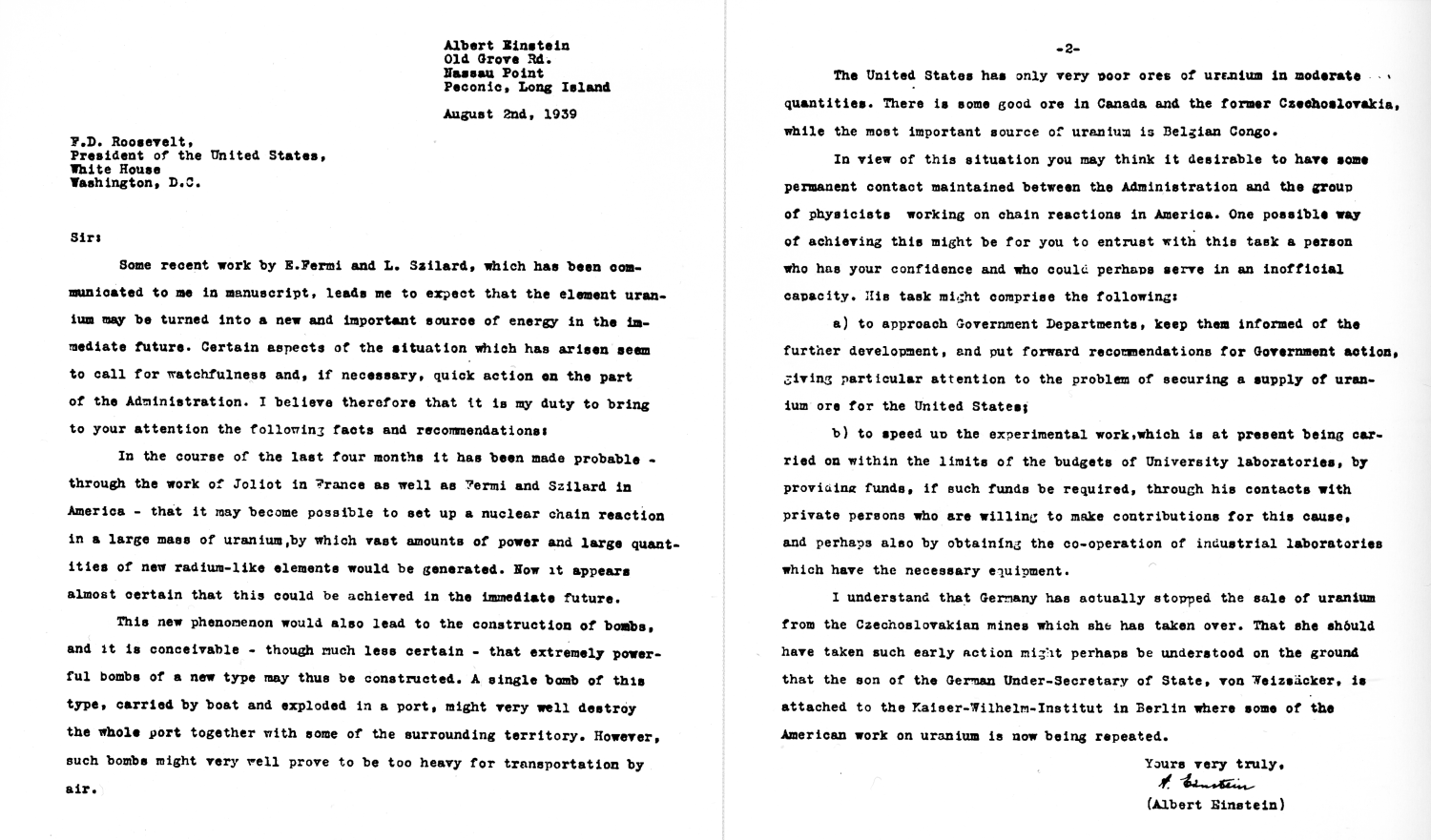
The Einstein–Szilárd letter was a letter written by Leó Szilárd and signed by Albert Einstein that was sent to the United States President Franklin D. Roosevelt on August 2, 1939. Though Szilárd consulted with his fellow Hungarian physicists Edward Teller and Eugene Wigner on it, he was the principal author. The letter warned of the danger that Germany might develop atomic bombs and suggested that the United States should initiate its own nuclear program. It prompted action by Roosevelt, which eventually resulted in the Manhattan Project developing the first atomic bombs.
On this day in 1832, a war ends:
1832 – Black Hawk War Ends
On this date the defeat of Black Hawk and his followers at the Battle of Bad Axe, ended the Black Hawk War. Black Hawk led the American troops northward while the rest of the Indians constructed rafts and canoes to facilitate an escape over the Mississippi river. The plan was successful initially but eventually General Atkinson realized the ruse. In the battle, women, children and the elderly hid behind rocks and logs and American soldiers often could not or did not differentiate between warriors and the women and children. Atkinson sent Wabasha and his Sioux warriors, enemies of the Sauk, after the approximately 150 members of the British Band that made it to the Western bank of the Mississippi. The Sauk, “escaped the best they could, and dispersed“, but only 22 women and childern were spared. Black Hawk escaped, but the Battle of Bad Axe marked the end of the war. [Source: Along the Black Hawk Trail by William F. Stark, p.142-153]
