
Author Archive for JOHN ADAMS
Daily Bread
Daily Bread for 7.15.14
by JOHN ADAMS •
Good morning, Whitewater.
We’ll have a high of sixty-six this Tuesday, with a one-third chance of scattered afternoon showers.
Common Council meets tonight at 6:30 PM.
So if you’re in Australia, and you’ve had a few shark attacks on bathers, what to do? For Hamish Jolly, a solution meant thinking about a shark-deterrent wetsuit:
On 7.15.1903, a company takes its first order:
On this day in 1903, the newly formed Ford Motor Company takes its first order from Chicago dentist Ernst Pfenning: an $850 two-cylinder Model A automobile with a tonneau (or backseat). The car, produced at Ford’s plant on Mack Street (now Mack Avenue) in Detroit, was delivered to Dr. Pfenning just over a week later.
Google-a-Day asks a geography question:
In the Russian monument of the founder of Moscow, which hand is he holding out to the side?
Birds
Lots o’ Hummingbirds
by JOHN ADAMS •
Local Government, Press
The Police Chief Turned City Administrator Turned School Public Relations Man
by JOHN ADAMS •
The Gazette has a Monday editorial in support of hiring Milton’s former police chief-turned-city-administator for a public school, public relations job.
It’s almost a self-parody of insiders flacking for insiders. (See, subscription req’d, Our Views: Was Milton School District’s Hiring of Jerry Schuetz a Reasonable Move?)
It’s grandiose and wasteful to think that Milton’s schools – or Whitewater’s – would need a public relations man. They don’t. The way to present oneself at open enrollment is better teaching and to offer better academic, athletic, and artistic opportunities.
That is, the best reputation comes from good work, itself.
Public relations is not a substantive, fundamental field. It’s a secondary activity. Success comes from accomplishments in substantive and fundamental fields (e.g., mathematics, history, etc.) and from that comes a true & good reputation.
Of this hire, we have a serial job-shifter. Because, after all, who in the city would be better? —
However, perhaps no one besides Schuetz was as suited for the role the district envisions. The city hired him as police chief less than six years ago. He moved up to city administrator in 2010. Schuetz has become deeply involved in the community and says he and his wife love Milton. He has a background in policing, in the city and its economic development. He even has dabbled in teaching on the side. Combine this experience with his investment in the community, and Schuetz has knowledge and talents that likely were unmatched by the six other finalists the district interviewed.
You see, the cop-turned-administrator would be perfect for a school district’s public relations flack because he “loves Milton” and has “even dabbled in teaching on the side.”
The Gazette‘s editorialist forgot to add that Schuetz likes moonlit walks, apple martinis, and bureaucrats who care about world peace.
Funny how the editorial ends – coming as it does from a newspaper – with the argument that one will not know the value of this hire for years to come:
School officials might take heat for this hiring now, but it could be years before anyone can gauge whether Schuetz and his marketing efforts are worth the investment.
That’s a joke, right?
The burden is now – at this moment – on those who hired Schuetz to justify the cost and his selection over other, profesionally-qualified candidates.
It’s false to say that there’s no evaluation to be made now, and it’s simply a transparent – and weak – attempt to stifle criticism behind the notion that no one can now know.
If what the Gazette‘s editorialist contends were true, there would be no point in much of a hiring process for anyone, after all, on the theory that no one could be certain of someone’s selection for years to come.
Is this editorial board unaware that feasilibity assesements come at the time before hiring, (2) that’s also the purpose of an interview process, (3) that such predictions based on sound analysis happen all across America each day, and (4) that one would have to be dense or gullible not to see as much.
Perhaps they’re aware, perhaps they’re not.
At the very least, I’m quite sure most people in Milton, and Whitewater, can easily see through a weak argument on behalf of an unsuitable candidate for a needless position.
Local Government, Open Government
A Municipal Building’s No Proof of a Progressive, Modern Outlook
by JOHN ADAMS •
A public building doesn’t make a city respectable – a city’s respectable, high standards and open government make a public building worthy.
It’s more than odd that, literacy notwithstanding, an editorial board would contend – as one did recently about Milton, Wisconsin – that Milton’s new [city] offices suggest professional, progressive city (subscription req’d):
Milton residents have reason to beam about their new City Hall and police station.
The offices are so new that workers were adjusting door locks and downspouts while Mayor Brett Frazier and City Administrator Jerry Schuetz gave a tour Wednesday. Boxes from Monday’s move had yet to be unpacked or discarded. Seeding and landscaping awaited.
Milton is, after all, a city struggling economically, and one that somehow thought it wise to make its police chief a city administrator and now a newly-created public relations specialist for Milton’s school district.
Here’s how a newspaperman who covered that city for twenty years assessed the transfer (again, subscription req’d):
Because of this history of [district] frugality, it surprised me when I saw the district job posting for a new public relations position—but not because of the need in this age of competitive school choice. I was surprised at the position’s $80,000-per-year salary. It can be argued the district would have attracted many highly qualified candidates from the public relations professional world at two-thirds that salary.
When I learned former Milton Chief of Police and current City Administrator Jerry Schuetz was offered the position, my inner red flags of cynicism went up—not because I question Mr. Schuetz’s abilities but because these are questions that once were expected of me by taxpayers of Milton. Was this all preordained? Is this what used to be termed a “good old boy” hire?
Those questions were only intensified when The Gazette broke the story early this week and the article, seemingly, was all about this position being able to allow Mr. Schuetz to find “balance” in his personal life.
No, a new city hall doesn’t make a city modern – true modernity comes from the high standards of a community.
To think otherwise is to fall into the amazement of Oklahoma!‘s fictional visitor to Kansas City, convinced as he mistakenly is that “they gone about as fer as they can go.”
Music
Monday Music: Colin James, Jumpin’ from Six to Six
by JOHN ADAMS •
Public Meetings
CDA Board
by JOHN ADAMS •
Public Meetings
CDA Seed Capital Screening Committee
by JOHN ADAMS •
Daily Bread
Daily Bread for 7.14.14
by JOHN ADAMS •
Good morning, Whitewater.
Monday will be partly sunny, with a one-third chance of scattered showers.
Whitewater’s Planning Commission is listed to meet at 6 PM tonight.
It’s Bastille Day:
The Storming of the Bastille occurred in Paris, France on the morning of 14 July 1789. The medieval fortress and prison in Paris known as the Bastille represented royal authority in the center of Paris. The prison only contained seven inmates at the time of its storming but was a symbol of the abuses of the monarchy: its fall was the flashpoint of the French Revolution.
In France, Le quatorze juillet (14 July) is a public holiday, usually called Bastille Day in English….
On 19 May 1789, Louis XVI convened the Estates-General to hear their grievances. The deputies of the Third Estate representing the common people (the two others were the Catholic Church and nobility) decided to break away and form a National Assembly. On 20 June the deputies of the Third Estate took the Tennis Court Oath, swearing not to separate until a constitution had been established. They were gradually joined by delegates of the other estates; Louis XVI started to recognize their validity on 27 June. The assembly renamed itself the National Constituent Assembly on 9 July, and began to function as a legislature and to draft a constitution.
In the wake of the 11 July dismissal of Jacques Necker, the people of Paris, fearful that they and their representatives would be attacked by the royal military, and seeking to gain ammunition and gunpowder for the general populace, stormed the Bastille, a fortress-prison in Paris which had often held people jailed on the basis of lettres de cachet, arbitrary royal indictments that could not be appealed. Besides holding a large cache of ammunition and gunpowder, the Bastille had been known for holding political prisoners whose writings had displeased the royal government, and was thus a symbol of the absolutism of the monarchy. As it happened, at the time of the siege in July 1789 there were only seven inmates, none of great political significance.
When the crowd—eventually reinforced by mutinous gardes françaises—proved a fair match for the fort’s defenders, Governor de Launay, the commander of the Bastille, capitulated and opened the gates to avoid a mutual massacre. However, possibly because of a misunderstanding, fighting resumed. Ninety-eight attackers and just one defender died in the actual fighting, but in the aftermath, de Launay and seven other defenders were killed, as was the ‘prévôt des marchands’ (roughly, mayor) Jacques de Flesselles.
Shortly after the storming of the Bastille, on 4 August feudalism was abolished and on 26 August, the Declaration of the Rights of Man and of the Citizen was proclaimed.
On this day in 1948, Janesville tries the latest:
1948 – Janesville Sprays for Bugs
On this date, intending to create a bug-free environment, Janesville tested a DDT fogging machine that quickly emitted a “smokescreen of insect-killing fog.” City officials hoped to persuade the county to buy the machine for use by all municipalities or to buy it jointly with Beloit. [Source: Janesville Gazette]
Google-a-Day asks a science question:
If the Saffir-Simpson Scale had existed at the time, the storm described in Erik Larson’s 1999 book would have been rated as what?
Public Meetings
Common Council
by JOHN ADAMS •
Animals, Nature
“Apis Mellifera: Honey Bee”
by JOHN ADAMS •
Animation, Film
Sunday Animation: Girona
by JOHN ADAMS •
GIRONA from Pau Garcia Laita on Vimeo.
Daily Bread
Daily Bread for 7.13.14
by JOHN ADAMS •
Good morning, Whitewater.
Sunday in the Whippet City will be mostly sunny, with a high of eighty-one, and just a one-in-five chance of afternoon showers. Sunrise is 5:28 AM and sunset 8:33 PM. The moon is in a waning gibbous phase with ninety-seven percent of its visible disk illuminated.
They’ve had a season of widespread forest fires in Canada, and the effects of these fires are so clear that they may be seen from space —
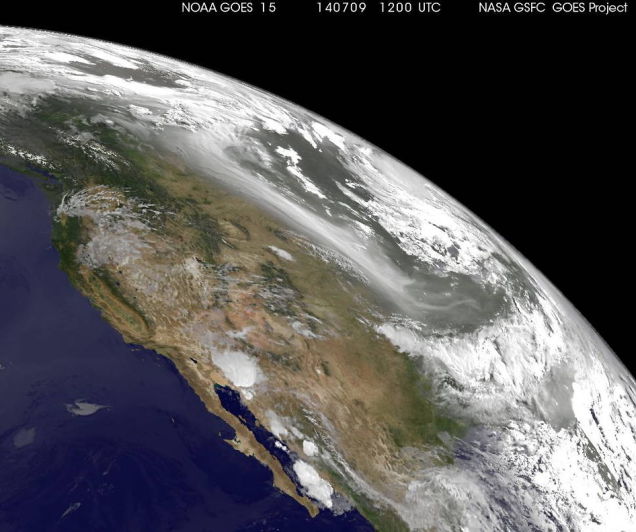
For more about the photograph and the fires, see Smoke From Canada’s Copious Wildfires As Seen From Space.
On this day in 1787, Congress under the Articles of Confederation passes the Northwest Ordinance:

The Northwest Ordinance (formally An Ordinance for the Government of the Territory of the United States, North-West of the River Ohio, and also known as the Freedom Ordinance or The Ordinance of 1787) was an act of the Congress of the Confederation of the United States, passed July 13, 1787. The primary effect of the ordinance was the creation of the Northwest Territory, the firstorganized territory of the United States, from lands south of the Great Lakes, north and west of the Ohio River, and east of the Mississippi River.
On August 7, 1789, President George Washington signed the Northwest Ordinance of 1789 into law after the newly created U.S. Congress reaffirmed the Ordinance with slight modifications under theConstitution. The Ordinance purported to be not merely legislation that could later be amended by Congress, but rather “the following articles shall be considered as Articles of compact between the original States and the people and states in the said territory, and forever remain unalterable, unless by common consent….”[1]
Arguably the single most important piece of legislation passed by members of the earlier Continental Congresses other than the Declaration of Independence, it established the precedent by which the federal government would be sovereign and expand westward across North America with the admission of new states, rather than with the expansion of existing states and their established sovereignty under the Articles of Confederation. It is the most important legislation that Congress has passed with regard to American public domain lands.[2]