
FREE WHITEWATER

Author Archive for JOHN ADAMS

Phil the Groundhog’s Forecast

It’s Groundhog Day in America, and we’ve now a prediction from Punxsutawney Phil, the planet’s most famous groundhog.

Phil’s call, not having seen his shadow earlier this morning, is for an early spring:

On this February 2nd, 2013,
the One Hundred and Twenty Seventh Annual Trek of the
Punxsutawney Groundhog Club at Gobbler’s Knob….

Punxsutawney Phil, the King of the Groundhogs,
Seer of Seers, Prognosticator of Prognosticators,
Weather Prophet without Peer,
was awakened from his borrow at 7:28 am
with a tap of the President’s cane.

Phil and President Deeley conversed in Groundhogese
and Phil directed him to the chosen Prognostication scroll.

The President tapped the chosen scroll and
directed Phil’s Prediction be proclaimed:

My new Knob entrance is a sight to behold
Like my faithful followers, strong and bold

And so ye faithful,
there is no shadow to see
An early Spring for you and me.
Daily Bread for 2.2.13

Good morning.

It’s a forecast of light snow in the morning, leading to a mostly cloudy day with a high of fourteen.

On this day in 1887, the first ‘official’ Groundhog Day:

…Groundhog Day, featuring a rodent meteorologist, is celebrated for the first time at Gobbler’s Knob in Punxsutawney, Pennsylvania. According to tradition, if a groundhog comes out of its hole on this day and sees its shadow, there will be six more weeks of winter weather; no shadow means an early spring.

Groundhog Day has its roots in the ancient Christian tradition of Candlemas Day, when clergy would bless and distribute candles needed for winter. The candles represented how long and cold the winter would be. Germans expanded on this concept by selecting an animal–the hedgehog–as a means of predicting weather. Once they came to America, German settlers in Pennsylvania continued the tradition, although they switched from hedgehogs to groundhogs, which were plentiful in the Keystone State.

Groundhogs, also called woodchucks and whose scientific name is Marmota monax, typically weigh 12 to 15 pounds and live six to eight years. They eat vegetables and fruits, whistle when they’re frightened or looking for a mate and can climb trees and swim. They go into hibernation in the late fall; during this time, their body temperatures drop significantly, their heartbeats slow from 80 to five beats per minute and they can lose 30 percent of their body fat. In February, male groundhogs emerge from their burrows to look for a mate (not to predict the weather) before going underground again. They come out of hibernation for good in March.

In 1887, a newspaper editor belonging to a group of groundhog hunters from Punxsutawney called the Punxsutawney Groundhog Club declared that Phil, the Punxsutawney groundhog, was America’s only true weather-forecasting groundhog

In 1905 on this day, a sports advancement for Wisconsin:

1905 – Professional Baseball Arrives in Wisconsin
On this date the Wisconsin State League was formed, bringing professional baseball to five Wisconsin cities. The six-team league began play the following summer with franchises in Beloit, Green Bay, La Crosse, Oshkosh, Wausau, and Freeport, Illinois. The league lasted through 1914, although its named was changed to Wisconsin-Illinois in 1908.

From Google-a-Day, a geography question: “The cities of Amsterdam, including Rotterdam, The Hague and Utrecht make up what area that is home to more than 40% of the population of The Netherlands?”

Friday Catblogging: Ultimate Predator Edition™

Your pet cat may not be as cute and cuddly as you might think. According to a new study published Tuesday in the journal Nature Communications, domestic cats kill billions of birds, mice and small animals in the U.S. each year.

Biologists estimated that cats are responsible for the deaths of as many as 3.7 billion birds and 20.7 billion smaller animals, including mice, voles and chipmunks, the Agence France-Presse reported. The study also concludes that cats are likely the No. 1 killer of birds and small mammals in the country.

Led by Scott Loss of the Smithsonian Conservation Biology Institute, the study drew from past research on the predatory habits of cats. While previous studies have suggested cats are responsible for billions of small creature deaths, the most recent estimates are significantly higher.

Via Domestic Cats Kill Billions Of Mice And Birds Per Year, Study Estimates.

Friday Poll: Super Bowl XLVII

About as likely as any poll topic before of this weekend: 49ers or Ravens? Oddsmakers give San Francisco about a 4 point edge, not far from the odds when betting began.

Those odds seem about right to me, but I’ll make a sentimental pick and say Ravens by three, 24-21. That’s not a reasoned picked: it’s heavy on hope. Still, if there’s ever been a day for wishful thinking, it’s Super Bowl Sunday.

But has there been a recent Super Bowl with more criticism and controversy about the players on both teams? Press scrutiny of comments from San Francisco’s players, and Washington Post stories about Ray Lewis of nearby Baltimore (hitting him as hard as they possibly could), stand out as exceptions to typically bland SB coverage.

What do you think?


Daily Bread for 2.1.13

Good morning.

It’s a cold Friday, with a high likely to be about eight, increasing clouds, and wind chill measurements between -10 and -20.

On this day in 1884, a great dictionary is born:

…the first portion, or fascicle, of the Oxford English Dictionary (OED), considered the most comprehensive and accurate dictionary of the English language, is published. Today, the OED is the definitive authority on the meaning, pronunciation and history of over half a million words, past and present

Plans for the dictionary began in 1857 when members of London’s Philological Society, who believed there were no up-to-date, error-free English dictionaries available, decided to produce one that would cover all vocabulary from the Anglo-Saxon period (1150 A.D.) to the present. Conceived of as a four-volume, 6,400-page work, it was estimated the project would take 10 years to finish. In fact, it took over 40 years until the 125th and final fascicle was published in April 1928 and the full dictionary was complete–at over 400,000 words and phrases in 10 volumes–and published under the title A New English Dictionary on Historical Principles.

Unlike most English dictionaries, which only list present-day common meanings, the OED provides a detailed chronological history for every word and phrase, citing quotations from a wide range of sources, including classic literature and cookbooks. The OED is famous for its lengthy cross-references and etymologies. The verb “set” merits the OED’s longest entry, at approximately 60,000 words and detailing over 430 uses.

In the Wisconsin of 1860,

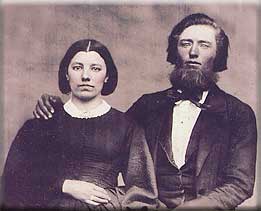
CharlesCarolineIngalls_2

1860 – Ma and Pa Ingalls [Were] Married

On this date Charles Ingalls and Caroline Quiner were married in Concord, Wisconsin. They were the parents of noted Wisconsinite Laura Ingalls Wilder, author of the “Little House” series. [Source: Herbert Hoover Presidential Library and Museum]

Google-a-Day poses a history question: “What notable river was close by the campaign in which Lee defeated the much larger army led by Major General Joseph Hooker?

Daily Bread for 1.31.13

Good morning.

We’ll have a colder day, with light snow, in the city today, at a high of eleven.

On this day in 1865, the House of Representatives approved a constitutional amendement to be sent to the states, and later to become the Thirteenth Amendment:

Washington, Tuesday, Jan. 31.

THE PASSAGE OF THE CONSTITUTIONAL AMENDMENT

The great feature of the existing rebellion was the passage to-day by the House of Representatives of the resolutions submitting to the Legislatures of the several States an amendment to the Constitution abolishing slavery. It was an epoch in the history of the country, and will be remembered by the members of the House and spectators present as an event in their lives. At 3 o’clock, by general consent, all discussion having ceased, the preliminary votes to reconsider and second the demand for the previous question were agreed to by a vote of 113 yeas, to 58 nays; and amid profound silence the Speaker announced that the yeas and nays would be taken directly upon the pending proposition. During the call, when prominent Democrats voted aye, there was suppressed evidence of applause and gratification exhibited in the galleries, but it was evident that the great interest centered entirely upon the final result, and when the presiding officer announced that the resolution was agreed to by yeas 119, nays 56, the enthusiasm of all present, save a few disappointed politicians, knew no bounds, and for several moments the scene was grand and impressive beyond description. No attempt was made to suppress the applause which came from all sides, every one feeling that the occasion justified the fullest expression of approbation and joy.

This House vote forms the principal plot of Spielberg’s Lincoln. Here’s the international trailer for that film:

‘Lincoln’ – International Trailer from Angel Cabrera on Vimeo.

Google has a science and industry question for us: “Who founded the company named for the man who invented vulcanized rubber?”

Daily Bread for 1.30.13

Good morning.

It’s a snowy midweek for Whitewater, with about two to four inches expected, and temperatures falling in the afternoon from thirty-two to about twenty-three. The Weather Channel is increasingly dramatic about our weather, but there’s nothing surprising about snow, in the winter, in Wisconsin. It’s only the absence of snow that would be surprising.

On this day in 1948, a Hindu extremist murders Mahatma Gandhi:

Mohandas K. Gandhi was killed by as assassin’s bullet today. The assassin was a Hindu who fired three shots from a pistol at a range of three feet.

The 78-year-old Gandhi, who was the one person who held discordant elements together and kept some sort of unity in this turbulent land, was shot down at 5:15 P. M. as he was proceeding through the Biria House gardens to the pergola from which he was to deliver his daily prayer meeting message.

The assassin was immediately seized.

He later identified himself as Nathura Vinayak Godse, 36, a Hindu of the Mahratta tribes in Poona. This has been a center of resistance to Gandhi’s ideology.

Mr. Gandhi died twenty-five minutes later. His death left all India stunned and bewildered as to the direction that this newly independent nation would take without its “Mahatma” (Great Teacher).

Google-a-Day has a history question for today: “At the time of signing, what was the title of the man who is the first of the two names in the name of the 1901 treaty that nullified the Clayton-Bulwer Treaty?”

L’ ONDÉE (RAINS)

We’ve had a bit of rain in town these last days; here’s an animated film about a place also having rainy weather.

Enjoy.

L’ ONDÉE (RAINS) from DCDA on Vimeo.

Directed by: David COQUARD-DASSAULT
Production: Folimage/ ONF-NFB/ Canal+
Music: Christophe HÉRAL
Year of production: 2008

Posted also at Daily Adams.

Which Homeowners for Whitewater?

The preceding post, Who Should Live in Whitewater?, was about immigration. Here’s a second question, a bit more specific: which homeowners for Whitewater?

One hears repeatedly that out city could use more families with children. I don’t disagree: it would help our public schools to have a stable, or growing, school-age population.

Here’s where I depart from others’ plans to attract more families with children: I believe that the best program to attract families is one that invites all prospective homeowners who’ll show concern and pride for their properties.

Unmarried couples, married couples without children, married couples with children, unmarried couples with children, relatives sharing a house, houses with tenants: demand from among those who’ll care for their properties should be the principal concern. Each of these kinds of prospective homeowners could advance that goal.

Efforts to target existing families with children have been mostly ineffectual, are wrongly biased, and are misguided (in any event). One knows these efforts have been ineffectual as the fundamental composition among all Whitewater homeowners hasn’t changed much over the last decade. They’re also biased in a way I think wrong: government shouldn’t be thinking about one kind of homebuyer over another. It’s enough to have a buyer who can manage his or her own house properly.

In fact, it’s more than enough to have buyers like that: it’s a community gain. When new homewoners of whatever situation share a common desire to improve their homes, Whitewater becomes attractive to other buyers, including those with children.

The way to get more families with children to find Whitewater desirable is to stop focusing on attracting only those families, and commit instead to attracting anyone who’ll be a good steward of his property.

Who Should Live in Whitewater?

It’s a simple question, with a simple answer: anyone who’d like to live here.

Who those many will be, ten or twenty years on, I am not sure. One may be confident that the city will be more diverse, but in which ways there’s no certainty.

(It’s better that there is no certainty, for if there were, we’d not merely know the future, but likely know it because we were trying to control the time from now until then.)

Did some want to bring Arizona’s laws to Wisconsin, and — of all places — Whitewater? One well knows that there were some in this town who wanted exactly that, who dreamed of making something like the Star Packaging Raid the standard practice of this beautiful city. Their dreams were, in truth, the dark nightmares of intolerance and unfairness. They stood against free choice, voluntary exchange, and free markets.

The unreconstructed, nativist impulse to restrict immigration into Whitewater – an impulse that was the fuel of lies, rogue policing, prejudice, and cruelty – is finished in this city, as it is now finished in most of America. (See, along these lines, Rubio Shows Opposition to Immigration Reform is an Inch Deep.)

Those who sought to torment and roust Whitewater’s immigrants, and to build a career or legacy upon it, may now look around and see the ruin of their ambitions. It would have been better for all Whitewater if this rebuke had come sooner, but come it has.

There’ll be rear-guard actions and ferocious kicking and screaming – but a Know Nothing impulse has met its deserved rejection by the majority, a majority with a respect for tolerance and pluralism.

We’re a better city today, and will be a better city in the generation to come, for having turned away from that dark course toward a better one.

Daily Bread for 1.29.13

Good morning.

It’s a warm Tuesday of thunderstorms and sixty-degree temperatures ahead for Whitewater.

On this day in 1845, Edgar Allan Poe publishes The Raven:

Edgar Allan Poe’s famous poem “The Raven,” beginning “Once upon a midnight dreary,” is published on this day in the New York Evening Mirror.

Poe’s dark and macabre work reflected his own tumultuous and difficult life. Born in Boston in 1809, Poe was orphaned at age three and went to live with the family of a Richmond, Virginia, businessman. Poe enrolled in a military academy but was expelled for gambling. He later studied briefly at the University of Virginia.

In 1827, Poe self-published a collection of poems. Six years later, his short story “MS Found in a Bottle” won $50 in a story contest. He edited a series of literary journals, including the Southern Literary Messenger in Richmond starting in 1835, and Burton’s Gentleman’s Magazine in Philadelphia, starting in 1839. Poe’s excessive drinking got him fired from several positions. His macabre work, often portraying motiveless crimes and intolerable guilt that induces growing mania in his characters, was a significant influence on such European writers as Charles Baudelaire, Stephane Mallarme, and even Dostoyevsky.

Google-a-Day poses a question of literature and musicals: “Who scored the musical version of the movie that’s based on Patricia Resnick’s story?”